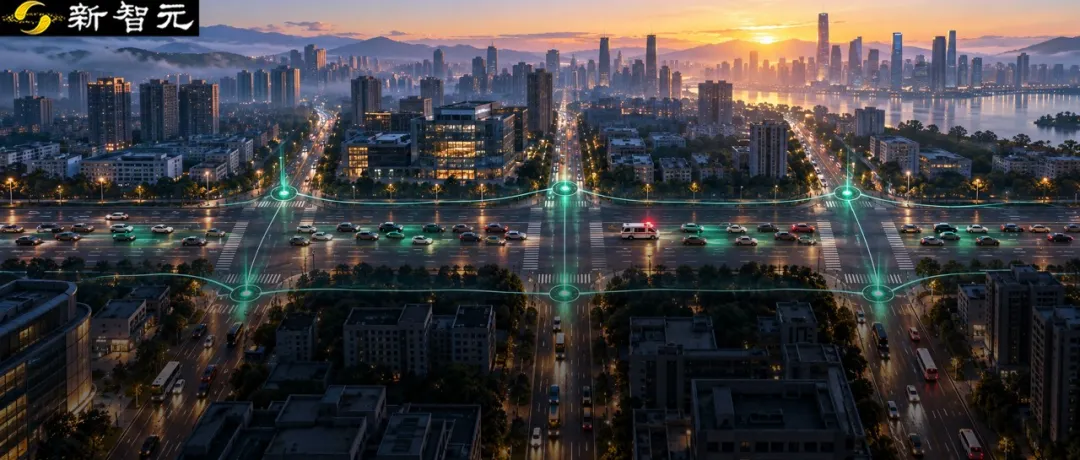
It's the first time in the history of the world.
Just yesterday morning, an open-source model of 320B was born across the sky, with the weight attached to the blog, and a breath of fresh air was lost.
This black horse is called IQuest-Q1.
As you can see, there are so many volumes in September: GPT-6 Astra, Fable 5.1, Gemini 3.8, Flash, and Qwen 3.8, GLM-5.3, which were released three days in a row.
In this group, a team called All-knowing suddenly issued an open-source 320B response, and many of the top models were involved in coding libraries, excavating security vulnerabilities and performing complex tasks.
I can't wait to see what happens next.
We just pulled it down and did some real stuff.
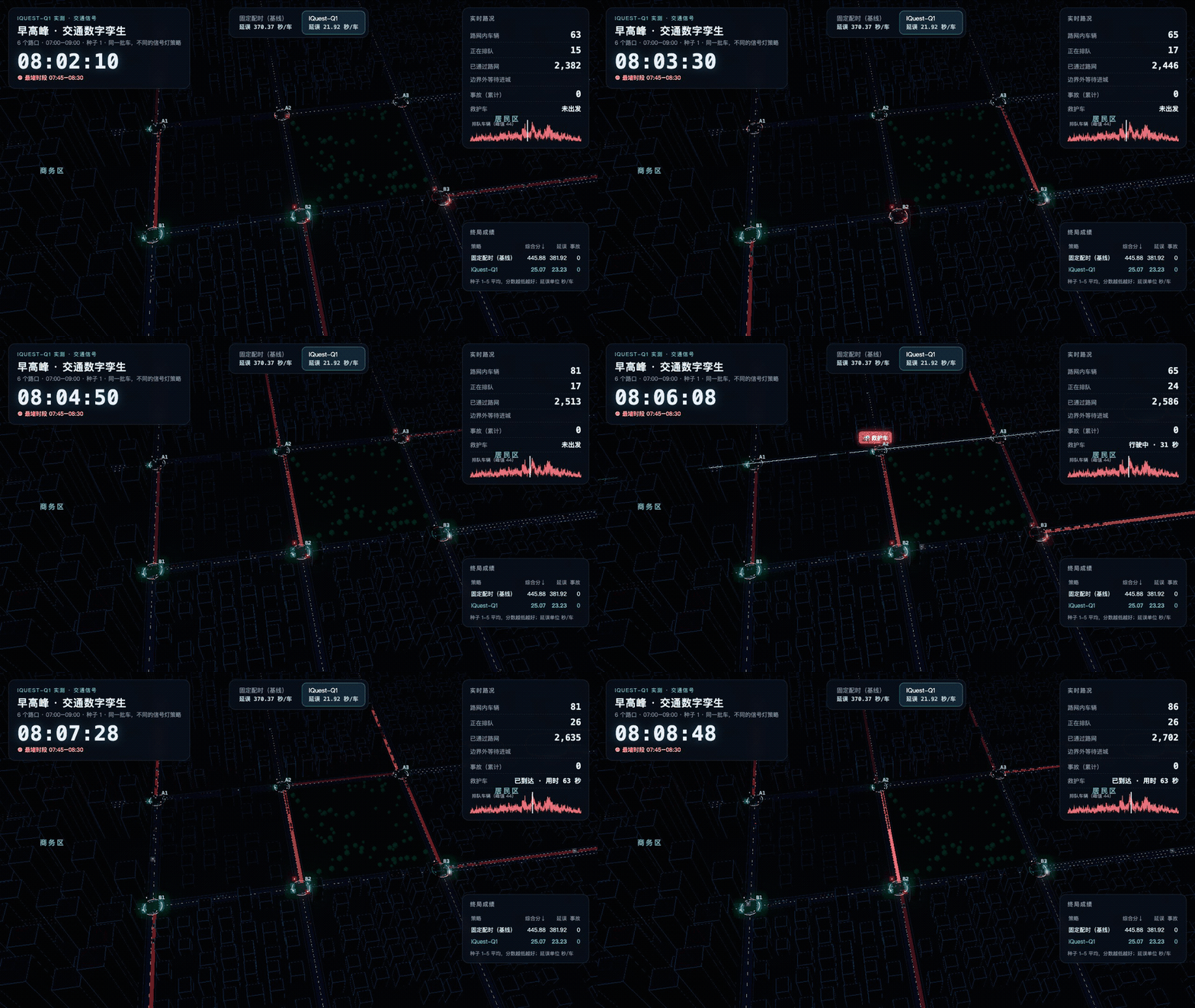
The early peak, under the command of IQuest-Q1, overlooks the entire city, with six intersection lights switched on as the traffic flows through the streets.
Ghost Empty Card Death TrainingIt's a model of its own "catching bug".Let me tell you one of the most impressive stories.
In a R&D team reinforcement training, the training halfway through, the scoring curve of the model suddenly flattened, and there was no way to practice again.
Strangely, the system was neither reported nor crashed. Everything was normal on the screen, but the score was static.
It's the most headache-worthy type of cockroach. It doesn't cry, it doesn't break bowls, you don't even know where it's coming from.
In the past, it was only possible for engineers to search through stacked logs, usually staying up for several nights.
This time, the test was not given to anyone, but to IQuest-Q1 itself.
It was embedded in a training journal, preserved conversational records and related code, folded from top to bottom.
It's just a lot of space.
What's going on? The training uses multiple rounds of conversations, where each time the model answers a round, the system takes the original answer back to the historical record and then asks the next round.
The problem arises in the middle link: the reasoning service responsible for running the model fills a gap in the output when returning the text.
It's like an unseen, untouchable void that overwhelms a normal training session.
The training system is word-for-word correct. It discovers that the backwards history and the model that was originally written is one character apart, cutting a coherent dialogue into several intersections.
The previous rounds of answers, although still in dialogue, are no longer counted in the training.
So the scores are so quietly stuck. The whole training framework seems to be running, and in fact most of the data is "setting up".
After finding the pathogen, it turned off the setup of the dosage vacuum and re-trained. The average score went from 0.704 tons to 0.769, and the latter rose further to 0.799 tons to improve visual acuity.
It's a project that would have taken engineers a few nights to complete.From the beginning to the end, the model itself is complete.

IQuest-Q1 is a page of analysis I made after examining the question, the second page marks the space that was extracted, and the last page is the score curve that was corrected.
As the name implies, IQuest-Q1 is backed by a Chinese team called IQuest Research, a well-known innovation institute.
In their case, the model gives itself a checkbug and it is a daily operation.

IQuest-Q1 works efficiently, and the model architecture and training strategies are worth mentioning.
In training, the team used a technique called multi-teacher online strategy distillation (MOPD).
Simply put, ask the four "teacher" models not to produce a standard answer for students to copy, but instead to look at the "student" IQuest-Q1 answer itself and criticize it directly in its work.
What's the point of this?My own mistakesThe only thing that changes is the mistake it actually makes, not the feeling of being on a bunch of topics it already does.
Finally, a series of stages, a series of training routes, were combined.

IQuest-Q1's training process, followed by pre-training, mid-term training, supervision of mitigation, reinforcement learning plus MOPD, ultimately merging several models into one.
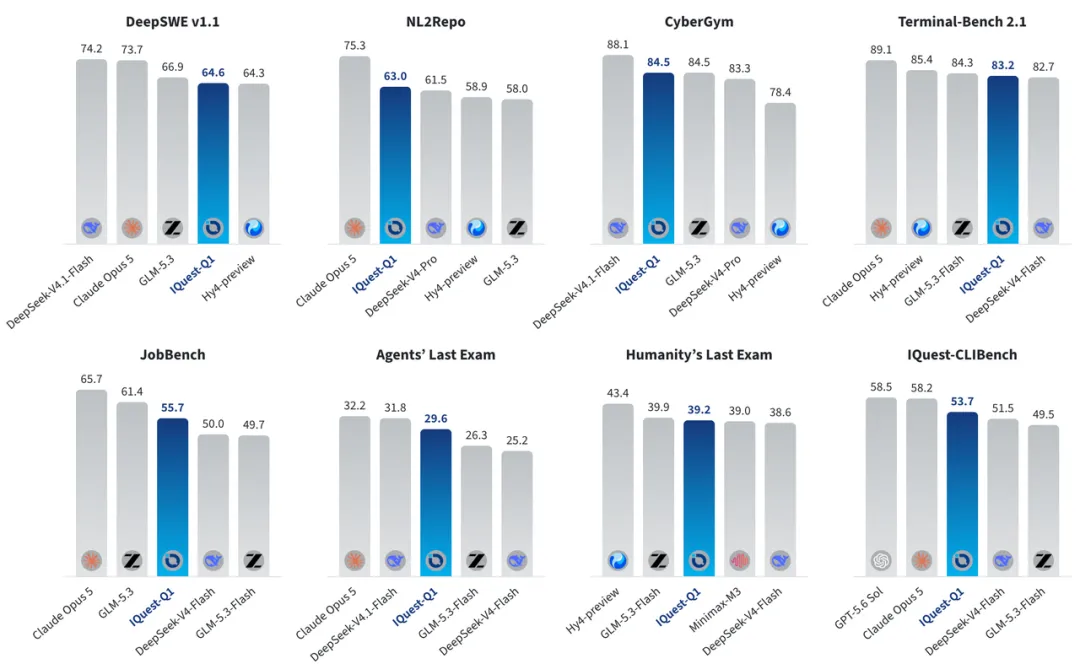
IQuest-Q1, which has been practised in this way, performs well at NL2Repo (which only gives a fool's need to write a complete code library from scratch) and CyberGym (which actually digs up and replicates security flaws in open source libraries).
At the same time, it also performed quite well in the evaluation of complex tasks such as Terminal-Bench 2.1, DeepSWE v1.1 and JobBench for the professional office scene.
 It's got six roads to the summit.An ambulance on the road with a green light
If you look at the scores on the list again, it will all come down to real life testing.
Our first assignment was to build a small town on top of a hill.
At the intersection of six roads, traffic flows to the business district from 7:00 to 9:00 am, and at 8:05 am, an ambulance has to cross the city walls, which is a test with standard answers, scores and no confusion.
As a contrast, we ran the most common "foolish" red-green light scheme around six roadsides, switching off lights at the same time, giving 30 seconds of green light in each direction, regardless of where there are fewer cars.
At its peak, the main entrance to the city was blocked to the outskirts of the city, similar to the holiday high-speed charging station.

The same group of cars, at the same time, approaching the busiest B3 intersection.
IQuest-Q1's solution is not a fancy one, but it's clever, and it's a "green wave".
It takes about 18 seconds to get from one exit to the next, and then lets the green light on the next exit shine again 18 seconds later.
Things have turned on, and the car is still going south-north to stop.
Six roads are lined up in the bottom two rows, and it pushes the signal of the next row of roads 18 seconds later, and the car from north to south passes the next row, and it catches the green light when it reaches the next.

IQuest-Q1 records the work of traffic questions, first does something to the green wave and then misses the two routes for 18 seconds.
It's a lot simpler on the side of the ambulance. The ambulance goes into which line, the lane is completely greenlighted.

The footage follows the ambulance, departing at the same time. The ambulance is still blocked at the red light entrance when it goes up for a fixed distribution; below it is the IQuest-Q1, all green emissions, and the ambulance goes all the way to the end.
The whole thing changed by its own side, running for 54 minutes. In return, it never saw a car flow test, completely zero accidents.
How obvious is the effect? Because of the average time between red lights and queues, each vehicle can go from a high speed to a high speed.6 minutes to 22 seconds.The ambulances exaggerated that they had to go through the city for almost four minutes, and now they are leaving for one minute.
Two-Eleven warehouses and elevatorsIt's a death trap. It's a live one.The second living child, we threw it into an e-commerce warehouse.
Eight transporting robots were to deliver cargo from the shelves to the most left-handed packing booths. On weekdays, 220 units, double 11 units, 420 units, and another attempt to temporarily shut down a passageway.
For example, we started with the simplest of scheduling: pick up the first order for the empty car, take the shortest route, and don't look at the other car.
Within minutes of the opening, eight cars were stuck near the corridor and the parking lot, like a crowd of people crowding the subway, and no one could move.
After IQuest-Q1 took over, I didn't come up with an algorithm to write a whistle-blowing algorithm, but I built a schedule that could run, and then I started working on it.Stage-by-stage review of running recordsI'm trying to figure out why the car was blocked.
It printed out the position of eight cars in one second and found the first problem: when two cars collided in a two-dimensional corridor, no one allowed anyone to hit directly.
So it laid down the rule: when faced with an encounter, one must turn around.
The problem of the crash was solved, and there were not many orders to send out. It went down and found that there was a car in the mailbox for a long time. The reason was that the finished car stopped at the mailbox and did not go, and the car in the back row for delivery was blocked.
So it moved the car to the rear of the car. The car stopped at the entrance of the parking lot, or it turned the road. It changed the wheel again to make the road perfect.
Looking back, it writes in the record of its judgments:This issue is mainly thrown at traffic jams, whereas collisions are secondary.This judgment is similar to the intuition of an old warehouse manager.
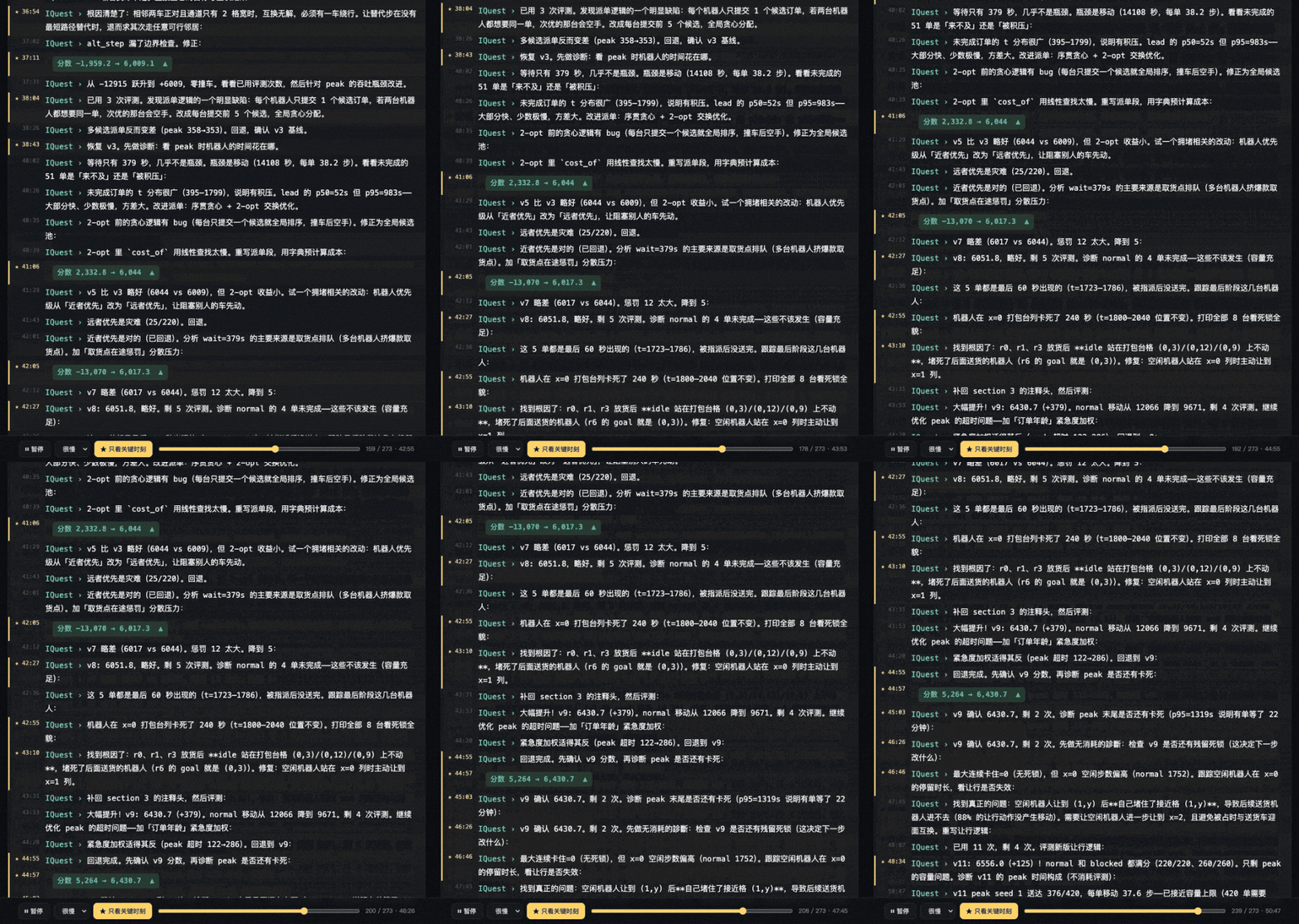
IQuest-Q1 did a working record of the warehouse issue, which printed the locations of eight cars, to find out step-by-step why the pads were blocked.
In exchange for an unprecedented order review, eight vehicles crashed completely zero. The station and the road closure department delivered all the orders. Once the corridor was closed, it immediately routed the vehicle around the closed road section and continued to ship.
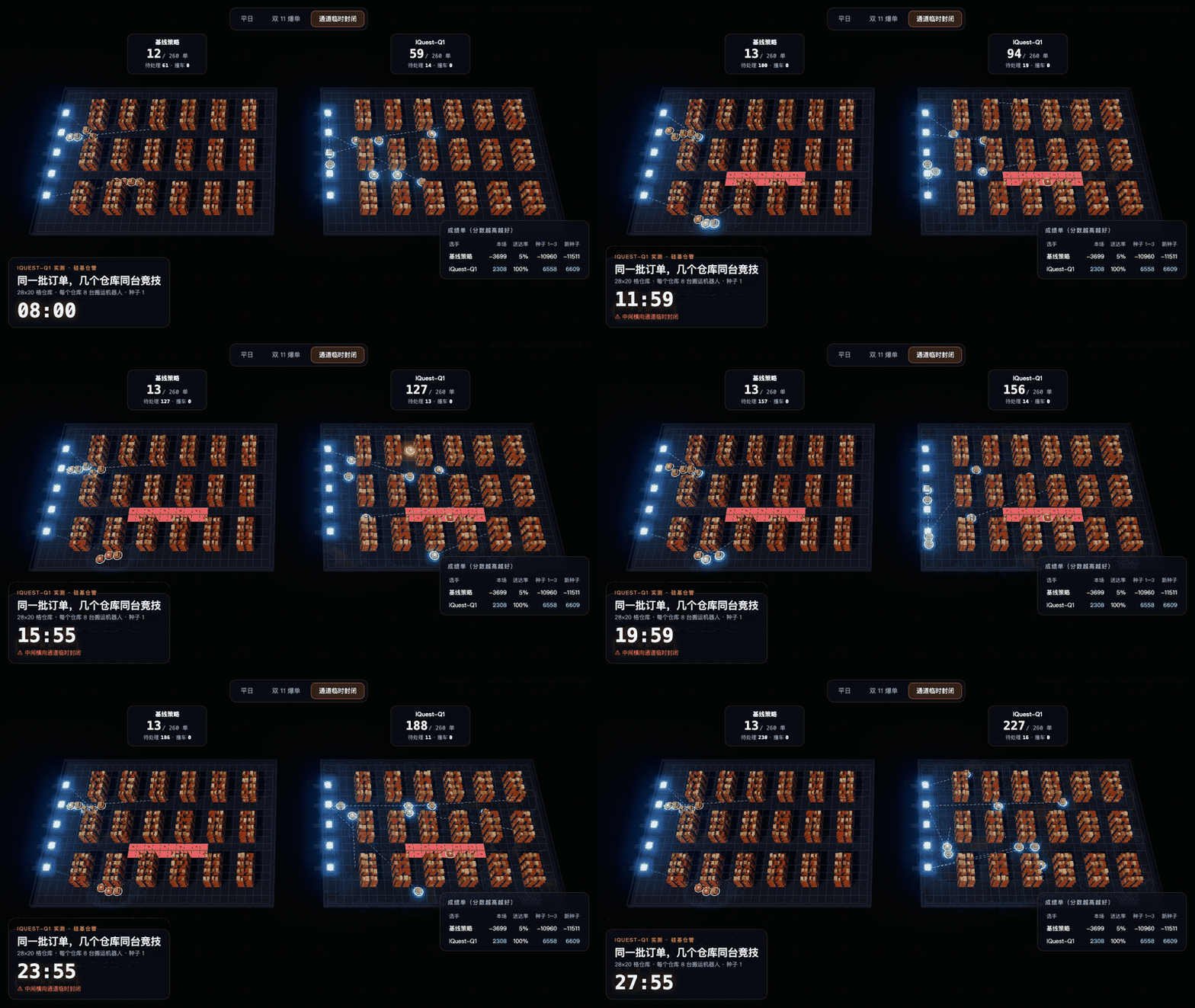
The middle section temporarily blocks a passage, red is the blocked section, left is the plain layout, right is the IQuest-Q1.
The maximum number of single-season orders for the Double 11 was 420 units, which had already exceeded the limit of eight cars that could be delivered within the prescribed time, but it still shipped.87%The same order, simple scheduling, only sent out dozens of units. One in the sky and one underground.
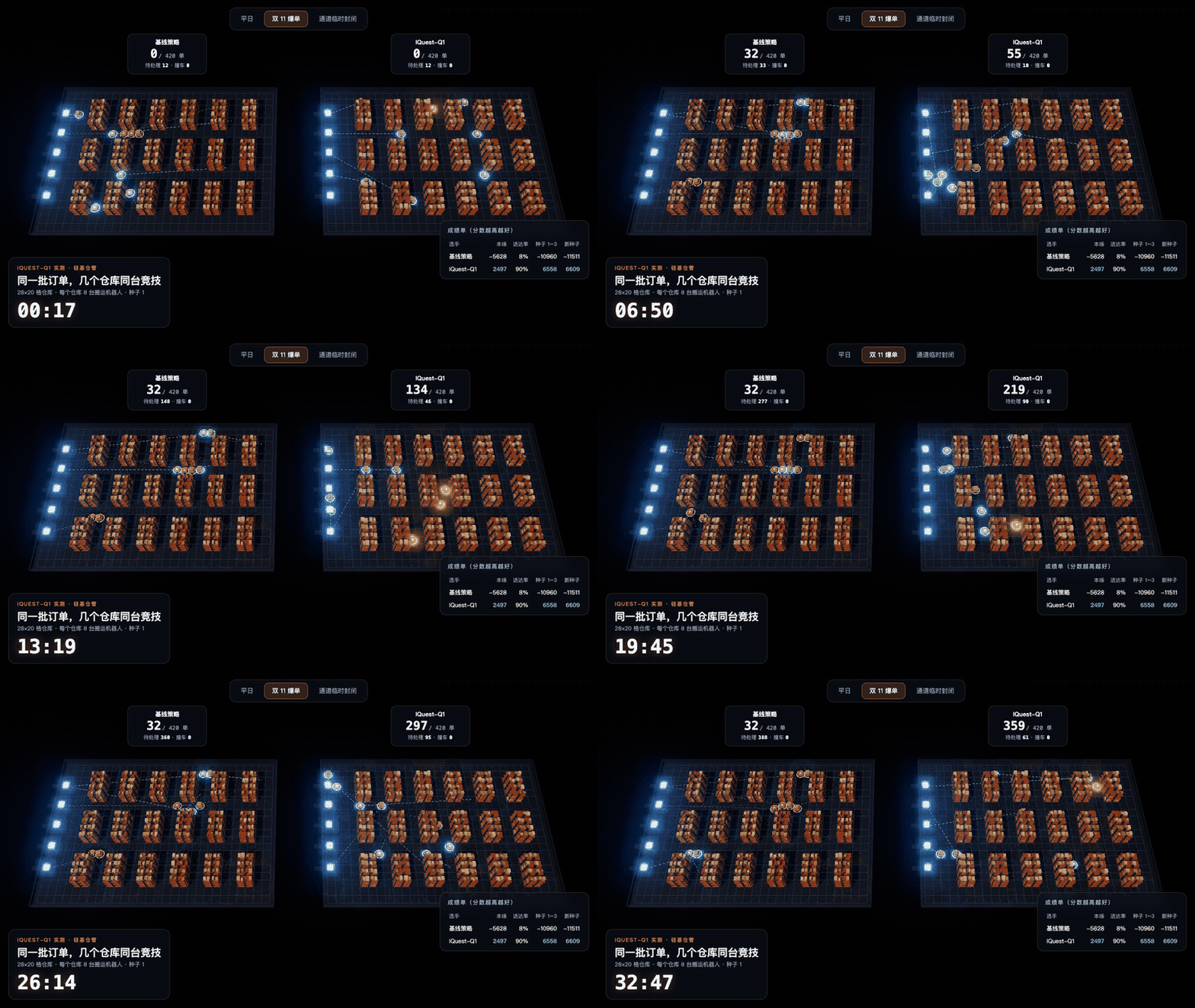
Double 11 pop-ups, with plain scheduling on the left, and IQuest-Q1 on the right, with the top card showing the number of units delivered in real time.
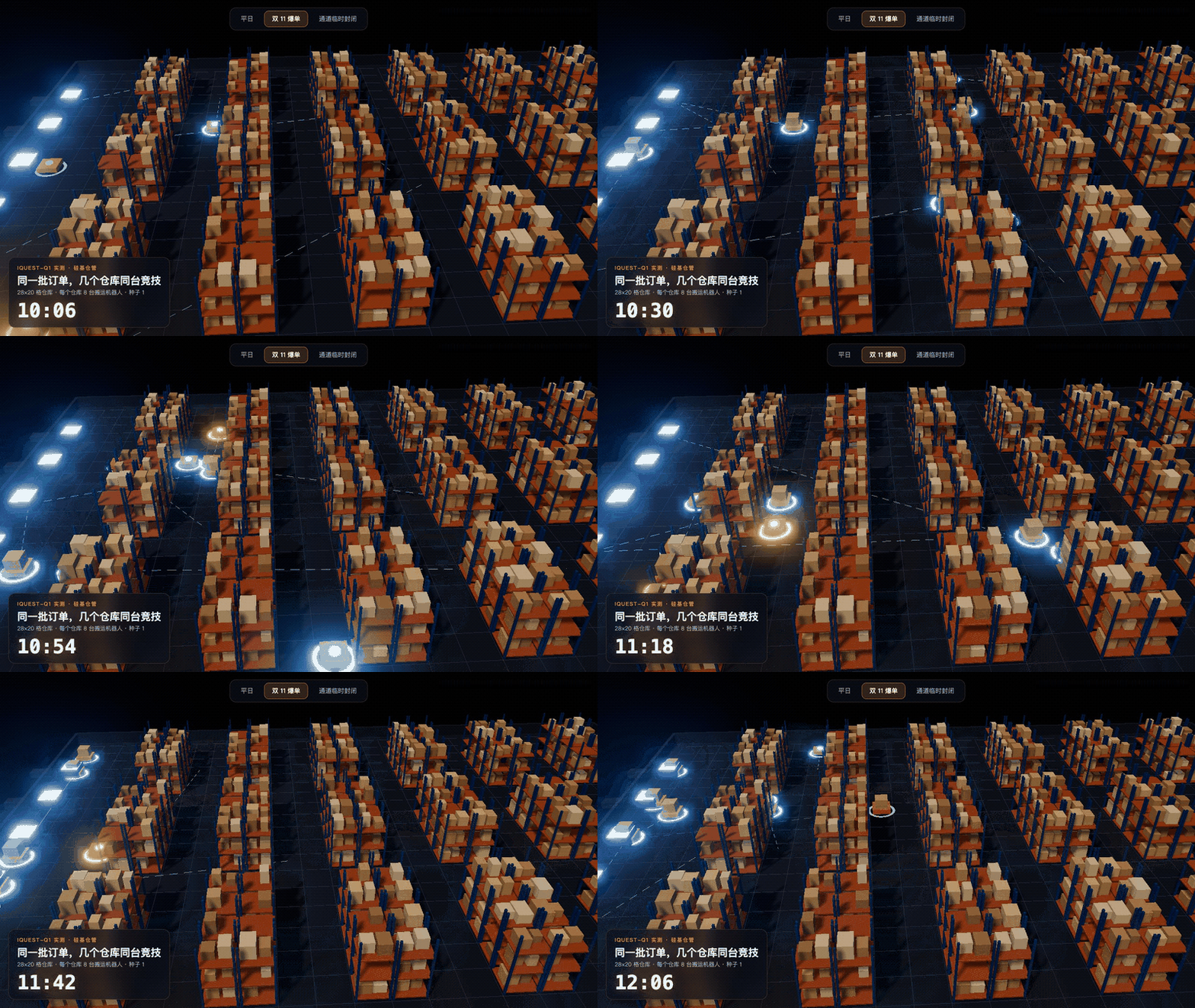
Look closely at the warehouses of the IQuest-Q1, and robots are lined up on top of the cartons in the corridor, to the left of the packing deck.
Office elevator: 24 floors and 4 stepsThe third is the four elevators in a 24-story office building.
The rules are simple: it is not permissible to enter the elevator for more than 60 seconds after pressing the button or to stay in the elevator for more than 180 seconds.
The controlling scheme is still the simplest: the person who waits the longest to pick up the elevator that is empty, sends only one person at a time, and there are no bumps along the way.
At the top, the hall is lined up like a red tea shop.
After taking over the IQuest-Q1, he wrote his own analytical script, ran through the data, and discovered a stubborn fact: at its peak, the elevator was full of 13 people per cabin.The elevator itself is no longer enough.。
Since there's so much transportation, the hardware can't change, it's written on the software.
It left the empty elevators in the hall for a while, and the people were full or waiting long enough to leave, and each room was filled as much as possible, so that they could wait and not run empty.
At the peak of the night, everyone came down the stairs, and it changed its strategy: let the elevator go up to the highest floor that someone was going down, and then down the road, connecting people along the way, and filling it up.
However, the elevator to the lower floors was often full, and the people on the lower floors were not able to get up. It also reserved a place for the lower floors, and solved the problem of "eating alone on the higher floors".

On the left is the easiest way to climb the ladder, and on the right is the IQuest-Q1, with the top card showing the score in real time.
In exchange for unprecedented passenger traffic reviews, late peak scores were lower than previously seen.26% said 61%.The peak has risen from 70% to 88%.
A thousand lines of an HTML fileIt moved Jiangnan into the browser.Finally, let's look at the front-end capabilities.
After all, it's one of the most beloved racetracks in the world.
We gave it a couple of design questions, each with only one HTML file, images, stickers and sound effects generated entirely by code, images and model files are almost impossible to use.
Most of its works contain two or three thousand lines of code.
"Twenty-Four Gas Water Villages" is a moving Jiangnan painting. The white-walled horse walls of the people live along the river, the air changes, the sky, the grass and the weather slowly change.

"Twenty-Four Winds in the Water", 24 winds per year flowing in the same painting, with the upper left corner denoting the current winds.
When the snow came, the roofs and the walls of the horses were covered with snow, and after dark, the houses lit up the red lights, all of which were code-painted, not posters.
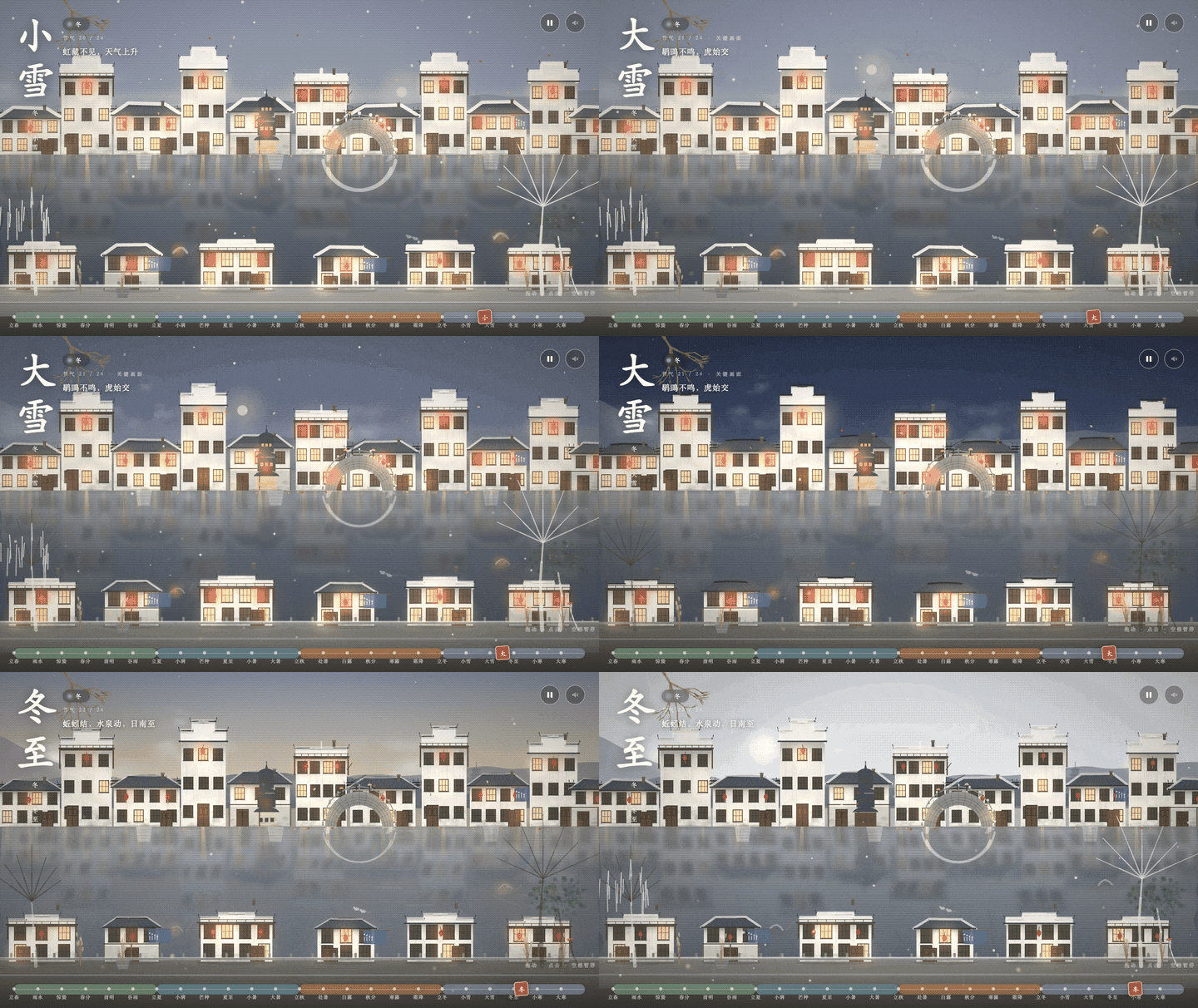
During the snow season, the roofs and the walls of the horses were covered with snow, and the red lights lit up in the deep blue night sky.
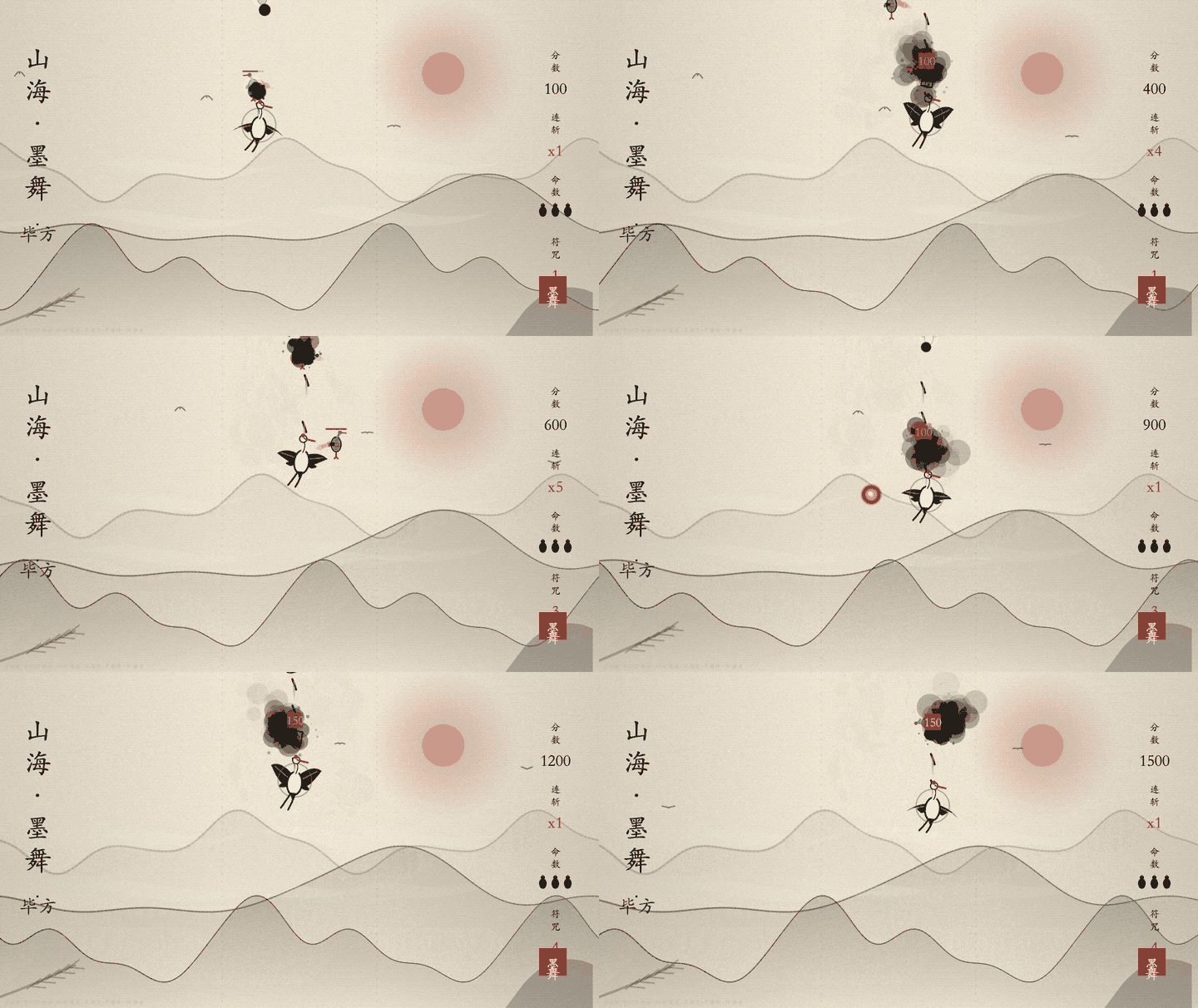
"Shanhai Muke Dance" is a water-in-the-air shooting game with the theme of "Shanhai Muke".
The game's story is told from the perspective of a mermaid, a fox, a fox, a monkey, and a creature with only two fingers and a tail. The game's story is told from the perspective of a fox.
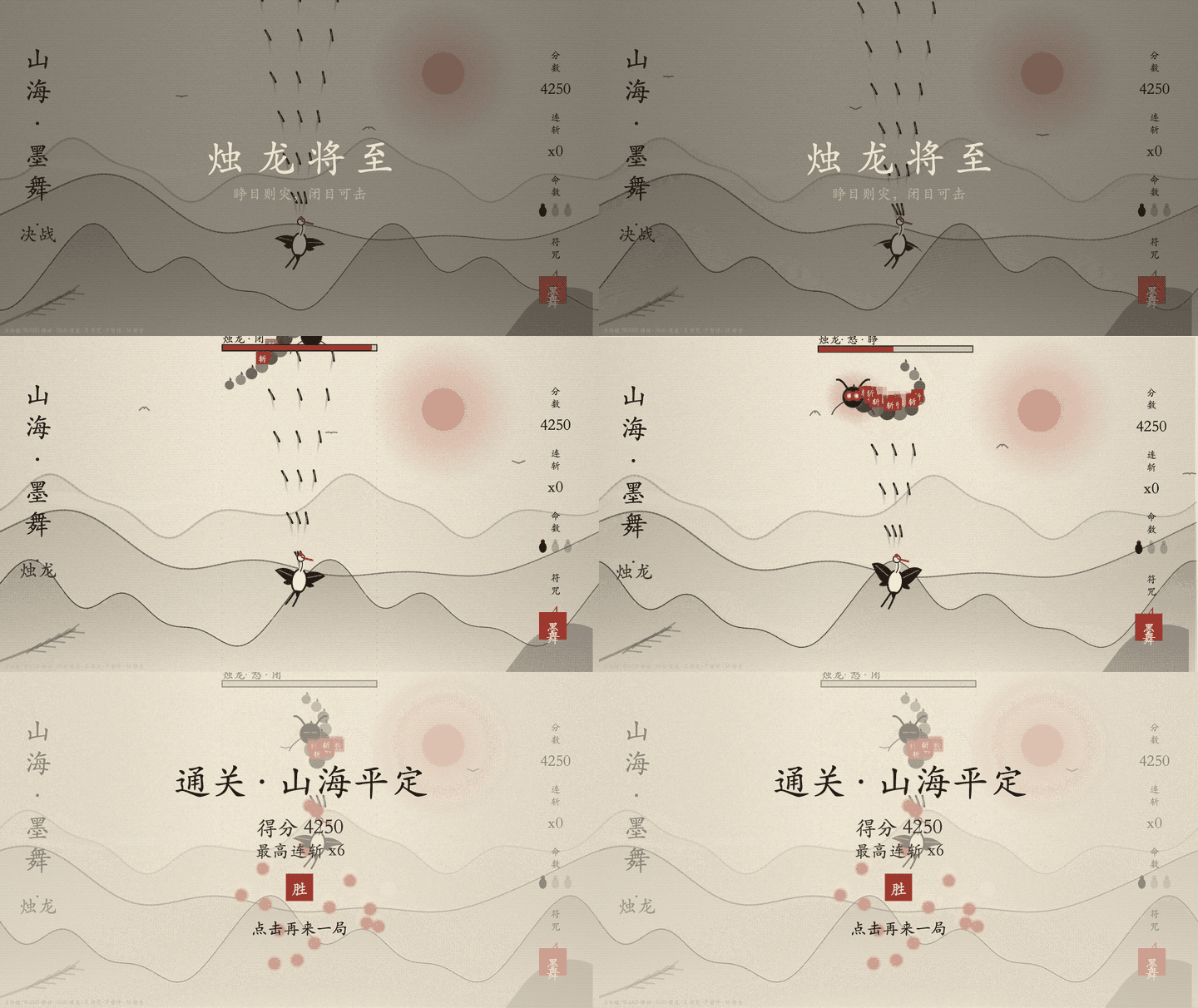
The color of the paper in "Shanhai Meek Dance", the color of the ink on the far side of the mountain and the red sunset, the arrow feathers of the Sendai rays hit the monsters, the point of the ink on the right side, the rank and rank on the right side.
The last of the bosses to appear on the stage was Zhonglong, who set up the shell when he blinked and played it when he closed his eyes. The background music was also composed of five sound stages.
"Boss will come", the boss throws out a juicy shell and covers it with a juicy "Win" after the gate.
The evolutionary craft is just turning around.From the green waves at the roadside, the rules of the warehouse, to the world in a browser, you'll find the number of active paths is always the same:First find out the root of the disease, and then turn to it; then turn to it, and turn to another direction.
This is not a profound methodology, but it is an ability to execute the process steadily.
An open-source model of the 320B has been able to help check the training bugs and write the next round of training programs.
It's moving fast, and the next generation of IQuest is going to look like, honestly, it's too early to tell.
But one thing is for sure: when AI really starts working, solving tasks, the value comes out.
The model weight is fully open-source, linked below.
GitHub:
Hugging Face:
Blog: