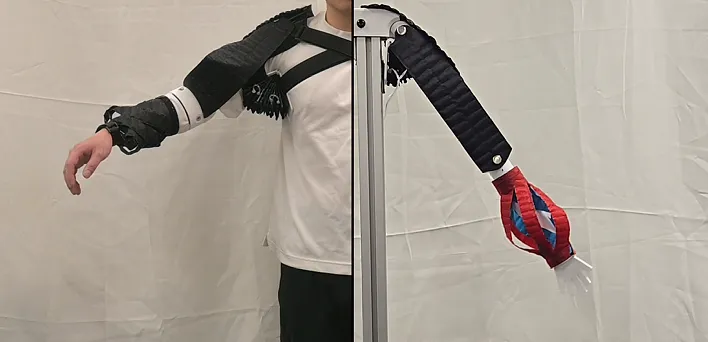
“ Software robots began to move from casting parts to casting materials.
Can you start making robots with a scissors, an electric grinder, and a bookie?
Recently, the authoritative journal Science Advances published a study from the University of Michigan in the United States: FaBrick, a portable fabric building platform.

It looks like a cloth, but inside it is a large number of inflatable airbags. Depending on the cutting, heat sealing, folding, and knitting methods, the same material can achieve five movements of shrinkage, bending, twisting, rotation, and condensation. The team further used it to make robotic sleeve suits, single-piece claws, a nose-like mechanical arm, and even a four-legged robot that can walk.
Video or motion
But what's really interesting about this paper is that it doesn't use plastic to make robots.
In the past, software robots were largely forged in the manufacture of executors. They wanted to bend a set of structures, want to shrink a set of structures, want to reverse a possible re-selection of materials, design geometric shapes, and make molds.
FaBrick wanted to insert these things into a roll of standard material in advance. Then he designed a software robot, perhaps not starting with the executor each time, but cutting from a roll of rolling cloth.
01.
Why do you want to do five moves?
The underlying structure of FaBrick is actually not complicated.
It consists of two layers of TPU-coated fabric, with an airbag arranged in the middle to be processed according to the rules. Each airbag can be understood as a tiny cylindrical muscular tube: after inflation, it bounces outwards, shortening the plane length as a result, producing motion and force.
The air bags are arranged in rows, with air ducts connected between adjacent units, so an intake port can inflate the entire material. The researchers can then determine which part of the air duct is moving and which part is not moving by thermal closure.
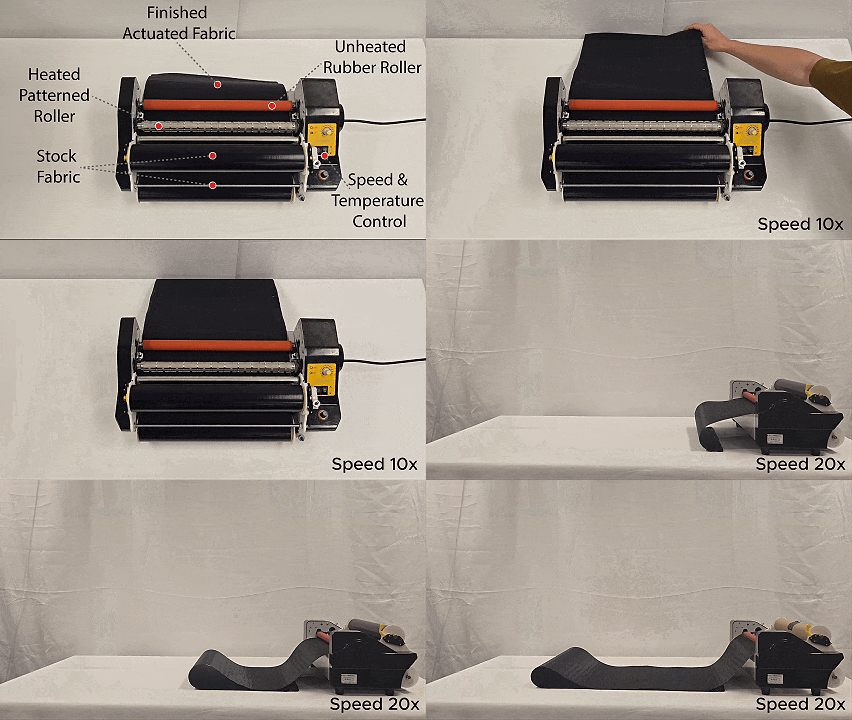
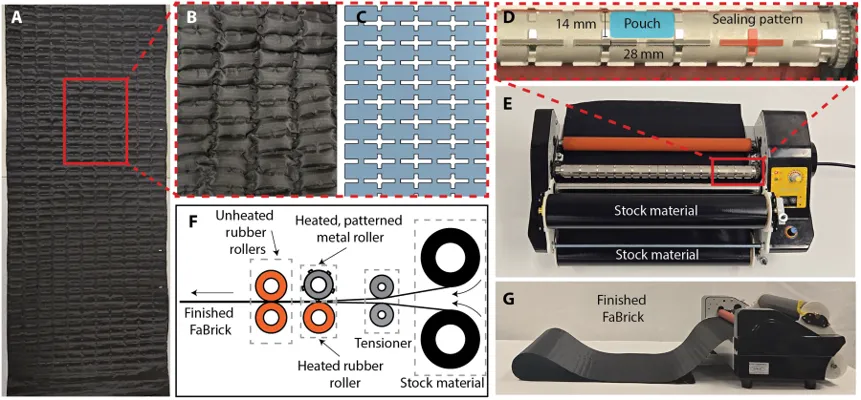
Design and manufacture of FaBrick
What really changes the way we move is the process behind it.
The most direct way is to shrink. If a piece of FaBrick is sealed, inflated, and the inside of the airbag is blown up, the whole piece of material will shorten.
If it were cut into a parallel quadrilateral shape and then wrapped around the cylinder structure, the airbag's original straight shrinkage would turn into a slashing motion, forming a twist. Folding a row of airbags like an organ and fixing it on the same rotating axis, the airbags would squeeze each other after inflation, producing a spin.
Curving is more straightforward. Researchers use a regular padlock to attach the air-filled layer to a layer of FaBrick that cannot be freely stretched. When the pocket is drilled, the degree of deformation on both sides varies, and the entire material bends to one side, changing the distance between the padlock and adjusting the direction and curvature of the curve.
The latter is condensation. When FaBrick is wrapped and expanded by an external structure, the soft fabric can be temporarily transformed into a load-bearing structure.
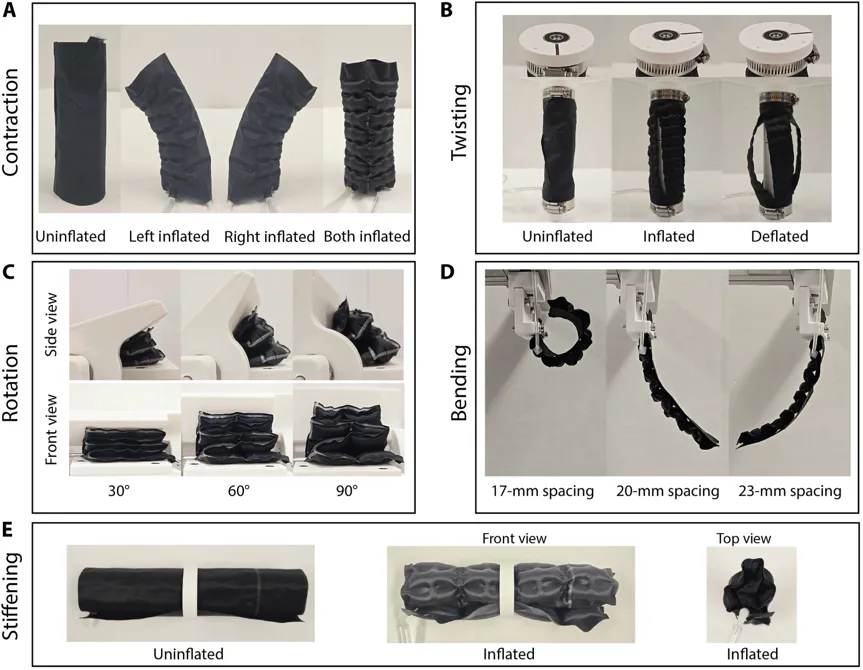
FaBrick can be used to achieve different driving movements
The paper tested six structures with a diameter of 26 tonnes (36 mm). At a pressure of 207 kPa, the peak resistance reached 25.7 tonnes (45.0 N) when the structure was 20 mm thick; only 3-4 N when not pressurized, and the hardness increased by about 7-15 times.
Thus, the same material, after cutting, sealing, folding, knitting, is transformed into a completely different executor. This is also the biggest difference between FaBrick and ordinary flexible materials: the ability to move is not a one-time death in the parts, but can be rearranged on the material.
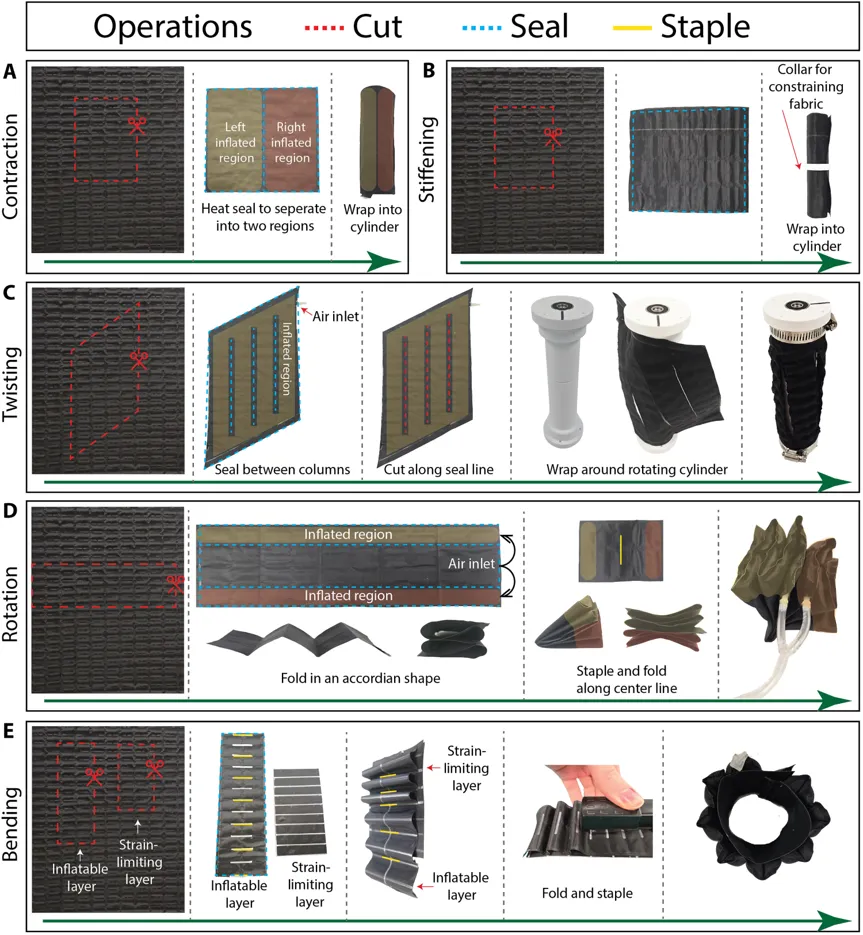
FaBrick is able to manufacture all the main types of soft actuators through simple design steps. A) Concrete actuators: a specific area of the sealing material (yellow and orange) and set up independent inputs to achieve independent controlled contraction. B) Strengthening structure: tightly winding the film along the direction of width, and adding a limiting radius to the expansion of the external rings, which can form an air-strengthening element. C) Concrete actuators: cutting the film into a parallel square, then sealing and decomposing the columns, and enclosing it on a cylinder, which can be turned into a linear contraction of each column.
02.
From a dedicated executor to a unified material platform
If FaBrick is just a piece of fabric that can be inflated and deformed, it's not that new.
In the field of software robotics, there are already PneuNets, McKibben artificial muscles, FREEs, and a variety of bag-shaped gas executors. FaBrick's real move forward is to try to integrate past decentralized manufacturing methods into the same material and production process.
In order to do this, the team specifically designed a patterned heat pump process.
Two rolls of TPU coated fabric simultaneously enter the pressure equipment, above which is a metal sheet with a convex pattern. The fabric is obsolete, with only the convex area coming together under the influence of heat and pressure, directly forming a sealed border and airbag structure, while the internal airway is retained.
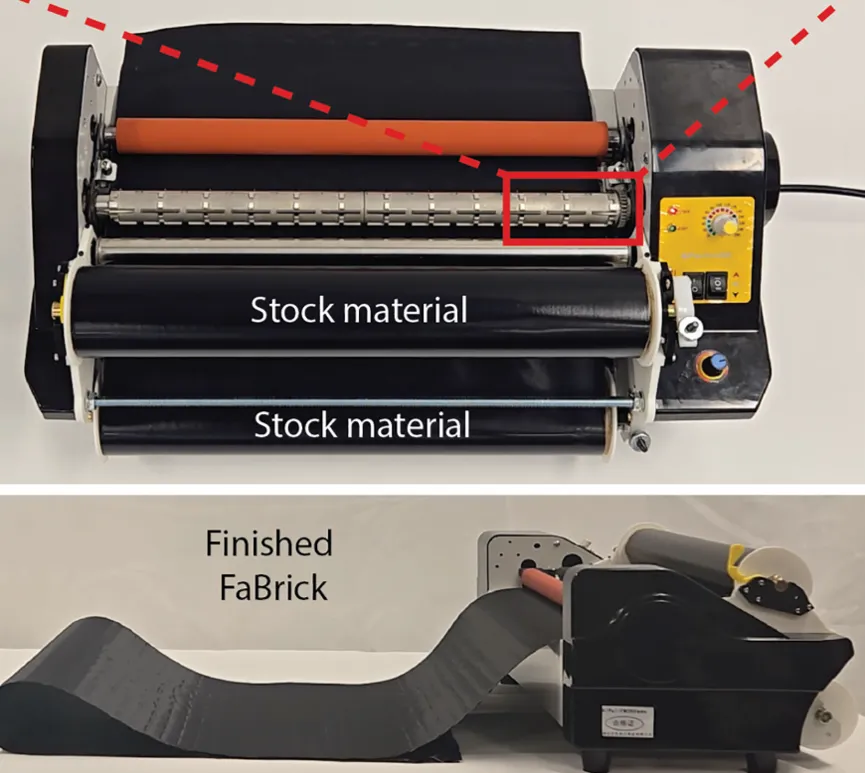
The temperature of the cylinders used in the paper was 150°C (160°C) and the speed of rotation was about 10 rpm. The material width of the existing equipment is limited to 335 mm cylinders, but the length can be continuously extended. In other words, the scheme is closer to textile or rolling material processing, rather than the conventional software executors.
This brought about a very critical change. If you want to make the run of the executor longer, take several rows of air bags on the same volume of material; if you want to increase the power, more columns are connected.
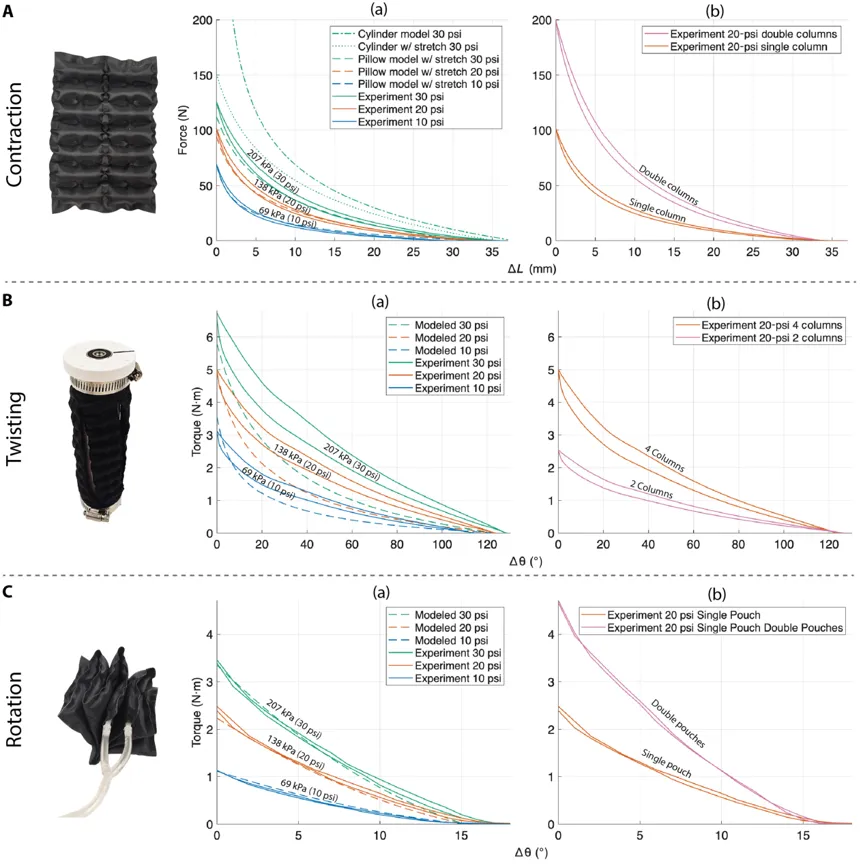
In the experiment, the actual contraction rate of an 8×1 air bag array was about 27.1%, while the team's pillow-shaped model predicted 27.4%, while the conventional cylinder model predicted 30.6%.
The researchers further compared single-column and dual-column structures, with the power generated by dual-column executors approaching twice that of single-column, showing that output can be more regularly magnified by adding and connecting units.
This is another area where FaBrick is easily overlooked: it's not just a silicon cutter. The team has also developed a model that predicts contraction, torque, angular displacement and curvature based on the shape of the airbag and internal pressure.
That is, theoretically, designers do not have to cut a test piece first and then change its size continuously, but instead can calculate: how much power do I need? How many layers do I need?
Once this relationship is stable enough, it's really possible for a volume of material to transition from clay to a programmable robotic base material.
03.
One canvas, four robots have been made.
To prove that FaBrick could not only drum a few air bags on the testbed, the team used it to build four complete systems.
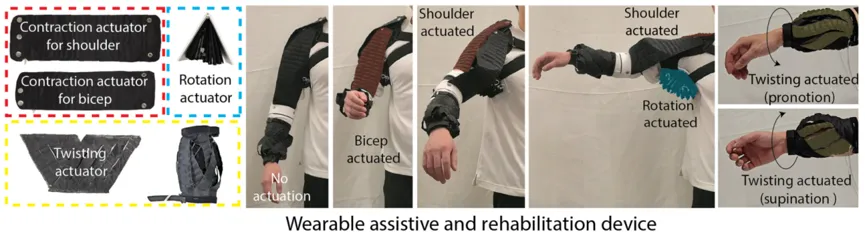
The first set is a wearable robot sleeve.
The contractor simulates the muscles of the forearm, helping to lift the forearm; the contraction and rotation structures jointly assist shoulder movement; the two opposite-directional torsion performers, opposite to the front and rear of the wrist.
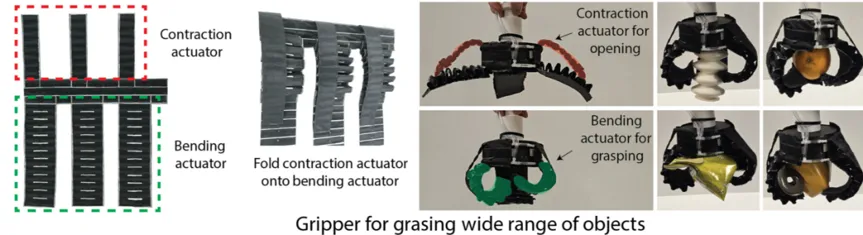
The second set is a single-piece soft claw.
The researchers directly divided the contraction zone and the bending zone on a FaBrick: the contraction layer was responsible for opening the fingers, and the bending layer was responsible for closing inwards. Finally, the entire material was surrounded by a cylinder, without the need for additional complex rigidity joints designed to grasp objects of different shapes and weights.
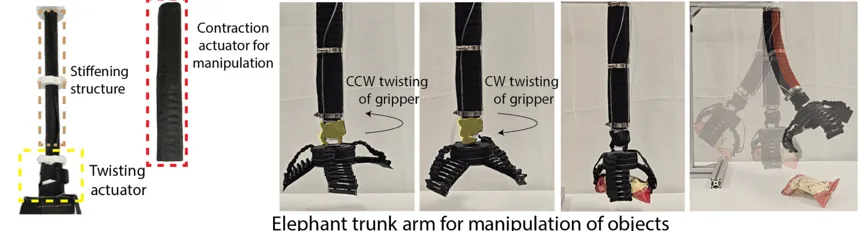
The third set is more like a nose-like mechanical arm.
The three independently inflatable FaBrick drive poles are arranged and controlled by the pressure of the different columns, allowing the mechanical arm to swing and bend in different directions. The ends are re-assembled with the FaBrick claw and joined with the rotating structure responsible for adjusting the grip direction.
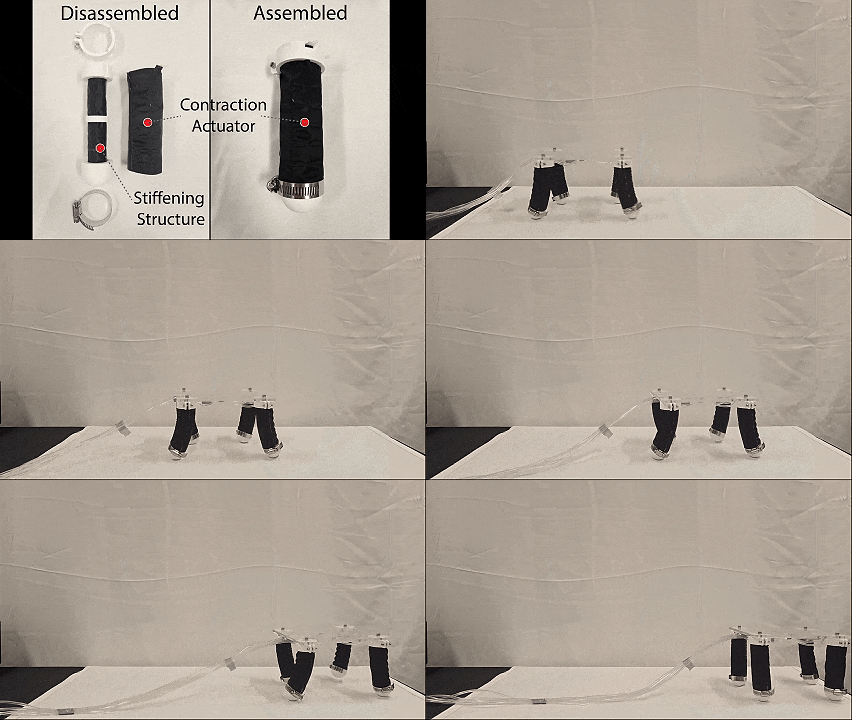
Finally, the team even built a four-legged robot.
FaBrick's rigid structure is responsible for supporting the weight, and the contractor is responsible for controlling the legs to swing forward or backward, then alternating movements through two sets of opposite corners, allowing the robot to complete a continuous advance.
The performance of these four systems is not a replacement for mature robots at the moment. But they prove something more important: wearability, grip, operation and mobility, which in the past often required the development of different performers separately, and can now at least start with the same material.
04.
What is the next step in building a real robot?
Of course, a FaBrick is a long way from a real robot.
The narrower the airway, the greater the airflow resistance; after material folding, bending, there may also be local twisting.
At the same time, the shared airway also means that the units are not completely independent. When some air sacs are extruded, the internal air can flow into the adjacent units, causing collisions. Currently, the research team can only monitor the input pressure, and it is not possible to know in real time what happens inside each air sack.
Second, there is still a trade-off between universality and finite performance. The paper also explicitly acknowledges that performance may exceed FaBrick for specifically optimized performers for a particular operation. For example, PneuNets can redesign complete geometric structures around curved performance, while FREEs can be aimed at reversing optimized fiber angles.
Now, FaBrick is still a research prototype. Manufacturing width is limited by equipment, airways are clogged and backlogged, and several robot demonstrations rely primarily on experimental construction and adjustment, rather than being done directly by analytical model design.
It is also a short distance away from the open box, which is the height of a robotic pump.
05.
The Future and the Word
FaBrick's value is not in maximizing one indicator. It is more important to try to cover the demand for more forms and sizes of motion using the same materials and manufacturing methods.
It attempts to leave more design changes on how to cut, seal, and combine pots, rather than re-molding or manufacturing equipment for different performers.
The paper emphasizes that because the same volume of material can be made into multiple executors and assembled directly into systems, it is particularly suitable for tasks with limited resources or rapidly changing environments, such as field robots, field medicine, space missions and educational environments. These places often lack molds, dedicated equipment or large manufacturing tools. Users do not need to manufacture expertise to explore, design and replace software robots as long as they use scissors, bookkeeping machines and cast iron.
In other words, FaBrick reduces not only costs but also participation thresholds. It makes it possible for software robots to move from a small number of laboratories with customized tools to a material platform that more people can try, thereby driving innovation in research, education and applications.
In the past, materials were only raw materials for the manufacture of actuators; FaBrick attempted to make lithium-driven lithium itself a material. If this path continues, future robotic materials such as this could be further integrated into sensors, electrical drives and even control networks.
By then, what needs to be redefined is perhaps not just a piece of fabric that moves, but the boundary between materials and machines.