With the GPT-6's slogan of "working hard", Claude put programming and terminal operation firmly at home, and the open-source camp accelerated its consolidation on the same frontline for half a year. From the Qwen 3.8, the Kimi K3, to the Hy4, almost every time it appeared, the main line of "code + intelligence" was pushed forward.
One common signal is that the model's value threshold is shifting from "pretty answering" to "doing something".
And in the Red Sea of this big language model, a new player is stealthily entering everyone's sights.
We observed that just last night, the Institute of Innovation opened up a model called IQuest-Q1. The model uses a rare MoE architecture, with a total parameter of about 320B, activation parameters of only about 15B, with a training focus on code, software engineering and complex task execution, while extending to reasoning, tool use, long-term context understanding and multi-step task processing.
In the contemporary open-source model, it is a somewhat "lightweight" size, but from the official evaluations and demonstrations, it does not yield lightweight results.
The model weight has been released simultaneously with Blog.
GitHub:
Hugging Face:
Blog:
List performance: Small activation parameters, balancing is another measurement besides demonstrating the run score
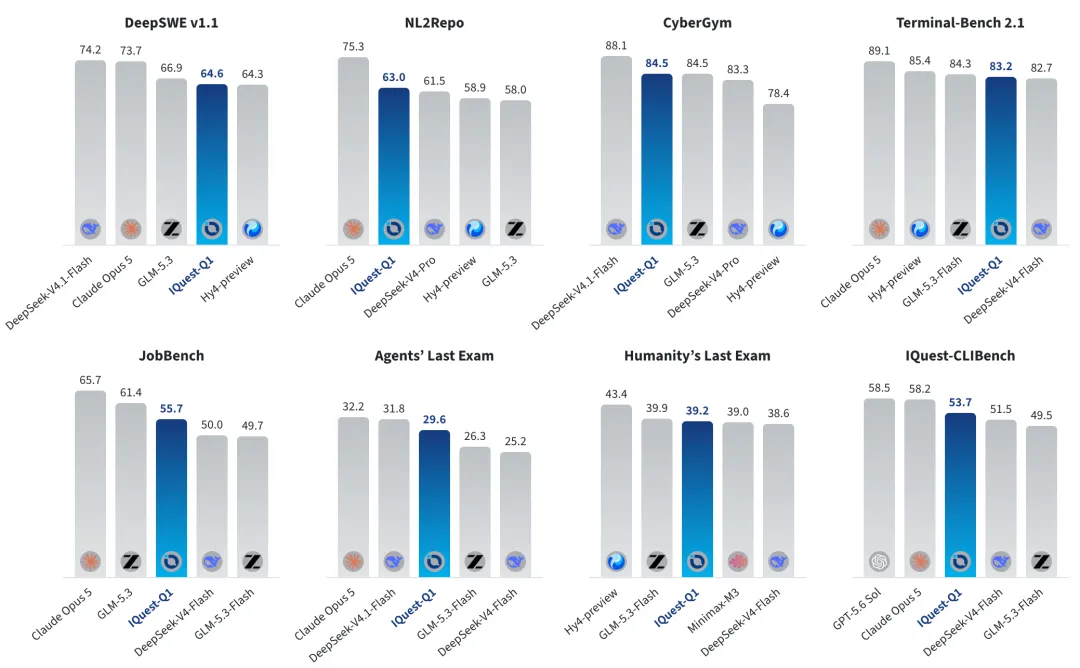
In multiple standard assessments covering code, software engineering, terminal operations, tool use, and complex intelligent body tasks, the overall performance of IQuest-Q1 was relatively balanced.
Specifically, the following items:
Among them, IQuest-Q1 has a robust score on NL2Repo, which generates warehouse-level code, and CyberGym, a cybersecurity benchmark.
It also has the ability to demonstrate balance in the evaluation of complex tasks such as Terminal-Bench 2.1, code-length tasks DeepSWE v1.1, and office scenarios JobBench.
Given the size of the activation of 15B, this scoreboard also leaves little room for cost reasoning.
From writing a game to fixing a bug, the model starts to come alive.
IQuest-Q1 focuses on "delivable" models that continue to understand context, call tools, process feedback, and ultimately deliver a verifiable result, rather than a piece of code stuck in the editor.
We've got a couple of mission presentations officially released, covering front-end interaction, 3D scenes, training modeling and real-world work environments, that basically delineate the boundaries of the model's capabilities.
In the front-end scenario, a natural language instruction is dropped by the user, and the model speaks directly to a workable interactive application.
As an example of an FPS game, IQuest-Q1 has a one-time set of three-dimensional scenarios, character movements, shooting and shelling, life values, counts, boss battles, even resource and equipment purchases, code generation, multi-file organization, interaction logic, visual presentation, several things running at once.
Consider the example of a racing game. Track extensions, prospects and background switches, which typically require a high level of spatial continuity. The IQuest-Q1 approach is comparatively resilient, showing that it is already stronger in the generation of applications with spatial relationships and continuous interaction needs.
After an abnormality occurs in reinforcement training, the model looks down the training curve in sequence, reads the logs, looks at the execution trajectory, analyzes possible causes, positions to the specific code, and then moves to change. Reboots after repair, then reboots the training with new indicator curve verification results.
In another case of reinforcement learning training diagnosis, the system found that the abnormal decline in Reward was not caused by the model itself, but by an operating environment failure. After a positioning problem, the system repaired the environment with rating logic, restored effective reward signals, and avoided abnormal feedback continuing to affect the training.
In real-world office scenarios, the model accesses a series of contexts such as chat, online documentation, forms and comments, completes analysis, generates documentation, revises results, and finally delivers a program that can be used directly.
Technical breakdown: 320B overall input / 15B activated MoE architecture
The IQuest-Q1 uses a decoder-only Transformer main stem + sparse MoE, with a total parameter of about 320B. The activation parameter is about 15B. In the open-source rhythm of the current dynamic "the bigger the parameter, the stronger the parameter", the training consists of three stages:
Pre-training: laying the foundations for world knowledge and competence;
Medium-term training: transition to complex tasks;
Post-training: Special training around software engineering, long-range tasks and general reasoning, combined with supervisory mitigation and reinforcement learning.
The team used Multi-Teacher On-Policy Distillation (MOPD) to combine the strengths of different teacher models on different tasks into a single model.

In addition to the model itself, the team also disclosed the R&D process used in this version.
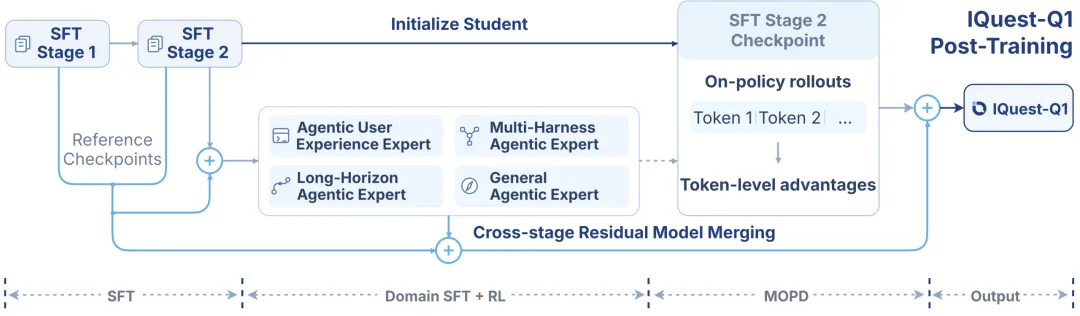
In the research and development process, models participate in the ability to diagnose, design training programs, and perform some experiments; human researchers are responsible for the review and decision-making of key nodes such as research direction adjustment, high-cost experiments, and version adoption.
Verified model updates, training assets and research processes will be directly replicated in the next iteration, and data processes, training configurations, evaluation methods and tools will continue to be depleted in each iteration.
From this practice, we observe that new players in the model track of the Institute of Knowledge have begun to show clearer technical connections in areas such as code intelligence, complex task execution and model evolution, and that the next steps of the institute are worth continuous attention.
We are interested in experiencing the opportunity to apply for a test before we know it.