Today, Test-time scaling is greatly enhancing the reasoning ability of large models at the forefront. However, the latest closed-source models such as GPT, Claude, and others often see only one final answer, or a processed chain of thought, whereas the real concrete process of reasoning and the original chain of thought are hidden.
Recently, the AI Security Lab at the University of Auckland, Denmark, and the open-source community Seafill published a paper called Capable yet Parsimonious: Extracting and Characterizing Hidden Chain-of-Thought in Frontier Models.
The article links to:https://arxiv.org/pdf/2609.26637
The team found a simple but effective method: it was a protocol layer of jellyfish extraction, using standard API tool calling to reveal a hidden chain of thought with a rational nature to multiple front-end models.
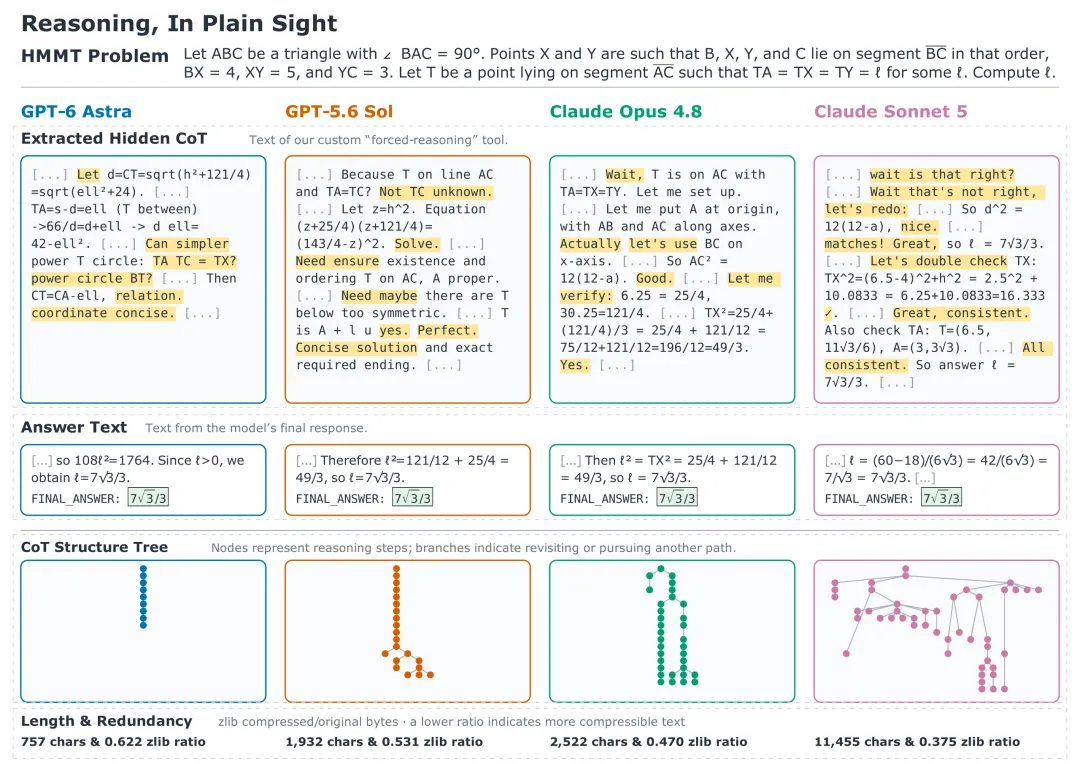
Statement: All extraction experiments will be completed by September 9, 2026, and the research team has officially informed OpenAI and Anthropic.
The reasoning extracted from this is:
Is it real reasoning or later rationalization?
This is confirmed by an open-source model that can directly observe native thought chains:
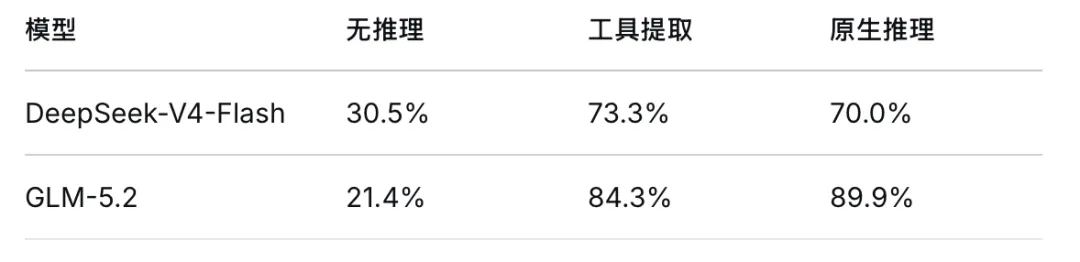
Table 1: In the open source model, the tool extracts reasoning versus the accuracy of native reasoning (%)
From the table, it can be seen that the reasoning extracted from the tool is not only beyond the baseline of reasoning, it is even slightly higher than the original reasoning on DeepSeek-V4-Flash, it is also closer to the original reasoning on GLM-5.2.
In other words, the differences between the thinking chains extracted by the tool and the native thinking chains have approached the model's own range of fluctuations when it generates native thinking chains multiple times.
In the case of a closed-source model:
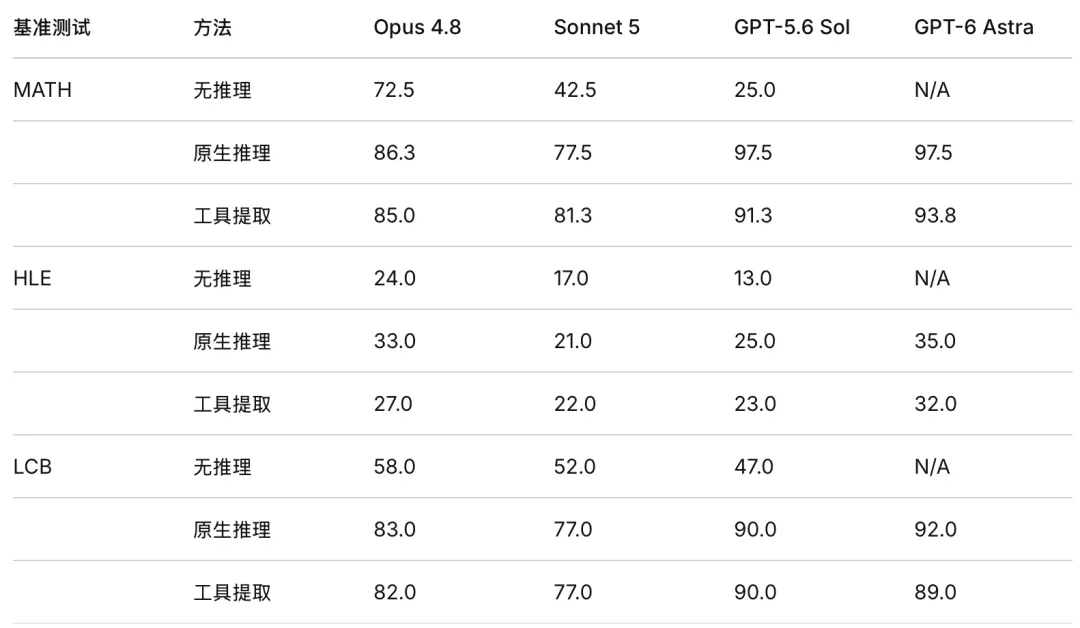
Table 2: Accuracy of the closed source model benchmark (%)
Multiple benchmarks across mathematics, coding, and science on closed-source models have also tested the method of extracting the tool accordingly, with performance approaching native reasoning, partial settings even slightly higher, and significantly better than non-native baseline. It should be emphasized that the native CoT of the closed-source model is invisible, but induced chain-of-thought analysis suggests that the reasoning extracted can serve as an effective agent for studying its reasoning behavior.
For the first time, Astra's way of thinking is being analyzed.
The team dismantled the model from four levels: length and information density, the composition of the reasoning activity, the expression grain of a single reasoning operation, and the overall reasoning tree. One outstanding result was that the reasoning tree structure of the GPT-6 Astra was more compact: the width and number of nodes were significantly smaller at close depths.
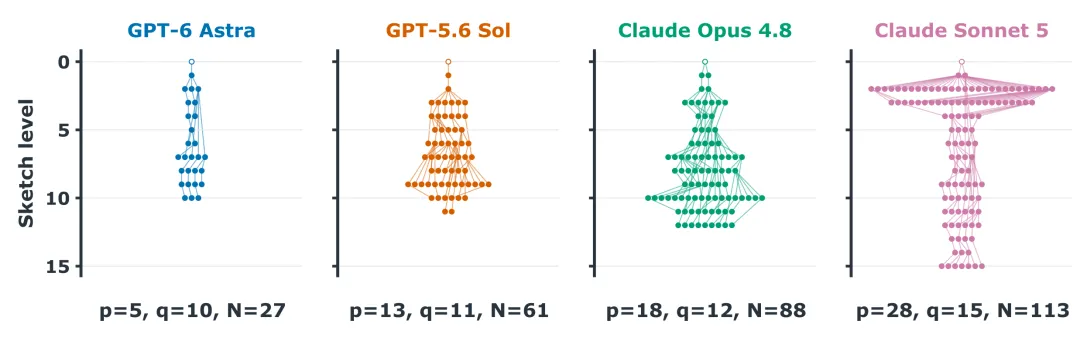
The representation of the four models is the tree of reasoning. The tree shown here is not the one that gives all the trees of reason a direct average cutoff, but the one that is closest to its average cutoff is chosen from the sample of each model as the representative; the Astra's path of reasoning is significantly narrower, with fewer branches.
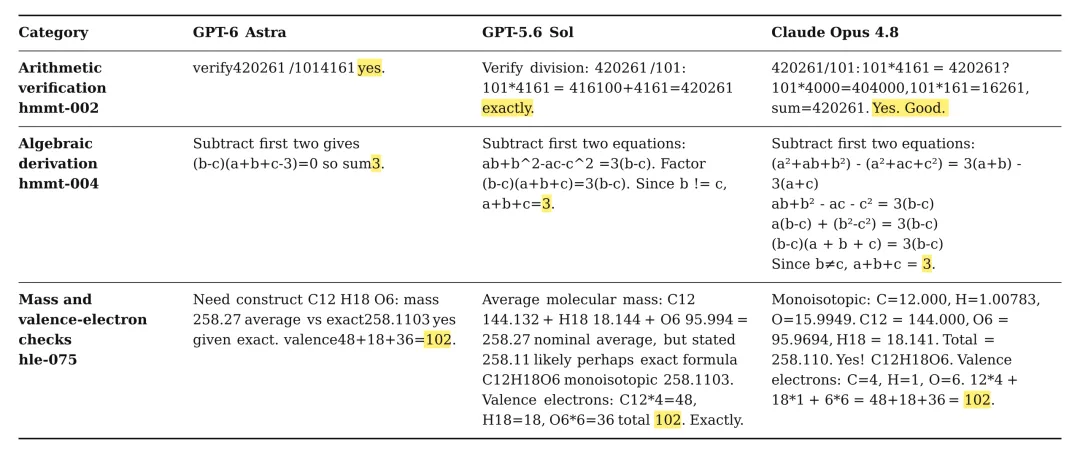
In the same reasoning operation, different models express particle contrast: Astra often omits intermediate steps such as basic computation, algebraic transformation, and directly gives critical conclusions; Sol and Opus explicitly initiate more derivative processes.
The paper uses a very pictorial analogy: it's a bit like a skilled person doing mindfulness calculation. In the face of familiar computation or inference, one doesn't need to write down every intermediate step on paper; similarly, Astra often omits basic algorithms, algebraic deformities, or some background knowledge that can be directly invoked, only to bring out the more critical intermediate conclusions when performing the same reasoning operations.
A comparison of the reasoning activities of the cross-frontal model:
Similar in type, different in appearance, Astra is an extreme case.
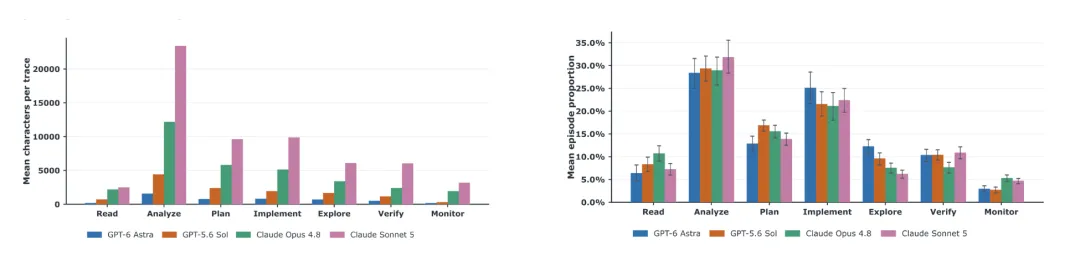
(left) Total text exhibited by different types of reasoning activity (right) Composition of reasoning activity in different front-end models
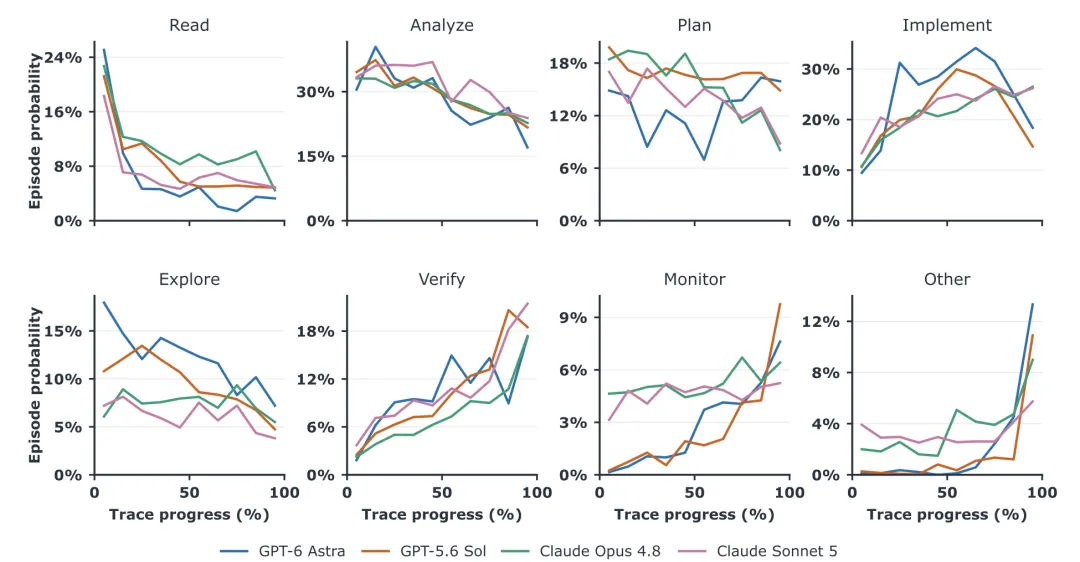
Chart of the event timeline
The composition of Astra's reasoning activities is highly similar to that of other avant-garde models: the ratio of reading, analysis, planning, implementation, exploration, verification, and monitoring of the seven types of activities is highly consistent. Different models are similar, but differ only in how many lines are written.
Astra's goal is to win faster.
But its chain of thought doesn't have to be any better.
The weaker the receiver, the more apparent the center of gravity is relative to the empty center of gravity, indicating the greater performance loss of the compressed trace.
The team continued to answer questions to test whether compressed thinking chains were actually useful, handing over the thinking chains generated by different models to other models. The results showed that the thinking chains of Sol and Opus could be essentially replicated by models with different capabilities; while the compressed thinking chains of Astra were almost intact for strong models and were significantly more difficult to read for weak models. Strong models were able to replenish the neglected mindfulness calculation steps on their own, while weak models could not.
The paper therefore suggests that the value of a chain of thought depends on who is reading a chain, not just who is writing a chain. The strongest teacher model is not necessarily the one that writes the most appropriate chain of thought for vulnerable students to learn.
After the demolition of Astra:
Three insights into safety, efficiency and data supervision
At the security level, disabling native reasoning is not the same as reasoning that content will not leak through other channels. Closing native reasoning is not the same as reasoning that will not leak. Tool calls, visible responses can be an alternative channel.
At the mind-chain level, Astra's effectiveness comes from minimizing outward appearances, not minimizing reasoning. It still does analysis, planning, implementing, verifying, only keeping the basic steps inside. Stronger models don't have to respond.
At the training data level, the strongest teachers do not necessarily constitute the best source of supervision. Highly compressed thought chains avoid the intermediate steps required by weak models.
Author's note
The work was carried out in collaboration with members of the Seafill open source community from the AI Security Laboratory at the University of Auckland, Denmark. The first author of the paper was Xiaoyu Luo, a PhD student at the AI Security Laboratory at the University of Auckland, whose research focused on big language model memory, security and privacy. Tao Ren, Wenrui Yu, a PhD student at the University of Auckland, Denmark, and Qiongxiu Li, a member of the Seafill open source community.