It's the first time in the history of the world.
At the end of July, when the MiniMax H3 became available, Artificial Analysis video editing list Elo 1130 points.
It's the first in the world, and it's a community thing.
I can't say that the H3 is good.
But when it comes to mass production, there are also shorts: multiple shots, the characters start to look the same; several sets of merchandise, the outline is not right; dozens of shots run together, and the back becomes more and more different from the same film.
From "running through" to "producing usable", the worst part is engineering.
And now this section has been added.
On September 29, RunningHub released H3 RH Enhanced, an enhanced model based on the MiniMax H3 open-source base for deep post-training.
RunningHub is a one-stop, all-in-one creation platform owned by Haima Cloud and is currently the world's largest community of AIGC developers, bringing together more than 5 million professional creators in more than 140 countries and regions.
In 2000, a group experiment was conducted.The H3 RH Enhanced multi-lens chronometric narrative capability is significantly better than Seedance 2.0, with overall performance directly following seedance 2.5.
For example, a second's worth of money can be made directly into pieces, reducing costs.
This means:An open-source, post-trained model that works as a closed-source effect.The cost is only one tenth of an equivalent-effect closed-source model.
H3 RH Enhanced is now available on MiniMax for public calls to global B-end creators. It is now available for free on the RunningHub platform.
Link to experience:
rhTV:
RHSTORY:
The demos at the event were good and the question was what the real scene looked like.
RunningHub's evaluation is based on business scenarios: continuous character depiction, multi-scene relay, multi-character interaction, more than 16 full-length narratives, four categories of 500 groups, a total of 2,000 group contrast samples, alongside Lazi's current mainstream model.
One of the most critical outcomes was a multi-lens narrative: 8 to 16 frames in succession, character identity consistency, scene element retention, three indicators for constraint retention, all of which led RH Enhanced significantly ahead of Seedance 2.0.
Let's take a look at some tests.
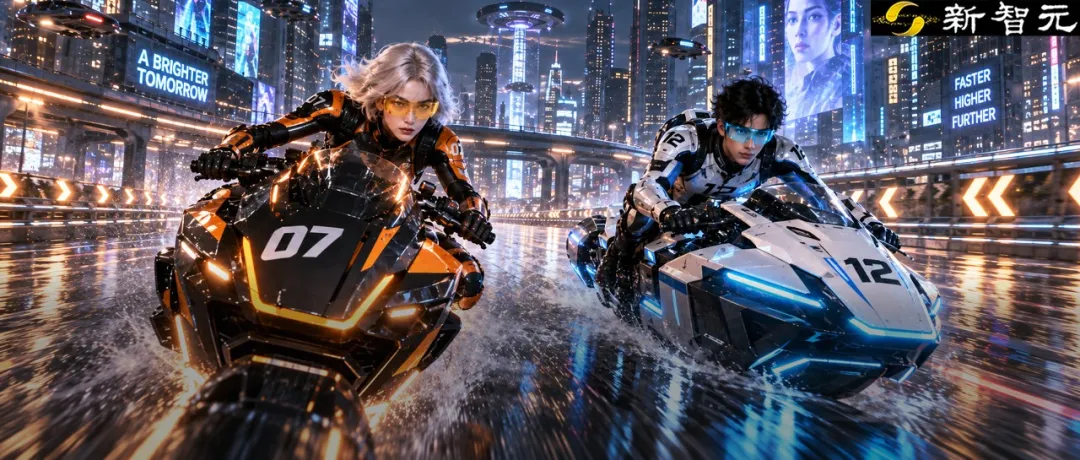
This is a 15-second chase of a cyborg car.The same reference graph, the same 14 lens prompts, respectively, are directed to RH Enhanced and Seedance 2.0, 480P, and the audio is generated by the model itself, without any targeted modification.
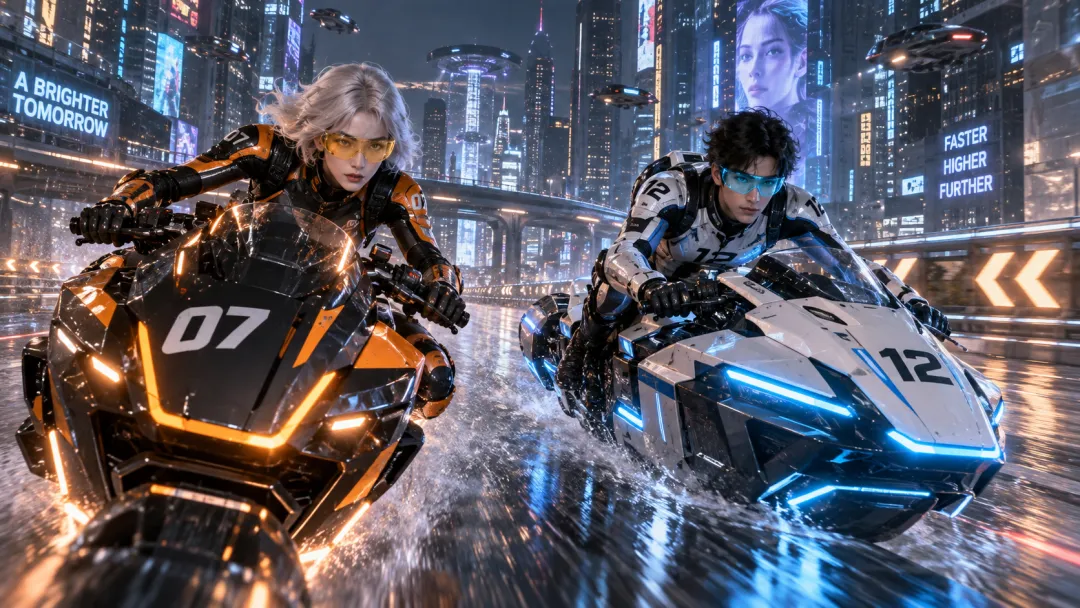
On the RH Enhanced side, the two cars from start to finish have been a reference to the two tyres, the 07 black and the 12 white and blue, the number plates have not been stained or changed.
The hostess changed the front, the back, the two characters, the final four seats, always the same face, the same set of orange shoulder sleeves, and the background city didn't run away.
The sound was generated in conjunction with the image: almost silent before the start of the run, the shots of the blast pulled up, the sound of the tunnel painting was simultaneously suppressed and the tunnel pulled out together.
RH Enhanced generated
Seedance 2.0's single-panel paint quality is not bad, and the back count in the lens is even more suggestive.
But most of the footage is loose: the 4th mirror turns into a Tron-style light wheel, which is no longer a reference to the car in the picture; the 5th mirror takes a direct shot of a city, the billboard is completely gone, and the model is clearly worn; the 6th mirror's women's aircraft obey the armor and return to ordinary leather clothes.
It's not broken, but it's not the same film anymore.
Seedance 2.0 generated
After 10 shots, RH Enhanced recognized the image as a reference, and Seedance 2.0 began to re-draw with impressions.
I'll take another look at an e-commerce site.The biggest fear of e-commerce is not the bad picture, but the change in the goods.
This 15-piece fragrance, full-bodied RH Enhanced bottle, is a reference to the same diagram: square-thick glass, bottle full of amber liquid, black gold cap, ORBIT 07 not floating.
Models crossed the desert, rainy night windows, elevators, skyscrapers, the same face, the same silk dress.
RH Enhanced generated
Seedance 2.0 is just as refined, but the elevator mirror, the bottle, hangs above the palm of your hand.
Seedance 2.0 generated
Extreme long-term scenario: Personality breakdown rate decreased by more than 60%.
16 Mirrors later, Seedance 2.0's characters forgotten and began to explode, with good actresses on the front suddenly changing their faces, changing their clothes, and losing props. RH Enhanced, under the same conditions, cut more than 60% of the damage.
We tried two 18-lens footage.
18 mirrors, five worlds, the model can't remember who she is.
RH Enhanced from Rainbow, Desert, Sherry, Subway to Space Station and back to Rainbow, with four faces featuring the same face, a yellow raincoat holding a hat, a red hat holding a black bag slanting. The first mirror buried the corner clock, and the 16th mirror hung back in its place.
RH Enhanced generated
Seedance 2.0 opens and closes well, and the final feedback is like a reference chart.
But the middle part collapses: the rainbow hat is worn and the rainbow is picked up; more importantly, the rainbow runs from the rainbow to the subway to the entire space station, floating for almost four seconds, three shots, and the rainbow does not appear again until the door.
And the suggestion that "red jackets, black jackets, raincoats are floating at the same time" is exactly what needs to be measured.
Seedance 2.0 generated
The other is an eighteen-mirrored Eastern fantasy, with two people plus a monster, and three subjects simultaneously online.
RH Enhanced is solid: White hair, red forehead, and end-to-end markings are the same face, the sword is not out of hand; Black Cavalry Generals have positive close-ups, faces, armor, guards, and long guns are all appropriate for reference; the ghost is the same every time it appears.
The most difficult mirror remained: the palace was half collapsed, the rubble was still falling, the lady and the frog were at the head of the bridge, the general was at a distance, and the three of them could see clearly where they were.
RH Enhanced generated
The Seedance 2.0 image is equally gorgeous, but the general's close-up view is that the armor has no face; the final gate to the palace is intact, and "half-fall" has not occurred.
Seedance 2.0 generated
RH Enhanced is a self-developed RH long-range memory engine.
The memory of a typical model is like a sliding window, with multiple lenses and the face of the first lens being squeezed out of the window.
Long-range memory engines are designed to capture cross-sectional information at the model architecture level, allowing the 14th lens to remember the five senses, clothing and props of the first lens, rather than later repairs.
Since its launch, RH Enhanced has generated nearly 1 million video seconds per day, equivalent to 67,000 15-second videos per day, or more than 3,300 five-minute episodes.
What did you do after training at RunningHub?Five-level engineering transformationHow to make H3 more stable and saving faster in the mass production scenarioRunningHub's move is not just about weight.
From post-training, resolution adaptation, sampling strategies, reasoning engines to service scheduling, the five layers change, and each layer corresponds to a constant problem in mass production.
Stage one: Scenario-oriented training that trains the business constraints of short, e-commerce, and comedy into models.
The H3 baseline is a universal capability that can do anything.
However, in short plays, the characters often change places, in e-commerce the product outline and material can not change a bit, in short plays the action must be coherent and cannot be interrupted, these vertical scenes have different rules and need to be practiced separately.
RunningHub, based on H3's single-stream Omni-Transformer architecture and MM-RoPE multi-modal location encoding, provides RH Enhanced with a training link for "scenario SFT → consistency optimization → stepless distillation".
The training data is built around RunningHub's three real-world businesses: short, e-commerce, and comics, with each sample identifying which reference material, which target characters, and whom the camera instruction points to.
There are four things that go wrong when training: people don't change faces, a reference image needs to look like, the movement is complete, the lens doesn't jump, which are the four cases with the highest rate of waste.
The second layer: Resolution perception to match the training of the pumps distributed in alignment with actual delivery specifications.
Short films, e-comedies, and comics have their own delivery specifications and do not have the same training resolution as the default models.
RunningHub divides the training data by width, height, density, and length, so that the distribution is directly attached to the delivery specification; then the regional weighting, the face, the product outline, the clothing structure, these decisions "can't be used" are weighted and the background is appropriately loosened.
The result is a shorter visual token, more economical calculation, but the clear face and merchandise are still clear.
Third layer: Slow distillation presses tens of steps of mass into several steps.
Video generation is essentially a step-by-step transformation from noise to image, with H3 running dozens of steps by default, each step being a full round of Transformer forward.
RunningHub distilled the trajectory using a "teacher-to-student" pattern: Teachers run a complete sample, and students not only learn the end result, but also teach teachers to rebuild the speed field direction and end goal at each stage, pressing the multi-step quality into a step-by-step model.
The number of steps is also not one-size-fits-all, static lenses, dialogue games are less than a few steps, large-scale movements, multiple reference materials are more than a few steps.
Level 4: Attention and caching synchronize the accelerator to make every step faster.
RunningHub overlays three techniques to reason on the execution layer.
SageAttention2 performs low-precision operations on the attention matrix from group values to smooth and fine particles, without losing accuracy to improving throughput.
Cache-DiT is RunningHub's self-developed Dual Block cache, with little change in DiT middle layer characteristics between adjacent sampling steps, all of which are wasted, which determines which modules are duplicated according to the magnitude of the change in characteristics, which are recalculated, which end modules retain real-time computation, the middle key values are duplicate residues, and a continuous duplication ceiling is set to prevent errors from accumulating.
Torch.compile compiles a compute graph into a merger algorithm, reducing back and forth between the Python layer and the display.
This combination is designed specifically for PCIe-connected normal multi-card environments, without the need for NVLink, so RTX-level servers that can be purchased in Jindong can run.
Level 5: 10 thousand tonnes of bulk service schedules run together, and costs are squeezed down.
The first four layers of how to solve a single video are quick and good, but the mass production faces hundreds of thousands of videos a day.
It's fast, the GPU utilization rate doesn't go up, the task scheduling is unreasonable, the storage is fragmented, and the synthesis book doesn't come down the same way.
The service layer of RunningHub approximates the input shapes; sampling the configuration of the compatible task automatically divides the batch; high frequency configuration for parameter preheating and compile cache replication, avoiding cold start; and real-time routing of the task queue between multiple servers.
It's not a few seconds of video production that counts, but GPU time, passing through rate and batch throughput that counts down to the delivery cost of each passing through.
It's a lot of money for a second.
Heima Cloud's decade of GPU engineering, acceleration and superdivision are synchronizedThe five-layer transformation makes it clear that what is needed is a full-fledged GPU engineering capability, from training to reasoning core to cluster modulation.
RunningHub's parent company, Haima Cloud, has done cloud rendering for a decade, with more than 60 edge nodes across the country hosting over 30 million monthly, 8 to 10 milliseconds of real-time cloud gaming.
Ten years of cloud rendering has been really left behind by the experience of operating and scheduling large-scale heterogeneous GPU clusters: how to unify different types of cards, how to get each one to run full, and how to rationalise optimization into the chain.
This set of experiences of AI migration is theoretically common.
The peak of cloud rendering is concentrated after 10:00 p.m. and the peak of AI reasoning is from 9:00 a.m. to 6:00 p.m., and the two loads are just the wrong peak to achieve integration.
So RH Enhanced is not just a weight on diplomatic payments, but a whole suite of post-training models, calculations and service packages that customers can get their hands on.
This is also the biggest difference between it and other platforms on the same track.
Most AI video platforms do model aggregation, bringing in different APIs for user calls; while RunningHub does model engineering transformation, moving from a weight-to-weight level to a service level.
To understand why RunningHub wants to reach so deep, one thing is clear: the model itself is not lacking.
One by one the open source platforms are getting closer and closer to each other, and there are many scenarios where it's hard to decide which, who, and how much is coming out.
The real gap has been in both directions. Down is the ability to scale up GPUs, lower the cost of reasoning; up is the ability through post-training and private deployment to turn an industry's knowledge into a model's own reality.
The Heima Cloud is based on this idea: a five-layer capability matrix with a data closed loop in the middle.
At the bottom is the computational layer. The above-mentioned isomorphic GPU scheduling, throttling peaks, are all in this layer, and RH Enhanced's reasoning acceleration and bulk scheduling are in this layer.
There are three things at the top: post-training, the model itself, the layout. Heima Cloud does not train the general model from scratch, the first is to train the open-source base like RH Enhanced, and the second is to unify the global mainstream model: which scenarios should be more expensive, which scenarios should be more affordable, and how to align with business needs.
Once again, the Harness execution layer gives the model handles and feet. The model itself spits out text and pictures, and Harness allows it to capture an entire business link that is actually working in the process.
The fourth layer is the data layer, the deepest layer of the Citadel River. The RunningHub generates tens of thousands of professional workflows per day, which are embedded in expert trajectory demonstration data sets and then transformed into a vertical knowledge base.
Applications run out of data, data replicates Harness and models, models become stronger, applications better, and then run out of more data to lock a self-turned loop, achieving recurrent self-evolution, which is hard to copy on the outside.
At the top of the application layer, there are three forms: API, SDK, App with interface. RunningHub is the verification of this capability: workflow, AIGC application market, visualization canvas, API services, the entire link goes through.
Modeling capabilities are being commoditized, and the barriers are going in two directions: lowering the cost of computing, and on top of that, turning industry knowledge into the capability of the model itself.
So it's not a model, it's a set.
Previously open-source, RH Lightning accelerated the H3 logic by 12 times, pressing 5 seconds of video from 349 seconds to 29 seconds, and the program was fully released on GitHub; the recently released RH Upscale video superimposed, the first comprehensive performance in 13 sensing configurations, including the volcano engine program, and the best in the ultra-modular human-facial video scoring industry.
Lightning tube speed, Enhanced tube output, Upscale tube quality: RH Enhanced output, 1080P is repeated at Upscale.
From generation to acceleration to enhanced graphics, a complete AIGC video industrial pipeline is enclosed within the RunningHub platform.
There's also a signal: RH Enhanced has been officially recognized by MiniMax, and the upcoming MiniMax website is going global.
Models are just the first step.Calculator that can be integrated into the production workflowNow the team that makes AI shorts, e-commerce videos, and comedies isn't as good as they used to be.
Instead, the multi-lens role is to increase the amount of waste, the waste rate is high enough to be reckoned with; it is more expensive to deploy an open-source model and run it than an API, and it works well with a closed-source API, but the bills at the end of the month do not go away.
RH Enhanced has two numbers to deal with: breakdown rate and cost per second.
Multi-lens is stable enough to be mass-produced, low enough to be used by small teams, and the platform can be tuned without using its own 120GB display storage machine.
Double the argument, it's better to be at the top of the list, of course, but if you want AI video to go from hotspots to infrastructure, you have to put those two numbers down.