
It's the first time in the history of the world.
The AI for Math team at Peking University has just announced that they have independently completed one of the Millennium Grand Prize puzzles, the full formalization of Pyongyang's guess in Lean 4!
In 1904, Pongaly suggested speculation; in 2002, Russian mathematical genius Perelman gave less than 70 pages of abridged proof-of-print; subsequently, it took years for top mathematicians to write over 500 pages of papers.
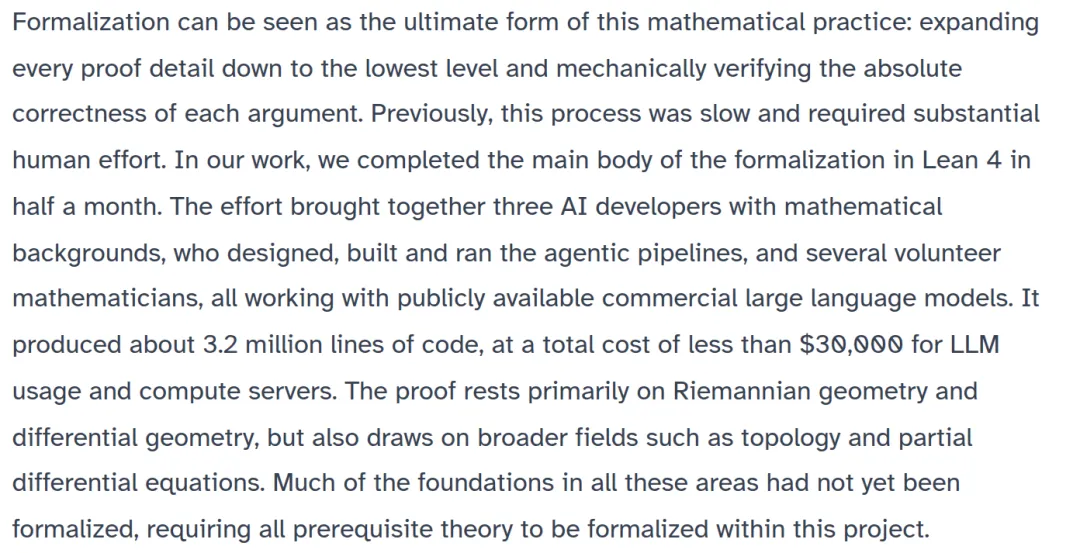
And today, in just half a month's time, at a cost of less than $30,000, the Northeastern team collaborated with the Intelligent Body to transform it into about 3.2 million lines of code!
According to the team, this is the first known formalized version of Pongaly's conjecture to be tested simultaneously through Lean build and Comparator.
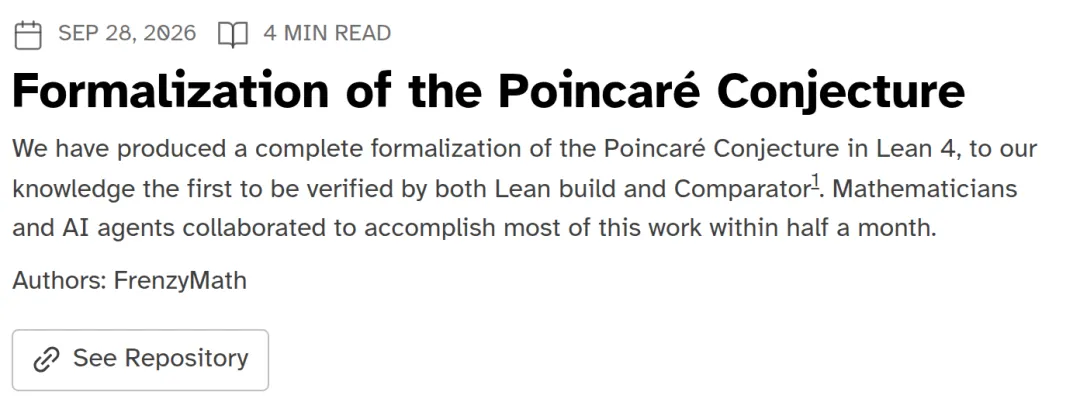
Three AI developers with a mathematical background, along with several postdoctoral fellows and PhD students, completed this work using a large open-source commercial model that costs less than a penny a line of code.
According to the estimates previously given by the Nordic team, human experts can write about 250 lines a day. According to 250 working days a year, 3.2 million lines are given to one person to write for 50 years.
On the same day as the North team's announcement, the U.S. team, led by Chu's disciples, also submitted a 4.7-million pound Pongaly guess Lean proved.
Both teams finished independently, but on the same day. The era of large-scale machine-formalised verification really came.
North Korean team, half-year cost decreased to one tenthThe team, from the Beijing International Center for Mathematical Research at Peking University, known locally as FrenzyMath, aims to accelerate modern mathematical research with large models and AI-enabled bodies.
The team made two representative papers in March and April this year, the last of which was signed by Prof. Dr.
In March, they formalized two research-level mathematical problems using the self-developed Archon system.
In one, AI wrote about 8,800 lines, ran for 50 hours, and spent $1200, an average of about $0.14 per line.
The cost of each line of code fell by one-tenth of what Pongaly had guessed at the time.
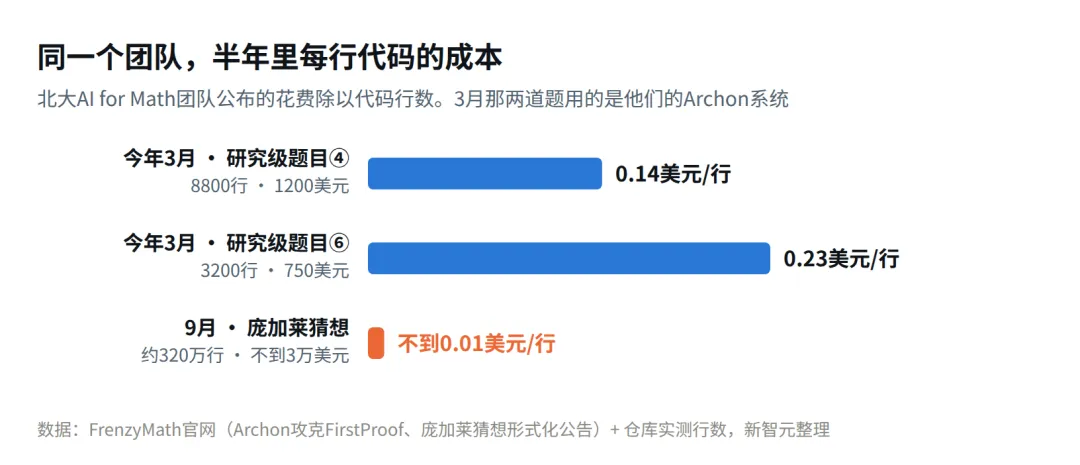
Half a month, 3.2 million lines were written, an average of more than 200,000 lines a day, the equivalent of more than 800 human formalization experts working simultaneously.
The US$30,000, including the call fees for the large model and the cost of computing servers.
This team has done more than that this year.
In April, they had two smart-body interfaces, one in charge of proof-of-concept and one in charge of writing Lean code, to solve a public problem in the exchange algebra that D. D. Anderson posed in 2014, for a total of about 80 hours.
In August, their brains helped mathematicians overturn two important assumptions about the Kazhdan-Lusztig polynomial.
Also in August, the team launched a scheduling system called Archon Horizon, specifically to formalize a group of Codex or Claude Code smartphones for a long time. It listed two ongoing projects at the time, one of which was Pongaly's guesswork.
According to a 500-page article, it is broken down into 83 milestones.Perelman wrote three pre-print editions of less than 70 pages that year, and many of the key steps were merely conclusions. Morgan and Tanong later wrote a book of more than 500 pages to supplement the details.
North's goal is to move the whole book to Lean.
Their core secret is the perfect synergy of "human intelligence + AI intelligence".
In this project, three AI developers with mathematical backgrounds became "packers".
They don't write millions of lines of code themselves, but they design, build and run complex intelligent workflows.
Postdoctoral fellows from multiple mathematical disciplines joined as volunteers, using open-source commercial language models to instruct AI to complete a vast amount of basic derivation and coding.
The biggest difficulty in this is not that Ponggale speculates on itself, but that it is "ground".
The proof of Pongalle's conjecture is that the soil is deeply rooted in Liman geometry and differential geometry, while also requiring extensive mathematical tools such as topology and partial differential equations.
However, in the current Lean 4 library (Mathlib), the vast majority of the basic theories in these deep domains are entirely blank.
Well, in half a month, the North team not only completed the construction of the tower, but also built a huge base of all these pre-set theories from scratch within the project.
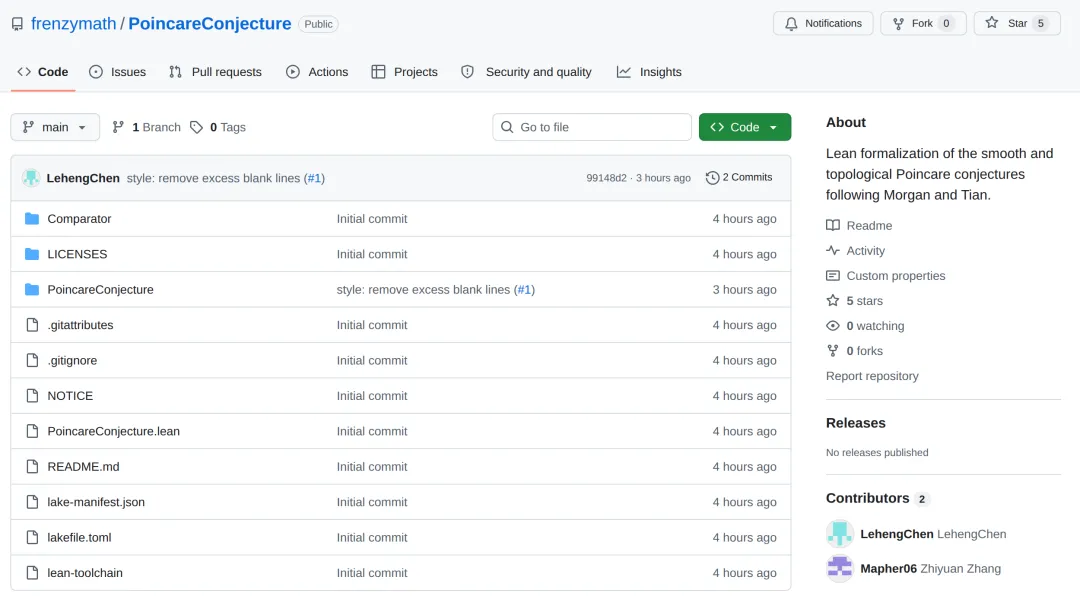
In July, the project was put up on GitHub and began by writing a comprehensible blueprint. The blueprint has six chapters, listing 279 definitions and theorems, each of which identifies the source of the book, who cited who painted it clearly.
It's the same thing with landfills.
The team made 16 textbooks, lectures, and papers as supporting blueprints, ranging from smooth flow, Liman geometry, to partial differential equations. Two of them were used as reference materials for Ricci flow, and were authored by Ben Chow, the leader of the American team.
During the mid-August review, the blueprint included 11 "external interfaces", or "this step is based on someone else's conclusions".
The code, which was delivered on September 28, contains no apologies and no additional formalities. These 11 white papers were either verified in Lean or circumvented.
The real code, broken down into 83 milestones according to the blueprint, was pushed from the bottom of the Ricci flow base estimate all the way to the final assembly.
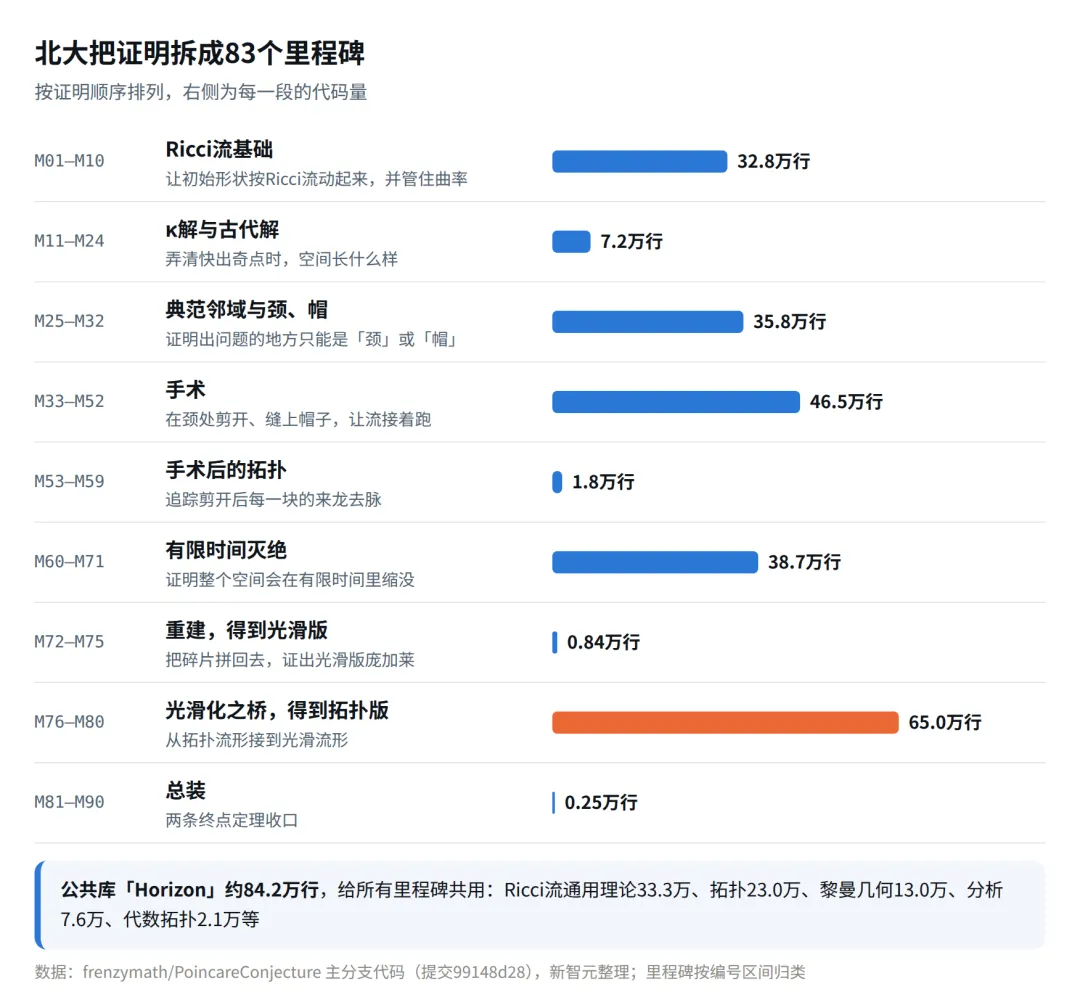
We downloaded the full statistics from the Great North Warehouse for a total of 27,203 Lean documents.
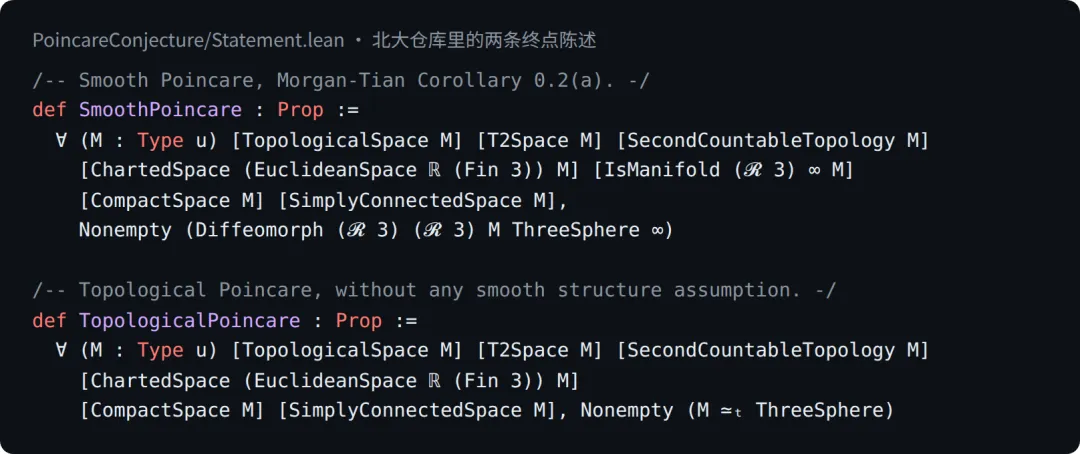
In the end, the two layers of the Poincaré theorem cited about 2.9 million lines of code, containing more than 76,000 theorems and arguments.
The most valuable piece is not Perelman.
Perelman's most famous operation, written about 470,000 lines, demonstrates that the part of space that shrinks in a limited amount of time is about 390,000 lines.
The largest piece of hard bone in the collection is a milestone in the M76 series. It contains about 650,000 lines and is nearly three times the size of the second.
It works to build a bridge between the topological flow and the smooth flow.
Pongaly's conjecture is that the topological space, whereas the Ricci flow can only run in smooth space, must first be proven that any three-dimensional topological flow can be cut into a small quadratic block and then processed smoothly.
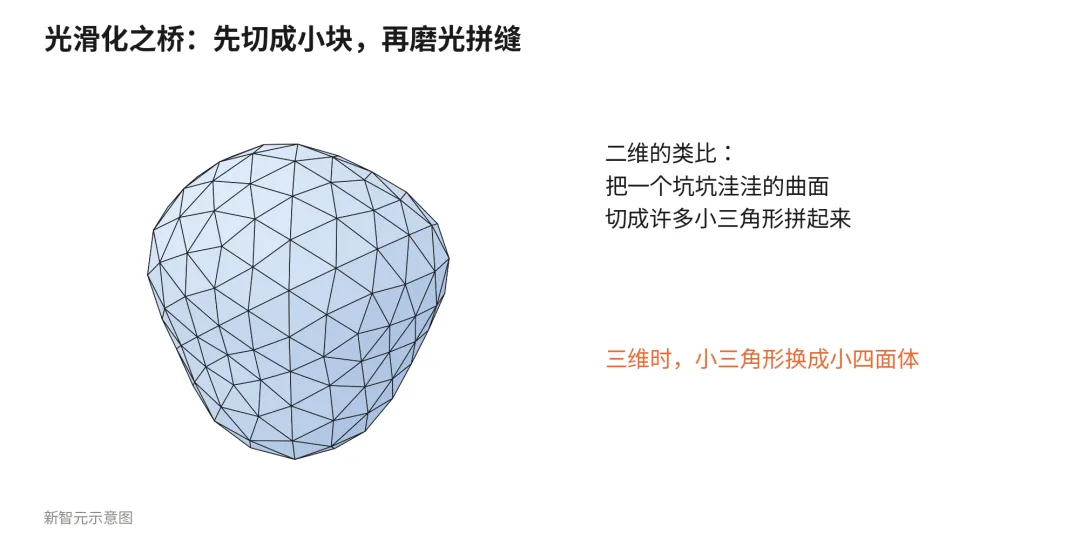
This is an old theorem that was proven in the 1950s and 1960s, and once inserted into Lean, the code was written more than Perelman's surgery.
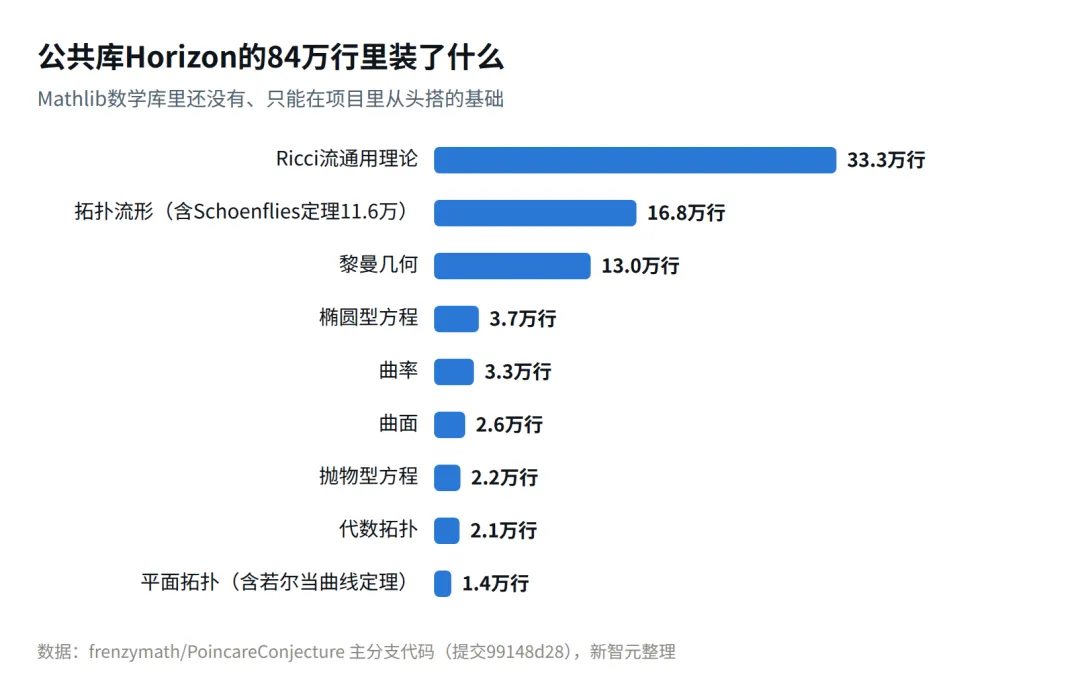
The other big block is the 83-mile shared public library Horizon, about 840,000 pages.
Nearly 40% of these are the general theories of the Ricci flow, and more than 100,000 lines of Riemann geometry, and more than 200,000 lines of topology, all of which are not yet in Mathlib's mathematical library and can only be constructed in the project itself.
Even a mathematician's default common sense has to be proven in front of machines.
Drawing a circle on the plane, inside and outside separated, this is Rahul's theory of curvature.
Furthermore, the circle is actually inside a circle, which is the Schoenflies theorem, and the corresponding code is 116,000 lines.
It's been a while since I've seen a famous mistake, and I've passed a double check.
Moving a book into Lean means taking every sentence out of the book and re-examining it.
In an August review document of the project, a mistake was recalled.
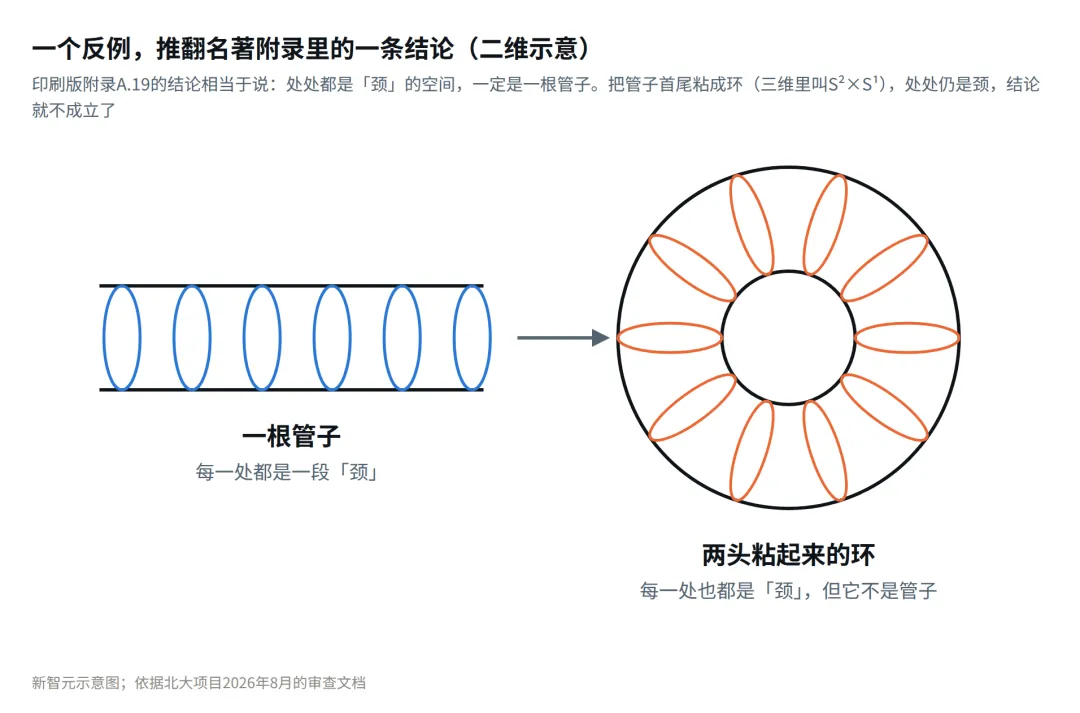
The printed version of Morgan and Tan Kong's appendix A.19 gives an unconditional conclusion that it is a three-dimensional space consisting of a tube, which must be a tube.
And a single sentence reviewing the document overturned it.
At the end of the tube, a ring is attached to the end of the tube, which is not a pipe anymore. This ring is called S2×S1 in three dimensions, which is the opposite of what the book concludes.
So the team abandoned the A.19 and changed it to the book's adjacent A.20, concluding that it was "either a pipe or a ring".
After the code is written, the examiner has already done this link.
It is reported that this release is the first version to be simultaneously compiled by Lean and tested by Comparator.
The Comparator was Lean's official judging tool, like an ironclad, selfless examiner. The subject of the test must be the same as the test word, and must be accepted by the core system with only three standard axioms.
Not only that, but North Korea has added an assurance that another set of independently written nuclear nanodes will be reviewed from start to finish.

This set was also used when Anthropic formalised Fermat's theorem into 13 million lines of code shortly before.
Verification of the Millennium Challenge costs only $30,000The price of $30,000 will change the way the mathematical community verifies the proof.
In the past, a mathematician came up with a major proof that the entire mathematical community spent several years reviewing a page. After Perelman's proof was posted, it took three or four years for a group of top mathematicians to confirm that it stood up.
Now, write it in a line of code that the machine can understand, and then look at it from start to finish, in half a month, plus the budget a lab can afford.
More than a year ago, AI took the gold medal in the Olympic Games. Today, a puzzle that has plagued the mathematical community for nearly a hundred years can be verified for three dollars.
Recently, Anthropic announced that it had completed the formalized verification of Fermat's theorem.
Numerous proofs: Mathematical proofs of AI's abilities will be formalized and will explode soon.
RoboInd editorial channelResearch, robotics companies and market intelligence for cross-border sourcing.Explore the channel ↗
Share this
End of editorialExplore more from Global Robotics News ↗