This Monday, the news broke!
AMD has announced the acquisition of World Labs, a startup company owned by Lee Fee-Fee!
The deal was reportedly a full-stock transaction valued at about $8.2 billion.
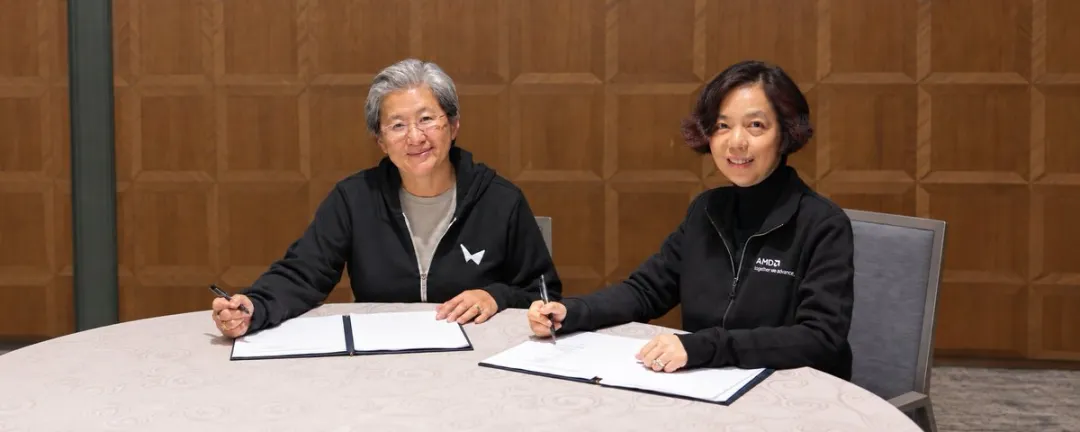
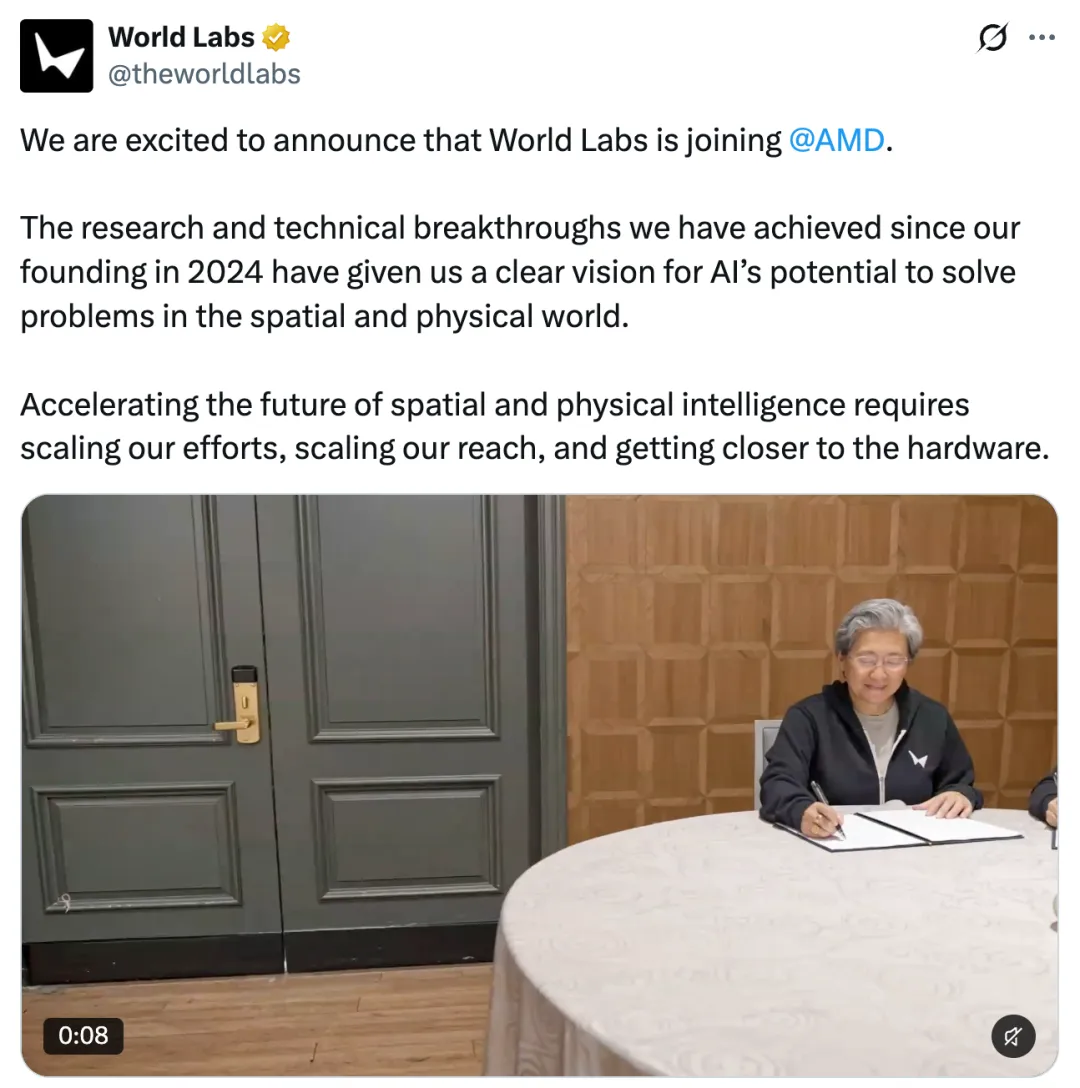
The following is a complete translation of the official's announcement:
World Labs is joining AMD.
This is a momentous moment for World Labs, for our team, and for me personally. I would like to take this opportunity to talk about what this means and why I am so excited about the new chapter that is about to open.
Come on, my friends, now is the time to look for a new world, it's not too late.
Lord Dunne was born, Lord Ulysses S. Grant.
A story about growing up
For me, AI is both a very personal matter and a matter of human civilization as a whole.
In 2000, I had just become a graduate student, entering the field with a curiosity about a question: how to make machines and brains have visual intelligence. At the time, I didn't know, this was actually the start of my career, and this career surprised me too.
Over the years, from computer vision, deep learning, robotics and medical health research, to being the chief scientist in the Google Cloud AI department and helping to create the department, to being the founding director of Stanford University's Institute for Artificial Intelligence (Stanford HAI), I've always wanted to work with humans to solve real-world problems with technology for better outcomes for society.
As generative AI began to drive a new round of change, and as large-scale, cutting-edge AI research shifted from academia to industry, I realized that the path to creating the deepest, broadest, most positive impact and the most worthwhile path was to start a startup to tackle the most ambitious technological challenges.
In early 2024, I co-founded World Labs with two great co-founders, Ben Mildenhall and Justin Johnson, who are world-class AI researchers and have contributed significantly to the development of the field.
Our goal is to create a cutting-edge laboratory that focuses on one of the most important challenges of AI. If these problems can be solved, it will significantly improve AI's ability to address real-world problems.
The world is not just written.
When we started this company, there was one basic belief: language alone is not enough to support the development of the model.
The universe is not made up of text, but of things that actually exist. Many of the most important problems that AI has to solve - from science, entertainment to robotics - require models to understand and reason with the structure and behavior of the physical world.
To tackle these problems requires a team with a very wide range of skills, including data, computer vision, big model training, systems, and even computer graphics. I'm very fortunate to have assembled such an innovative research and engineering team that brings together world-class experts in these fields.
We have started to train a new class of basic models to solve the most difficult problems in the field of spatial intelligence and have made significant progress towards the goal.
Since its inception in 2024, World Labs has built a leading AI space intelligence capability covering scenes ranging from creative work to design. We have built a world-leading model training team focused on image, video and space reconstruction. With the acquisition of SceniX, we are also building industry-leading robot simulation capabilities.
Recently, we released Atlas. This is a pioneering all-modal model architecture that solves a critical and long-standing problem in the field of space intelligence: new camera view prediction.
Just as a big language model can predict the next token based on a piece of text, Atlas can train from scratch to predict the next perspective based on the input two-dimensional image, and performs better than current state-of-the-art results or even better than models specifically trained for this task.
By combining generative models with multi-view geometry, Atlas actually solved a long-standing problem in computer vision called sparse reconstruction.
This will have direct and far-reaching implications for many fields, including design, engineering, science and robotics.
We have seen great interest in Atlas in all areas, including environments for robotic reinforcement learning, the creation of scenarios for therapy and entertainment, and real-world reconstruction for the real estate, design and construction industries.
It's moving along our northern constellation toward AMD.
The research and technological breakthroughs made by World Labs in such a short period of time further inspires our ambitions and makes it clearer how much potential AI holds in solving the problems of the space world and the physical world.
Now that we have concrete results that prove these possibilities are real, we hope to do everything we can to accelerate this future.
To do this, we need to expand our input, expand our reach, and get closer to the hardware.
Without work specifically focused on hardware, AI will be limited in efficiency, as well as in scale. As far as the issues we are concerned, AI will still be trapped in the digital world.
This is also true of AMD.
Since the very beginning of World Labs, we have been working with AMD. Dr. Lisa Su, CEO of AMD, has long been our investor and supporter of our mission. We all believe that AI can drive our society towards a better future.
Last year, we began an in-depth technical collaboration with AMD, initially focusing on model training and reasoning optimization on AMD GPUs.
In the course of the collaboration, we saw firsthand how Lisa led AMD in a bold and powerful way, making it an important player in the hardware ecosystem and maintaining a strong development momentum.
As the two teams deepened their collaboration, we realised that it was very natural to integrate our AI software with hardware ecosystems, basic models with applications.
Just as I knew starting a startup was the right way to advance basic model research beyond the LLM and maximize the impact of AI, I'm just as clear now that for me and World Labs, the right way to continue our mission is to be part of AMD.
In the future, we will continue to work together to advance AI at the forefront of solving real-world problems with AI, while staying open and moving forward with communities and ecosystems as a whole.
Our mission has never changed. Today, we look forward to continuing to build a world-leading, cutting-edge research organization capable of long-term sustainable development and keeping it vibrant for decades to come.
We will also strive to provide the best open models and platforms that allow AI to run from hardware, software, models to end-to-end data platforms that support it.
Solving real problems and creating a better future for humanity
We are very excited to be part of this journey together towards the future.
In the future we want to build together, powerful AI platforms and systems will be developed and deployed to solve some of the most fundamental problems facing humanity: from drug discovery to releasing human creativity; from changing the way we learn to unlocking the next generation of robotics.
I'm also looking forward to joining AMD as Executive Vice President and Chief Scientist, working directly with Lisa and her team.
Looking back on my career, it seems to have taken me to this point: as a scientist and technology leader, continuing to grow and lead a cutting-edge research team at a leading AI company.
With a platform and an opportunity like this, I feel humble, grateful, and hopeful. We will continue to build a future that we believe in, and we will always use that platform to guide me to make technology serve humanity.
I'm so excited about the future, and I'm so grateful that World Labs and AMD have the opportunity to build a future together.
The original address: