It's the first time in the history of the world.
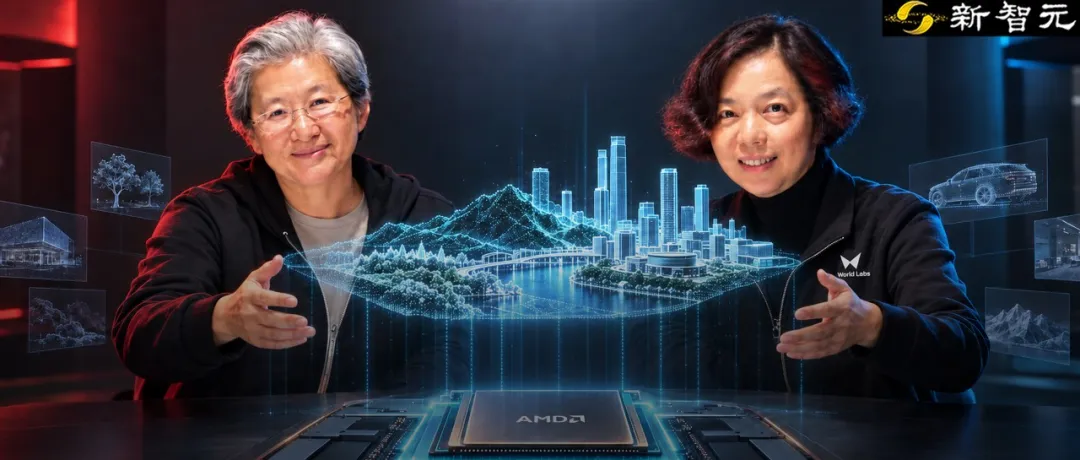
Recently, there was an epic merger in Silicon Valley.
World Labs, a space-intelligence startup founded by Li Feifei, was acquired by AMD for $8.2 billion.
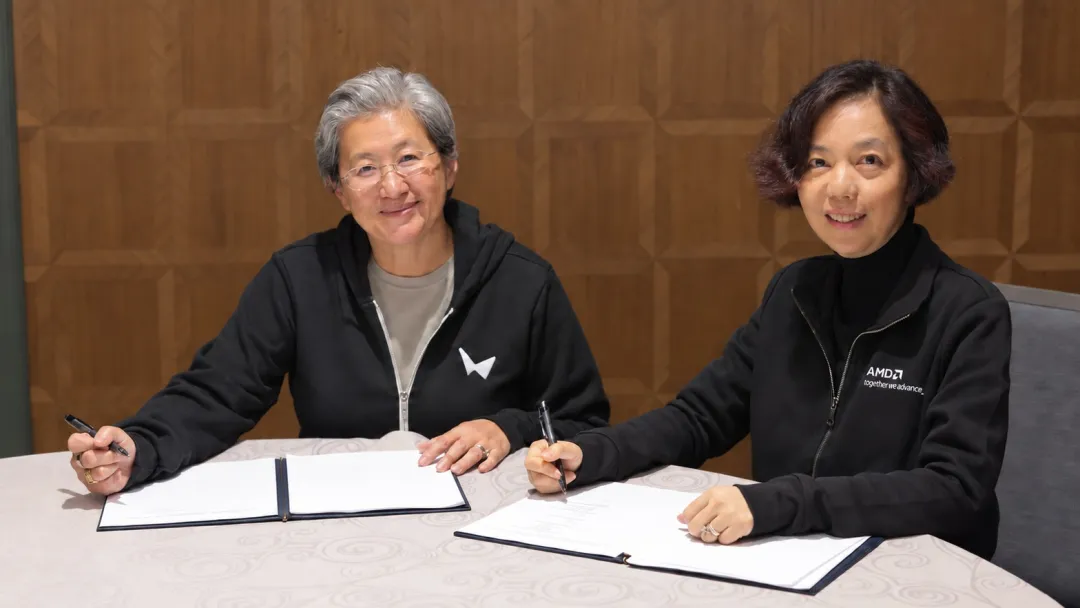
It was so shocking to see the two great Silicon Valley queens, Suzhou Fong, and Li Feifei, join forces.
The computing giant has been working on the 3D ecosystem itself, marking the official transition of AI from the language dimension to the physical world.
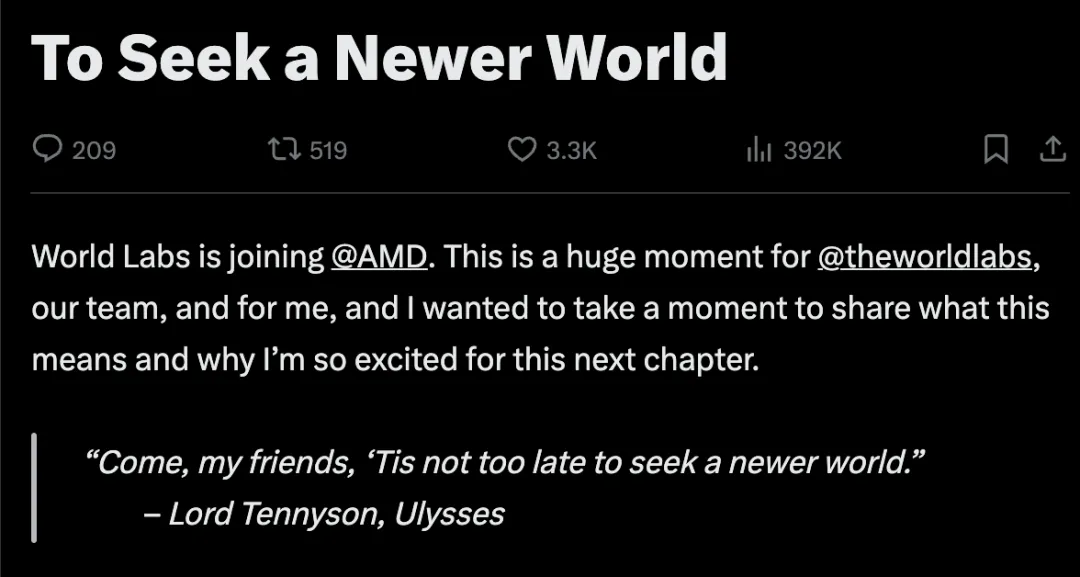
In an open letter to the public in search of an updated world map, Lee Pfeiffer quotes the English poet Ding Dong from the Ulysses:
"Come, my friends, look for a new world, it's not too late".
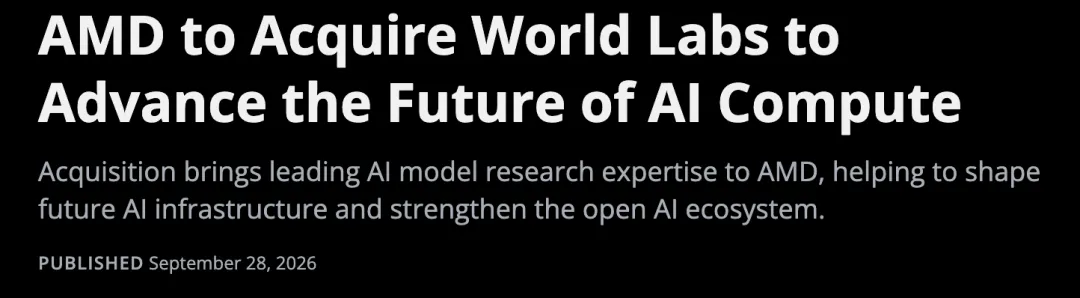
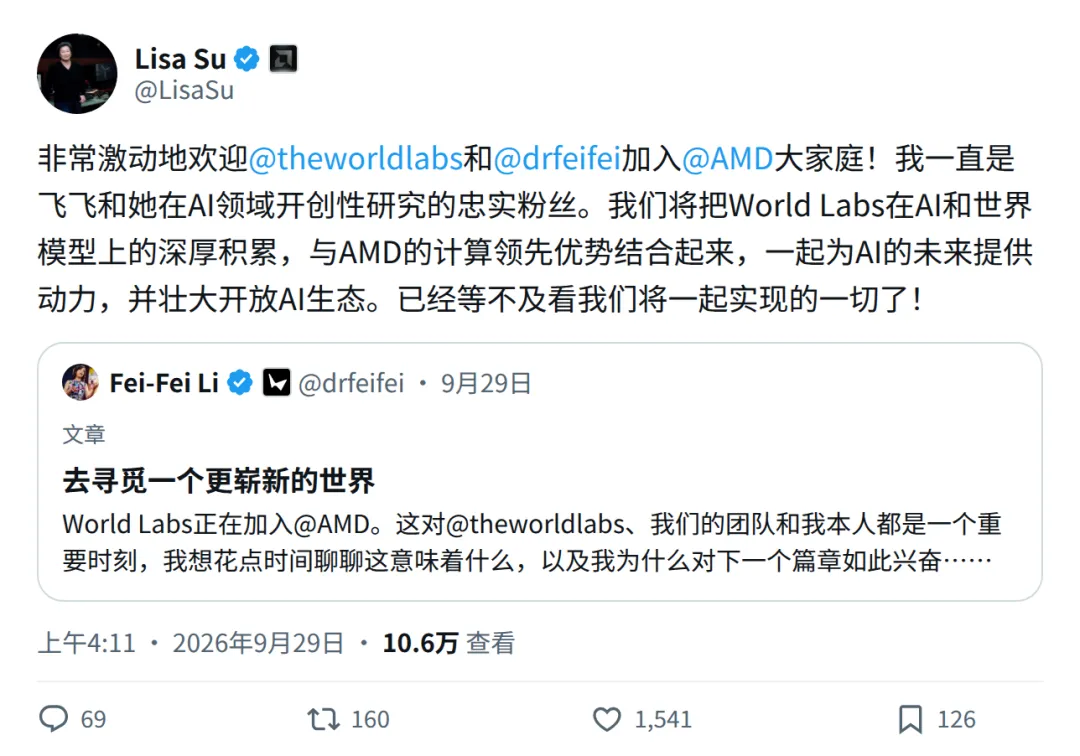
Today, AMD officially announced that it has reached a final agreement to acquire World Labs, led by Li Feifei.
Following the completion of the transaction, Li will serve as AMD's Executive Vice President and Chief Scientist, reporting directly to AMD Chairman and CEO Suzhou Tong.
The $8.2 billion deal, a handshake between two Chinese queens, is far larger than a typical commercial merger.
In 2014, she took over the year-long loss of AMD, reversing in desperation, hardly making it the most difficult opponent of Ingrid.
On the other side was "AI teacher" Li Feifei. She was working in New Jersey as a laundry maid for a suburban girl who later created ImageNet herself, opening the door to an era of deep learning.
It's been a long time coming for both of them.
When World Labs was founded, Suzhou was an early investor and strong supporter of the company, and since last year, the two have been training together on AMD's GPUs.
At CES in January this year, Suzhou Feng took Lee to the stage for the keynote address, announcing that Marble had improved its performance on AMD's MI325X by more than four times.
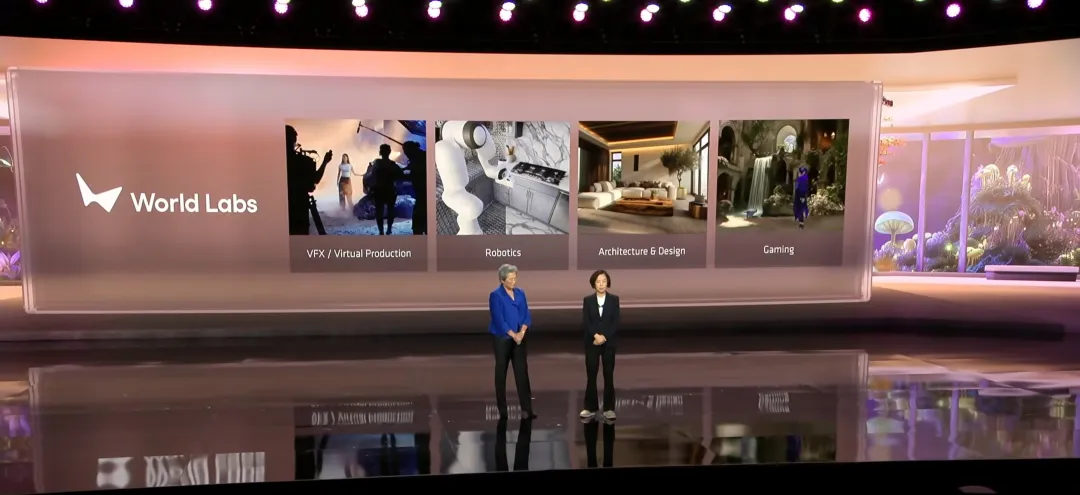
Nine months later, Suzhou just bought the entire company. Li Feifei took over as executive vice president and chief scientist of AMD, reporting directly to Suzhou.
The two legendary queens chose to be bound at this time, because they wrote in one of Li Fei Fei's poems, "The universe is not composed of letters, but of real things".
As big language models get closer and closer to the ceiling, tech giants are increasingly convinced that if AI is to truly change the world, it must allow machines to understand, perceive and transform the real physical world.
This can't be done on one hand.
Suzhou needed a top team to tell her what kind of chips the next generation of models would need a few years in advance. Li wanted AI to create 3D worlds that could be entered in real time, and her appetite for computing was frightening, she wrote in a long line that without special hardware input, AI would always be stuck in the digital world.
Bringing AI into the physical world is the ultimate mission of World Labs, and for AMD, it's a key step to the tunnel supercar!

In the letter, Lifeifei rarely dissects his 26-year AI journey and writes a thought-provoking statement:
For me, AI is both personal and civilized.
In 2000, as a graduate student entering academia, Lee was deeply drawn to the proposition: How to solve the problem of visual intelligence in machines and brains?
What she didn't know at the time was that she took these steps with curiosity and stepped precisely on every historical node along the path of AI.
In 2009, AI was in a long "winter" of pessimism about the future of neural networks in the industry.
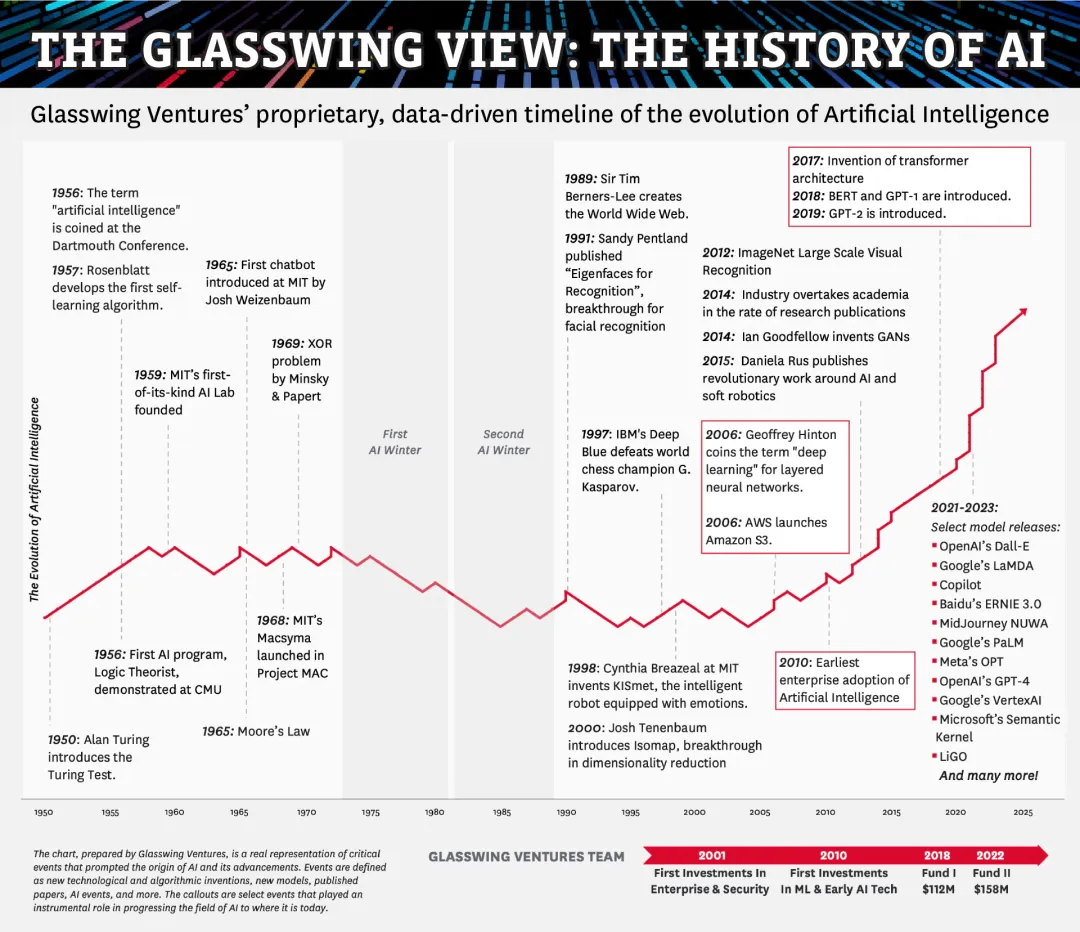
But Lee and her team did a seemingly "crazy" thing when they released ImageNet, a massive data set containing tens of millions of artificially tagged images, which provided a huge amount of "food" for AI algorithms.
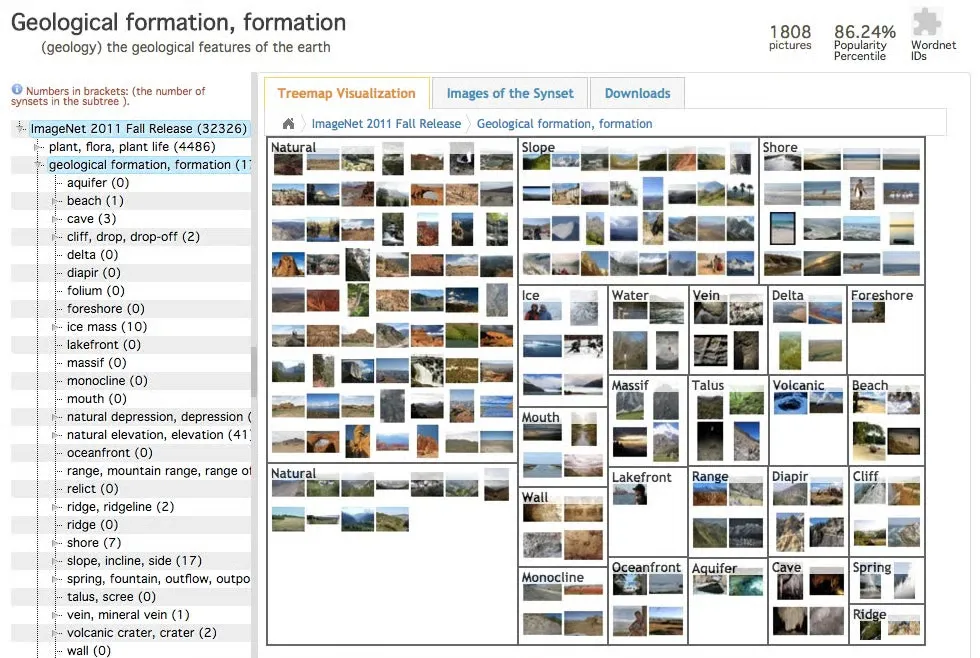
It was the birth of ImageNet, combined with neural network algorithms and their implementation on GPUs, which together triggered the AlexNet miracle of 2012, directly ushering in the era of deep learning.
It's fair to say that without ImageNet, there would be no AI boom today.
Over the next few decades, Li Feifei's career began to unravel:
Top academic research in the fields of computer vision, deep learning, robotics and healthcare;
cross-industry, as the chief scientist of the AI division of Google Cloud;
He returned to school and became the founding director of Stanford HAI.
It can be found that every turn of Li Feifei has a clear logical loop, "human-centered".
Her work has always been guided by a strong desire: not to play tricks, but to solve real-world problems and work with humanity to promote social welfare.
Today, Li Feifei is keenly aware that it is no longer possible to keep up with the frenzy of the age based solely on academic research.
"I know that the deepest and broadest path to impacting potential is to start a startup company and tackle the toughest technical challenges".
So in early 2024, she pulled together two world-class AI researchers, Ben Mildenhall and Justin Johnson, to found World Labs.
Her goal is unmistakable: to build a cutting-edge laboratory that focuses on the most important challenges in AI; once addressed, these challenges will significantly improve AI's ability to cope with real-world problems.
In just two years, World Labs released an answer that shocked the industry earlier this month: the multi-modal world model Atlas.
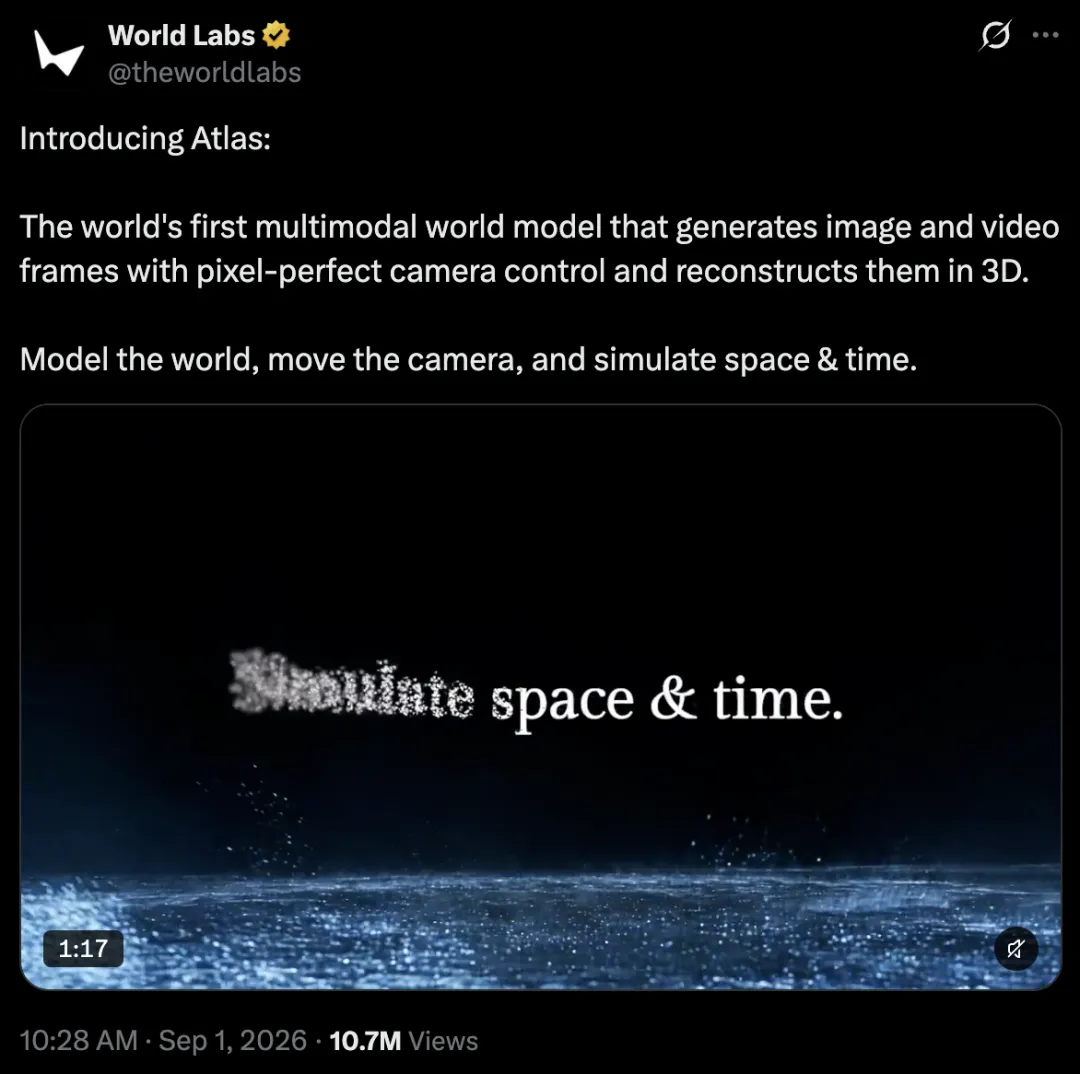
Its principle is to predict the "next perspective" by inputting a few 2D images. It is the first model of its kind to be trained from scratch, capable of generating, reconstructing, and simulating interactive 3D environments directly from text, images, and video inputs.
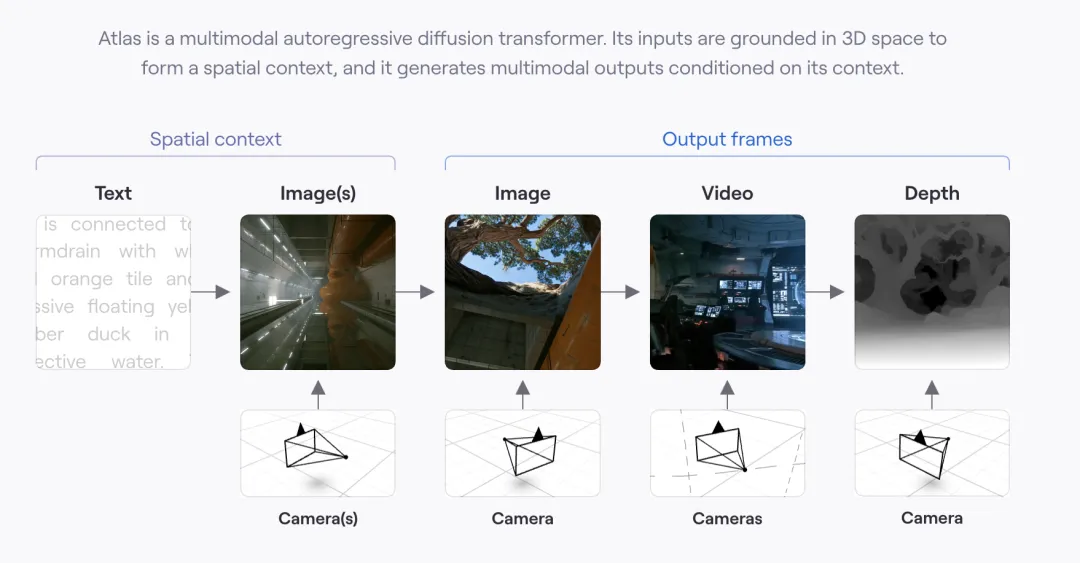
AI has finally developed a pair of "three-dimensional eyes" that truly understand the physical world.
Suzanne, bet on the next AI war.The man behind the chessboard is Suzuki Fong.
When she took over as CEO of AMD in 2014, the company had a market capitalization of less than $3 billion and annual revenues of $4 billion, and Wall Street felt it was dying.
Twelve years later, AMD's market capitalization has surpassed $1 trillion and its stock price has risen 45 times.
What did she do right? Two crazy bets.
The first was selling the Wave Factory and outsourcing all the chips to IBM. At the time, everyone thought AMD was crazy and gave up its "self-made chip" identity.
Second, betting on the Chiplet architecture, which disassembled the chips into small pieces and packaged them again.
In 2025, AMD signed a 6GB GPU supply agreement with OpenAI, directly shaking the myth of "one size fits all".
The MI355X chip has surpassed the B200 in multiple tests, providing 40% more tokens per dollar.
But Suzanne looked further, and she knew there wasn't enough hardware.
The future AI competition is a full-blown war of "chips+models+applications". So when Lee founded World Labs, Suzhou was the first investor.
Both companies have been training models on AMD GPUs since last year. The acquisition of World Labs gives AMD a world-class world model team that can predict what hardware future AI models will require.
Where it is slow, where the data is moving, what designs need to be changed, the model team and the chip team can work together to find the answer.
Of course, $8.2 billion is just the beginning. The transaction, which is expected to be completed by the end of the year, still needs regulatory approval; the efficiency of technological collaboration will depend on subsequent results.
But Suzanne's intention is clear: where the next round of AI is going, AMD should be at the table sooner.
"Building the next generation of AI computing platforms requires an in-depth understanding of how the model evolves".
The top team at World Labs joins AMD, which means AMD will have the world's most advanced "algorithmic brain" to guide future chip design.
This is the true power of "Two-Sword Combination".
Since then, Li has gained the freedom of unlimited computational ammunition and underlying hardware to accelerate the realization of spatial intelligence.
Suzuki received the sword, allowing AMD's hardware to directly grow on the next generation of the most advanced AI models.