“ One experiment using only 0.5 milliliters of resin, a small sample model, solved the problem of the incompatibility between "aluminium" and "aluminium" in photosynthetic 3D printing.
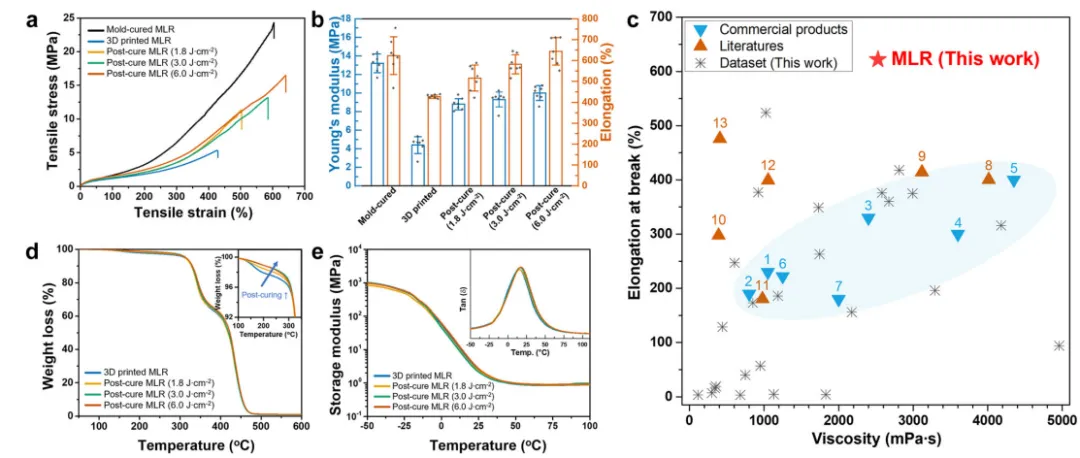
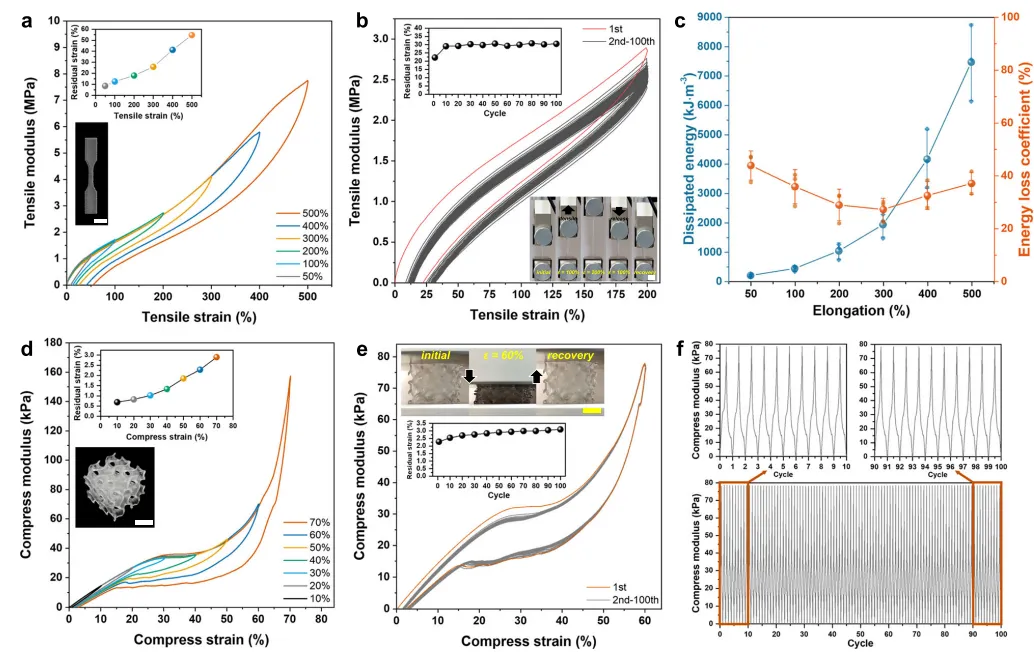
Recently, a team from South Korea has been working to make it possible for DLPs to print elastic bodies.Broken length greater than 600% and resin concentrations of about 2500 mPa/sThe paper was published in the journal Nature Communications.
01.
First of all, the problem is that the concentrations are high and unstable, the elasticity is high and the concentration is too high.
The advantages of DLP are that it is fast, accurate, and can form complex structures at once, and microcontrollers, electronics, and software robots are all in use. But it has a long-term problem: the resin that can be printed is often not strong enough, and the resin that is strong enough is unstable.
To get high stretch performance, the formula has to increase the amount of molecules in the polymer, but this concentration can be reduced to tens of thousands of mPa; and the printable range of conventional DLP systems is usually less than 5000 mPa. To ensure that the material can be padded and solidified, the common practice in the industry is a reactive diluent of zinc, the cost of which is the density of the coupling decreases, and the stretch strength and rupture are combined and damaged.
In the past, this path was essentially based on trial and error, combining different low-grade polymers, singles, and pairs, which groups were both good and strong enough to use. The problem was that the formula space was too large, the group-by-group experiments were both expensive and slow, and a small block that was naturally inclined towards "beating" those too stiff, solidified too slow combinations often failed to enter the printer and had no chance to be evaluated.
The team pointed out exactly this layer of bias: there are already machine learning resin studies that mostly optimize the composition and mechanical performance relationships within the printable area, but do not incorporate the same set of explicit constraints in the formulation phase. The gap is here, and the work begins here.
02.
Key design: Small volume mold solidification with 36 sets of alternative models
The core design of this work is to change the way training sets are "expanded".
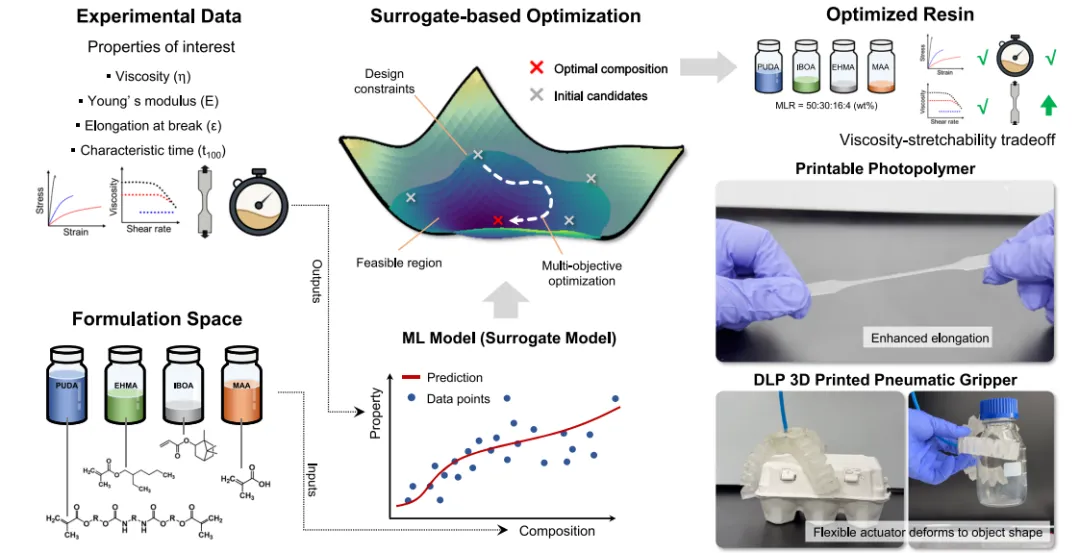
The team locked a four-component system: polyunsaturated polyunsaturated fatty acids (PUDA) with a molecular weight of about 27,000 g/mol, 60°C concentration of about 24,000 mPa·s) as the structural skeleton, IBOA responsible for rigidity, EHMA responsible for flexibility, MAA responsible for enhancing solidification efficiency, and 1 phr light-inducing agent TPO, which forms an insoluble acrylic acid system that covers the mixing balance between flux, solidification and dynamics.
Where did the data come from? They didn't just pour all of the 36 formulations into the printer, they did it with about 0.5 milliliters of resin.Small size mold solidificationPerformance: Direct DLP projection exposure on the loaded glass, washing off the non-consolidated portion and measuring the thickness of the solidified layer, then applying Jacob's law to fit the t100 required for solidification to 100 μm; the concentration is evaluated at 25°C by a rotary flow variable.
This is a key step: mold solidification dissolves the material's characteristics and printer limitations.Therefore, the training set can literally contain high-density, non-printable formulas, and the model learns not the insertion value of the small angle that can be printed, but closer to the printable boundary itself. Of the 36 groups of formulas used for modeling, 33 groups are grid-bound sampling training sets, three other groups have physical focus points, and independent external verification groups do not participate in training.
The alternative model uses RBF nuclear support vector regression (SVR), where four target quantities are modeled individually, first log1p conversion stability diagram and error margin, cross verification and then reverse conversion back to the physical scale.R²=0.870±0.052It's the T100.R²=0.839±0.120The most stable, modular and elongated R2 is 0.768 and 0.645. Only thirty sets of samples, both fluctuating and solidifying, can stand, which is the value of this set of workflows.
Optimized differential evolution searches within component boundaries: the target function rewards high extension rates while punishing high density, long t100, high modulus, plus comparisons and constraints in the form of penalties.MLR, PUDA:IBOA:EHMA:MAA = 50:30:16:4。
03.
From a bottle of water to an egg, the soft claw prints the recipe into the robot.
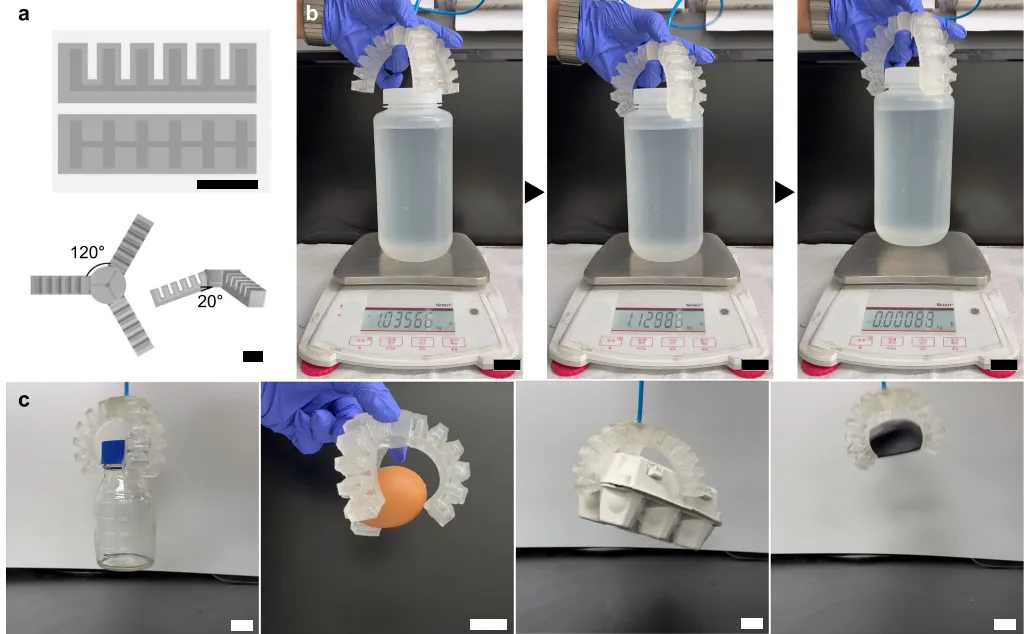
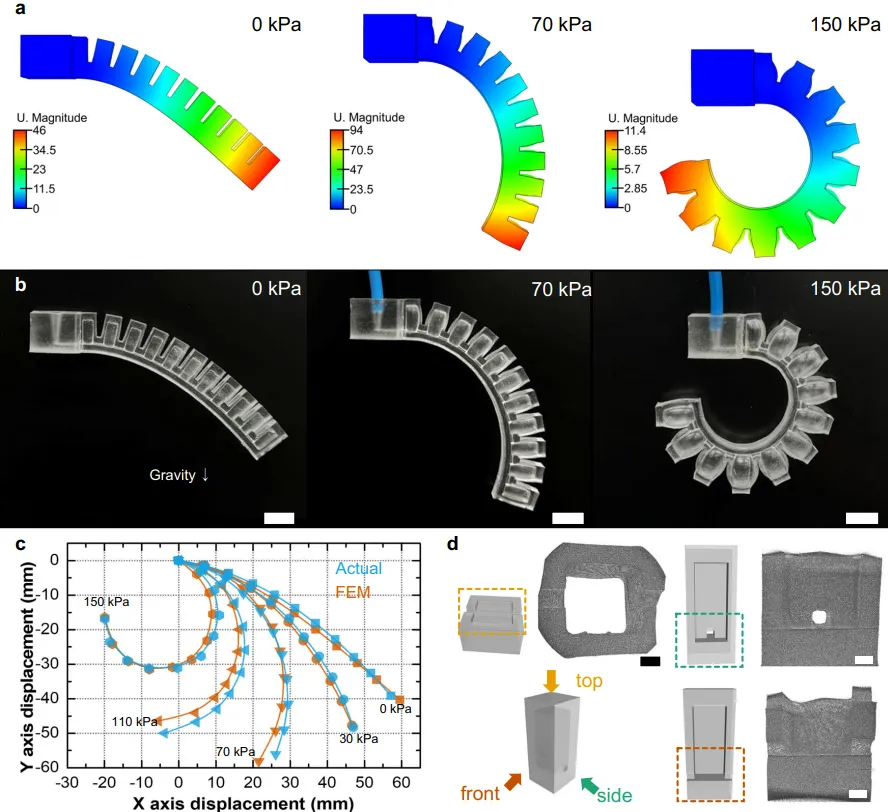
The material was unsuitable and eventually landed on the device. The team first used this resin to print an air drive made up of 11 series of curved units. They fed the experimentally measured stretch modules into a limited metamodel to simulate deformation under different air pressures, and then compared the curved shape of the resulting drive with real printers at a gradual elevation of 0, 70, 150 kPa.In the laboratory, the material's intrinsic properties are effectively transmitted to the macroscopic performance of the printed structure.It also means that you can go ahead with the simulation and then print the validation.
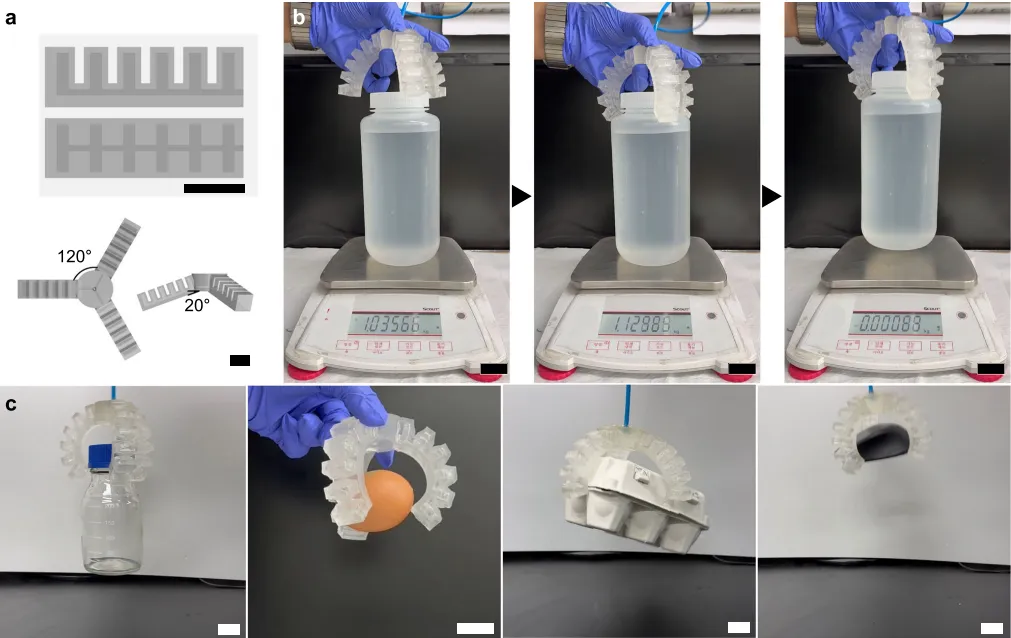
Based on this drive, the team assembled a three-fingered airtight claw.A bottle of 1 kg of water is raised steadily without falling.At the same time, it can adapt to the shape of the object to handle fragile and fragile cracks, glass bottles of all shapes, eggs, paper bags with eggs, and a mouse, all of which can be grabbed without slipping or crushing. This is what soft materials want to achieve:Using the material's own flexibility, rather than complex control algorithms, to securely grasp irregular objects。
In summary, the boundary of this approach is that the current formula space is still limited to the PUDA-based quadrilateral system, with further verification needed to be extended to other resin chemicals; while the data set is limited in size and will introduce Bayesian optimization, active learning and uncertainty perception exploration in the future, with the prospect of making candidate formula selection more efficient.
But the revelation given in the paper is clear.When the "small-volume mould expression" unravels the printing limitations, machine learning has the opportunity to find reciprocal equilibrium points that are almost untouchable by human error in the broad area between the printable and the unprintable.This may be a replicable formula design paradigm for soft robots and flexible electronics looking for high-strength photosynthetic resins.
Song, Y., Park, B., Jeon, S., Kweon, H., Lee, S. & Na, J. et al. Machine learning guided formulation design of digital light processing printable elastomers beyond viscosity stretchability tradeoff. Nature Communications, 2026. DOI: 10.1038/s41467-026-73735-4