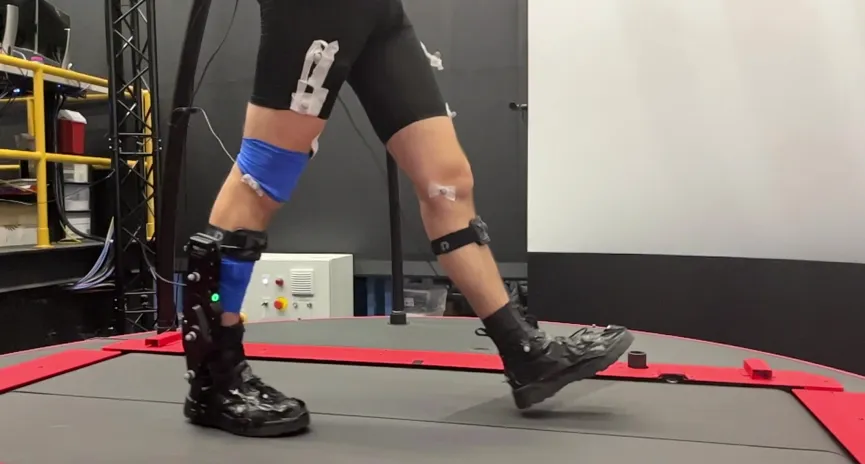
“ Six electrodes that read muscle secrets.
When a person walks on a treadmill, the muscles underneath the skin shrink. Six electrodes are attached to the lower leg, which also track these changes.
They did not take pictures of the muscles, but extracted clues from the electromagnetic signals that stretched inside the muscles. The results of the ultrasound measurements were compared, showing a stronger association between the two.
This is exactly what a team at Georgia Institute of Technology in the United States recently published in the journal Science Robotics, where they applied electrodes to the skin to track changes in muscle stretching as people walked.

For wearable robots such as external skeletons, this means the opportunity to use easier-to-wear electromagnetic sensors to obtain part of the muscle information typically obtained by ultrasound observation.
Now, researchers want to go a step further under the skin and see what the muscles that really move the legs are doing.
01.
The six electrodes that want to take part in the ultrasound live
If a muscle is compared to an engine, the movement of the joints is equivalent to the external movement it brings. To know how the inner workings work, another observation is needed.
The ultrasound is one of them. It can record the electrical signals produced by muscle excitation, which is equivalent to capturing the message of starting work. Ultrasound can further observe how the internal structure, including a bundle of muscle fibers, is stretching. But bringing ultrasound to a wearable robot is not easy. The probe must be fixed, the equipment must be powered, and the images must be processed in time.
Can these changes within the muscles be measured in a way that is easier to wear?
The team opted for the resistance-to-muscle imaging technique (EIM) which uses electrodes on the skin to apply a low frequency current to the tissue, then measures the voltage response, and calculates the resistance of the tissue. The entire process requires no implantation.
In simple terms, this can be understood as allowing the current to travel through the muscles. The structure and physiological state of the muscles changes, and the resistance encountered during the passage of the current may also change.
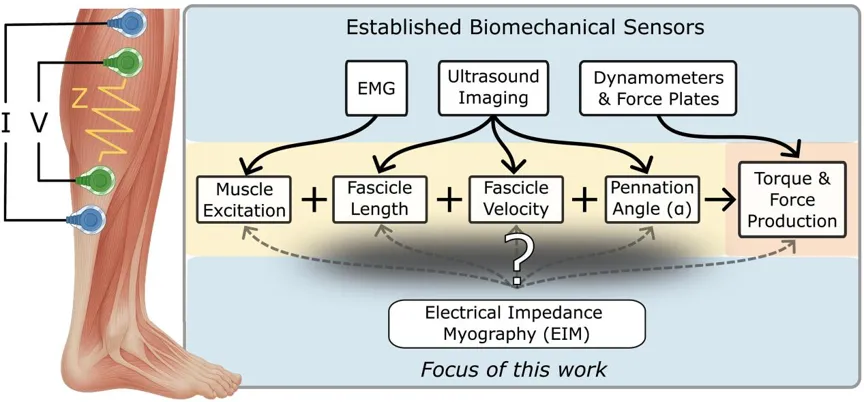
Work summary
Specifically to this system, the team placed six electrodes on the surface of the epithelial muscle on the inside of the small leg, collecting signals from two directions at two frequencies, and then extracting information from it to stretch the muscle bundle.
In this way, without the need to generate ultrasound images, there is also the opportunity to track changes in the internal muscle bundle. For wearable robots, this means a sensing program that is expected to be easier to integrate, with lower power consumption.
02.
It doesn't matter how much power you use to read the electrodes.
Electrolytes can capture changes in muscles, but how should these changes be interpreted?
The internal structure of the muscles often changes when the force is applied. The resistance to resistance changes, whether it reflects the force or the stretching of the muscle bundle.
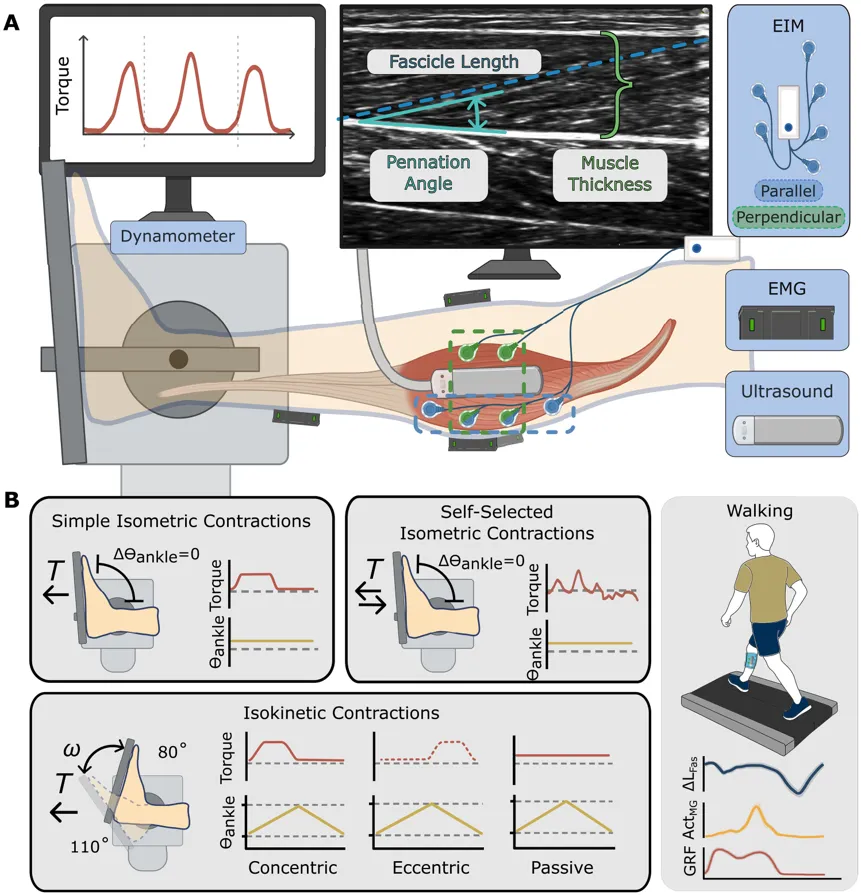
Previously, studies had attempted to use resistance to estimate muscle strength. This time, the team wanted to break down the relationship between the two. They recruited 10 healthy adults and had the subjects change their ankle angles with varying degrees of force.
The result is beautiful when the ankle is fixed at one angle: the degree of force changes, the resistance signal changes with it, and the two are highly correlated.
Putting data from different angles together, the same resistance readings may correspond to different joint forces. That is, it is not possible to directly judge how much force a person uses by looking at this signal.
In contrast, the relationship between the length of the muscle bundle and the resistance is more stable. This relationship still exists across different test angles. There is an anti-intuitive detail here: the leg is unmoving and the muscle bundle may also be shortening.
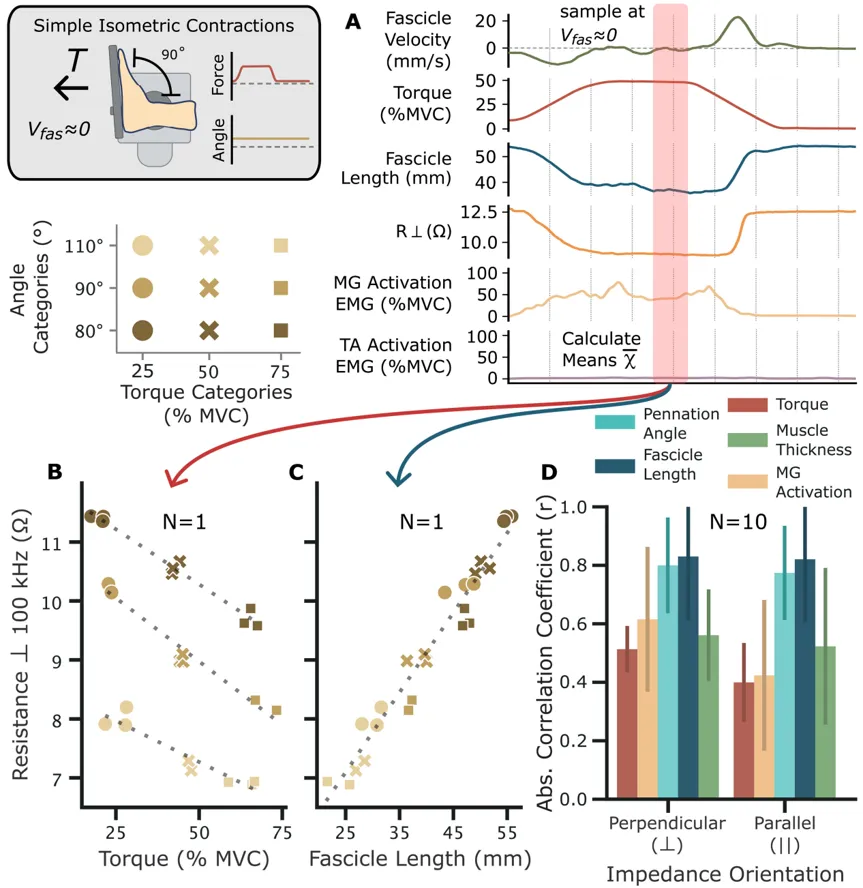
The electrodes captured included these outwardly invisible stretches. This allowed the researchers to find a more precise interpretation of the information about the changes in muscle bands in the resistance to electromagnetic radiation; further determination of strength was also required in conjunction with conditions such as posture.
For wearable robots, this finding is practical. The angles of the joints are constantly changing as people walk, and the correlations established under fixed postures may not be enough. Tracking muscle stretching provides another clue for the robot to understand the state of the human body, and also lays the foundation for subsequent combinations of biomechanical models to estimate the power.
03.
Do you know how to read, stand up and walk?
Next, the team moved the test to a runner. For wearable robots, this is closer to the actual use scene. People have to move and sensors have to keep up.
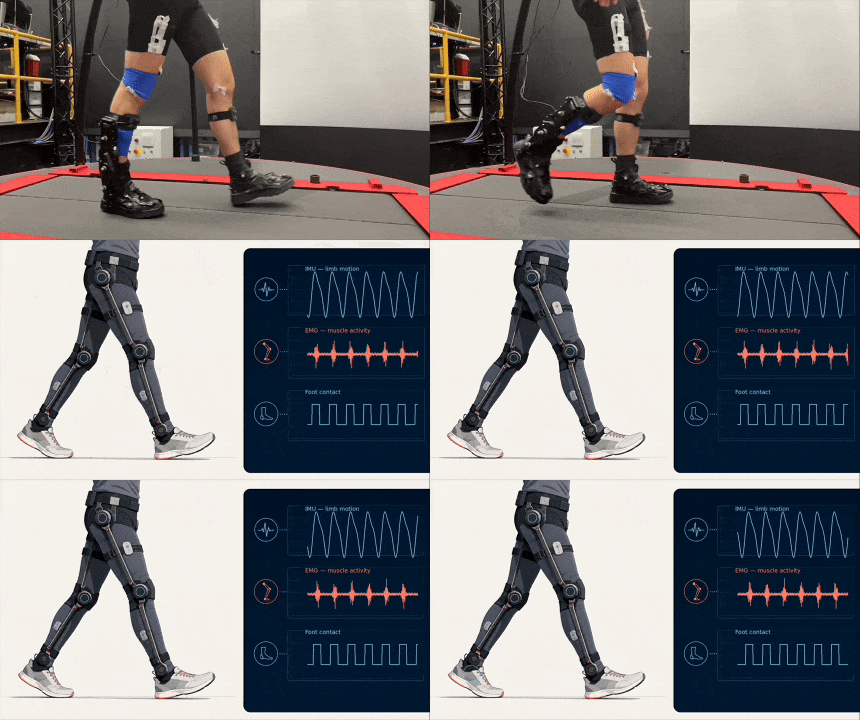
When walking, the muscles continue to stretch, the level of activation changes gradually, and the tissues below the electrodes also move relatively. Many variations overlap, and the signals are much more complex than in a fixed position.
The team combined data collected from two frequencies, two directions, and then analyzed the main components to extract the main patterns of change. The simplest understanding is to find a common law of change from multiple upward and downward curves, and then contrast it with ultrasonic recordings.
Of the nine participants who were finally included in the analysis, the corresponding coefficients of signal composition and relative changes in the length of the muscle bundle were derived at 0.83.
This suggests that muscle-strengthening information can still be extracted from electrode signals without being overwhelmed by complex changes along the way.
But it's not enough to read one person. Everyone's muscular structure and walking habits are different.
The team added a test. They used data from other participants to build relationships and then estimate who did not participate in the modeling. The results showed that the method had some trans-human generalization in this small sample group.
This makes sense for subsequent applications. If each user switches, a large amount of data is collected again, a model is created, and the usage threshold for the device is increased. This verification provides clues to reduce this burden, but it also requires larger, more mass testing.
Currently, this method is better at tracking how much longer and shorter muscle bundles are than it used to be. Determining the absolute length of muscle bundles may still require personal calibration; identification of muscle activation is not as stable.
Overall, it has been able to track some of the changes in the muscles of walking, one step away from fully reading the state of the muscle.
04.
Read about muscle changes, how do you use a robot?
The revelation of this research into the development of wearable robots can lead to a specific question: Can the controller get a little bit of feedback from the muscles themselves?
For example, an extra-articular bone, if it knows how to rotate the joints and stretch the muscles at the same time, has the opportunity to use existing biomechanical models to more accurately estimate the state of the human body and provide a basis for timing and strength.
In addition, it is possible to simultaneously observe muscular excitation signals and subsequent structural responses, especially when factors such as fatigue change the relationship between the two.
For developers, it is therefore worth noting that there is more than one type of sensor strap. This study explains the link between signals and muscle behavior and provides the basis for subsequent selection of control models and combined sensory information.
However, sensory ability has not yet turned into a supporting result. The paper has only done offline analysis, has not used this signal to effectively control the outer bone, and has not reported a decrease in the energy consumption of walking. The experiments were mainly aimed at healthy young people who walked at a speed of 0.75 meters per second; rapid exercise, long-term wear, and patient use performance needs to continue to be verified.
The next thing to look forward to is to get this signal into the robot and see if it can provide a more appropriate aid. From a laboratory perspective, the six electrodes read the beam changes; from the perspective of robotic research, they point to a more interesting target strap that allows the wearer to adjust their movements according to the actual changes in the muscles.