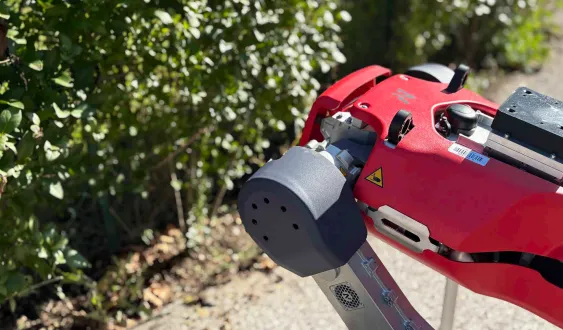
“ Without expensive laser radars or camera arrays, you can see the background of the branched leaves as long as you let the machine dog swing around and around like a worm.
In environments such as forests, disaster ruins, abandoned factories, exploring robots often faces the same problem:These visions are obscured by leaves, leaves, and weeds, which can severely interfere with the robot's visual sensors, leaving it unable to see what is in the background.
In the latest edition.Science RoboticsA joint team from John Kepler University in Linz, Austria, the Free University of Bolzano, the University of Trento, and the University of Sussex, England, gave an inspiring idea:Let the four-legged robot imitate the insect and make a rhythmic left-and-left swing.
This movement has a special name in biology:"Peering" (side view)How robot dogs see the unseen (How machine dogs see the unseen)
01.
From the "side-eye" of worms to optical synthesis holes
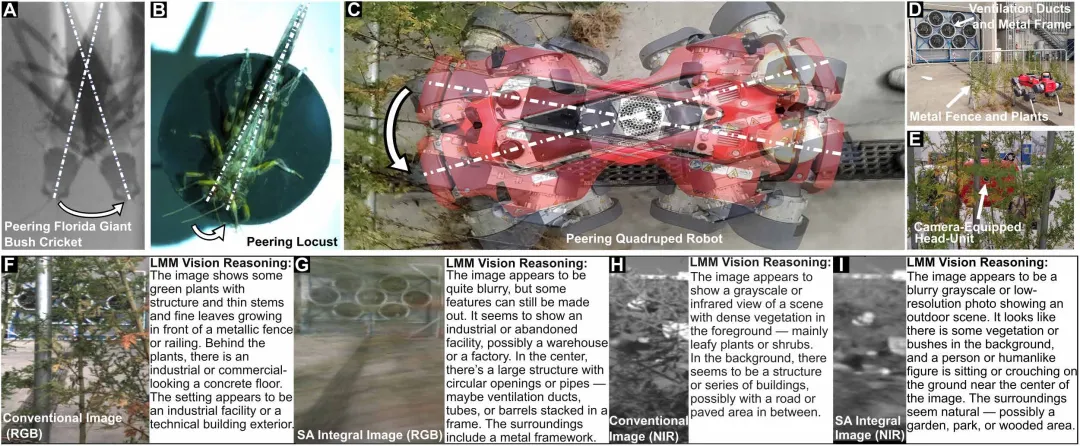
First, let's talk about the source of the movement - the insects, the horseshoes, the cockroaches, the insects, etc., do it before they prey on or jump.Characteristic left-to-left body movementThese insects have limited stereoscopic vision and have short distances, and they use this motion to produce a "movement visual difference" in relative displacement of nearby objects to distant objects, thus determining the distance. For example, a worm's leg movements cause the body to rotate around its abdomen, producing lateral displacement of the head, while the head rotates reversely to keep the eyes steady.
But even if civilization does point out,Whether peering can also help animals see through shadows (e.g. finding prey through leaves) has not been studied before.
The research team did a lot of research.Peering in visual perceptionwithSynthetic aperture (SA) sensing in optical imagingIt's a great way to connect.
The principle is this: a typical robotic camera's lens is typically less than 1 mm wide, and for fixed focal lengths, the depth of field is large, meaning objects near and far can be seen.It's also clear.This design is beneficial for tasks such as visual distance measurement, but has a fundamental limitation:PreviouslyAny shadows in the scene are as clear as the background, thus obscuring the background.
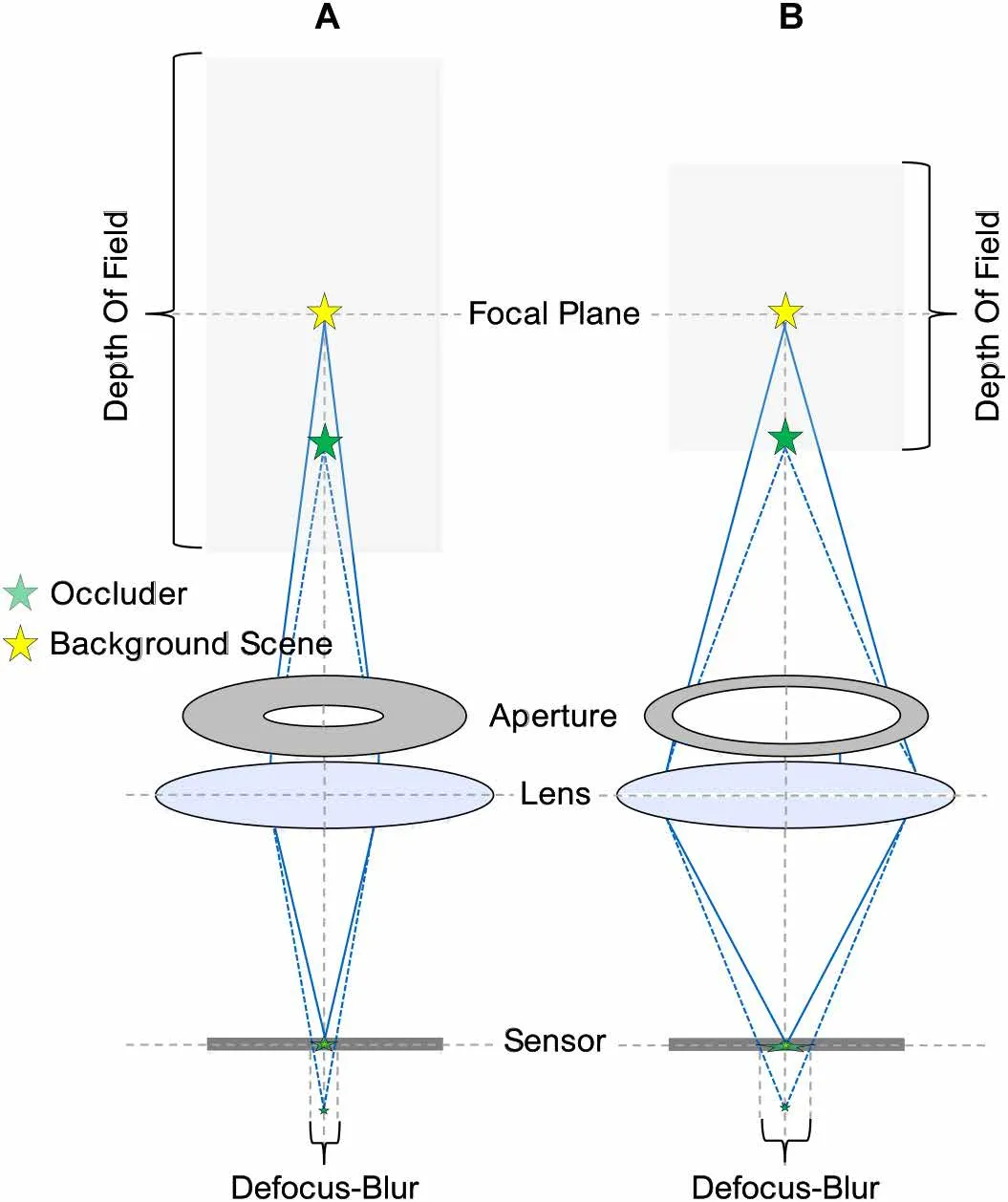
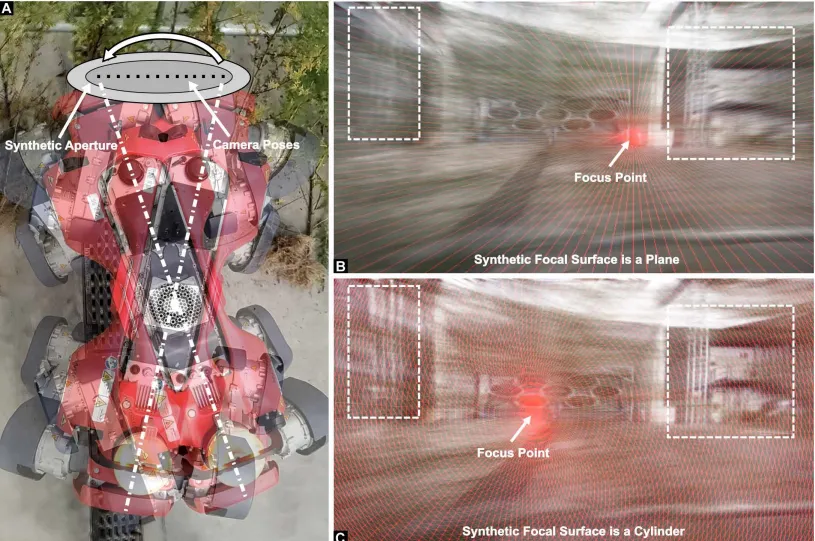
The idea of synthetic perforation sensing is the opposite: when the camera is moving, it continuously collects a series of images from different locations, and then uses precise camera positions to take those images.Projection and average to a synthetic focal lengthIt is possible to synthesize computationally a "virtual hole" much larger than a physical sphere.
As a result, the scenery has become extremely shallow:Background signals near the focus are amplified, while non-focused coverings are superimposed on the focus and blurred.The paper explains that the focal plane can be shaped like a plane, a cylinder, a sphere, and can be scaled, displaced, or rotated in three-dimensional space to fit the background area.There is a depth of focus to get the whole volume at the same time.
The entire process is projected to average, computationally efficient and real-time on a mobile processor.It's running, andNothing to do with wavelengths.It is used in a variety of spectra, including visible light (RGB), thermal infrared (FIR) and near-infrared (NIR).
The paper, while citing previous statistical analyses, notes that the effect of synthetic perforations is to obscureBest at about 50% coverageThe density of the shading increases and decreases; the size of the synthetic perforations does not have to be large, and the number of samples does not have to be very high, but they cannot be sampled.
02.
Why mainstream 3D vision fails under cover
A natural question is: Since 3D reconstruction methods are now quite mature, why not use them directly to obscure them?
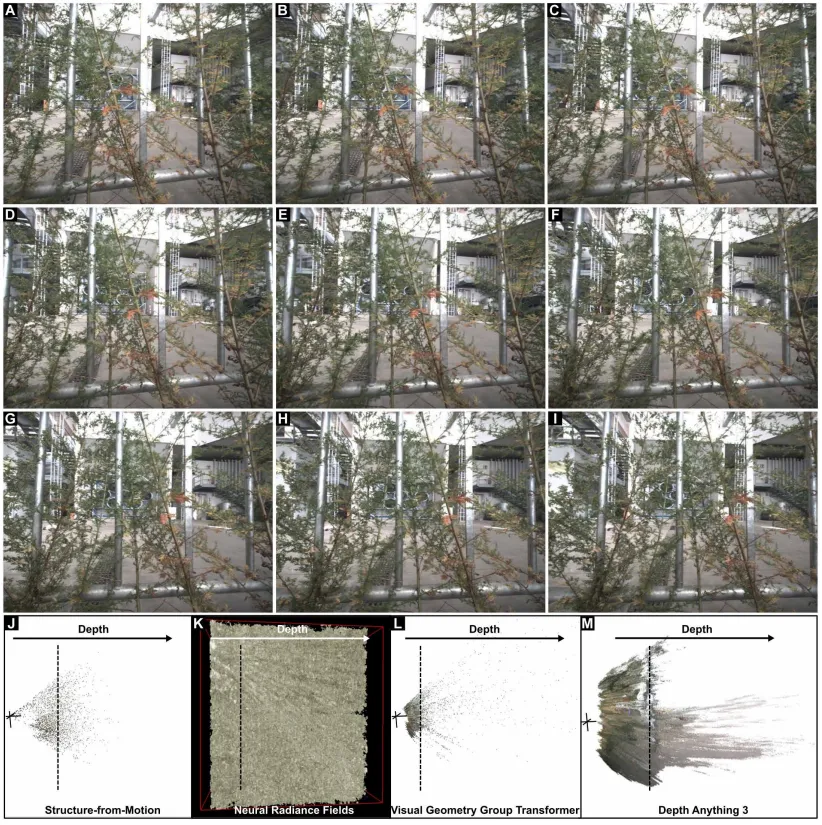
The team verified this by taking 300 images collected from a wide-angle RGB peering experiment, and inputting four of the most advanced 3D visual methods available today:Structure-from-Motion (SfM), Neural Radiation Fields (NeRF), VGGT, and Depth Anything v3 (DA3)。
The results show that the point clouds reconstructed by SfM, VGGT and DA3It consists mainly of prospective coverings.NeRF, on the other hand, generates a large amount of inconsistent noise and is obscured by the background (ventilation pipes and support structures).It's not recovered by any means.This is because these methods rely on consistent characteristics between images, while the shadows appear randomly in multiple view inputs and fail when the characteristics are shadowed randomly.
The gap in computational time is equally evident.SfM and NeRF take a few hours (experimentally 5 to 6 hours), VGGT and DA3 take a few minutes (experimentally 7 to 15 minutes) even on high-end GPUs.In contrast, peering synthesizes perforated imaging in experiments.In just 17 milliseconds.The paper explains that, unlike 3D methods that rely on deep reconstruction, synthetic perforation sensing does not rebuild depth, but suppresses partial obscurations in two-dimensional images.
03.
It's the right, the left, the right, the right, the right.
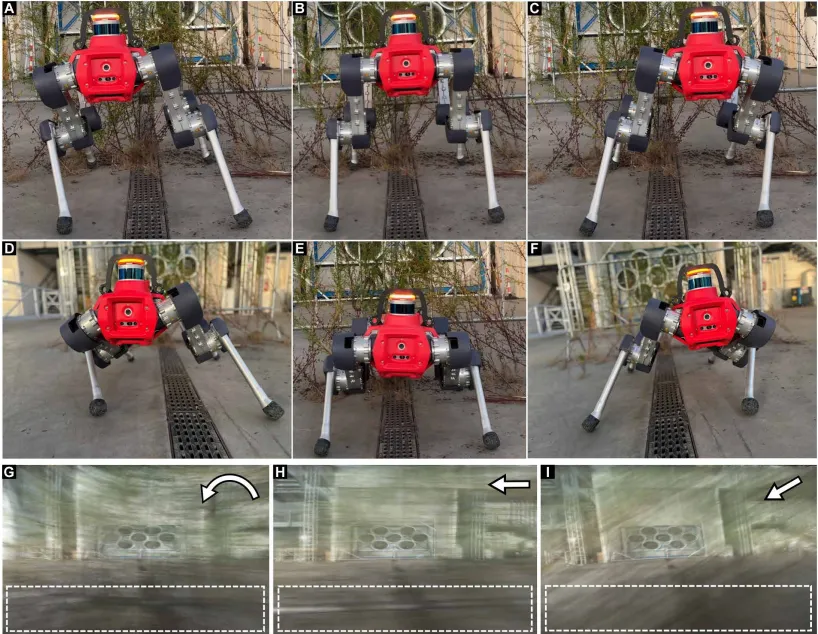
On ANYbotics' ANYmal quadruped robot (its mechanical limit is 30 cm horizontally, 20 cm vertically), the team compared three movements:Axis rotation, horizontal alignment and angular alignment。
The experiment concluded that:The effect of horizontal displacement is better than axial rotation, as horizontal displacement maximizes movement vision.However, the pure horizontal movement is difficult to suppress horizontally arranged shadows (e.g. metallic vertical bars) as these shadows cling to the background from multiple angles.Equivalent to angleIt performs better because it makes use of horizontal and vertical movement differences at the same time. The paper also notes that effective shading can be used.Number of samples less than one quantityThis means that even if the camera's shutter speed is limited, it can move faster.
A notable detail is that rotational motion can cause visual differences because the optical center of the camera does not overlap with the center of rotation; if the two overlap, there will be no visual difference and camouflage cannot be achieved.
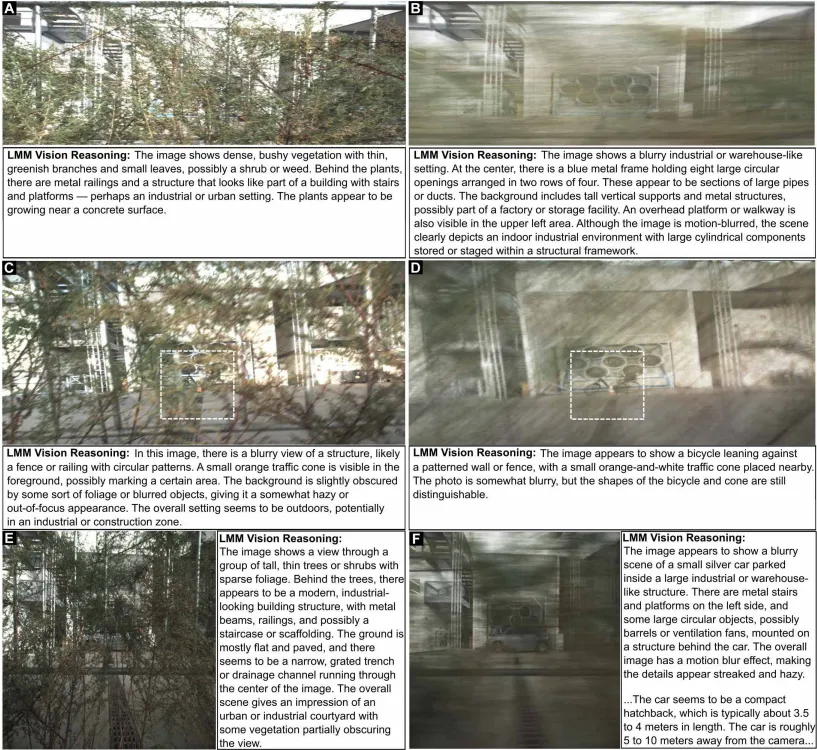
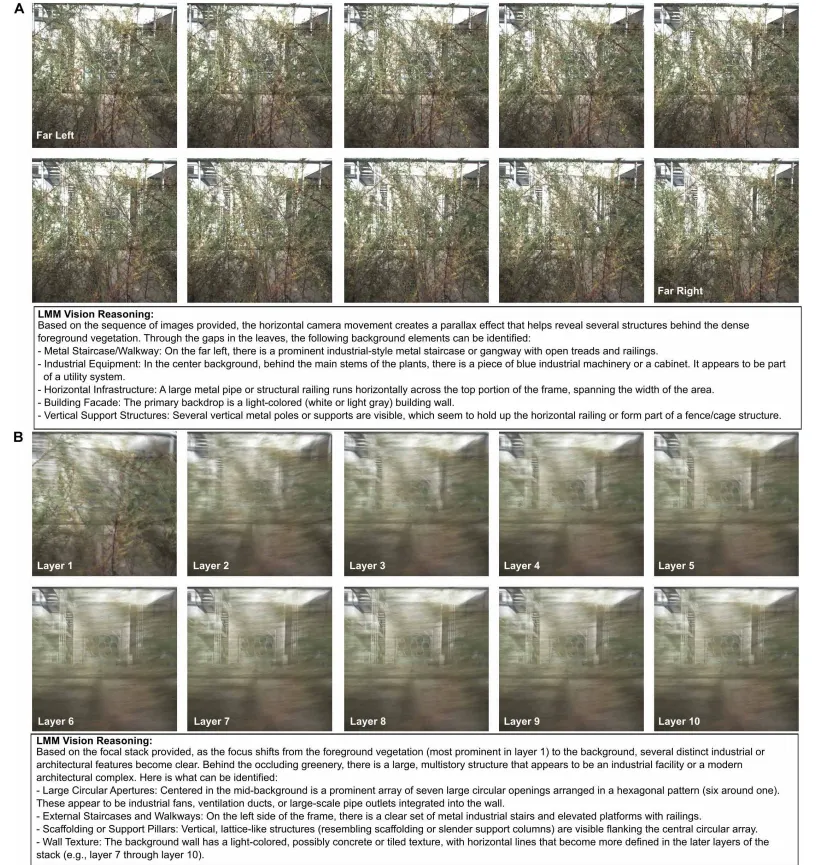
In combination with the larger model, the team separated the conventional image from the synthetic perforated pointed image that had been obscured.ChatGPT-5.0The results show that in the face of conventional images shaded by vegetation, models can be reasoned.The main focus is on the prospects.Background interpretation is inadequate; and when the shading is suppressed in a synthetic perforated score image, the model is able to identifyEstimates of wind tunnels, metal frames, bicycles and traffic barriers added later, and vehicle distances beyond about 5 metersThe paper also notes that the visual reasoning model itself is uncertain, and that multiple queries of the same image can result in slightly different results, but the overall law is consistent.
04.
Masking enhances paint quality, focusing stacks away from "predictive distance"
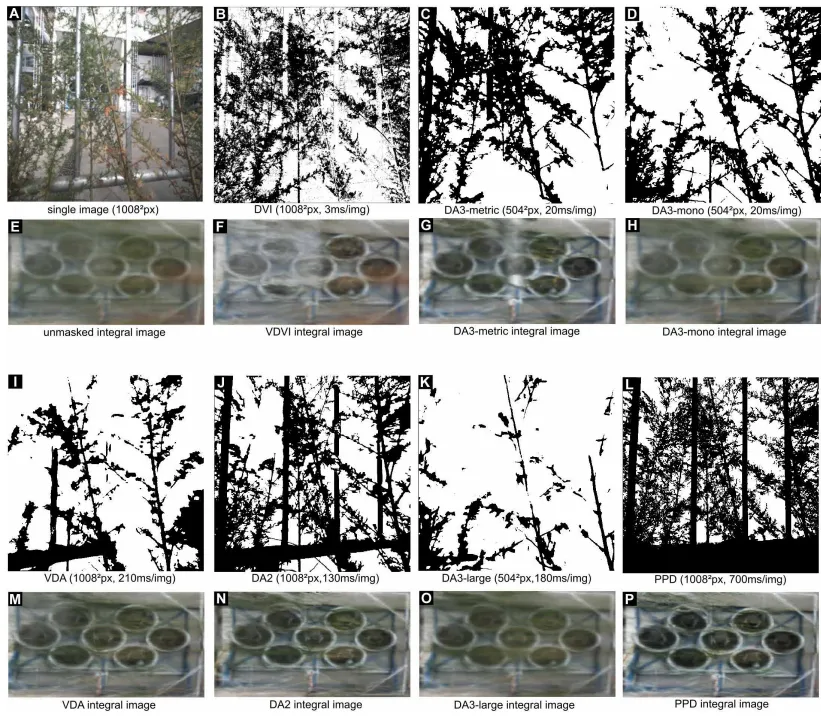
A simple average of all pixels would leave some blurred focus. To improve contrast and colour reconstruction, the team introducedCovering the membraneFirst, identify the potential shadows in each image, averaging only unshadowed pixels. The shadows can be generated based on the vegetation index (VDVI) or depth cues. The text evaluates VDVI and six depth reconstruction methods.Pixel-Perfect Depth (PPD) works best, but the calculation takes the longest.The paper also notes that deep learning 3D methods are less effective in gray NIR images than in color images, possibly due to the training of color biased data.
Against the constraint that "synthetic perforations need to know the background distance in advance", the team proposed a quick calculation.Focus stacks(a series of images with different synthetic focal lengths)Gemini 3Analysis can be accomplished even without knowing the target distance; the model can also estimate the target distance if the layers are coded in the prompts. For example, the paper explains that seven unidentified vents in a conventional image sequence were successfully identified in focus stack reasoning.
05.
What is the meaning of this verse?
The advantages of this approach are thatLow cost and instant deploymentThe paper also objectively illustrates the best effect of border shading at about 50% coverage, while overly dense shading is still difficult to handle.
The experiment is currently being carried out on the ANYmal quadruped robot, but the authors point out that peering capabilities are not available.It is not limited to four-legged platforms, but also to two-legged, six-legged, wheeled or crawling platforms.The team also mentioned that they are developing a new platform based on the Boston Dynamics Spot with multi-spectrum (especially thermal imaging) sensors to support more comprehensive outdoor experiments.Two-wayResearch into robotics can in turn promote the study of animal behavior.