
“ 4 hours, 19 minutes and 52 seconds, one battery.
The machine dog ran a full marathon without changing the batteries, without charging.
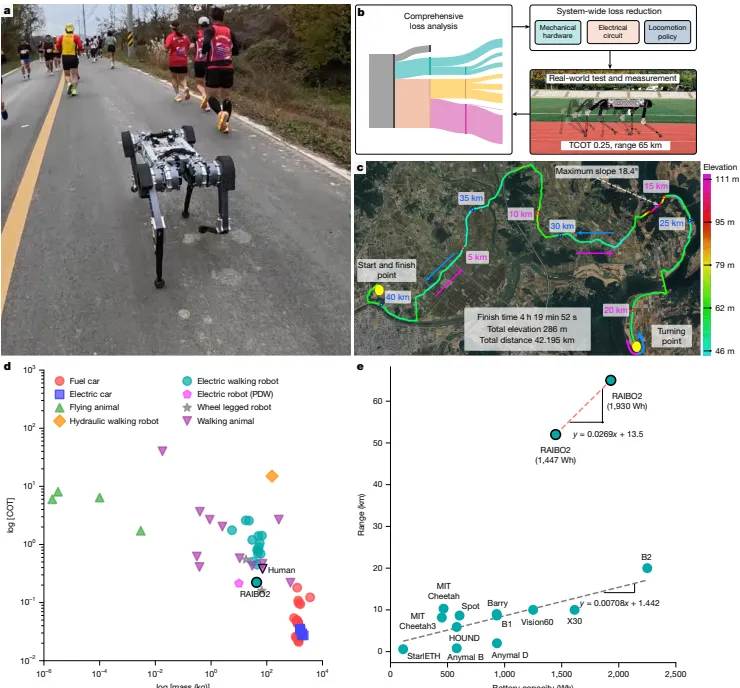
The result was 4 hours 19 minutes 52 seconds, 42.195 km, with an average speed of 2.64 m/s.
To accomplish this, the four-legged robot RAIBO2, developed by the KAIST (Korean Institute of Science and Technology) and the AI Lab, was recently featured in Nature.

The most important number is not the time of the race, but the time of the race.Total transportation cost (TCOT) is only 0.25 tonnes, which is 0.37 tonnes lower than that of humans.In other words, according to the unit of weight, the unit of distance consumed, the machine dog runs more efficiently than humans.
During the entire race, it consumed a total of 1280Wh of electricity, accounting for 66% of its 1930Wh battery capacity.RAIBO2's theoretical duration under full power is 65 km.This is equivalent to more than three times the distance a four-legged robot runs per Wh of electricity.
01.
First, we need to figure out where the electricity is going.
Why do quadrupeds charge electricity is an old question.
Wheeled robots can move forward by rolling, while leg robots must sustain the output torque at the joints to support the weight, and the impact of the feet on the ground with each step of landing will result in power loss. What is more troubling is that there is a loss between these losses.Contradictory Weights and Balances。
A typical example: reducing the electrical power consumption of the motor can increase the deceleration rate or increase the body height, but both can increase the parity of the end of the foot and increase the loss of landing impact; and vice versa.
So the research team did not directly modify the hardware, but instead did a more basic task of measuring and dismantling the entire loss structure of the machine.
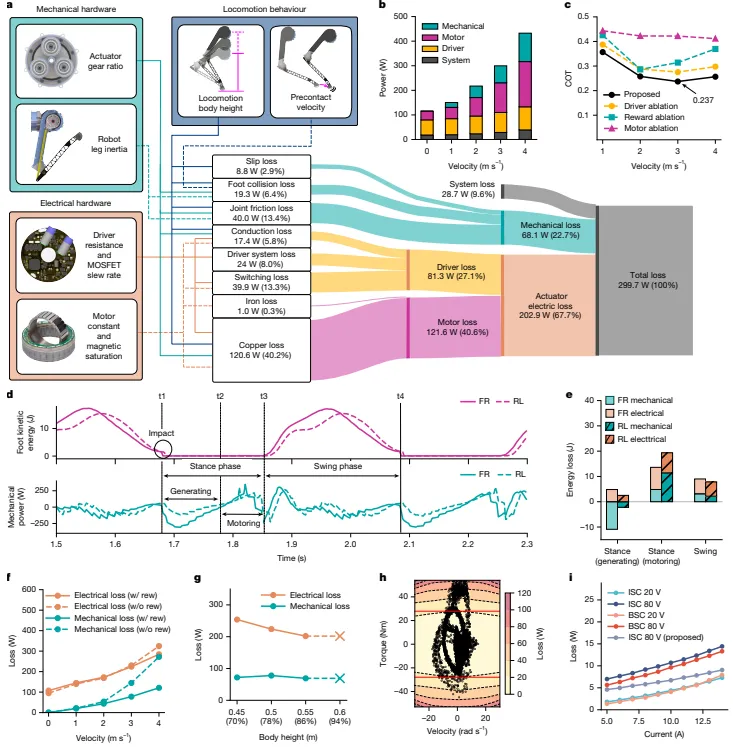
Under the lowest operating conditions of 3 m/s, the total power consumption of the whole machine is 299.7W.The electrical losses of the executors were 67.7%, mechanical losses were 22.7%, and system losses were 9.6%.。
Continued downward demolition: the copper loss of the engine consumed 40.2%, the largest single loss; joint friction loss 13.4%, driver switching loss 13.3%, driver system loss 8.0%, driver guidance loss 5.8%, end collision loss 6.4%, slip loss 2.9%, iron loss only 0.3%.
This loss map directly determines where each subsequent change is going to be.
02.
Hardware:1.1 kg leg, and a drive board with "aluminium resistor"
The idea behind the mechanical part isForces-transparent and lightweight。
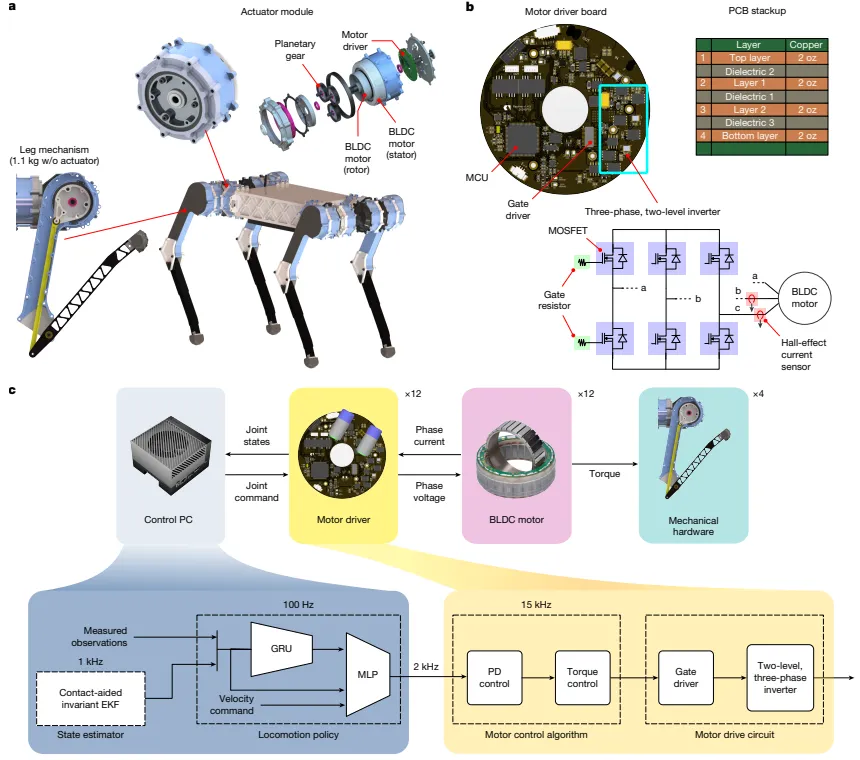
RAIBO2 uses four identical legs, three identical executors on each leg, forming a modular structure. The knee joint uses four-stroke drive, the executor decelerator uses only single-stroke planetary gears, the lower the deceleration rate than 7.15:1 tonnes, and the lower the friction losses caused by relatively slippery surfaces.
The single-legged organ (excluding the executor) weighs 1.1 kg.All leg organs account for only 10.2% of the total body weight.。
The team also made a subtle trade-off on the engine selection model. They compared the three high-motion constant frameless motors to the ILM115×25: although the ILM115×50 had a higher engine constant (1.47 vs. 0.87), its rotational inertia was almost twice that of the previous one, with a worse COT at 4 m/s.The impact on high-speed losses is decisive after torque inertia is decreased versus squared.
On the electrical side, the team's dashboard is a silicon motor drive board that has long been neglected by system-level energy consumption analysis.
On conduction losses, all layers of PCBs are made of 2oz (about 0.07mm) thick copper, which reduces the equivalent resistance to about 1.8mΩ; MOSFET changes from a model of 7mΩ to a model of 2mΩ, which reduces the equivalent resistance to about 33mΩ; the current sample is changed to a Hall sensor, which has a conduction resistance of only 1.5mΩ, while avoiding the problem of low-resistance flow resistance schemes for transporting large volume amplification.
In switching losses, due to the adoption of high-voltage operation, there is a clear balance between the transmission losses and switching losses, which reduces the resistance of the MOSFET lithium electrode voltage, and the total loss is higher at 80 V. The team's solution is to optimize the wiring to reduce parasitic electricity.Press the polar resistance from 180Ω to 10Ω on the official assessment boardAt the same time, the switching frequency was reduced from 20 kHz to 15 kHz, striking a balance between efficiency and control performance.
03.
Strengthening learning strategies: Keep your feet "lightly grounded"
On the software side, the control strategy uses the GRU plus MLP network structure, relying only on in-body sensing information to run at 100Hz, the underlying motor is controlled at 15kHz, and the state estimates that the contact-assisted continuous expansion of Karman waves will run at 1kHz.
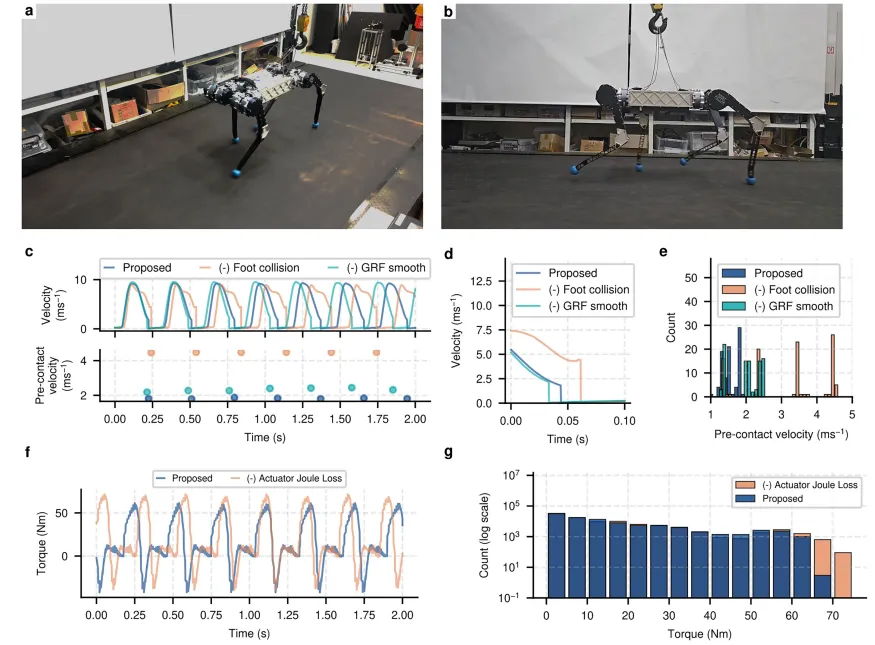
It's worth noting the design of the reward function. The team didn't simply give "total energy consumption" a negative reward.Break down the energy-related rewards into several items, each targeting specific sources of losses: reducing frontal leg speeds to reduce collision loss, suppressing contact speeds to reduce sliding, and an eardrum loss consideration of magnetic resonance imaging.
The magnets and this is crucial. The motor enters the cylinder and zone after the nominal torque is exceeded, and the resulting torque gain decreases with the increase in current, at which point the current demand is approximately proportional to the torque squared.84.1% of jobs fall within the qualitative latitude。
In terms of collision losses, it is difficult to predict accurately when to touch, so the team put the contact information into the observation of the value network, allowing the strategy to slow down in advance.
There was also an anti-intuitive result: lifting the body, while reducing operationality and increasing end-of-foot equivalent inertia, combined with reinforcement training strategies based on electrical stiffness control of the joints.Electricity losses continue to decrease below 86% of the leg length, while mechanical losses remain virtually unchanged.The reason for this is that, unlike mechanical springs that can only store energy in a single leg module, shared batteries allow for stronger power generation in the right front leg, which is synchronized with the flexible redistribution of energy between the four legs, while the left back leg is more electrical.
In the end, the overall COT dropped to a low of 0.237 at 3 m/s.
04.
42.195 km of testing
Verified selection for the 22nd Shan State Pancake Marathon, one of the most difficult races recognized in South Korea:The total climb is 286 meters, with a maximum slope of 18.4°.The road is mainly made of cedar oil, and there is a wet sliding section covered with deciduous leaves.
Full-scale data were recorded: the battery voltage decreased from 67.2V to 57.6V (cut-off voltage 48V), cumulative power consumption of 1280Wh, corresponding to an average TCOT of 0.248, matching the results of the runner experiment.
Climbing still saves electricity, partly due to the energy recycling of the descent.Upstream added an additional 100.5W and downstream recycled 107.5WThe ups and downs are essentially mutually offset.
Of course, there are limitations: the current use of blind-eye controllers, which are different from the losses models for conventional topographical optimization, ladders, mountains, and other special environments, requires further development of environmentally-conscious efficient movement strategies; in addition, current experiments are based on artificial manipulation, autonomous navigation and need planners that can plan optimal energy paths based on global maps.
Link to the paper:https://doi.org/10.1038/s41586-026-11102-5