“ How does a ball get through land and water?
The robot is becoming more and more free.
Two-legged humanoid robots play at the podium, run marathons; four-legged robots walk through the patrol corridor; wheeled platforms carry codes in the warehouse scene; half-horse-mounted humanoid robots, deformable robots, and so on.
The 2026 White Paper on the development of the smart robot industry, published by PwC, explicitly states that the three forms of industrial mechanical arms, wheels/four-legged robots, and humanoid robots have formed a clear division of labor, and that by 2030, they will present a stable co-existence pattern of multi-dimensional, scenographically precise chemistry.
It must be like the age of the robot, and it's being rolled over.
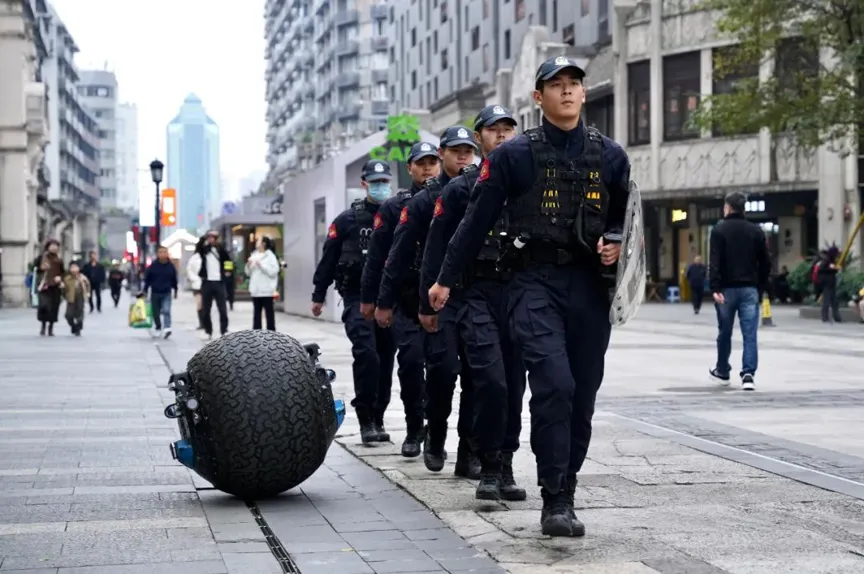
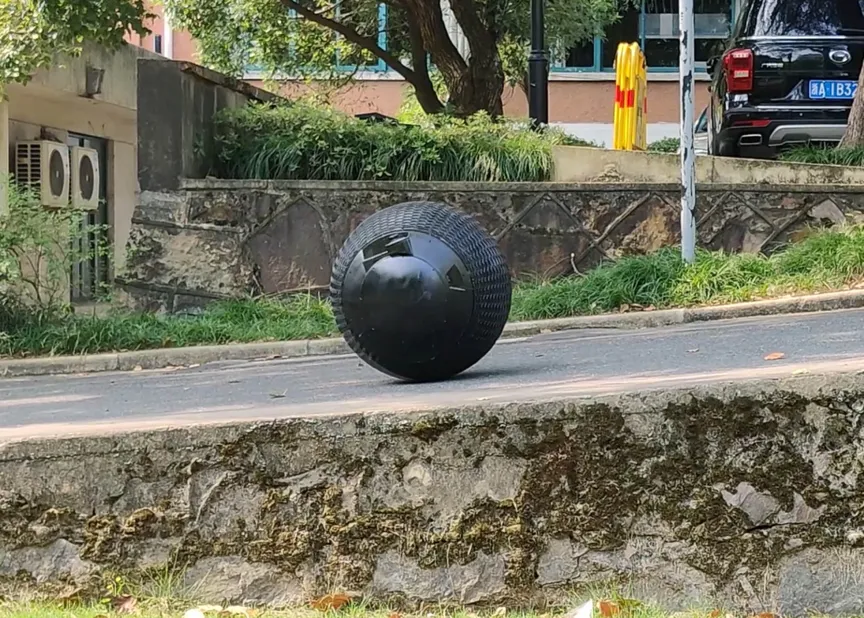
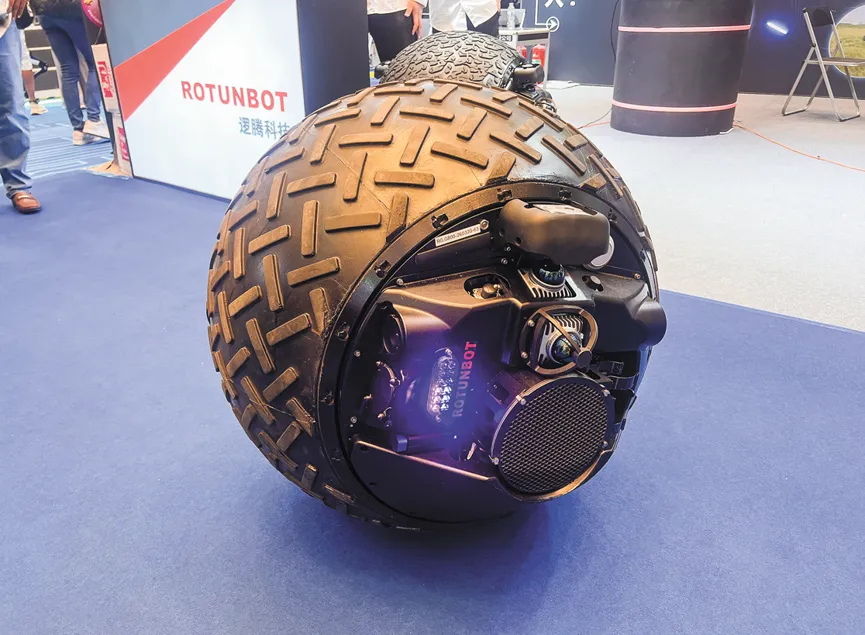
It was in this context that a ball came into view. In the exhibition hall of the China International Defence Electronics Exhibition, a black ball with a diameter of about 80 cm and a weight of about 190 kg attracted large crowds.
It has no legs, no straps, and is powered by a spherical motor and a swinging gear. It can roll both on land and on water. It can roll at speeds of up to 35 km/h on land, float on water with a propeller attached to it, and pass through the desert, snow, and wetlands.
It is a homegrown two-ball robot that has been featured in the National Defense Electronic Exhibition, the Civil War, and the Chemical Park.
At a time when the entire robotics industry was still debating whether or not to replicate human beings, ball-shaped robots gave another answer with an extremely simple geometrical intelligence.
01.
From the bowling alley to the roller-coaster submarine.
The study of ball-shaped robots is not new. Over the past two decades, the global academic community has been exploring the possibility of this bizarre form of motion.
Early designs largely followed the route of the Tibetan leg shaft, which was inserted into the mechanical legs inside the ball-shaped casing, stretched out onto the ground and crawled back into the water to be propelled by a propeller. This design logic is clear, but the cost is also clear.
The real turning point has been in the last two years. Researchers are beginning to realize that the sphere itself is an underrated engineering platform whose shell is both a rolling contact surface on land and can naturally become a floating and flowing vessel in water.
A study published in the Ocean Engineering Journal at the end of 2025 proposed an inspiring solution for the pump: a multi-modal propulsion system (MPS-ASR) that integrates swing drive and propulsion in synchronous ways. The swing is responsible for low-speed shallow motion on land and in water areas, the propulsion is responsible for deep-water high-speed propulsion, and the mixed-mode pumps of the two are specifically optimized for water transition bands on land, which both solve shallow risk and simplify the pattern switching process.
Experimental data shows that the hybrid propulsion mode is able to maintain 95% to 97% of pure propulsion speed while significantly reducing energy consumption.
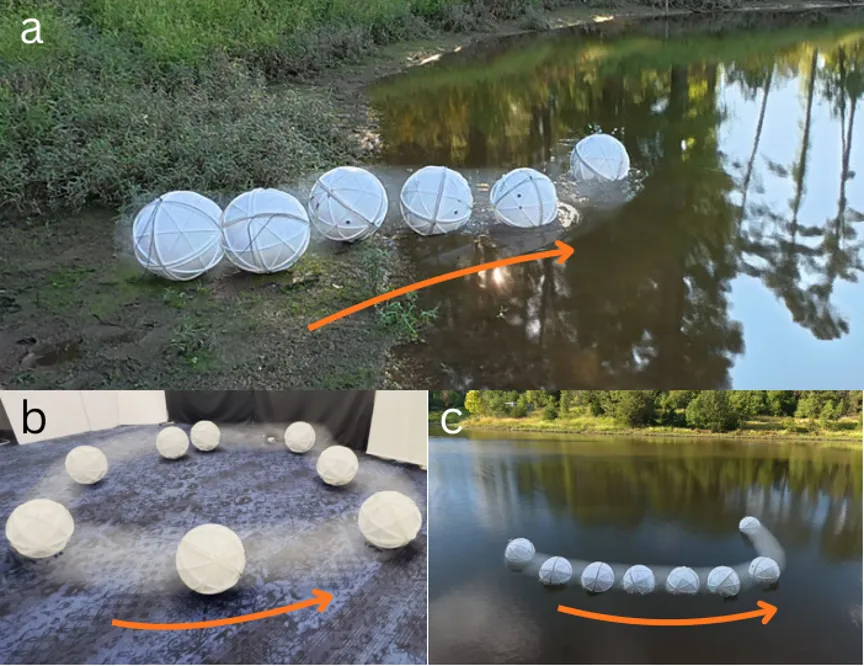
A more imaginative scheme came from the Marble robot, developed by a team at Duke University. It completely abandoned any outwardly exposed moving parts, relying entirely on the mass redistribution of the internal three rectangular sliders to drive the sphere to roll. The same mechanical architecture, which produces rolling on land and propulsion on water through passive filters, requires no mechanical rebuilding and no independent drive system.
This one-piece architecture, which feeds on two types of medium-sized robots, marks a shift from functional superimposition to system integration. The former is a product of engineering compromise and the latter is a real technological leap forward.
02.
When a ball learns to move its hands
Capture is another major breakthrough for ball-shaped robots.
In a 2026 study published in the journal Robotics and Autonomous Systems, a multifunctional mechanical leg with an integrated mechanical claw was developed for a bionic two-ball robot. The results showed that the mechanical leg had a maximum clawing power of 22.5 oxen and could still move efficiently underwater carrying 6 oxen load, with a clawing success rate of more than 90 percent. More importantly, the robot's ability to crawl on the ground was also verified.
This means that the spherical robot is breaking through the role boundaries of the sphere's mobile sensor array, and it is no longer just a device that rolls to take pictures, but is beginning to have physical interaction and operational capabilities. From underwater sampling in shallow water to target recycling in ocean exploration, the spherical robot is evolving in the direction of the sphere's mobile operating platform.
At the same time, multi-robot collaboration is also accelerating. In January 2025, Scientific Reports published a simulated biplane-shaped robot cluster control study that verified the three robots' ability to cluster movements in surface and underwater environments, including floating, submersible, free-movement and scenic tasks such as tracking water dynamics targets.
03.
From paper to battlefield: an industrialized path of a ball
The exploration of academia provides guidance in the technological direction, but the real way to roll ball-shaped robots from the laboratory into the real world is through the industrialization of Chinese enterprises.
The RT-G series of ball-shaped robots, developed by Hangzhou Science and Technology, were inspired by the concept of the Mercury detector at Uppsala University in Sweden, which originally aimed to design a ball-shaped device capable of rolling detection on the surface of Mars.
This off-the-shelf space shell gene gives it its natural all-terrain adaptability: the closed ball shell can withstand a shock of up to 4 tons, is equipped with an L4 class self-driving system, completes acceleration in 2.5 seconds and a top speed of 35 km/h.
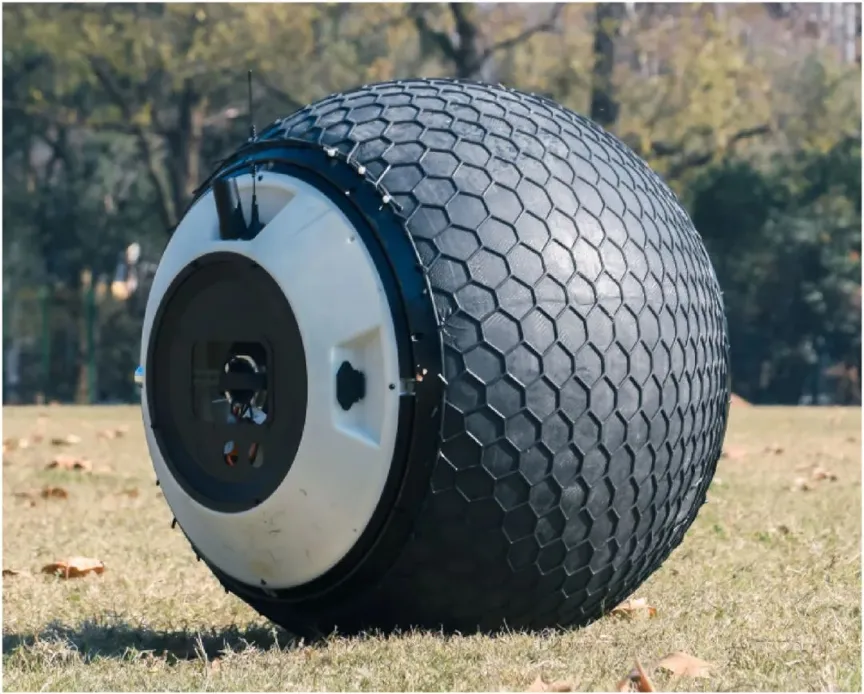
LogicTech was founded in late 2017 by Wang Yi, an associate professor in the School of Control Sciences and Engineering at Zhejiang University. The company holds nearly 20 international invention patents, including in major international developed countries such as the United States, the United Kingdom, and has established itself as a leader in spherical robots.
It is reported that its products are the only two-ball robot in the world to achieve commercial mass production.
At the China International Defence Electronics Exhibition, the ball demonstrated the tactical capabilities of far beyond patrol reconnaissance. It can be mounted with a net gun and a torpedo to carry out catches, can be mounted with a sound wave dispenser to shout out, the maximum volume reaches 140 decibels, and the enormous impact power of the ball itself can even directly break the door.
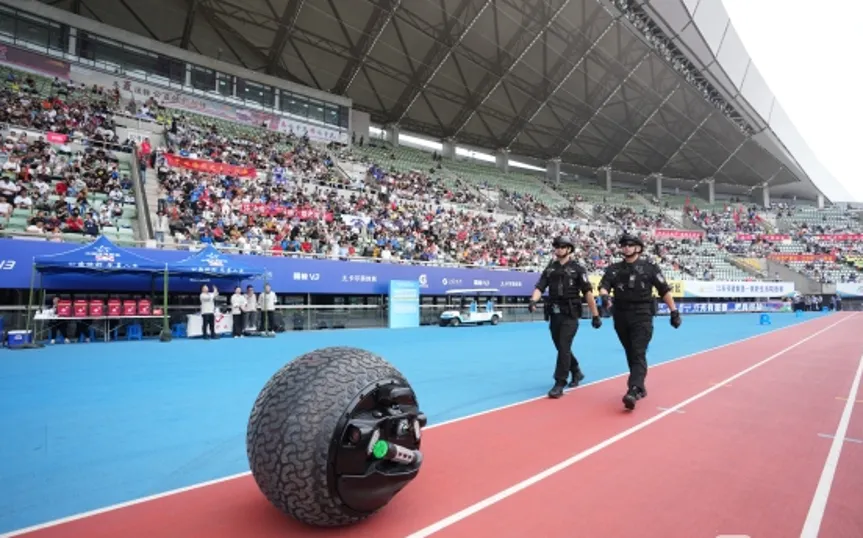
Wenzhou Public Security pioneered the use of ball-shaped robots in daily patrols, reportedly the world's first two-ball-shaped water-surface robot to participate in public-security real warfare applications.
In addition to accompanying the patrol to complete city patrols, it can also adapt to complex terrain such as the countryside, scrub, desert, carry out tracking, fighting, catching and other police tasks. The 80 cm diameter ball-shaped robot, weighing about 190 kg, was used for the first time in large-scale security operations, achieving L4 autonomous patrol protection for designated areas.
The boundaries of the scene are still continuing to expand. In the industrial field, ball-shaped robots have entered the scenes of airport birdwatching, oilfield patrol, chemical park patrol, underground pipeline monitoring, and their closed ball-shaped structure makes them particularly suitable as an alternative to man-made patrol in corrosive, radioactive and explosive environments. In overseas markets, products have been sold to the Middle East, Southeast Asia, Africa and Europe to undertake oil pipeline patrol missions.
04.
Under the shape of a ball, a declaration on the free-flowing shape of a sphere
Looking back at the history of the robotics industry, each paradigm shift is accompanied by a redefinition of what a robotic robot should look like. The industrial mechanical arm breaks the belief that robotic robots must be like human robots, four-legged robots prove that robotic legs don't necessarily need two pins, while ball-shaped robots challenge a deeper hypothesis about whether a robot's movement must rely on an external executor.
A completely enclosed sphere, without legs, without straps, without the need for a propeller to be exposed, can roll in the desert, float on water, patrol chemical parks, and make catches at police stations.
It uses an almost minimal geometrical form and completes the most symbolic interpretation of the term polymorphic motion curve.
Of course, a spherical robot is not omnipotent. Its limitations on precise operation, complex crawling, human-machine interaction, etc. are still evident. But as one practitioner put it, a spherical robot is created according to the unique needs of a sphere, and it does not mimic any organism, but starts from engineering constraints, looking for the best solution.
In an era of increasing emphasis on scene adaptation rather than form simulation, ball-shaped robots may be providing a more pragmatic way to open up the next round of unmanned aerial vehicles.