First mathematics, now biology is being disrupted?
In the early hours of Thursday, Beijing time, Anthropic announced a major scientific discovery made with the help of AI.
In a case where only high-level research directions were provided by human scientists, Claude independently discovered a previously undescribed enzyme system while searching the bulk genome database. This system, called ART (array-associated reverse transcriptases, array-associated retrograde enzymes) has a repeating DNA sequence structure similar to CRISPR and may represent a previously unknown biological mechanism.
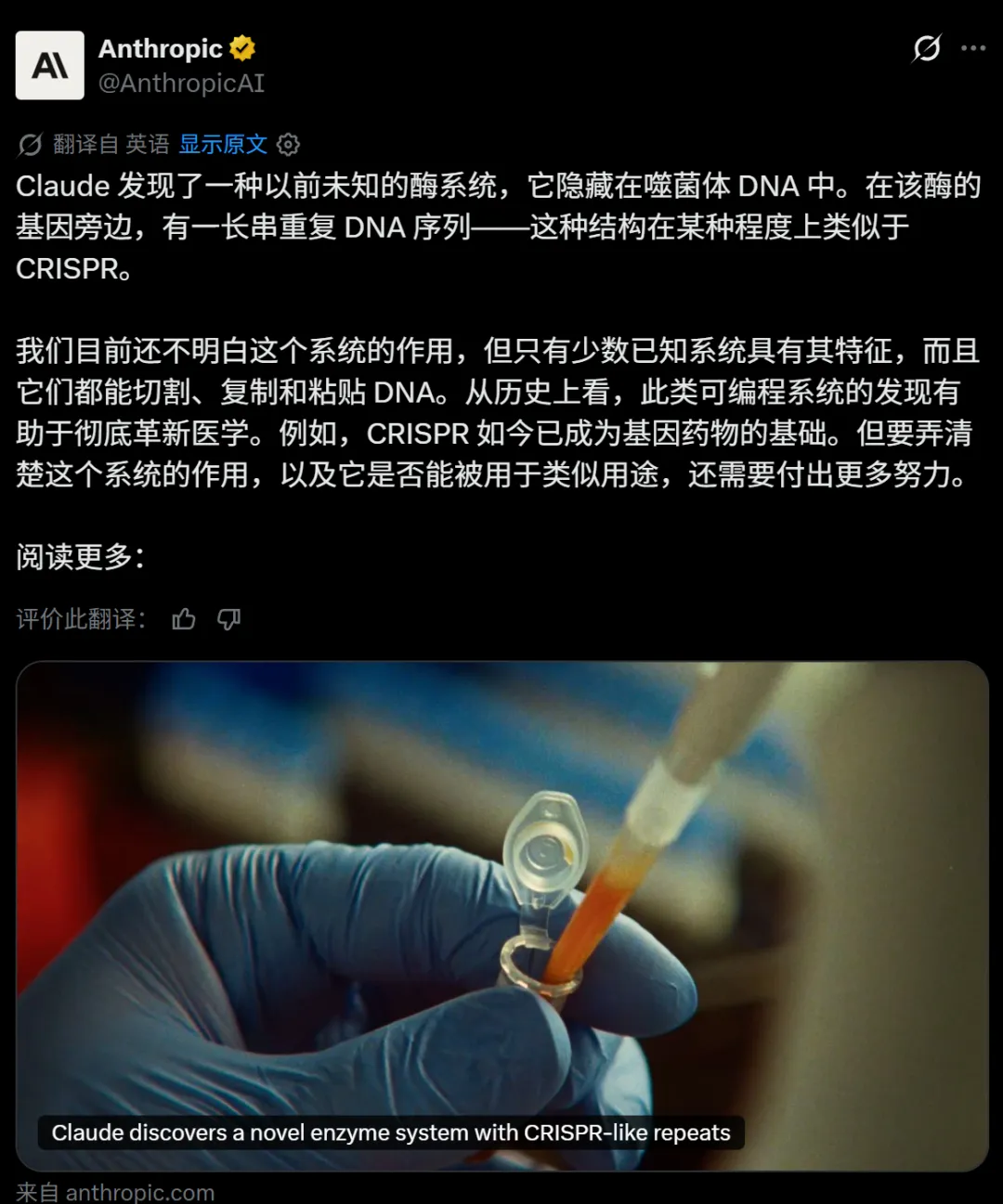
This was the first study by the Anthropic Molecular Biology Laboratory, which used about 950 Claude Agents, consumed about 210 million tokens in 21 hours, screened candidate systems from more than 200,000 retroviral enzymes, and eventually discovered this particular structure of DNA.
According to Anthropic, the study, like the way you interact with AI, begins with a Prompt:
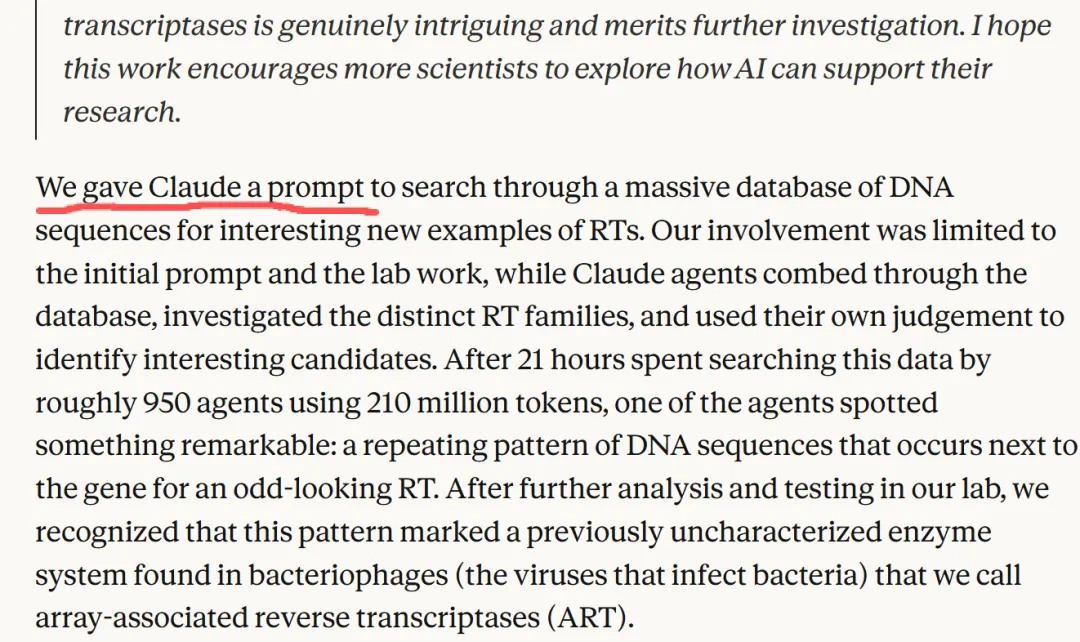
ART's function is still being studied, but it is known to have a similar architecture to other programmable biological systems that can manipulate genetic information. Anthropic says that if this AI-driven genome excavation can be expanded, it could compress the weeks or months of expert research into a few hours.
Anthropic calls the ART analogy CRISPR, which is one of the most influential technologies in the life sciences in recent years. As the foundation of modern gene editing technology, CRISPR is best known for its application of "gene editing" to the identification and cutting of DNA through Cas proteins, whereas retrograde enzymes can write information in RNA into DNA.
CRISPR is a DNA sequence composed of repeating sequences and interval sequences, capable of producing different RNAs and participating in guiding the identification of related protein targets.
Therefore, when researchers found a similar array of DNA in an unfamiliar biological system, and enzymes with special functions existed nearby, there was reason to investigate further whether this was a system capable of using RNA to guide enzyme activity. ART happened to have this worthy of study structural characteristic, a possibility that was also accurately identified by Claude.
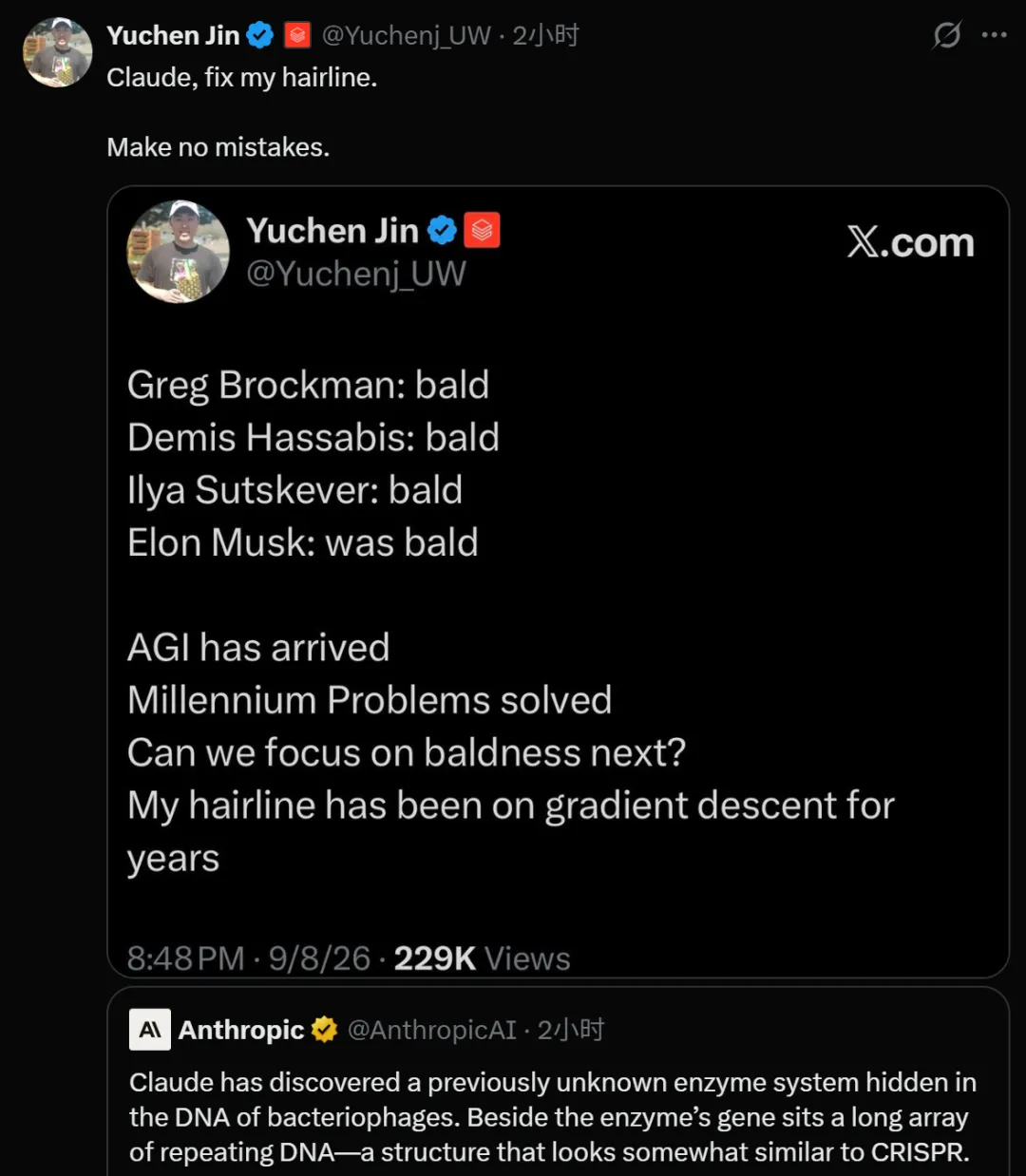
As soon as the news came out, everyone immediately welcomed the fact that someone had already opened the brainhole model. For example, the problem of AI is going to end here:
Some have also speculated that biological research will be accelerated and accelerated to reverse aging:
Dario Amodei, the founder of Anthropic, has also expressed optimism: "I wrote about AI's potential to 'cure most diseases' in 5-10 years in the Machines of Loving Grace series, which sounds impossible, but I believe it's barely possible if AI is applied at every stage of the process. The first step is to prove that AI can first help and then drive biological discovery. Claude's findings are the latest in a series of related early work over decades... I believe we are at the beginning of discovering such systems and will develop powerful tools for biotechnology".
ART is mainly found in fungi, a type of infectious bacterial virus whose genome contains a large number of genes and proteins that have not yet been fully studied. The ART system consists mainly of three parts:
Retroviral enzymes (RT) are able to synthesize DNA with RNA as a template;
Neighbouring partner genes encode an ancillary protein whose function is not yet known;
DNA repeat sequence arrays containing a large number of repeat DNA sequences with regular intervals, similar in structure to CRISPR sequences.
Individual of these components have been previously discovered, but there is a systemic association between them that has not been fully recognized before. Claude first discovered DNA replication sequences similar to CRISPR in the ART system through genomic analysis. Based on this observation, the biological research team at Anthropic conducted experiments. A key finding that has been made public is that the replication DNA sequences in the ART system can indeed express and produce a different set of short RNAs, which means that it is a sequence structure with actual biological activity.
From a biological point of view, this finding is quite attractive and could provide a new technological pathway for nucleic acid operation if the retrovirus enzyme system can use RNA to identify specific targets and synthesize DNA in a controlled manner.
Additionally, ART has repeat sequence arrays similar to CRISPR, and experiments have found that these arrays can produce different short RNAs, which gives researchers the motivation to further investigate whether it has a regulation or guiding mechanism involved in some RNA.
In the past, we have often seen AI make breakthroughs in the life sciences. The last milestone was DeepMind's AlphaFold, which won the 2024 Nobel Prize in Chemistry for predicting protein structure and helping researchers design new proteins.
In Anthropic, the autonomy of AI is further enhanced by Claude's involvement, like real scientists, in the vast process of finding research objects, screening out anomalies, judging the value of research, and proposing scientific hypotheses.
It was a process of truly exploring the unknown, and the researchers did not directly tell Claude to look for ART, nor did they specify a specific DNA sequence in advance. Claude needed to analyze different families of retroviral enzymes, look for systems that may not have been studied yet, and determine which candidates deserve further investigation.
This meant that in a highly open research space, Claude had to decide for himself where to devote his computational resources and analytical energy.
Claude chose to call up to 950 Agents for parallel studies. These Agents each performed data searches, sequence analysis, literature surveys, and candidate screening. Throughout the process, Claude gradually reduced more than 200,000 retroviral enzymes to 3,500 candidate systems, ultimately focusing on analyzing 20 of them. For human experts, similar analysis may take weeks to months.
During the discovery of ART, Claude examined primitive DNA sequences near a particular reverse transcriptase and found that they contained a set of irregularly arranged repeating sequences that reminded him of the CRISPR system. So Claude continued to perform multiple analyses, including statistical repeating sequences, measurement intervals, the structure of known reverse transcriptase systems, and examined the relevant literature to determine whether this trait had been previously reported.
It can be seen that AI has successfully made a series of exploratory decisions this time in the course of its research.
Interestingly, it's because AI has this potential that Anthropic says they're cultivating Claude's "scientific taste".
Since Claude was able to generate a large number of scientific hypotheses, the challenge for the research team now is to train it to judge which hypotheses are truly worth investing in experimental resources. Claude may generate hundreds or even thousands of candidate research reports, but most are not worth further experimentation. Anthropic is using feedback from human scientists to train Claude to allow models to gradually learn how to judge human scientists' research.
In the future, when faced with unknown problems, AI may be able to determine what is worth researching and which direction is more likely to lead to new discoveries.
References are given below: