It's the first time in the history of the world.
Have you ever been in a situation like this:
Give a bunch of information to AI, let it write a report, verify where it came from, and then turn it into a PPT.
When the first edition comes out, you feel that the structure is wrong, and you type a few words in the dialog box: "Mention the conclusion first".
After the second edition came out, you came up with another idea, adding a phrase: "Another page of competition comparisons".
In your interface, you've only spoken two more words.
But in the background, every time you add a request, the application may return the original material, task description and chat history to the model.
You've only changed two sentences, and the backdrop may be a recounting of the material you've read before. Every time you re-read it, it's burning your calculation costs and waiting time.
This backlog of recurring spending is the latest issue with OpenAI's upgrading target.
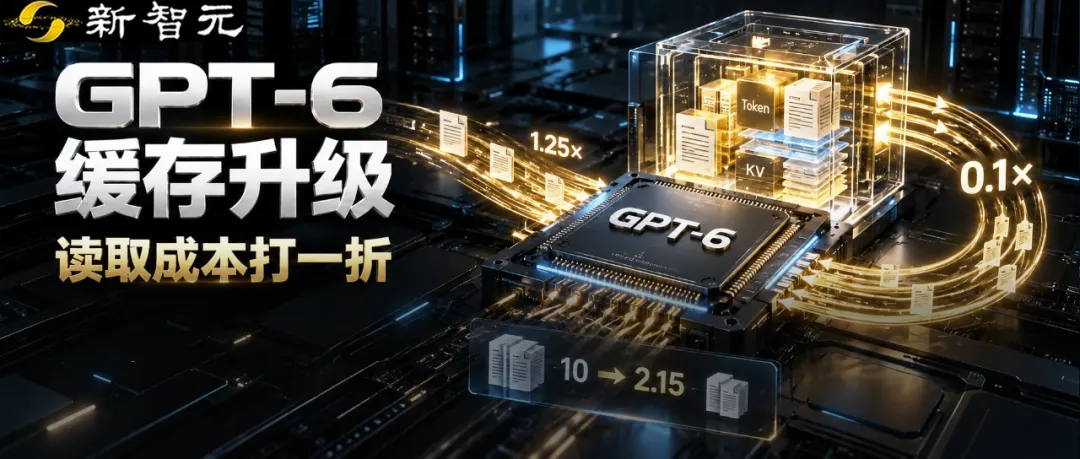
On September 22, OpenAI announced a major upgrade to GPT-6 prompt caching, which improves the default caching rate and provides more detailed monitoring, diagnosis and control.
How much can you save?
According to the officially published rate, the same piece of material is used 10 times in a row, and the cost of re-entering only this piece can theoretically be saved by 78.5% if it is stored for the first time.
Of these, hit cache inputs read only one-tenth of normal inputs.
When AI began to take on the complex work that takes hours for us to do, the tools were taken into consideration: not only "can't do it", but also "how long to wait" and "how much to spend".
But if the caching inputs are discounted, will our total bills be discounted?
What's left of the cache?Leave a "calculated draft"To understand how it saves money, you have to understand how AI "reads".
When a model reads large passages of text, it does not see with the naked eye as humans do, but instead calculates a complex intermediate state, known in the industry as the KV state, internally.
When generating the next response, the model needs to periodically review these states to keep the logical back and forth consistent.
The so-called caching and caching are the intermediate results that have been calculated in this part.
It can be understood figuratively as a "computing sketch" left by the last time the problem was solved.
In the next round of conversations, as long as the topic doesn't change, AI doesn't have to re-count the draft paper, taking the draft directly and going back and forth.
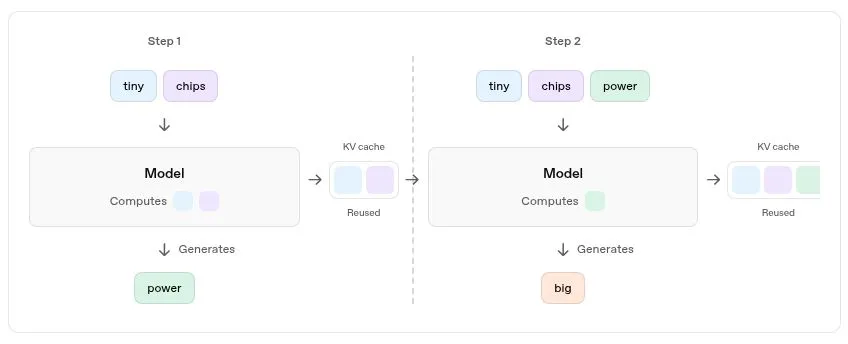
The official documentation shows the reuse of KV status, and the contents have been calculated for use in subsequent steps.
There are two very critical premises here:
First, caching is not the same as memory.
It's not a permanent memory library for AI, nor is it a direct copy of your last answer.
In the face of your new questions, AI still has to think hard and generate new answers, and it only saves the repetitive labor of "re-reading old data".
Second, replication must meet the exact matching.
The first half of the two requests must be identical, and the exact same content is known as the "sharing foreplay".
This foreword includes not only the chat text you type, but also the implicit instructions, tool definitions of the system, and the context of images, documents, and audio.
For the GPT-5.6 and later models, the caching shared frontend requires at least 1,024 visible input tokens.
And the cache has a shelf life: it stays on the server for at least 30 minutes after the last time it was written or used.
As long as you call again during this period, the storage period will be renewed without having to pay an additional subscription fee.
But staying in the same chat window doesn't mean 100% safe.
If the request is assigned to different server machines, or crosses different regions, caching may still fail.
Read it once and againWhy can't total accounts be directly divided by ten?OpenAI claims that the maximum input of hit caches is one fold, so why can't the overall bills be cut to that ratio?
Since there is no free lunch in heaven, it is necessary to pay a "buying fee" to register for the first time.
According to the latest development documentation, for the GPT-5.6 and later models, the cost of writing material into caching for the first time is 1.25 times that of normal input; and the read price is one-tenth of normal input if the subsequent caching is successful.
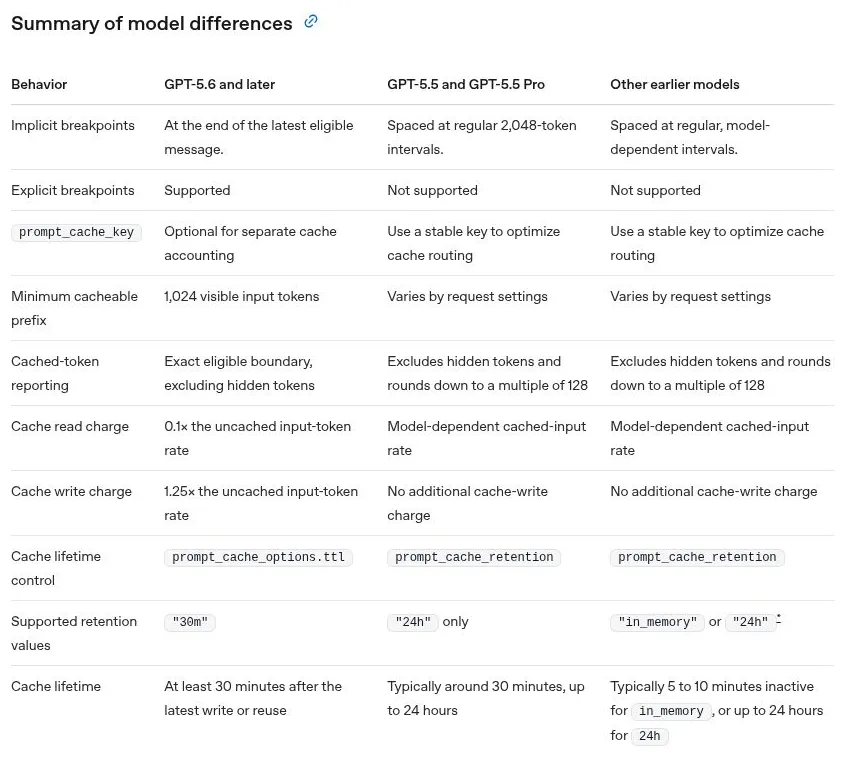
The official rate table: GPT-5.6 and later models cached reading 0.1 times, writing 1.25 times.
We're going to do one of the most intuitive things:
For example, if you have a huge amount of data that is processed with a standard input, you will have to pay a total of 10 dollars if you use it 10 times in a row.
If the caching mechanism is used, the first time you write in, you pay 1.25 cents; the next nine times you pay 0.1 cents, and nine times you pay 0.9 cents.
It's the same thing as saying, "I'm not going to be able to do it".
Compared to the previous ten, direct costs fell from ten to 2.15 percent, saving 78.5 percent overall.
This is the origin of the magical figure of a decrease of up to 78.5% at the beginning of the article.
However, please note that this decrease of up to 78.5% covers only that section of "old recycled materials".
In actual use, your new queries, AI-generated output content, and other additional calculations will still be charged at normal prices.
What is more realistic is that if you write a high-priced piece of material into a cache and you don't take care of it once, you have to pay for a higher initial write-up cost.
So, if you look at the one-time price, you can't really save money, and the overall recycling rate isn't high.
Why just a little change?The offer suddenly "closed"?As previously mentioned, caching relies on "precise matching".
AI is so rigid that it can't understand "the two words mean pretty much the same thing", and as soon as it changes a little bit at the beginning, the cache will fail instantly.
For example, some applications, in order to record time, always write the current precise time at the earliest of the cue words. This leads to the later reference, although the word is unchanged, because of the change in the start, the entire cue cannot match the old cache.
In order not to cut off the offer, the developers summarized a golden rule: Fixed unchanging content is always forward, and frequently changing content is added backwards.
In this upgrade, OpenAI also introduced several very practical control tools and methods:
One is the obvious break.
It's like inserting a bookmark into the article and telling AI: "This is fixed from the beginning, please help me keep it repeated".
It marks the boundary of caching rather than letting AI pause thinking.
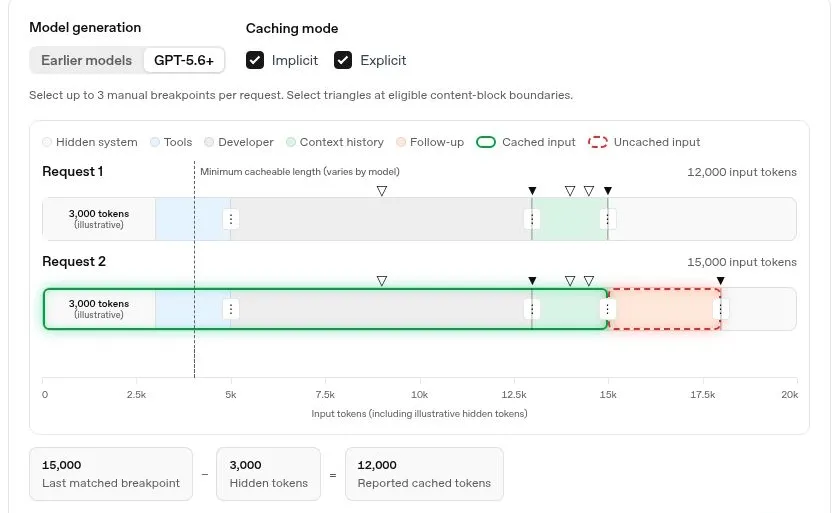
Official interaction examples: Green areas re-use old fortresses, red areas alternate treatment.
There are also definitions of stability tools.
Changing the name of the tool, adjusting the order of the parameters, will destroy the cache.
OpenAI recommends keeping the definition and order of the toolbox stable, and if a round of conversations does not require the use of a certain tool and can be temporarily hidden with the control parameters, please do not delete the tool definition directly.
The third is the careful adjustment of thinking power.
GPT-6, for example, would also disrupt front-end reuse if the overall reasoning intensity parameters were directly modified.
And if the thought force is adjusted through incremental updates within the dialogue, it can be perfectly cached while changing the precision of AI thinking.
Of course, the vast majority of these details are processed in the background by developers at the application level, without the need for ordinary users to memorize complex parameters.
However, the quality of the code you write will directly determine the time and cost of waiting at the front end of the line.
There are losses.AI can really accelerate price reductionsIn the past, many people have had similar confusions about AI:
It's not clear how Tokens are consumed so quickly, but what's the problem?
In this upgrade, OpenAI has complemented monitoring and diagnostics capabilities.
On the all-new cache board, the input data is clearly broken down: how many words come from the cache, how many words need to be reworked, at what point the hit rate drops.
An example of a cache sign published on September 22, showing the impact rate and input constitutes.
A diagnostic tool is more like an error-correcting expert, which can automatically compare current requests to historical responses, accurately find out which tools have changed names, which settings have changed, and even accurately estimate how many replicable tokens have been lost as a result.
Official examples show that just a small change in the name of a tool caused 5,629 tokens to fail to hit cache.
In addition to the diagnosis, another improvement that is more easily perceived by users is called "preheating" (Warmup).
When the application launches, the system will be able to pre-write known system instructions, tool instructions, or background information into the cache before you type in.
By the time you actually send a question, the preparation is already ready, and the response rate to the first words naturally increases dramatically.
Preheating doesn't make computation free (writing still costs 1.25 times), but it cleverly moves computation to wait, greatly compressing your waiting perception.
Currently, AI applications such as Manus, whose OpenAI models have improved cache latency from about 85 percent to more than 90 percent; GitHub Copilot, with trillions of requests requiring re-processing, has seen a decrease of more than 50 percent in the token share compared to the previous baseline, and a markedly faster response to headlines.
According to the Manus team, the post-optimized caching rate has risen from about 85 percent to continuing above 90 percent.
Finally, will we be cheaper with AI?
Looking back at all this hardcore nuclear improvement, we're back to the question that we all care about: can we save money with AI?
The answer is in two ways:
If you're a developer who uses a paid model directly through an API, these optimizations will be very intuitive in your bills and usage reports, saving you money.
But if you're a regular user who uses ChatGPT, Manus or other monthly subscription, packaging products, there's a commercial pricing for each product in the middle.
It must be clear that this update is not a discount announcement for ChatGPT.
Lower underlying computing costs could eventually lead to cheaper subscriptions, more affordable usage, or more sophisticated AI capabilities that could be used by the product side.
But there is a trend that is irreversible:
When AI moved from "simple questions and answers" to "hours of continuous operation" of complex tasks, competition between applications had already extended from single-call modeling capabilities to more sophisticated operations of underlying computing resources.
The model pricing may be exactly the same, but how to organize each request, how to maximize the use of the material read, determines who can deliver the most cost-effective service to the user.
When AI works for you on a daily basis, no one applauds you for "how many times a model has been called", and you only pay for "it's finally done efficiently".
And the next thing to look forward to is how much of this savings in computing costs will actually turn into benefits in our hands.