It's the first time in the history of the world.
The big model lake has changed hands.
On September 21, the MiMo team officially unveiled and fully open-source the new generation MiMo V2.6 series, with the release of three models Pro, Flash, UltraSpeed, directly reshaping the global open-source model landscape.
The MiMo V2.6 Pro scored 46 points in the AI Analysis Intelligence Index (AA Intelligence Index v4.3), ahead of the Kimi K3 and Qwen 3.8 Max.
The world's first open source model, the first domestic model!
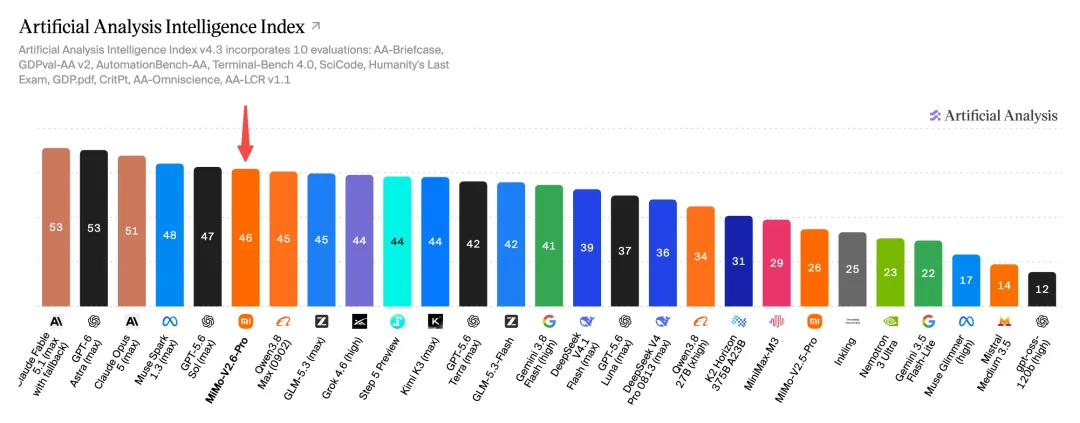
Pull out the AA list side by side: Fable 5.1 score 53, GPT-6 Astra score 52.8, Opus 5 score 50.7.
While the MiMo V2.6 Pro has not yet surpassed these "ceilings", it has firmly established itself in the top tier of the world, leaving behind all other open-source models.
What's more, the price of V2.5 remains unchanged.
The same money, the doubling of smart, directly paints a new "smart-cost" frontier in Pareto.
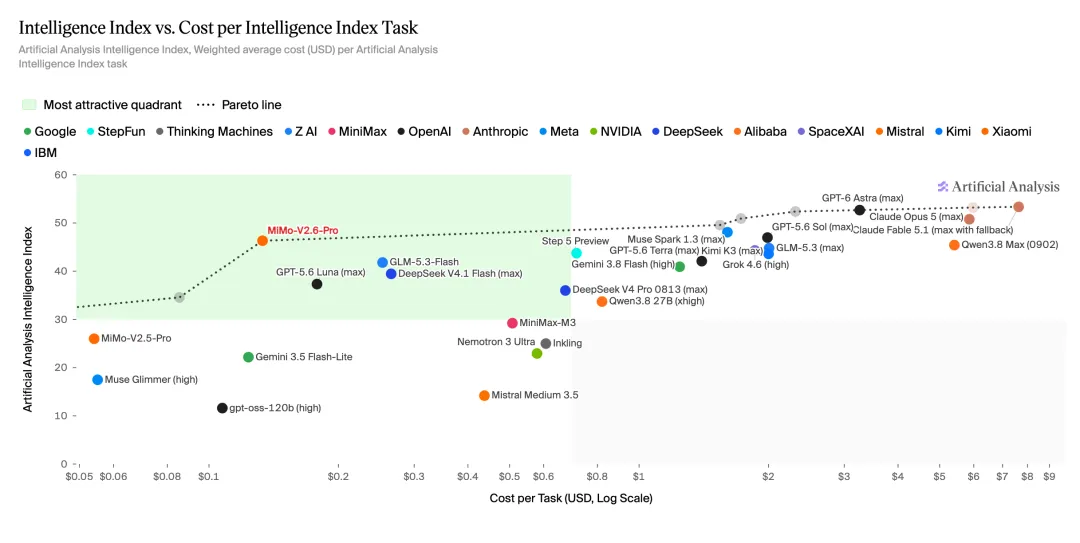
Others are also playing the "Killing Line" price fight, and the Miami knife is directly knocking down the game table.
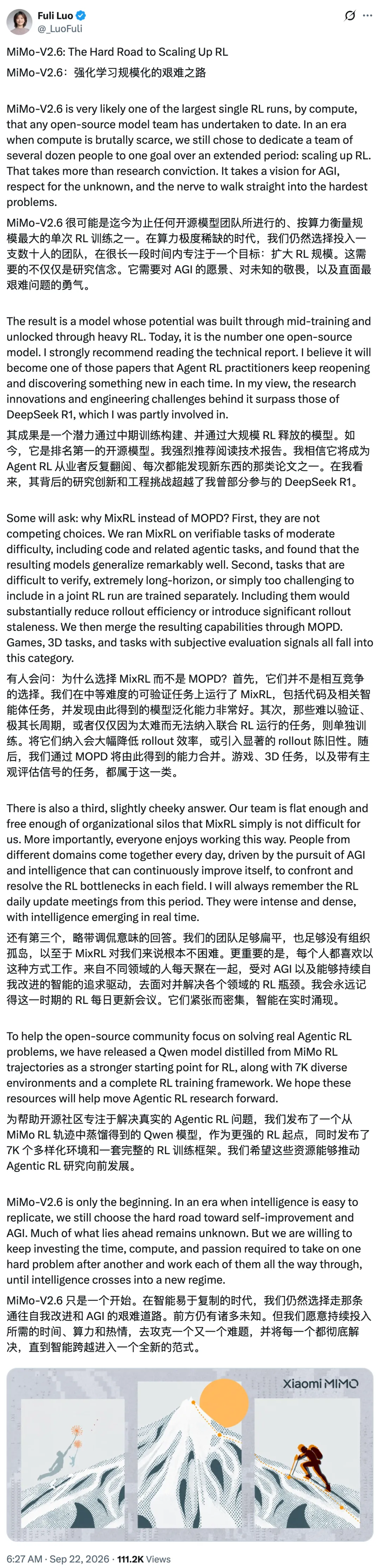
Well, the head of Xiaomi's big model, Rofoli, also posted a long post on X's The Hard Road to Scaling Up RL.
She said the MiMo V2.6 is likely the largest single RL training to date in the open source world, with dozens of teams putting all their calculations on one thing: how far reinforcement learning can go.
She even went so far as to say that the RL's research innovation and engineering challenges are even "more than DeepSeek R1".
Even more interestingly, on the same day, SpaceX's Grok 4.7 was also released simultaneously, and Musk was thrilled.
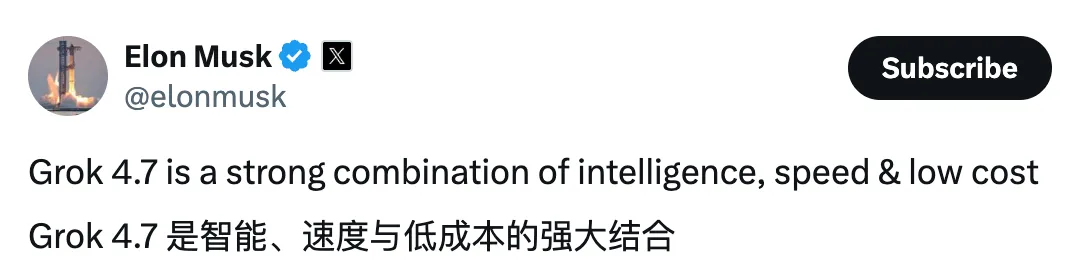
But the wind on X is turning faster than the plane.
AI blogger Chubby (@kimmonismus) first praised Grok 4.7, and then secondly corrected the error.
The MiMo V2.6 is really worth seeing.
Better than Grok 4.7, much cheaper, and holy moly is China back!
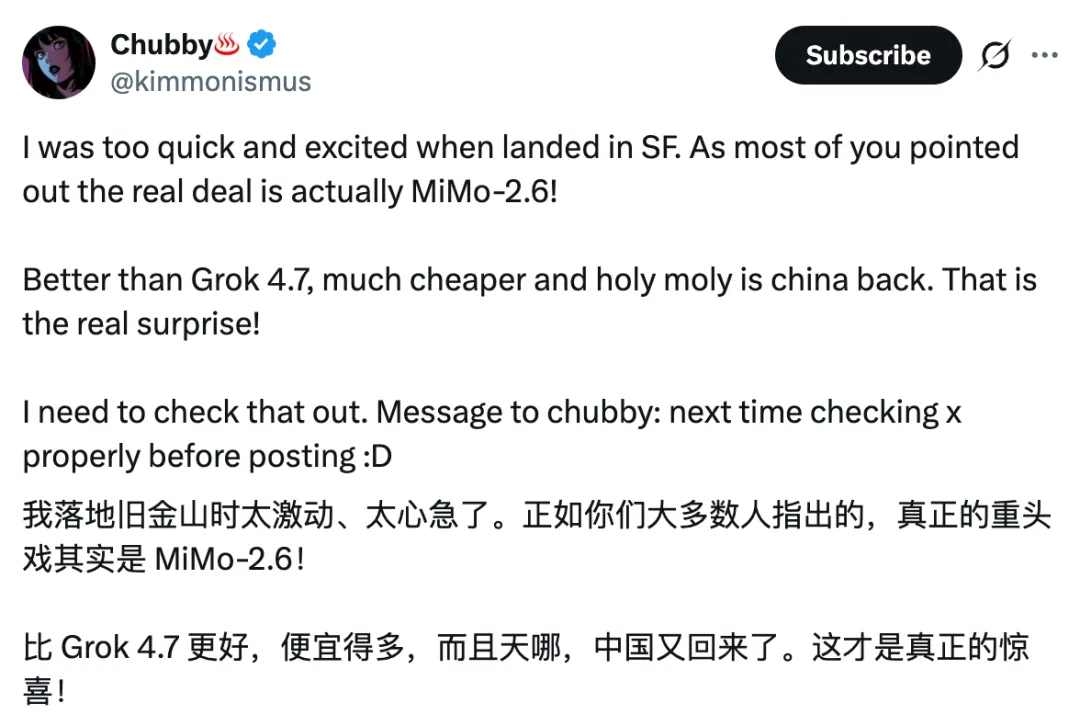
The AA Intelligence Index has the same 46 points, but the MiMo V2.6 Pro cost $0.13 for a single mission and the Grok 4.7 for $3.74, nearly 30 times the gap.
Shared, open-source, fully modular, 30 times cheaper.
The community's consensus is in five words: good and cheap.
Three arrows together: flagship, efficiency, high speed, all with deadly tricksThe MiMo V2.6 is a series of three models designed for different work scenarios:
The MiMo V2.6 Pro is the absolute flagship of the entire series.
Full-mode, ultra-high-performance, complex projects, long-range tasks, high-value work, and even the toughness of cybersecurity and scientific research.
Looking at the open-source world, it is the only model that is both fully modular and flagship.
The AA intelligence index is 46 points, which is the scoreboard it delivers; in most Agent Benchmarks, it has outperformed Opus 5 and GPT-5.6 Sol.
Design Arena's rankings reveal its power in more detail.
In the Chat Comprehensive scenario, the MiMo V2.6 is ranked as the 3rd open source model, 8th overall, ahead of Claude Opus 5;
The most frequently used Web site category in a Chat scenario is Open Source 2, Top 4, more than Opus 5, Fable 5 and GPT-5.6 Sol;
In the front-end development scene for Agent's Web Apps, open source is second, sixth overall, ahead of Kimi K3, Fable 5, Opus 5 and GPT-5.6 Sol.
Note that the names it surpasses are Opus 5, Fable 5, GPT-5.6 Sol. Each is a closed-source flagship that companies have invested billions of dollars in.
An open-source model that puts them underfoot in real developer voting scenes.
Let's look at an example of a front-end design.
Large headlines, restrained white-collared navigation on the left, desert images marked on the right, an entire web page like a printed magazine rather than a template stacked.
The MiMo V2.6 knows what to call it.

The MiMo V2.6 Flash follows the "efficiency monster" route.
Full-mode, high-smart, low-cost, high-frequency calling and scalable task design for professional offices. This generation of Flash has completely surpassed the previous generation's flagship V2.5 Pro.
If you want a model to run tens of thousands of tasks a day, Flash is the best partner for that painless token bill.
The MiMo V2.6 Pro Ultraspeed is designed for "high-efficiency" people.
It retains the Pro's flagship performance, not being quantified, without sacrificing intelligence for speed, while offering up to 10 times the reasoning speed, a conventional 500 TPS, and a peak of up to 1,000 TPS.
The three-fold price change is 10 times faster, and it's costly for strong real-time interaction and response-sensitive production scenarios.
Testing: not a runner, but an active toolThe list results are just entrance tickets, and the real thing that allows developers to pay is the real-world capabilities.
The performance of the MiMo V2.6 in several key scenarios confirmed that it was not a "test runner" for the race:
This is an interactive 3D open world puzzle created by MiMo V2.6.
The distant pyramids and towers depict the skyline, the dense sandy residential areas nearby, the wooden pedestals and the missing roof cover the entire view, the lens pulls at a steady rate, with no apparent drop and wear patterns.
It doesn't just "picture" a scene, it calculates the level of the scene, the reuse of assets and the rendering performance.
Even more difficult is the unification of aesthetics: the entire city is consistent in the colors and architectural grammar of the ancient cities of the Middle East, without a sense of collage.

Complex 3D scenario modeling is the ultimate battlefield for testing models for long-range reasoning and control of detail.
MiMo-V2.6 can generate 3D objects and scenes in Blender based on the user's text description or reference images.
It is a 3D model of a pickup frame. The body contours, contour radiation bars, bottom columns and brake panels are all composed of programmed geometries, and the spatial relationships between the components are tightly intertwined as they rotate and are constantly changing colors.
The MiMo V2.6 for space reasoning and control of detail on this class of mission has not lost its flagship closed-source model.

Multimodal inputs generate Office documents.
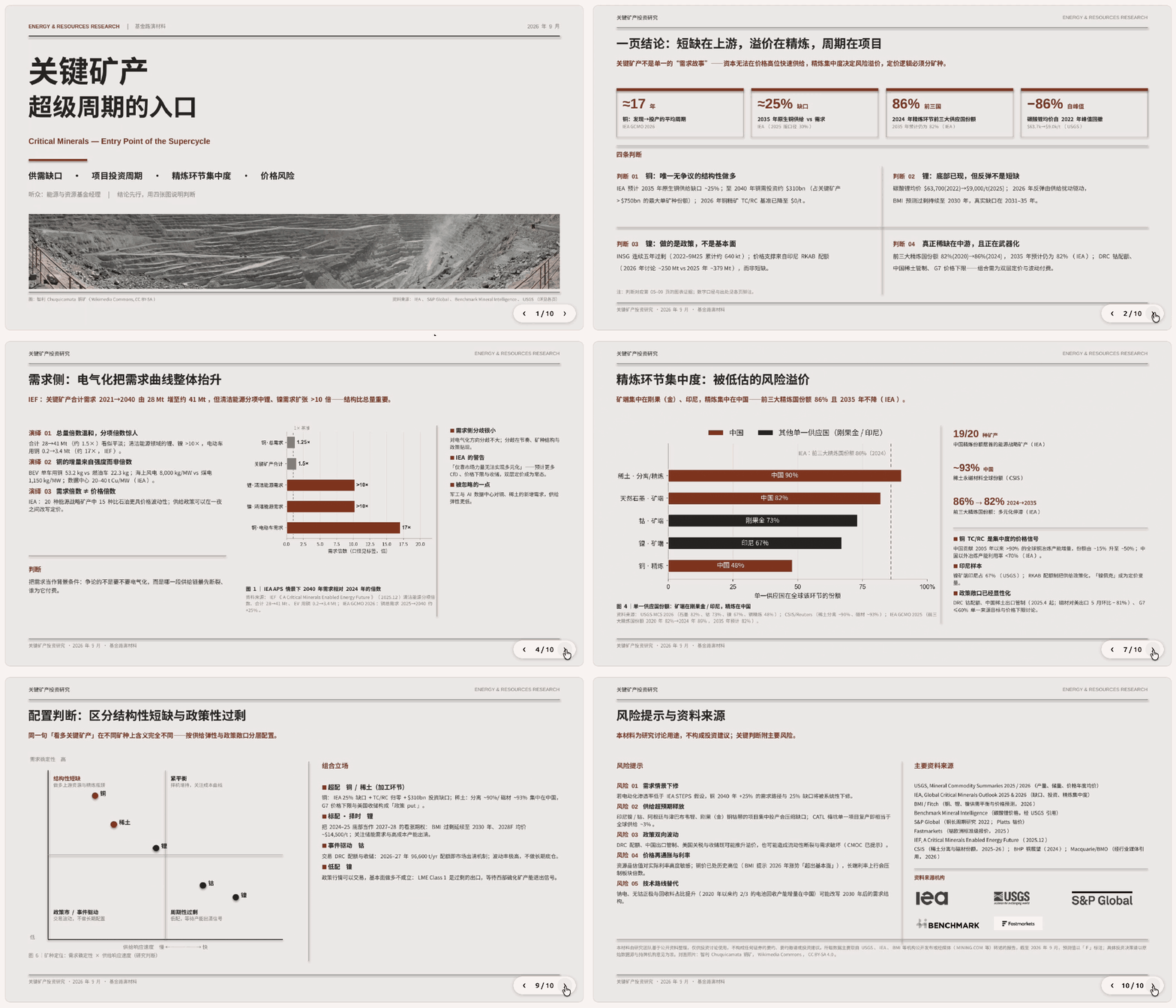
This is a slideshow of the "Critical Mining" Fund produced by MiMo V2.6, with the cover showing a sense of restraint through a press release: a large black-letter Chinese title squeezing the cover, a bright red English subtitle and a short horizontal line pointing, with four subjects arranged in a row at intervals, and a stairwell view of a Chilean Chuquicamata copper mine directly in front of the audience.
It's even more difficult to organize the text, explaining that the model is not just in serialization, but that it's important to figure out who to show the material to and how to say it, and that it's what an "analyst" who really understands the logic of the process knows.
The team used MiMo V2.6 Pro for a successful research mission: to design a new type of metallic organic framework material (MOF) capable of capturing PFAS from the water (which is composed of polymers and polymers known as "permanent pollutants").
Note that this is an end-to-end closed-circuit of scientific research that ranges from a review of literature and patents, proposing design assumptions and validating novelties, to automatically building computational simulation environments, calling on open source tools to "do-it-yourself experiments" and ultimately selecting material candidates.
Both the model-designed A50 and B50 MOF structures have an adsorption performance of millions to tens of millions of times that of the reference material in the simulation.
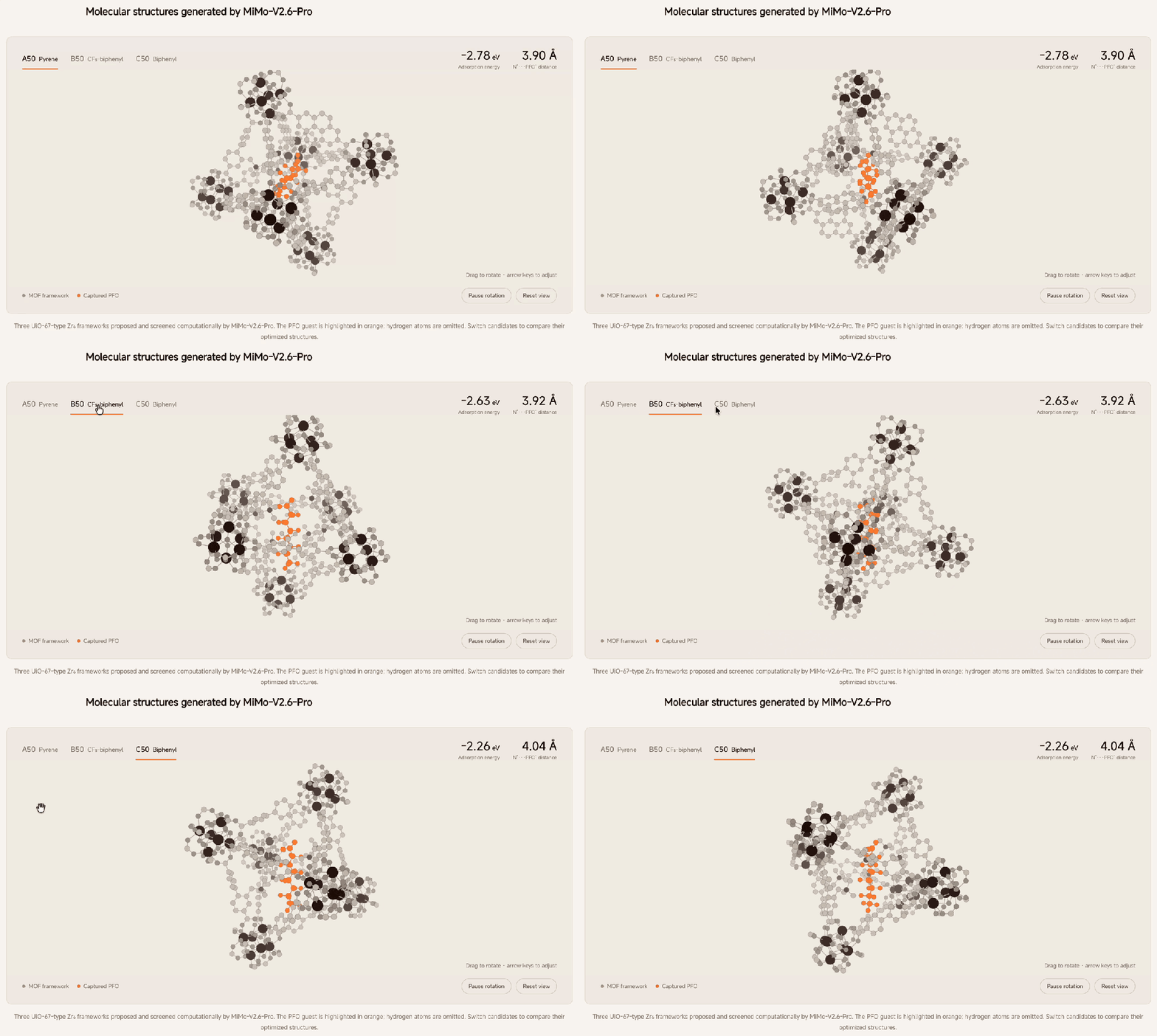
Throughout the process, the efficiency of the work of human experts has been increased by about 10 times, and the R&D cycle of one month has been squeezed down to two to three days.
Professor Zhang Jinghu, a research associate at Beijing University's School of Materials Science and Engineering, said: "The research capacity it demonstrated in this mission has reached the level of trained PhD researchers".
It was an open-source model that started working like a real researcher.
Furthermore, V2.6 has an underestimated advantage: its single-wheel delivery speeds are extremely fast.
In complex multi-step tasks, the MiMo can complete more iterations in the same amount of time, resulting in more controllability.
If you are accustomed to seeing an unsatisfactory result in the workflow of "Call for Demand" and "Wait a Half Day", the speed of V2.6 will allow you to redefine what is known as "human-machine collaboration".
Pre-training static and post-training doubledHow did MiMo do it?This is the most curious question in all of V2.6.
The baseline of pre-training hasn't changed, the parameters haven't changed, so how can the level of intelligence jump to "global open source number one"?
The answer lies in four words: post-training revolution.
Xiaomi's official position for this release is: the key step to exploring the RSI (return to self-improvement) path.
Based on verifiable complex tasks, the scale-up of RL computing allows the model to push the boundaries of intelligence a little further in continuous exploration and feedback.
On September 17, Rofoli, the head of the Xiaomi MiMo model, posted a tweet that shocked the entire AI community. Readership surged to three million.
She says the team has been silent for almost half a year, studying only one thing: how far reinforcement can be extended. Then, she did something unprecedented: live stream the entire RL training process of the MiMo V2.6.
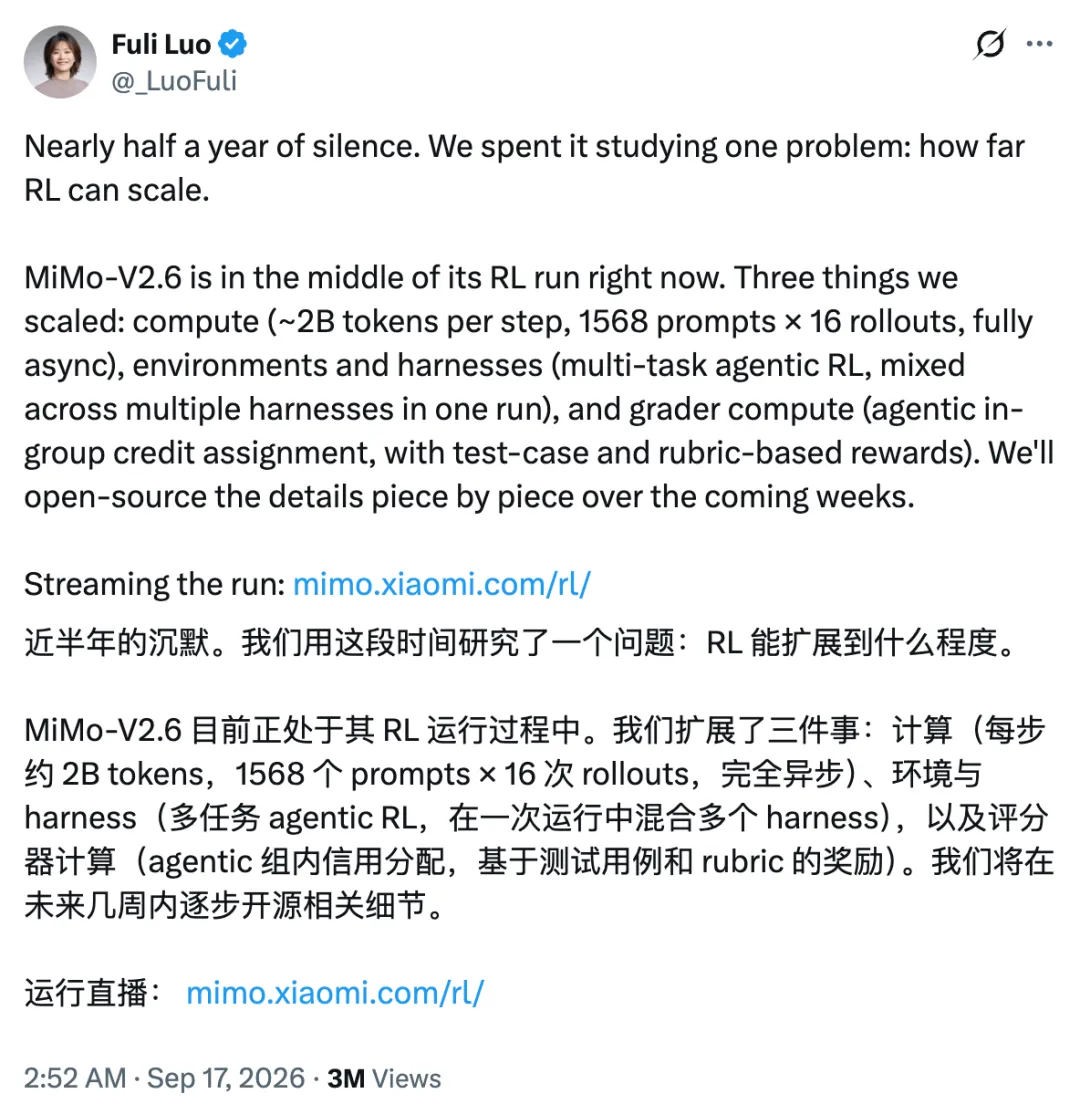
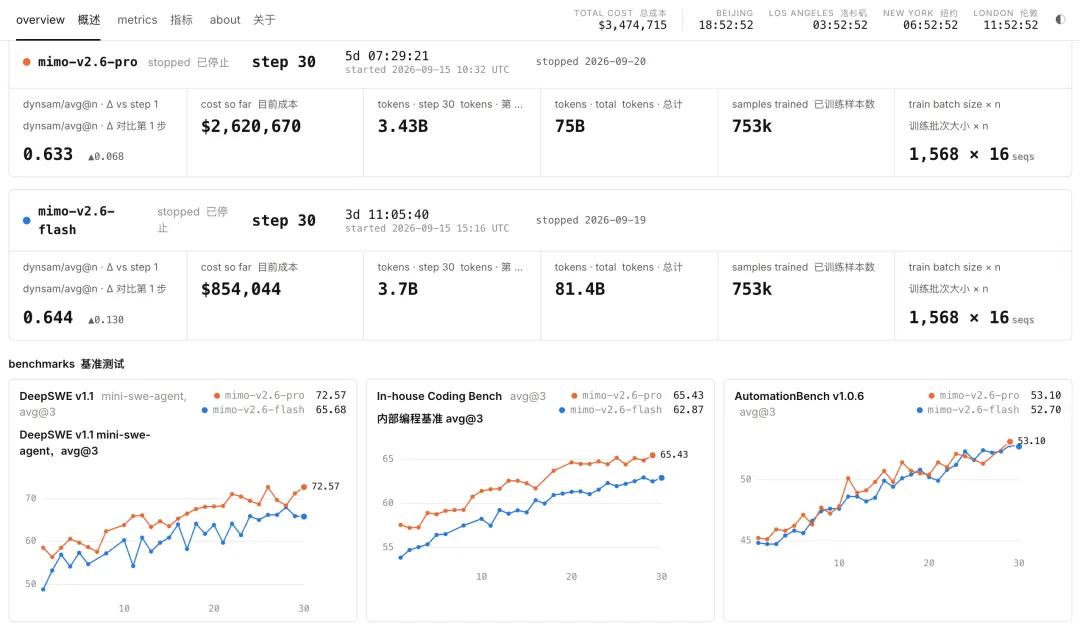
In less than six days, both the Flash and Pro models completed 30 steps each, accumulating about 750,000 tracks, and training costs about $850,000 and $2.620,000, respectively.
All the data is posted on mimo.xiaomi.com/rl in real time, and researchers around the world can see the training curve rising step by step.
This wave of operations directly targeted the overseas AI community.
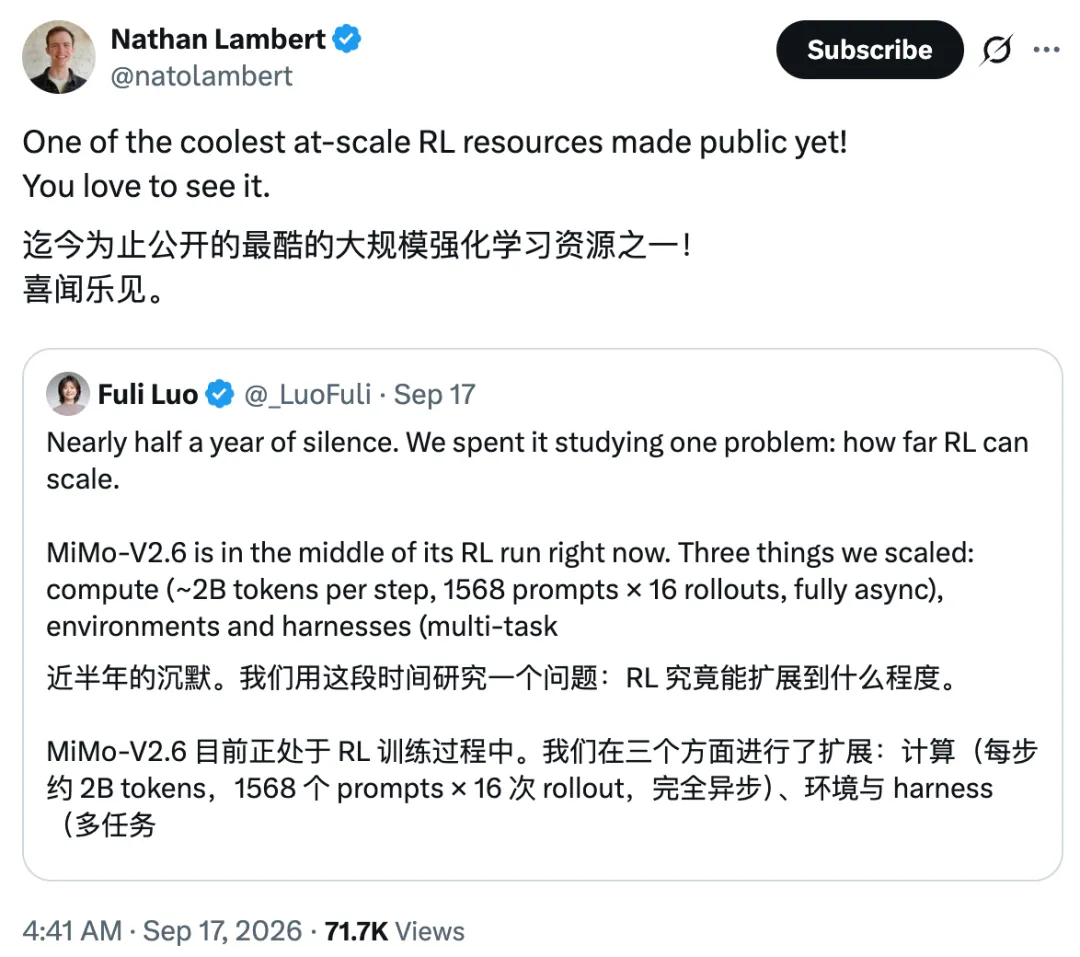
Nathan Lambert reviewed it as "one of the coolest large-scale RL resources open to the public yet".
"Imagine if OpenAI and Anthropic did the same thing".
 | 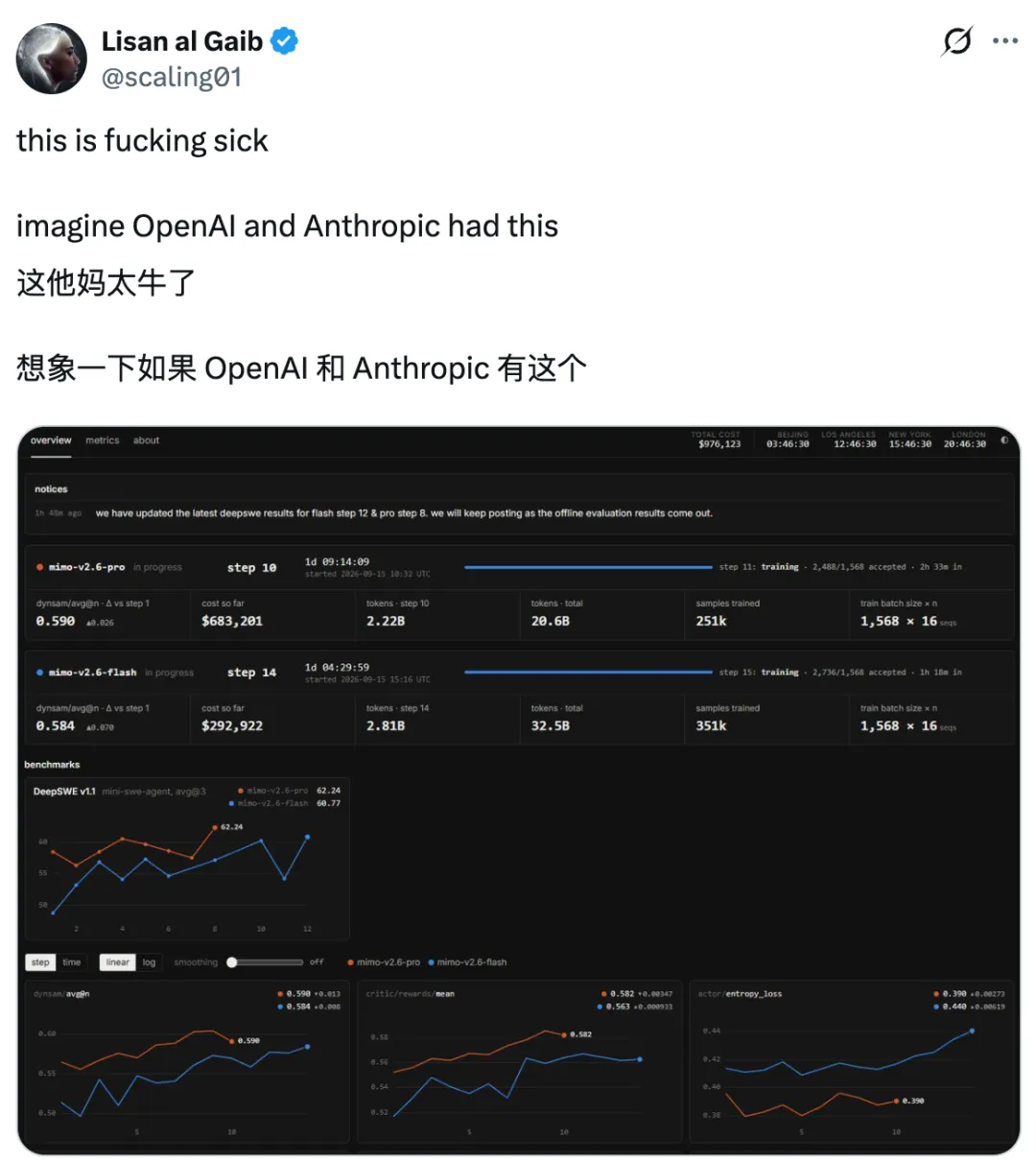 |
Live scores were also tough: training tasks for the two models improved by an average of 25% and 12% respectively, respectively; more importantly, on the long-range software engineering benchmark DeepSWE v1.1 that did not participate in the training, Flash went from 48.8 tons to 65.68, and Pro from 58.4 tons to 72.57 tons.
30 steps, 10 points - RL's sample efficiency, capacity for continuous improvement and generalization are all on the horizon.
But live broadcasting is just a metaphor, and the real core technology isMixRL for mixed tasksStrengthening Learning。
Rowley summed up the methodology in one sentence: You Only RL Once. A large-scale blended RL task enables the model to emerge simultaneously in all directions without having to train for each task separately.
The post-training of the MiMo V2.6 was not simply to "practice a few rounds", but to expand along three axes simultaneously, forming a self-improvement system of "Environment × Task × Score" tri-axis synchronization:
The first axis: Rollout computing is not practicing enough.
Each training step uses 1,568 Prompt, each Prompt has 16 Rollouts, a single-step training Token of 2.7 billion tonnes, support for context-length training on 1M, and complete asynchronous execution.
This is a huge "brush topics net" with 4,000 GPUs, allowing the model to simultaneously face 25,000 tracks and use a lot of trial and error to get closer to the optimal solution.
Why the bias is 16 times? This is because in the GRPO algorithm group, the comparison logic pump does only one attempt and the feedback is only "yes or wrong"; doing 16 times, the system gets a richer relative signal through comparison within the group, distinguishing between "accidentally biased" and "true understanding" - the sweet spot between cost and signal quality.
The four words "totally asymmetric" contain a key engineering insight.
Traditional synchronous RL is like a whole class exam: all GPUs first generate answers, then score, then update the model, and all have to wait for the next round to begin.
The problem is that Agent tasks take a huge amount of time, some running for 5 minutes, others for hours. In synchronous mode, fast GPUs can only run slowly.
MiMo V2.6 breaks down generation, rating, and training into continuous flow lines, where trajectories are rated and learned first.
The second axis: the environment is not wide enough for Harness to see.
Traditional RLs allow models to train on a single task, while MiMo V2.6 combines programming, general office, visual design, and cybersecurity with a variety of Agent tasks.
The technical report reveals a precise "formula": programming accounted for 68%, General Agent accounted for 12%, visual design accounted for 13%, cybersecurity accounted for 4%, instructions followed for 3%, across 25 data sources, 21 Harness frameworks, all mixed in one RL training.
It's not just "practice everything over again", but there are special quality switching mechanisms in each area.
The programming task establishes a three-dimensional quality check that only validates the original requirements (does not encourage excessive modification); repeatedly performs eight assurances of consistency for each task; independently audits Agent cross-validation.
Cybersecurity directions directly use OSS-Fuzz's real vulnerability training environment to evaluate standard response-based vulnerability types and crash locations for pure rule matching, while eliminating ratings that are "neglected".
Visual design is divided into two categories: open design first checks for functionality according to rules, instructional follow-up, layout and basic aesthetics, and then compares horizontally in homogenous schemes; high-fidelity replication is mainly based on similarity indicators such as pixel levels, supplemented by LLM overall assessment.
The technical report details how they build thousands of high-quality environments ranging from GitHub PR to financial legal document analysis, from website replication to loophole replication, each with local execution, replacement, and real-life professional scenarios.
The third axis: Grader's computational feedback is not accurate enough.
This is the most easily overlooked but perhaps the most crucial link.
V2.6 does not satisfy itself with the simple "do right for 1 and do wrong for 0", but instead makes the rating process itself an Agent.
Specifically, MiMo designed two scoring systems: simple tasks with offline Rubric are scored by default dimensions, with efficiency prioritized; and complex long-link tasks start with the online Agentic Grader, which compares all programs horizontally across the same set of 16 rollouts to "group ranking + credit allocation".
The Agentic Grader scores particles from five dimensions: whether the program is appropriate, whether it has been modified, whether the modification has been minimized, whether side effects have been introduced, and whether engineering quality has been transitioned.
It can even identify "processes that pass the test but are speculative choices", redistribute rewards to truly high-quality solutions, and guide models with shorter paths, fewer tokens to complete tasks.
In other words, MiMo made an uncommon decision: it also invested a lot of computing in the scoring area.
The traditional view is that computation should be devoted entirely to "getting models more trained", but Xiaomi found that fine-grained scoring signals make every step of training more efficient.
A comparison diagram in the technical report illustrates the problem: in training without a Grader, the number of conversational rounds and the consumption of tokens of the model inflated uncontrollably, and the pass rate quickly peaked; after a Grader, the model maintained steady turn control, and the pass rate continued to climb to step 52.
More interestingly, strategies without Grader training tend to write "all-in-one patches".
Compatibility branches, abnormal swallowing, loosening tests, only to pass the test; while the strategies trained by Grader make the generated code more accurate, concise, and easier to maintain.
The three axes are powered simultaneously, forming a self-improving closed loop:
The model's strategy generates multiple trajectories→ Grader extracts fine quality signals from it→ Quality signals guide the model to evolve better strategies→ Post-evolutionary strategies produce higher quality trajectories.
In this way, cyclical and intelligent levels achieve leaps and bounds.
This is what RSI explores in engineering: not relying on humans, but relying on models to try and make mistakes in feedback.
But the three-axis expansion is just one side of the coin.
On the other hand, mixing so many different types of tasks into one RL, the biggest challenge is not "how to run" but "how not to roll over".
The MiMo team built an entire stability infrastructure for this purpose.
The Sample Mixer coordinator is responsible for dynamically balancing 5 domains, 25 data sources, a task time difference of up to 56 times, a data volume difference of up to 159 times, and requires a four-tiered coordinating system to coordinate sample ratios in real time, ensuring that each direction is neither starved nor blown up.
The bottom layer also dissolves the control and data surfaces, allowing mass trajectories to flow at high frequency between multiple Agent frameworks.
Router freezing ensures training consistency. Under the MoE architecture, each word is processed by eight of the 384 experts, and the model becomes unstable if the expert routes drift frequently during the RL process, so Xiaomi chooses to lock the dead routes at the RL stage.
There are also three layers of Reward Hacking defense.
In RL training, models naturally "seek shortcuts": search for references in the environment, search for upstream repair, write code to confuse the test.
The next step is to remove logs, remnants of patches, compile products, container disconnects, git history disconnects to corresponding commits, counter-censorship, actively search for vulnerabilities, detect, fix, repeat, and identify new types of cheats.
Sex of the Table: MiMo ends the game while others are playing the kill lineOne of the most hotly debated topics in the big model industry over the past six months has been the "killing line".
A price curve drawn by the best-performing models, who is pushed down the line, loses its meaning. Manufacturers take turns to lower prices, trying to push their models up the line.
The MiMo V2.6 approach is simpler and rougher: it doubles smart, the price stays the same, and it directly draws a new line.
Compared to Opus 5 and GPT-5.6 Sol, the cache price is about 99%, the input price is about 89%, and the output price is about 95% lower.
The efficiency ratio is the same: the MiMo V2.6 Flash and the DeepSeek V4.1 Flash are close to the input price, but 50% lower than the output price.
For the first time, Artificial Analysis gives data: MiMo V2.6 Pro tests a single mission at a cost of only $0.13, bringing the world's leading smartphone to the $0.1 range for the first time.
In exchange for the same level of intelligence, the MiMo V2.6 Pro costs only 1/20 to 1/60 of the overseas models.
Speaking of which, on the "smart-cost" chart, models that can escape the MiMo V2.6 kill range are expected to be left with only Fable 5.1, Fable 5, GPT-6, GPT-5.6 Sol, Opus 5 and Muse Spark 1.3.
And they are, without exception, closed-source, much more priced flagship models.
It's not an explosion, it's a technological reappearance of three generations of models.Many people may ask: how long has it taken Xiaomi to make a big model and how did it suddenly become the world's number one?
The answer is, it's not "sudden".
Looking back at MiMo's technological routes, you'll find that the word "efficiency" is like a dark line running through it all the time.
MiMo-V2 on December 25 and V2.5, released on April 26, combined with MoE scarcity activation, sliding window attention, multi-Token prediction and reasoning system collaboration, to compress the actual activation of computation, KV Cache and generation delays while expanding model capacity and context capabilities.
The UltraSpeed version of the V2.5-Pro surpassed 1,000 tokens/s output speeds on single-board standard 8-card GPU nodes, officially claiming "for the first time without sacrificing intelligence, without relying on custom chips".
V2.5 uses 42% fewer tokens than the Kimi K2.6 and 50% less than the Meta Muse Spark, assuming a similar score on the Agent Criterion ClawEval.
In July 2016, MiMo V2.5 topped OpenRouter's Global Model Calling Monthly Chart, topped the Weekly Double Chart, with weekly calls topping 10 trillion tokens.
An open-source model that defeats all closed-source bidding on the world's largest model API aggregation platform is based not on marketing, but on the results that developers throw out with their feet.
The MiMo V2.6 is the phased closure of this efficiency route: the accumulated efficient architecture of the first two generations reduces long-track costs, faster reasoning speeds extend the scale of RL exploration, and richer environments with Grader improve mission success rates.
After-growth capabilities are delivered at a lower cost and faster speed through the same efficient system.
The more you turn, the faster you turn.
The MiMo V2.6 uses a full-fledged live RL training, a self-improvement system with a tri-axis collaboration of "Environment x Mission x Score", and a first-place global open source scoreboard.
Strengthening LearningIt can be extended far, open-source models can stand high, and technical efficiency can create true Pareto excellence.