Since this year, RSI (Recursive Self-Improvement) has gradually evolved from a Silicon Valley frontline theme to a global consensus.
From Anthropic's hotly debated release, When AI Builds Itself, to the return of OpenAI by former Thinking Machines Lab co-founder Aung San Suu Kyi, who spearheaded the exploration of technology related to RSI, to the efforts of former Google chief scientist Jeff Dean to innovate... the vision of the top team was almost at the same time focused on the same proposition: how should AI be involved in creating the next generation of AI?
Specific data illustrates this paradigm shift. Recently, Anthropic announced that as of August, 26% of AI research and development within Anthropic was led by Claude, and more than 90% of the R&D processes have entered the "AI Deep Collaboration" stage.
This seems to mean that in the digital world, AI's involvement in self-improvement has achieved phased results.
But it's obviously not that simple to extend this problem from the digital world to the physical world.
AI in the software world can quickly gain feedback through code, experimental environments, and simulation systems. While robots are faced with a continuous, dynamic, and rigorously constrained real world of physical laws, failing to capture, mistaken action planning can mean re-collecting data, and massive model re-training and re-deployment for days at a time.
Therefore, the core question facing the Physical RSI is: can robotic intelligence no longer be entirely dependent on the fatigue tactics of human engineers, have the ability to self-detect, actively generate verification hypotheses and continue to reverse the closed loop of its own physical intelligence?
Around this proposal, players from all walks of life began looking for a breakout point, and the newly formed startup team Simate ("Silicon Mate") was one of them. As its name suggests, "Silicon evolving with humanity", Simate hopes to make silicon intelligence a partner in exploration and development with humans.
Simate founder Zhang Chang, who served as the head of core technology at the leading autonomous driving company, pushed a state-of-the-art end-to-end driving program to the nation's leading level.
Autonomous driving as one of the closest physical AI scenarios to real-world deployments at the moment, with its accumulated data enclosures, high-frequency generation and engineering verification experience, is also an important foundation for exploring the evolution of robotic intelligence.
Just three months after its launch, Simate's AutoResearch automated research system took first place on RoboDojo's list of robotic intelligence ratings, demonstrating memory, high-precision operations, complex long-range execution and generalization capabilities via virtual machines.
The result was an engineering verification of Simate's Physical RSI R&D system built around AI for Physical AI. Through AutoResearch, Simate explored the path to achieving "human-driven RSI" by defining goals and constraints by human researchers, involving agents in experimental exploration, program optimization, and feedback.
This seems to release a signal: the exploration of RSI is expanding further from digital intelligence to physical intelligence, and AI is no longer just helping robots perform tasks, but is beginning to try to participate in driving the improvement of robot capabilities themselves...
From digital intelligence to physical intelligence:
Why is the Physical RSI the next step in exploration?
Over the past few years, the development of large-scale models has gradually given AI greater reasoning and generation capabilities, and at the same time, the field of robotics has begun to enter the era of basic models: the popularity of VLA architectures, the open-source use of large-scale robot datasets, and the gradual evolution of world models, allowing robots to have more universal perceptual and operational capabilities.
But robots still face a core challenge: how to continuously improve their capabilities.
Compared to the digital world, robots cannot get feedback by simply modifying code, which requires real-world interaction, physical data collection, model training, robot deployment, failure analysis, and re-optimization. While in traditional robotics research and development processes, much of the work still depends on humans: researchers make assumptions, design experimental programs, collect training data, train models, deploy tests, and analyze failure.
The problem with this process is that the rate of improvement in robotic intelligence is largely constrained by human research efficiency. The evolutionary cycle of physical intelligence is difficult to shorten rapidly when every algorithm improvement, data adjustment, and experimental verification requires researchers to personally push it forward.
As a result, Physical AI requires not only a larger parameter, more sophisticated single-point model architecture, but a set of evolutionary frameworks capable of systematizing, coding and automating the behavior of "doing research".
This is also the background for Physical RSI: allowing AI to participate in the process of physical intelligence research, allowing robots to improve their capabilities from a single artificial mutation to a continuous evolutionary loop.
AutoResearch is at the top of RoboDojo:
Engineering verification at a weak RSI stage
Faced with the complexity of the physical world, Simate did not directly propose a fully automated research system completely detached from reality, but chose to start on a more realistic path: the weak human-in-the-loop RSI.
In this setting, human researchers have established entirely new boundaries for collaboration with automation systems:
Human researchers remain in command of the research direction and are responsible for proposing research hypotheses, setting targets, defining boundary conditions and physical constraints of safety;
AutoResearch is responsible for automating the research linkage, and within the integrated system, Agent independently develops specific program improvements, generates code modifications, launches distributed experiments, calls for evaluation tools and completes multiple rounds of feedback.
In this system, research is not a series of pre-written deadboards, but a dynamic process that is constantly adjusted based on experimental feedback.
Researchers give goals and constraints, and the study agent combines knowledge to make assumptions, plan experiments, modify configurations and execute verification through model frameworks, and then decide to continue, adjust or terminate in the current direction according to the results.
RoboDojo's rise to the top of the list of robotic intelligence public ratings is the first engineering feat in this category.
As a comprehensive benchmark for robotic intelligence in dimensions such as long-range planning, spatial generalization, memory and sub-millimeter-level contact accuracy, the AutoResearch-driven model takes first place and proves a core fact to the industry: in robotic intelligence research that relies heavily on physical intuition and engineering experience, "the ability to do research itself can be both standardized and automated".
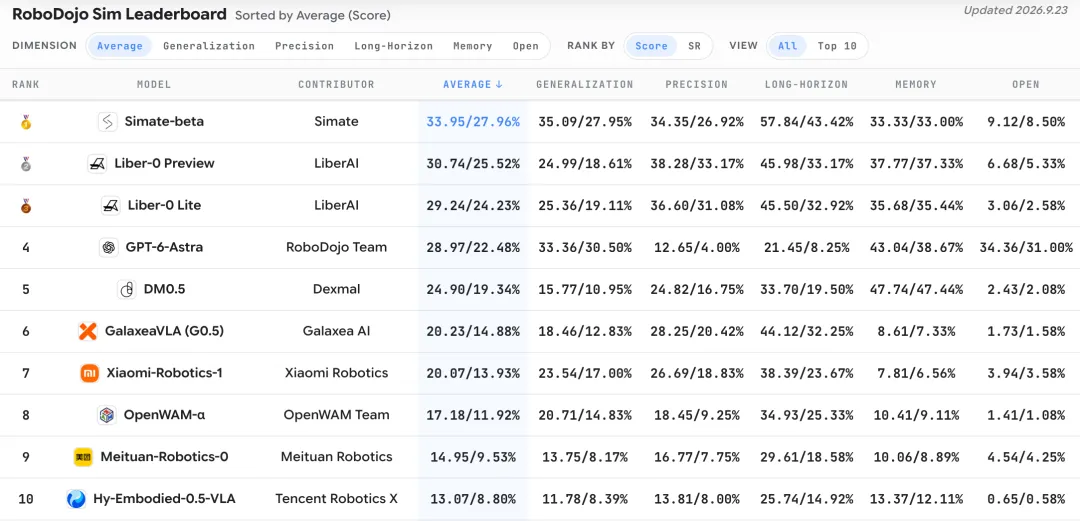
The link to the website:#news
The autonomous research infrastructure behind the Physical RSI:
Make "doing research" a sustainable operating system
To avoid becoming a code-generating toy on paper, automated research systems must have a robust physical data input, a modular algorithm base, and strong engineering infrastructure support.
To this end, Simate is building an autonomous research infrastructure that connects models, data, experiments, and feedback so that researchers and agents can ask questions, execute experiments, analyze results, and bring the experience to the next round of research in the same system.
Physical RSI requires an AI-native model framework, a researcher-friendly research memory and collaboration system, and a collaborative backing of AI-native data and infrastructure. The engineering behind it enables model modification, cloud experimentation, and the continuous linking of feedback to human judgment, and the use of effective methods and experience for the next round of research.
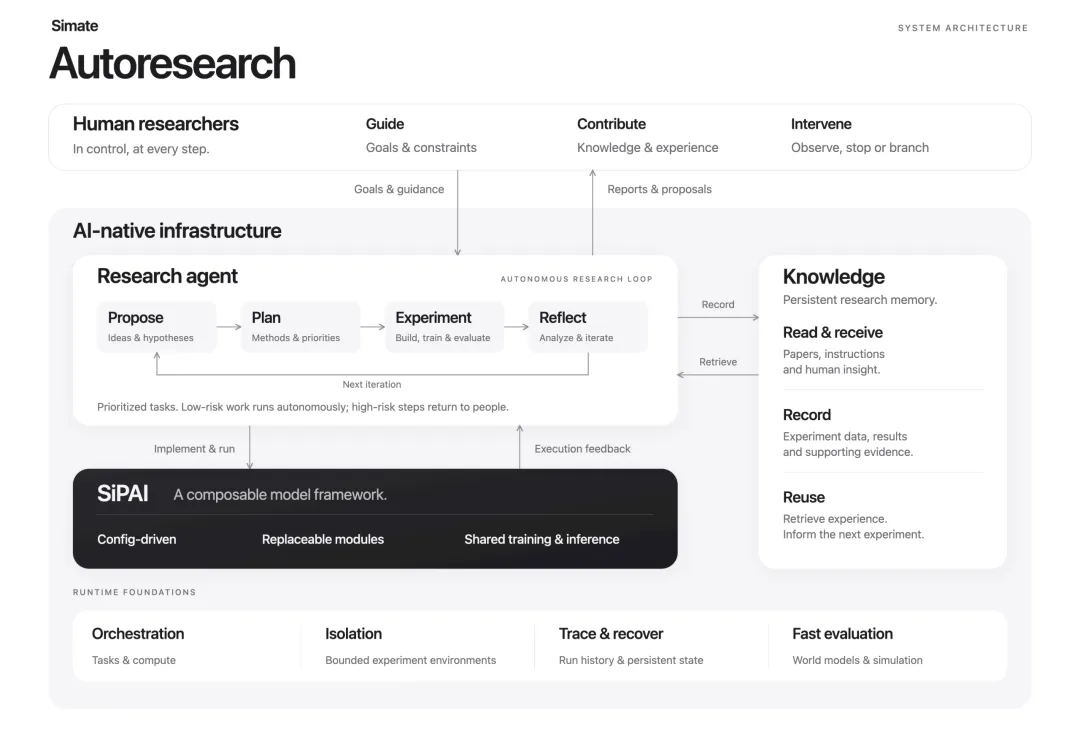
From research goals, model modifications, cloud experiments, to evaluating the relationship between feedback and artificial decision-making.
1. The first is the study paradigm of the weak RSI of co-driving robots.
The weak RSI paradigm defines the way in which human-machine collaboration works. Low-risk, easy-to-verify experiments are continually promoted by the Agent; nodes that encounter high-risk or require senior professional judgement are actively submitted to the decision of the researcher. Human researchers can intervene and adjust constraints at any time and really do "continuous advancement of the system, with the researcher always in control".
The core change in this model is that researchers are freed from carrying out repetitive experiments, putting more effort into problem definitions and directional judgments, while AI is an extension of research capabilities.
2. Pull-out model baseline SiPAI: making research ideas truly implemented into model changes
In order for Agent to be truly involved in model research, the model itself must be able to be understood, modified, and validated by the system. Simate builds the foundation for modular model development.
SiPAI uses highly soluble, removable designs that uniquely support multiple mainstream avant-garde architectures, including the World Model (WM), the World Action Model (WAM), the Visual Language Action Model (VLA) and the Visual Language Model (VLM).
Based on SiPAI and AutoResearch, the system has begun to explore key issues in the study of robotic intelligence:
Optimization of training and reasoning efficiency: system optimization revolves around computational integration, training of reasoning acceleration and distributed loading, improving the outcomes of the breastfeeding framework itself to make subsequent experiments run faster;
Memory balance of historical information: in the face of long-range tasks, the more the model retains the context, the better the system searches for the best balance between critical memory selection and running expenses through experiments;
Training Recipe with accurate comparisons: dynamic comparison experiments around key moves, easy to fail moves and samples of varying difficulty, directly answering "what data to use and how to train next";
Action execution and closed-loop deployment strategies: predicted continuous actions are not necessarily fully executed, and the actual length of Action Chunk execution directly affects the physical feedback frequency; the system experiments together with the execution of length, dynamic adjustment strategies and motion compensation to allow prediction and deployment to improve in sync in the same process.

3. Large-scale real-world physical data systems: allowing robots to experience the real world continuously
Utilizing Generalist's technology to scale real-world interactions and drive pre-training, Simate uses the UMI-based data collection system to carry a variety of tasks, objects, and scenarios in a unified observation and action interface.
In data governance, teams do not simply pursue the number of hours, but implement timeline alignment, trajectory quality, task coverage and training in four dimensions, driving collaborative expansion of high-quality data, model capacity and training computing, thus inspiring new task adaptation, skill combinations, and high-level emergencies such as unexpected recovery.
Based on this, the team explores transferable perceptual and motion characteristics, as well as higher-level emerging capabilities such as more steadily stimulating new task adaptations, skill combinations, and unexpected recovery.
4. Closed-loop mechanism: Research and data interact within the same system
For Physical AI, real deployment is not the end of R&D, but the beginning of the next round of research.
To this end, Simate has established a multi-level assessment and feedback system:
Agent assumptions are independently verified by experiments using models and data;
World Model Assessment and Simulated Closed Circuits provide high-frequency instantaneous signals to help the system rapidly disconnect positioning capabilities;
The final model is sent down to real-world physical robots to execute missions, and in real-world physical world encounters with contact slippage, trajectory cartons, or missions failures are systematically structured and re-deployed as the basis for the next round of Agent's study of the hypothesis and the adjustment of data ratios. Eventually, the physical world's exposed problems are transformed into "fuels" for self-improvement in computing and algorithms.
In this process, the physical world is no longer just a model deployment scene, but also an important source of model evolution.
5. AI-native Infra customized for automated trial and error
When multiple researchers run experiments in parallel with dozens of Agents in the same cluster, the traditional deep learning infrastructure based on scheduling scripts is apparently insufficient to support the need for a new infrastructure for Agent research.
For this purpose, Simate's built-in AI-native Infra provides the ability to include multi-agent sorting, multi-card unified scheduling, experimental environment management, fault recovery, and unified experimental asset records.
This ensures that the cluster will not be disrupted by individual crashes even in extremely high concurrent automation trials, and that all previous experiences of failure and success can be duplicated in a mix between different Agent and model versions.
In addition, the system also provides the observability of the research process. For example, the research spectrum can record different research directions, program branches and evaluation states; the running timeline can show the relationship between training, evaluation, diagnostic tasks, etc., so that researchers can understand which directions are continued, which programs are eliminated, and why the system enters the next stage of exploration.
According to the company, researchers can now learn about the system and apply for a trial via SiMate's official website. The system diagrams explain how the links are connected, real-life cases show how improvements are generated, and open inputs allow external researchers to learn more about the actual use of the tool.
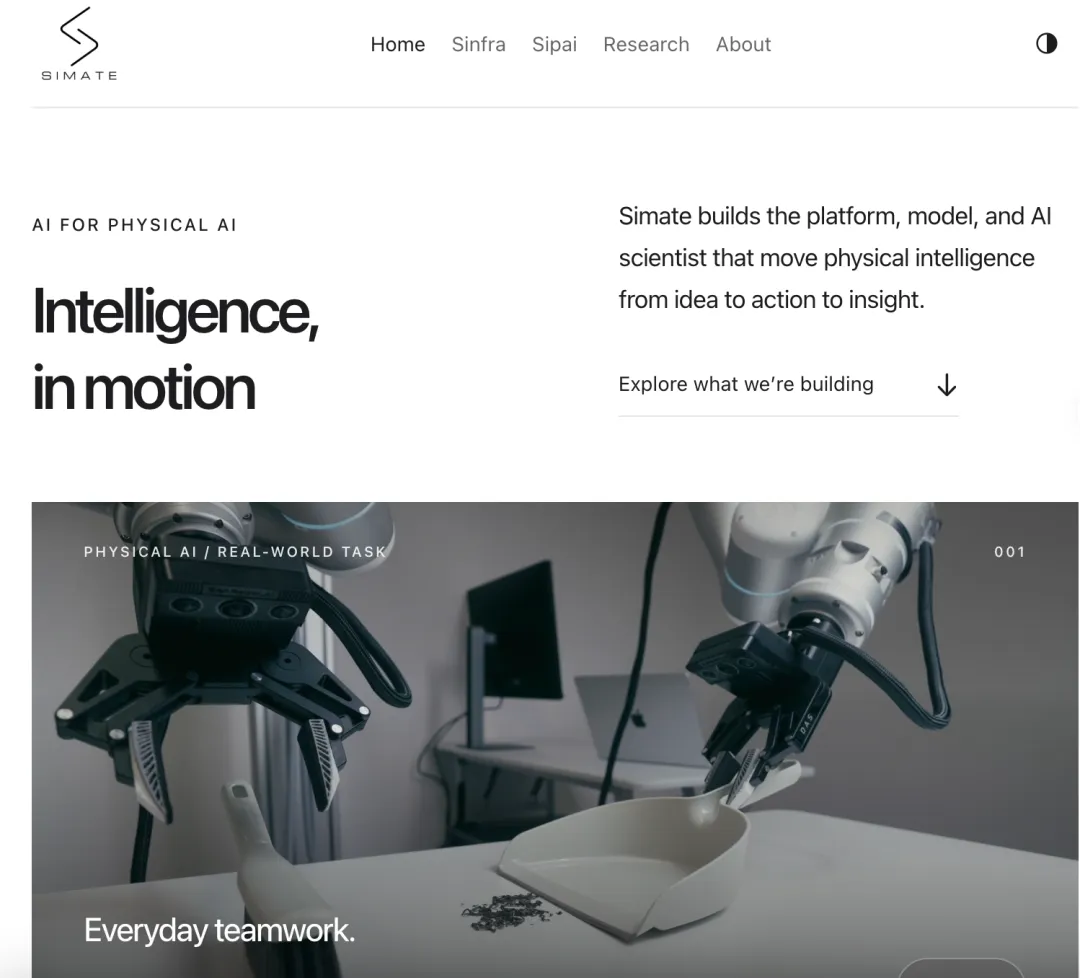
The official link:
Using 4D physics perception and memory to create a universal physics fast system
AutoResearch serves one clear goal for Simate: to build a large-scale, real-time deployment of physical native systems with 4D physical perception and memory mechanisms at its core, to improve the continuous execution of complex tasks, and to advance general operations to small samples and even zero samples by synchronizing with slow systems.
This goal is also echoed by leading-edge companies such as Generalist's exploration of general robot models and new task adaptations, the scale of which will be revealed in subsequent technical reports. Simate hopes to make larger model capacities compatible with real-time physical interactions through visual coding, time-space modeling and feature compression.
4D Physical perception focuses on spatial structure and its changes over time, allowing depth, geometry, motion and contact information to serve directly to understand and generate motion. Memory mechanisms revolve around task progression, continuity and immediate feedback on organized historical information, enabling models to take advantage of past observations of continuous action, and to coordinate long-range tasks with real-time responses.
This virtual machine demonstration further demonstrates the ability to adapt to tasks based on demonstration, memory, complex long-range execution, and precise operations. From understanding the task clues in the demonstration, to retaining the necessary information, connecting multiple movements, Simate hopes to replicate the model's acquired capabilities in more new tasks and new scenarios, reducing the input of specialized collection, training, and engineering debugging.
The ultimate test is whether robots are able to accomplish tasks with less adaptation and reliability when tasks, objects or environments change. This also determines whether model progress can be converted into actual commercial value.
A three-stage roadmap of the Physical RSI from co-driving to full autonomy
With AutoResearch taking first place on the RoboDojo list, Simate proved the engineering feasibility of its current "weak RSI" study paradigm, but for Simate, this was just the beginning, and the team set a clear three-phase evolutionary path for Physical RSI.
Stage one, weak RSI (Human-in-the-loop): Human researchers propose assumptions, set goals and constraints, agent autonomous program improvement, experiment execution, evaluation and feedback feedback.
At the heart of this stage is the proof of AI's ability to enter robotic research processes.
Currently, Simate has received solid engineering verification through AutoResearch's RoboDojo.
Stage Two: Strong RSI: Agents begin to undertake more research work, including attempting to independently propose research hypotheses, plan experimental pathways, and evaluate research directions, while humans shift to target governance and critical decision-making oversight.
At present, this is Simate's approach and is still being explored.
Stage 3: Fully Autonomous, Recurring Self-Improvement with No Human Participation: Research, data, models and real-world deployments are fully enclosed by systems operating autonomously, while physical intelligence evolves autonomously in continuous operation.
In fact, it can be seen that the role of R&D personnel will take a profound turn as the weight of system autonomy gradually increases: they will be freed from the burdens of experimental configuration and configuring to become top-level architects of defining system values and security boundaries.
From top-of-the-line intelligent driving systems to the fusion of world models and robotics
Similarly from Intelligent Driving, the team's technical accumulation can vary greatly. From graphics, graphics, to an end-to-end model, representing different technology paradigms, the Simate core team is on the third generation technology path and has delivered top-notch results in this direction, as well as a national minority of Intelligent Driving systems comparable to tesla fsd.
At the same time, assistant professors at the Hong Kong University of Science and Technology, the head of the World Mind Lab, and others with North American robotics research and entrepreneurial experience joined in bringing together research on world models, 3D vision, sophisticated operations and human control.
The combination of leading-edge engineering skills and the creativity of young researchers enables the team to advance models and systems from zero to zero and transform long-term accumulation into the pace of research and development after entering new fields.
Written at the end
A technological paradigm needs to move from the internal capabilities of a small number of teams to the infrastructure that more researchers can use in addition to technological breakthroughs if it is to truly influence the industry.
For a long time, robotic intelligence research has often faced higher thresholds: expensive robotic hardware, complex machine maintenance, high demand for computing, long-term data accumulation, etc., which limit the participation of large numbers of research teams.
In other words, the Physical RSI needs to be further developed by lowering the research threshold.
Based on this, Simate has opened its automated research system to in-house and outdoor university students in China, North Korea, MIT, California Tech, Harvard, and Gotham, and has been used by researchers. Subsequently, Simate also plans to gradually open up infrastructure tools to the industry to cover data, train and evaluate the entire process, supporting its top engineering capabilities in broader research and applications.
Simate believes that if the research automation capabilities represented by AutoResearch could be platformed to universities' laboratories and independent developers, the innovation cycle of the entire robotic intelligence pathway would be greatly reduced or squeezed. In the future, more researchers may be involved in robotic intelligence exploration as the research infrastructure for automation becomes more open.
Taking the number one spot on the RoboDojo list, which won Simate a beautiful landmark, but more industry-inspiring piece, is the possibility that it demonstrates: when the icy mechanical arm and the cluster of algorithms can not only perform tasks, but also learn to autonomously study the physical world in real collisions and wear, the evolutionary speed of physical intelligence, and perhaps break the clock limits set by the human body...
Finally, the AutoResearch Science Research Platform is currently in the heat of the moment, and interested friends are welcome to sign up!