At the recent 2026 Exam Conference, Northeastern University's Assistant Professor Feng Ling's share of "long-range mission learning" sparked industry attention. As AI moves from single-question to long-cycle complex tasks, how models accumulate from continuous interaction evolve.
Soon after, PhAI Labs released the interactive research workspace ScienceBuddy, the AItonomy Foundation launched the science research and development environment ScienceIDE, and in two prominent collaborative lists, Muchen AI emerged as a joint R&D and technology supporter.
Founded in Chongqing in 2024, this AI data engineering company, which is neither at the core of the Internet nor a model manufacturer, why is it often cutting into cutting-edge research and industrial projects?
In the second half of the big model,
The core of data services has long been not "stacks".
Large models are entering the complex task landing stage, and the competitive core of data services has long shifted from "sample quantity" to "process quality". The question of whether task boundaries are clear, whether evaluation standards are uniform, whether execution links can be traced, is becoming a more critical underlying capability than data size.
This is exactly the direction that Shenzhen Technology has taken since its inception: the delivery of data services includes not only the sample itself, but also making the sample available for task definition, judgement basis, quality recording and iteration mechanisms. In this, the structured evaluation standard (Rubric) is the core of the entire system.
Writing a scoreboard, however, is not the end. Standards must also be double-blinded with real samples to resolve differences in judgement among different people; models must be updated in order to avoid failure of the old standards; and production processes must be deeply bound to ensure that each batch of deliveries conforms to the same scale.
In this model, data production is no longer a one-time buy-and-sell, but a long-term operation that spans multiple model shifts. Chen defines it as Long-horizon AI Data Operations: long-term data engineering and evaluation operations for complex AI systems.
From delivery samples to delivery systems,
Commercial verification of long-cycle engineering capabilities
The idea is ultimately grounded in a real-life business scenario.
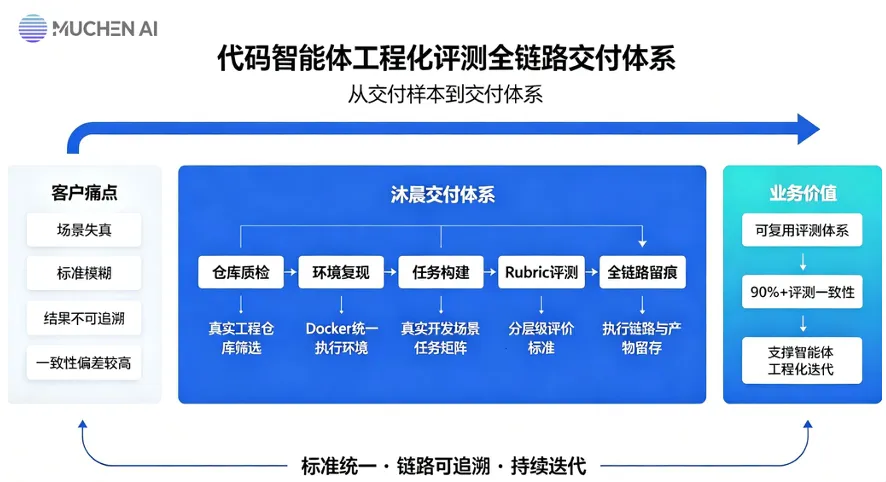
One of the leading code large model manufacturers has encountered a core bottleneck when advancing code intelligent engineering landings where the assessment system is detached from the real development scenario: traditional evaluation is based on isolated algorithm problems and simplified demos, tasks are detached from the real engineering environment, scoring dimensions are rough, the consistency gap between different people and different models exceeds 30%, which cannot effectively support the evolution of the real engineering capabilities of the intelligent body.
Instead of adopting the traditional delivery model of "producing samples on demand", Chen built a whole-link engineering assessment system for customers from warehouse screening to result tracing: establishing real code warehouse quality assurance standards, screening project warehouses with complete business logic and engineering structure; building a unified reproducible Docker container execution environment; designing a task matrix covering real development scenarios such as bug repair, functional development, engineering configuration; supporting sub-level Rubric evaluation standards and a full-link execution trace mechanism.
All tasks were completed in the Trae environment to independently validate the running of five mainstream code models, fully preserving execution links, scoring based on git diff products. The final evaluator's consistency was increased to more than 90%, the replicable rating system delivered, and the engineering capabilities of the client code intelligence continued to support iteration and multi-version optimization.
For Chen, single-cycle project acceptance is not the end goal, but rather the ability to build a continuous delivery capability across multiple rounds of tasks and model iterations. Compared to traditional data companies' "take projects, do deliveries, tie people together" models, this threshold for long-cycle operations is higher, but also creates deeper customer viscosity and business barriers.
In the two years since its founding, Shenzhen has expanded its capabilities from general big model data evaluation to multiple models, smart bodies, and other scenarios. More importantly, the company's growth is not dependent on low-cost manpower expansion, but is accompanied by continuous optimization of the revenue structure: high-value evaluation schemes, steady improvement in long-cycle operational services, continuous growth in customer repurchase rates and project average cycles, and a "quality priority" growth pathway.
It's a great way to get into the scientific scene.
Putting verification systems into AI research processes
If the commercial landscape confirms Chen's engineering landing capabilities, it's taking part in the joint research and development of ScienceBuddy that extends this capability to more advanced areas, and allows the closed loop of recursive science missions to "discover, dismantle, verify, and reverse" to truly achieve engineering landing.
Scientific research demands that results be credible far more than commercial scenarios: whether a scientific analysis is credible, cannot only be seen as to whether the text is flawed; whether a numerical calculation is acceptable, or whether the procedure is rejected. Methods, reference results, units, scope of errors, and experimental conditions all affect the effectiveness of the conclusion.
ScienceBuddy, published by PhAI Labs, focuses on the ongoing interaction between scientists and AI Agents in real-world research, where researchers ask questions, modify targets, evaluate outcomes, and systematically record complete tool calls and execution trajectories to provide a basis for understanding the behavior of the intelligent organism.
In the joint R&D division, the three main platforms form a connected closed loop:
PhAI Labs oversees the design of the recurring science mission central architecture and overall product interaction frameworks, as well as mission scheduling, state management and outcome-determination functions;
In collaboration with PhAI Labs, Chen is responsible for promoting the research and development of scientific discovery platforms, collecting scientific questions, generating candidate programs, and standardizing outputs of verification tasks.
The framework system design and engineering landing of the scientific verification platform is entirely the responsibility of Chen Chen, who has built a multi-level scientific inspection mechanism, structured trajectory recording system and automated scoring framework at the core.
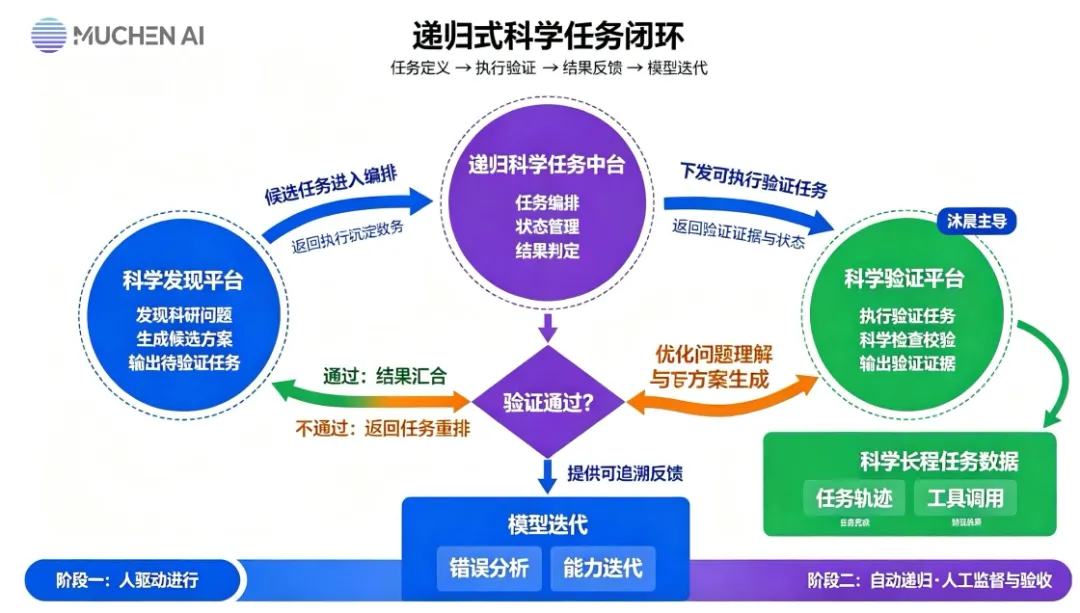
The scientific verification platform is not an isolated execution node, it forms a recursive link with the scientific discovery platform through the central platform: the results of the verification process flow back to the central platform, which, if determined to be insufficient to close the root problem, will drive the scientific discovery platform to optimize the understanding of the problem, generate iterations, and re-enter the verification link to achieve a gradual regression of the problem. With process standardization and data immersion, the closure is shifting from "human-driven regression" to "automated regression evolution, gradual execution" to artificial supervision and acceptance roles.
For the scientific verification platform, Chen integrated this capability into a scalable industrial service, independently producing the Sci/Eng scenario Agent evaluates the data set link delivery system: covering more than 10 professional areas: mathematics, physics, biology, engineering, designing complex multi-step tasks based on real scientific research workflow, using "MCP interface framework + professional tool call steps that require Agent to complete multi-step execution, evaluate model decoding products using automated script scoring, and fully deliver task data, reference answers, operational trajectory and environmental replication descriptions".
The final delivery was not a fragmented single-issue sample, but an end-to-end reproducible standardized evaluation benchmark system. Its inherent logic of "task definition, task execution, task verification, feedback, task retrieval capability" is the direct replication of ScienceBuddy's recurring closed-loop capabilities in industrial scenarios, which can be directly used for continuous retrieval verification of multi-model horizontal versus long-range task capabilities.
The shift from commercial delivery to collaboration in research is essentially the same underlying capability: the ability to dismantle tasks, rubric standardization capability, process traceability, failure analysis capability, as well as the ability to define research tasks, scientific inspection standards, track record execution, and verification outcomes. The shift is the application scenario, not the core logic of "turning ambiguous needs into verifiable, replaceable, replaceable standards and processes".
Why is it dawn?
The underlying logic behind the two-year run at the track
A company founded just two years ago by an AI data engineering company that runs a dual-race of commercial deliveries and cutting-edge scientific research at the same time, neither accidentally adding resources nor short-term marketing forces, but the inevitable result of a clear differentiation strategy.
Founded in February 2024, the core team has extensive experience in data engineering and model evaluation, and collaborative clients come from leading model manufacturers, AI data enterprises and research institutions. At the beginning of its founding, the team avoided the high-value direction of "stack of people, low-priced low-end data marking Red Sea, long-cycle data engineering and evaluation operations".
It is this "heavy-standard rather than stack number, heavy-long-term rather than one-off" business gene that enabled Shenzhen to build a stable whole-process quality system in commercial deliveries, as well as smoothly migrate capabilities to the research scene, supporting the joint research and development of cutting-edge projects. In the two years since its founding, the company has expanded rapidly from a five-person core team to more than a thousand people, simultaneously opening offices in cities such as Xi'an, in order to absorb more local talent.
According to the company's strategic plan for three phases from 2026 to 2030: a period of basic strengthening in 2026, runway capacity is defined and a double growth chain is implemented with enterprises; a 1 billion yuan annual revenue capacity is formed in 2028, and a large-scale replication of high-value capacity is completed; a capital attraction process is launched with a port-share IPO in 2029, with the goal of growth as a core service provider in the field of AI infrastructure.
What is the meaning of this verse?
As AI moves from "usable" to "useful", from general dialogue to complex tasks and scientific research, the underlying infrastructure that supports model generation is being redefined. Data is no longer a one-time production medium, but a continuous operational element of model generation, task execution, and scientific verification.
From commercial delivery to research and exploration, the growth path of Shenzhen Technologies is also a shorthand of China's AI industry's ever-growing subdivision. At a time when the leading manufacturers are focusing on the breakthrough in model capabilities, it is a group of deep-rooted underlying projects that make deep-rooted standards and verification, forming the foundation for the steady advancement of the AI industry.