
It's the first time in the history of the world.
The latest big news in the AI circle is that it's finally on the list of non-big models.
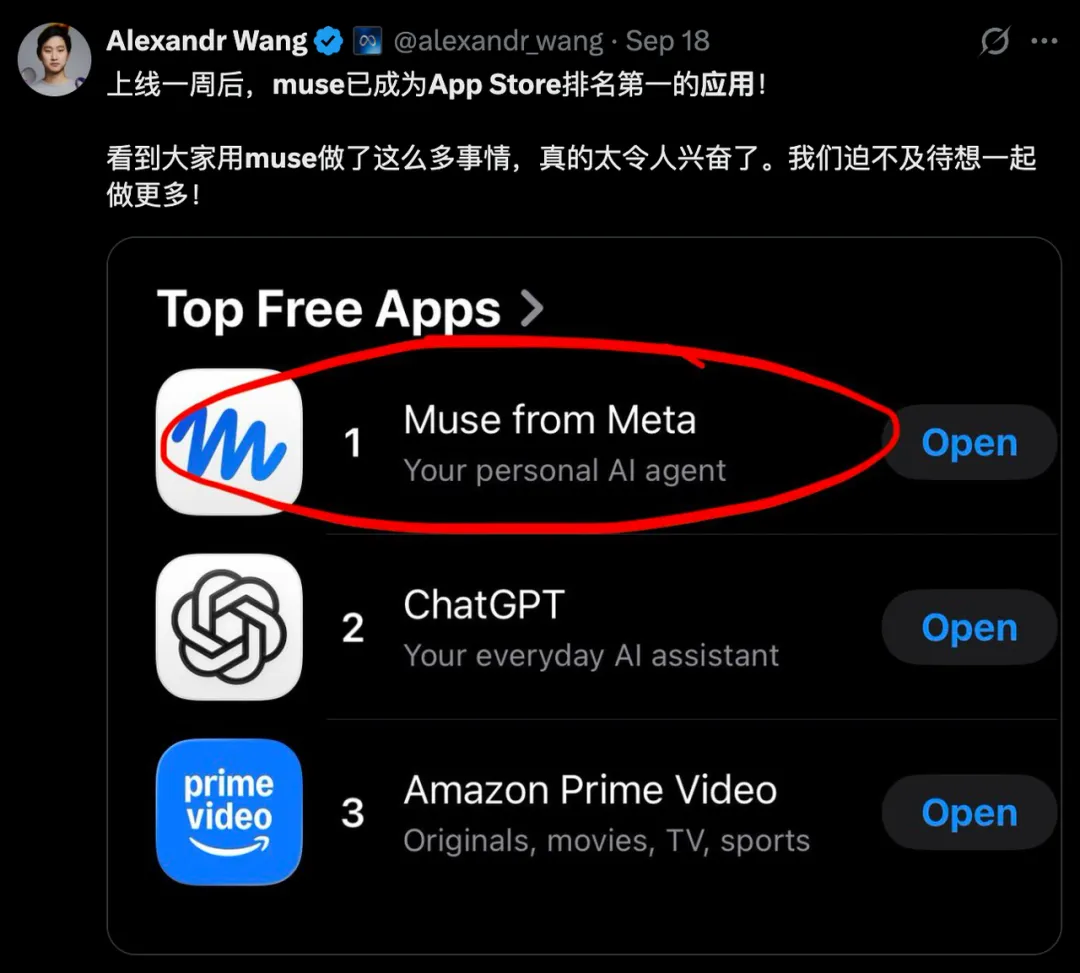
Meta's personal AI assistant Muse went online on September 8, and in less than a decade made it to the top of the U.S. App Store free list, squeezing ChatGPT to the back.
This is directly reflected in the price of shares. On Monday, Meta shares rose by 11.43%, and Rich Country Bank raised the target price from $640 to $796.
An app went online and caused a stir in the financial news.
Wall Street is really starting to grind: how big a business can an AI that works for ordinary people really be?
In the same two days, volumes were also handed over on the domestic side.
On September 22, at the Cloudflare Conference, the company announced that it would accelerate its efforts to become a "Personal Agent": relying on the Qwen 3.8 model's ability to build a completely new form of Personal Agent to provide sustained, personalized intelligence services to 300 million users.
This topic has become a new topic in the second half of AI.
Put down a thousand puzzlesAI finally takes care of your troubles.
People in the circle were talking about AI, and they always asked questions like: math problem solved, code written too fast, how many run scores did you get?
These are important, of course. But for the vast majority of ordinary people who don't code, why would an app stay on their phones?
Muse fire, fire here.

Meta's way is to give each user a cloud computer and a browser directly. You just have to say something on WhatsApp, and Muse can check the tickets himself, fill out all sorts of busy forms, and even refund the customer's money.
One user's Delta flight, which was delayed for seven hours, threw the mess directly to Muse. Five minutes later, $250 in compensation was paid, and the ticket was booked.

Alexander Wang, Meta's chief AI officer, called Muse "the first AI for people who don't believe in AI".
In one of his posts, the wife of a user who is extremely disgusted with AI, has piled up 160,000 unread promotional emails in her Gmail and deleted them manually for several years.
After Muse took over, it lasted three days. In the midst of hitting the back-crawler limit of Gmail several times, it went by itself and finally cleaned up the 160,000 spam emails.
A person who used to hate AI is also angry about this.

When AI is able to capture these terrestrial gases, it changes its relationship with us -- from "occasionally tasting fresh toys" to "the personal assistant you talk about".
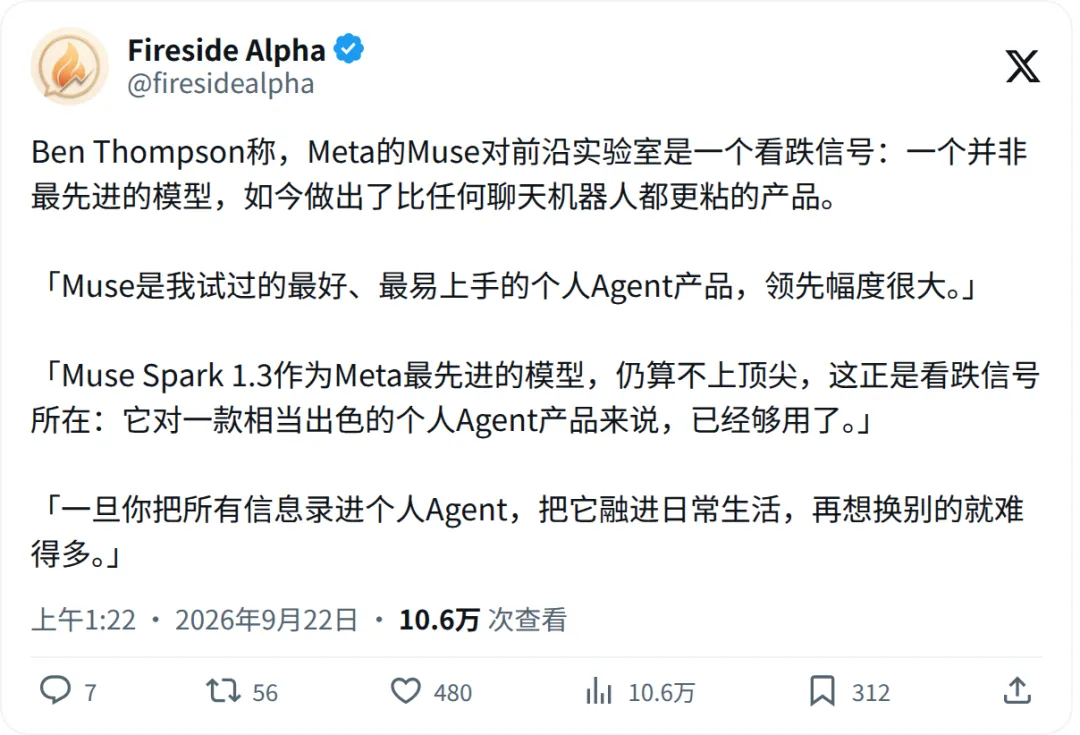
Is the model behind Muse's Spark 1.3 stronger? Well-known analyst Ben Thompson said it was "not even top-notch". But he went on to say that it was the best and lowest personal agent he had ever used.
This is enough for a personal assistant who works as a helper.
Think of it this way, when you have dozens of agents on your cell phone buying food for you, paying for it, booking a hotel for you, how much math does that take?
After "Gangers Write Code", "Gangers Run" is opening up another huge consumer market.
Say goodbye to cyberspace.Ask them to put the whole thing in context.It's time to go back to the country and ask more specifically how to do this.
"Let everyone have their own AI assistant" was the slogan of thousands of people last year. Access to the Ali ecosystem, open platforms, push small agents, is actually bridging the gap between "you ask for it" and "it's done".
The question of "Unified Context" is that we talk to AI later, and finally we don't have to "introduce ourselves" every time.
For example, if you set a goal, half a horse will run for two hours.
After obtaining your authorization, ask if you can remember your fitness status and even connect your dynamic glucose meter.
You've been running tirelessly today, you've been in bad shape lately, and it's all about going in and giving you training and dietary advice tomorrow.
Wait, who's really running at this speed, and it's going to jump out and say, "Good run, let's hurry for an hour and 40 minutes?"
The goal is still the goal, but AI knows how to keep up with your status.
Thousands of businessmen are lined up waiting for you.
To be able to remember you, it's just the first step. To really get into everyday life, AI needs to have professional skills and tools that really work.
In this section of finance, thousands of questions directly draw on professional financial data and institutional intelligence, even supporting some users to connect their own real holdings.
As long as you authorize it, AI will be able to piece together your personal financial goals, real-time big business, institutional research and analysis.
The expertise of financial institutions is encompassed as a skill that can be used.
Of course, AI is only responsible for the idea, and the final decision is up to you.
In addition to finances, there are many other things that can be done.
The open-source platform now covers more than 20 areas, with more than a thousand business owners lined up for sales, ticketing, housekeeping, job searching... the daily needs you can imagine are slowly coming in.
Models are responsible for moving the brain, and third-party tools are responsible for moving the hands.
300 million people, each with an AI assistant
A key word in the progress of this announcement is scale.
The most realistic problem is money, as a personal agent for 300 million people.
Allowing AI to help you follow a task, which involves repeatedly judging, manipulating tools, continuously tracking, and consuming computing power to follow a recipe is not a measurement at all. If it's too expensive, it's unpopular.
In order to calculate this bill, thousands of people have done special optimizations and added dynamic regulation technology to save tokens. The result is a 20% improvement in response performance, saving 40% of tokens consumed per user.
The value of AI will eventually fall into everyday life.In recent years, the AI industry has become accustomed to creating such a stunning "bedroom" moment.
But rather than being surprised, Personal Agent is more concerned with patience - the daily companionship of "you get the job done today, tomorrow you're ready to find it".
Alexandr Wang tweeted two days ago: "As long as the guy in the leather suit on LinkedIn hasn't found Muse, let's relax ourselves for a while".
This game is not meant to show the muscles of high-end gamers in the tech world, it's meant to steal from ordinary people.
Muse's explosion demonstrates that this demand is real and enormous, and what we're trying to do now is put "you know", "the tools" and "the environment" in a product map.
The next judging panel is no longer about scoring software, but about ordinary people's daily lives.
Less letting users fold themselves, more saving users ten minutes. AI blows so long, the ultimate value should always fall in the most real place.
RoboInd editorial channelResearch, robotics companies and market intelligence for cross-border sourcing.Explore the channel ↗
Share this
End of editorialExplore more from Global Robotics News ↗