In recent days, the Jev model has been a topic of discussion in the developer community.
Some netizens believe that while Jeff looks like a classifier, he has zero-sample capability and is near the cutting-edge model level. Many of the traditional machine learning ideas that have been overlooked may be worth re-excavating.

Karpathy commented that Jev was in a position on the Pareto optimal curve of the large language model to meet a class of long-term underestimated needs that did not require the model to carry out complex thinking, only to output a single token to make a reliable enough judgment under low-latency conditions.

After Jev went red, a model named Laya was quickly noticed.
Laya is an open-source multilingual System 1 decision-making model that completes classification and selection based on the probability of text output. Netizens refer to it as "the open-source version of Jev".
Currently, Laya has topped the Hugging Face Hot 100, followed by several local releases.
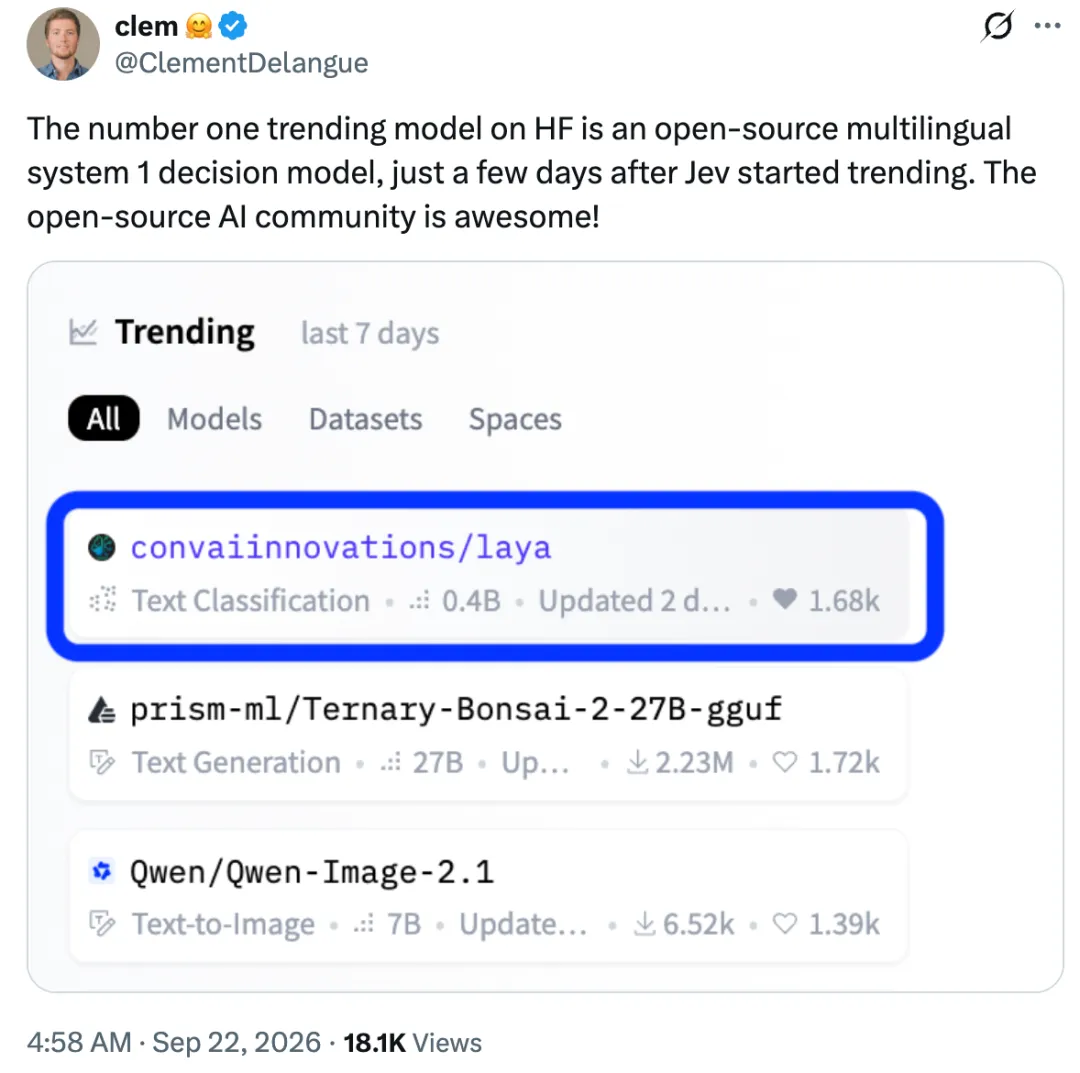
Laya becomes a hot model in a few days
One of the defining features of Laya is that it supports local operations.
The community project laya-mlx ported the model to MLX and performed performance optimizations.
According to the developers, the model has a maximum memory capacity of about 1GB when running on the device. On the M3 Max, it operates snake-eating, decision-making speeds of up to 60 times per second. The Core ML version reduces power consumption by up to 64% when the speed is basically unchanged.

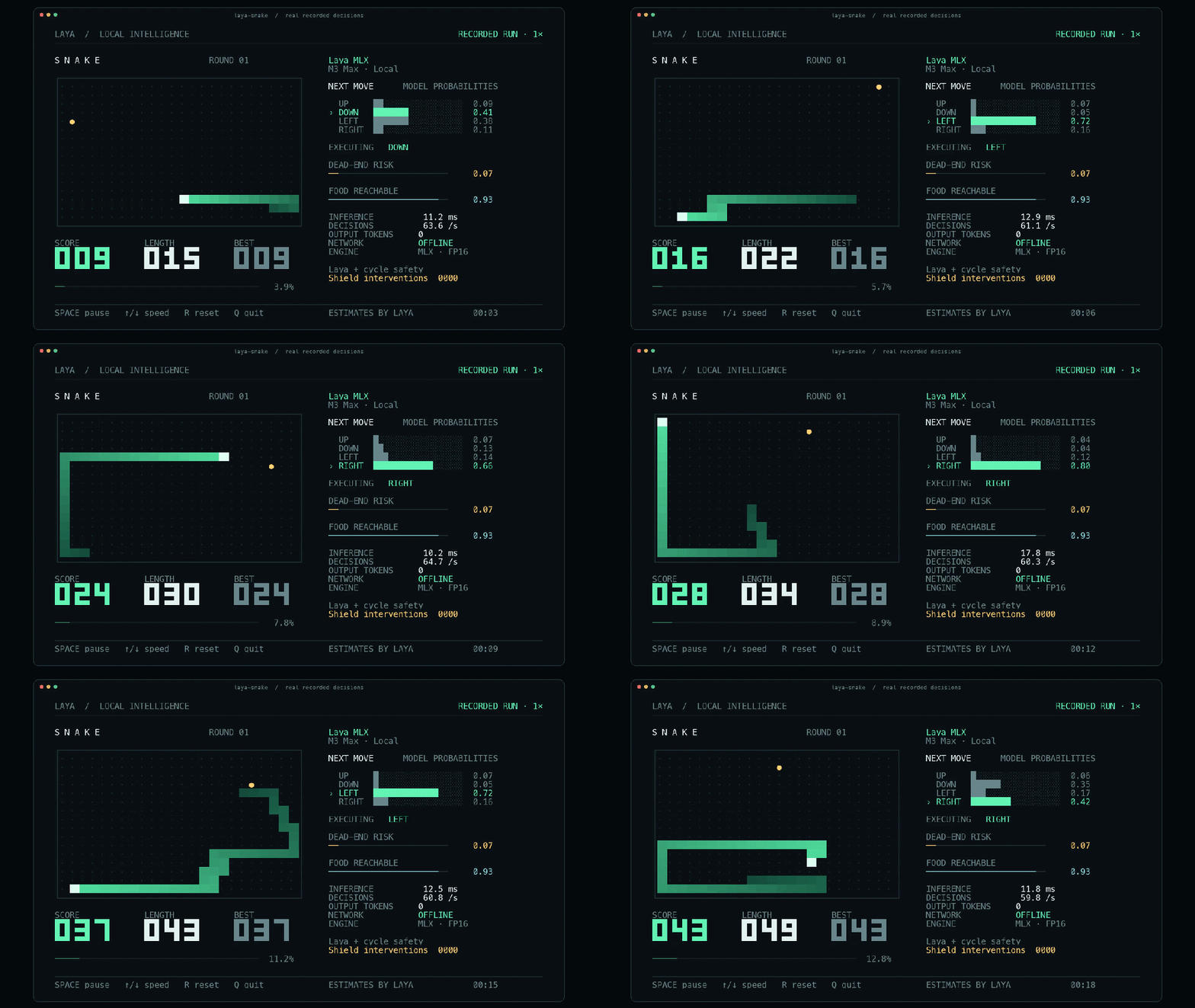
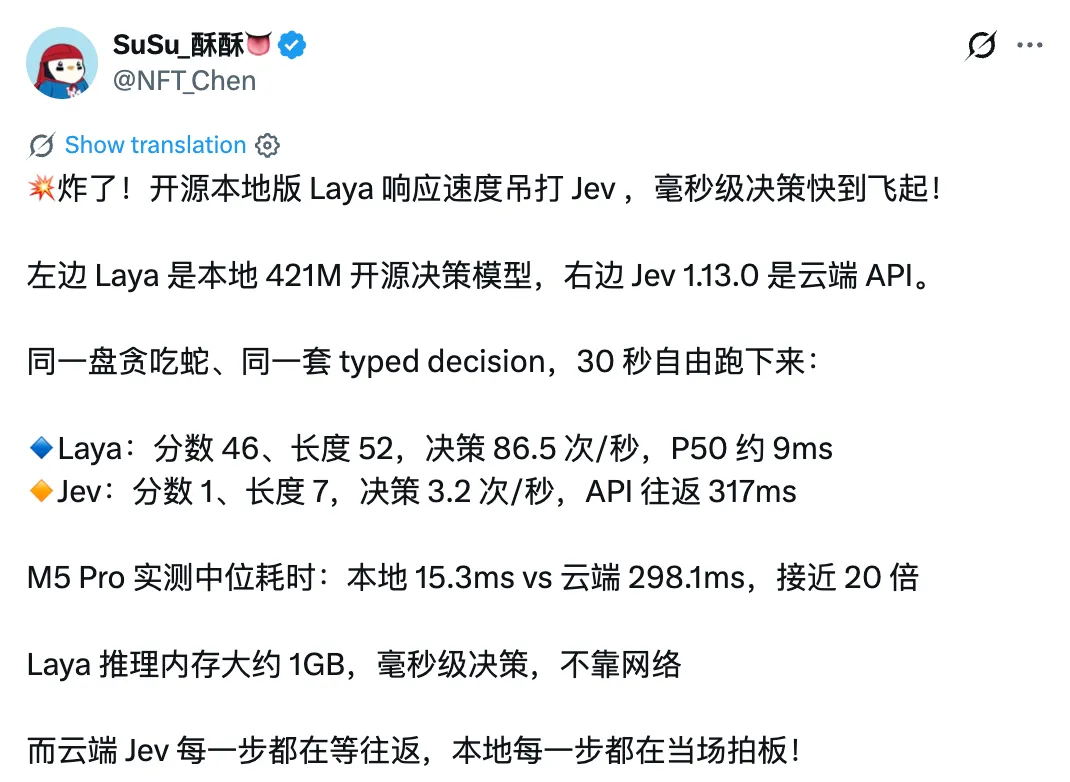
A community comparison test used the 421M version of Laya and cloud Jev 1.13.0, running the same set of typed decisions.
In 30 seconds, Laya scored 46 points, reaching a length of 52, an average of 86.5 decisions per second, P50 delayed by about 9 milliseconds; Jev scored 1, length 7, 3.2 decisions per second, API back and forth by about 317 milliseconds.
Another set of M5 Pro tests showed that the median time between the two was 15.3 milliseconds and 298.1 milliseconds respectively, with a gap of nearly 20 times.
In a Russian block test, netizens atomic.chat also said that Laya's decision-making speed on a 16GB MacBook Air is about 11 times that of cloud Jev.

The deployment behind the speed difference
These results first reflect the differences in deployment.
Jev sends the request to the cloud every step of the way, waiting for the results to come back; Laya completes the reasoning directly on-premises without relying on the network. For high-frequency interaction tasks such as greedy snakes, Russian squares, the delay gap of tens to hundreds of milliseconds is enough to change the final performance.

According to netizens, "Three days of online open source Laya beat two or three years of development Jev" and "Jev's walled river only lasted two days".
Jev and Laya show another path in big model competition, where the industry focuses not only on longer thinking and more complex reasoning, but also on the real needs of single-step decision-making, low latency and local operation.
The link is as follows: