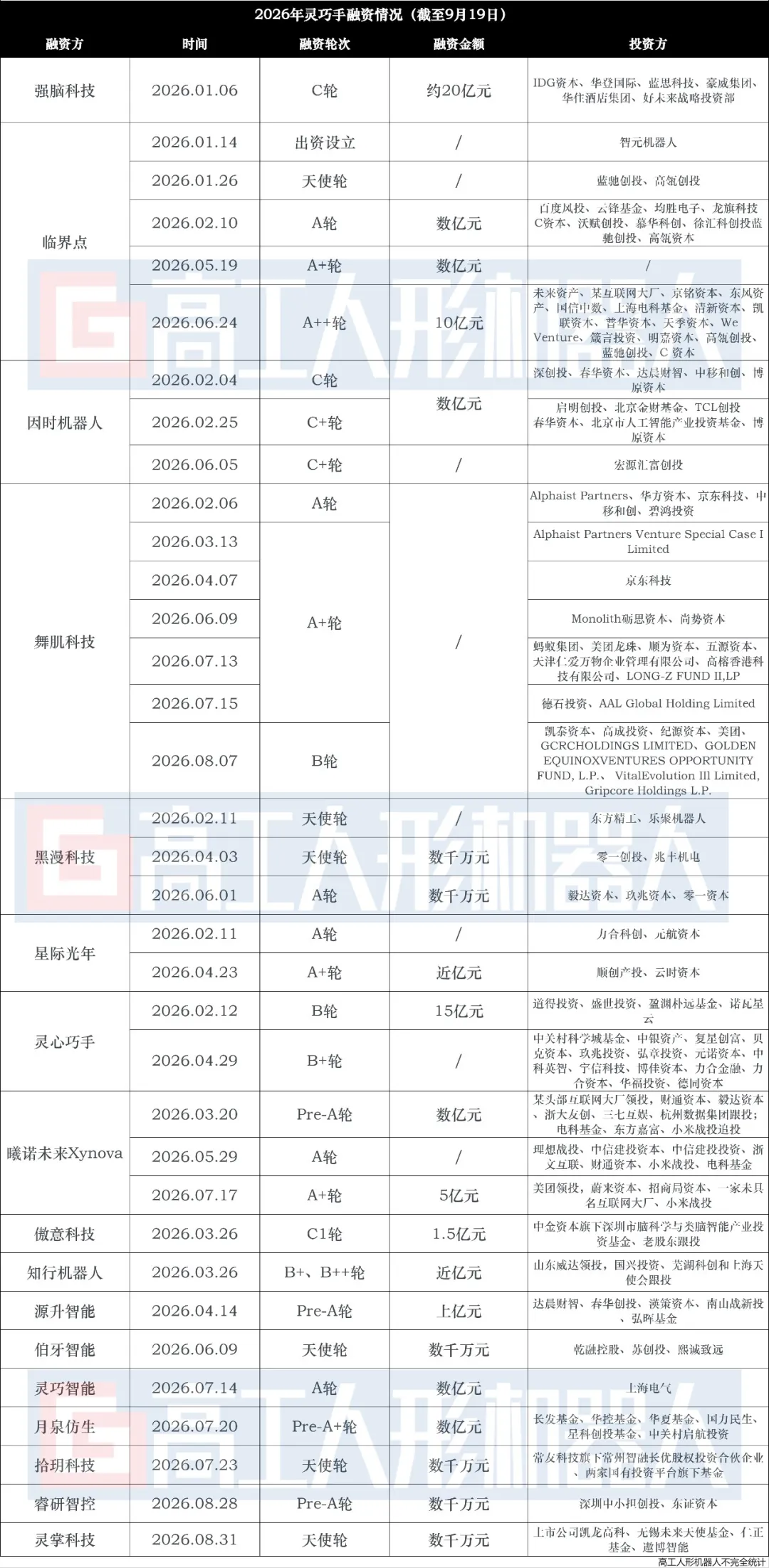
In terms of shipments, data from the latest GGII Research Report on China's Smart Hands for 2025 shows that in terms of sales, China's Smart Hands are expected to grow by 236.84% compared to 2025, with a growth of 265.63% in 2026, and a growth of 222.76% compared to 2026, in terms of market revenue.
Clearly, smart hands should no longer be viewed simply as a component of a humanoid robot, but as a complete system. They should not only provide end-to-end execution capabilities for the whole machine, but also be able to handle technical barriers, product definitions, business narrative and financial value independently.
With the expansion of the demand for humanoid robots and the doubling of capital expectations of warming, the agile racetrack has been characterized by a rapid evolution of product performance and technological convergence in a short time.
On the one hand, the demand for operational capability, reliability, and cost control is continually improving, forcing companies to accelerate product performance transformation; on the other hand, the pursuit of high-growth narratives by the end of capital and the tendency of many companies to follow the mainstream when the application scenario and industry standards are not yet fully aligned, resulting in a phased convergence of technological routes.
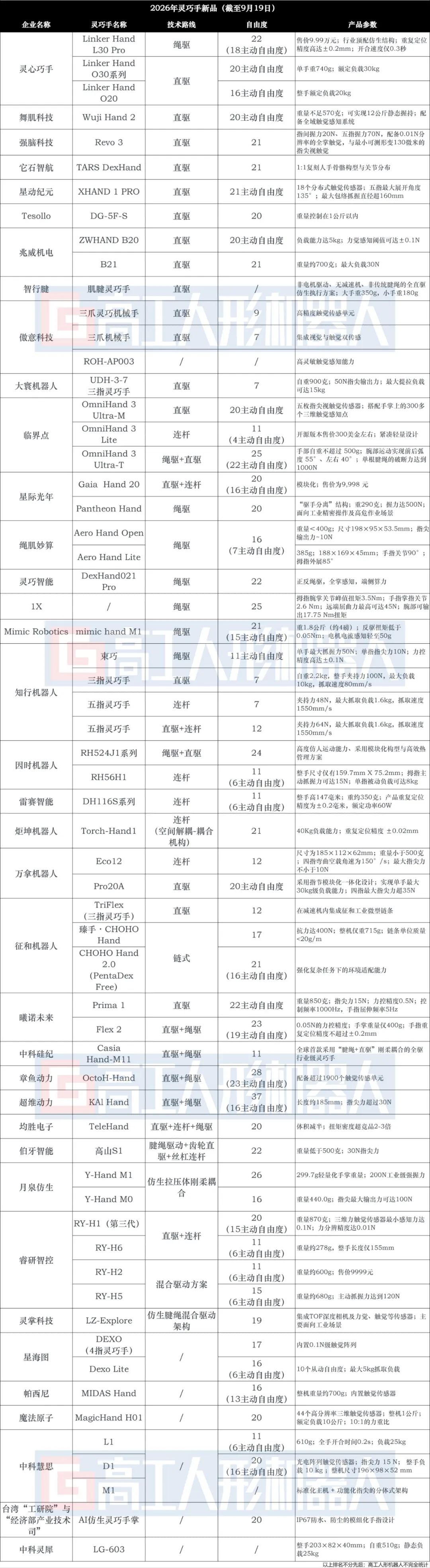
New developments in the smart hand industry in 2026 (as of 19 September)
(slide up and down to see)
As a result, the products draw on each other in terms of freedom, perception, drive, and control, while also pushing for new and fast shifts around metrics such as accuracy, load, touch feedback, service life and cost.
New ideas for smart hands
At the end of July, high-performance robotics made four judgments about the 2026 sleek handset:
In terms of landing scenarios, some of the new products are clearly geared towards industrial applications;
Biostructure is becoming an important landmark in product design, and the 1:1 homogeneous design is being reflected in an increasing number of new products.
There is also a growing focus on the diversity of touch perception schemes, and some companies have begun experimenting with full touch coverage.
Direct-to-direct programming has become the most popular technical route.
In less than two months, in addition to the four judgments above, we have again captured new changes.
First, the mixed-drive pairing became a hot spot for the layout.
In April 2026, the company released the world's first all-wheel-drive handset, the Casia Hand-M11, which uses a wire rope + direct-drive hybrid hybrid system.
As of August, Owl Power, super-dimensional power, and the robot-launched sleek innovations also follow the hybrid drive scheme.
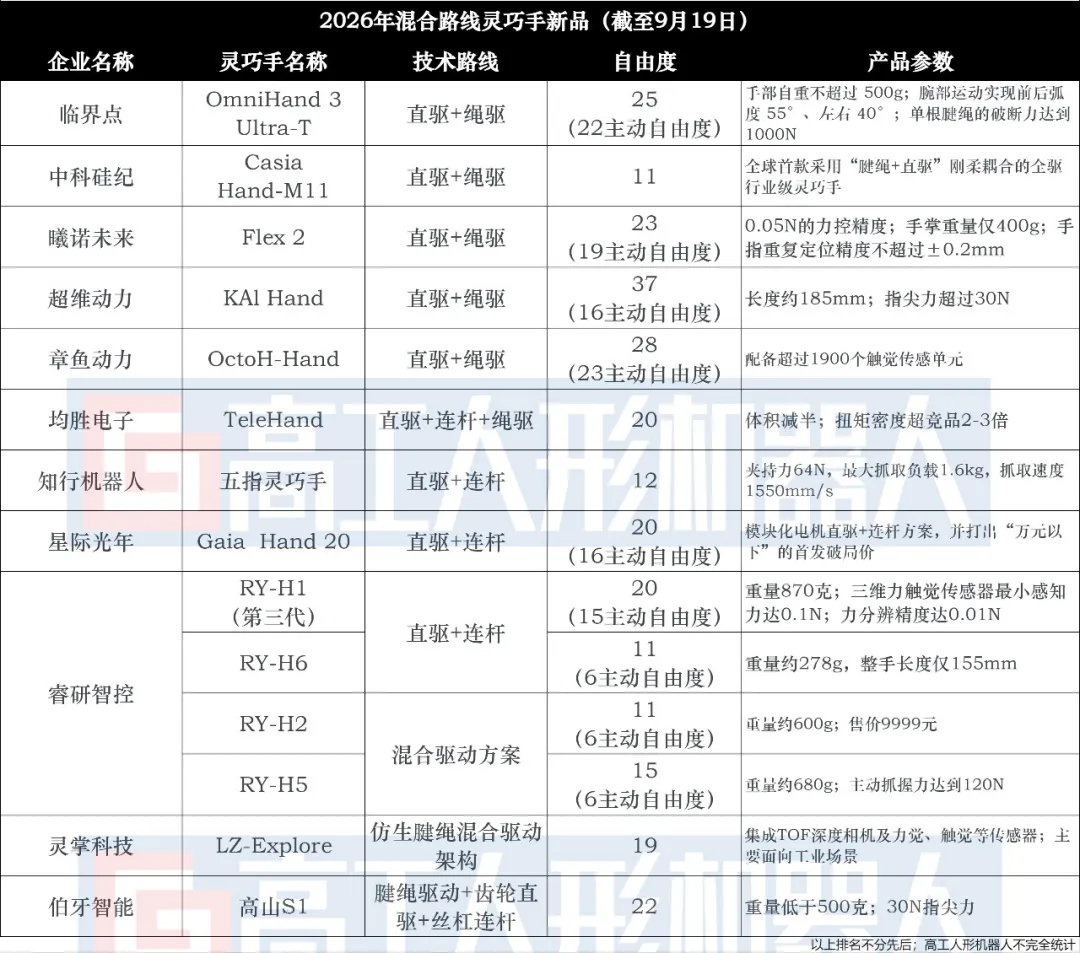
As shown in the figure, the route of a straight-drive + rope drive is the most common mixed-drive pair.
In the study, people in the industry told high-craftsman robots that there are alternatives to sleek-handed drive schemes, rope schemes that can be made with human hands in flexibility and size, but at the cost of sacrificing arm space, only using arm-handed integration design; the direct drive schemes are more friendly to the algorithm, but the motor costs are higher, the size is difficult to shrink, and the hands are too large to be a major pain point when landing on small ground. In contrast, the hybrid schemes are simpler than the pure rope schemes, but the direct drive is still the simplest, so the hybrid schemes can be considered an intermediate form.
GGII also gives a similar judgment that hybrid drives can complement different technological routes and are becoming a hot spot in the enterprise's layout. They are mainly based on rope drives and direct-drives, while improving response speeds, control accuracy and reliability while ensuring lightweightness and flexibility.
Second, enterprises rarely restrict themselves to a single product with a single degree of freedom, but instead introduce a product range with multiple degrees of freedom specifications based on differentiated needs.
This judgment is based on two main observations.
On the one hand, some enterprises present a variety of styles in the new product layout, with a variety of scenery covering styles, and in a short period of time they have launched a variety of products with different parameters of freedom.
In the past, differences in degrees of freedom have been reflected in different configurations of the same product; this year, companies have begun to make products with different technology routes correspond to different degrees of freedom respectively. This change is apparently a reduction in the thresholds of sophisticated design and manufacturing, as well as the differentiation of technical routes, but if examined carefully, many of these are worth paying attention to.
Reducing the threshold doesn't necessarily mean that the core barriers have been really broken, but it could just be the maturity of the integration of the program with the assembly link, allowing more players to quickly piece together the product matrix in a multi-route, multi-parameter manner.
Differentiation of technical routes is not necessarily a healthy technological development, but rather a decentralized bet that companies are forced to make when industry standards are not yet aligned and the final solution is not yet clear. Thus, multiple alignments, multiple freedoms parallel, seemingly covering more scenarios, may actually decentralize R&D resources, making each route difficult to do deeply.
In other words, the threshold may not have disappeared, but merely shifted; the differentiation of technical routes may not necessarily lead to the best solution, but it is more likely to expose the industry to a misguided lack of standards.
On the other hand, it has been more positive that some skilled firms have unrestricted product freedom through modular design.
On August 19, at TAIROS (Taiwan Smart Automation and Robotics Exhibition 2026) the Director of Industrial Technology of the Ministry of Economics of the Taipei Institute of Mining and Technology of the Taipei Institute of Mining and Technology of the Taipei Institute of Mining and Technology of the Taipei Institute of Mining and Technology of the Taipei Institute of Mining and Technology of the Taipei Institute of Mining and Technology of the Taipei Institute of Mining and Technology of the Taipei Institute of Mining and Technology of the Taipei Institute of Mining and Technology of the Taipei Institute of Mining and Technology of the Taipei Institute of Mining and Technology of the Taipei Institute of Mining and Technology of the Taipei Institute of Mining and Technology of the Taipei Institute of Mining and Technology of the Taipei Institute of Mining and Technology of the Taipei Institute of Mining and Technology of the Taipei Institute of Mining and Technology of the Taipei Institute of Mining and Mining, Taipei Institute of Mining and Mining, Taipei Institute of Mining and Mining, Taipei, Taipei, Taipei, Taipei, released an AI simulated fingerprinted handpiece handpiece handpiece handpiece handpiece handpiece handpiece handpiece, designed to meet the needs of a small number of manufacturing and precision assembling.
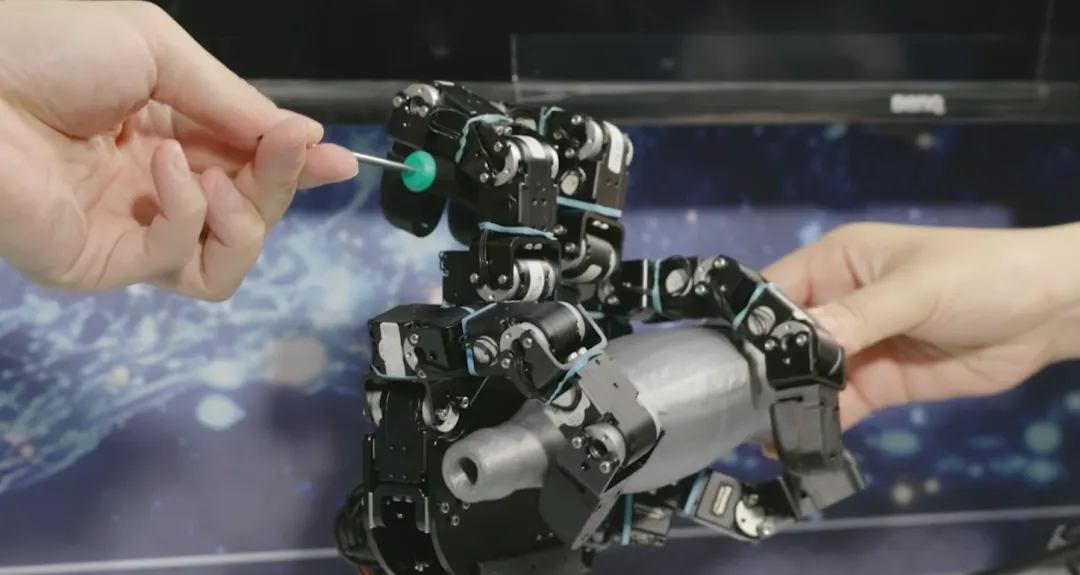
In the same month, China introduced the four-fingered M1, using a standardized master + functional finger split architecture, aimed at different scenarios, without the need to modify the algorithm, physically replacing the finger to complete the switching of operational tools.
Although there are no real-world cases of this type of product design, it does provide a whole new way of thinking about freedoms.
Third, touch sensors have become a necessity for skilled hands.
In addition to the new smartphones in the chart above as a reference, this finding comes from the GGII's upcoming China Smartphone Industry Survey Report 2026, which will be released on September 23.
GGII believes that brainstorming has become one of the priorities for the development of the physically intelligent industry, and that touch as a major model of understanding the physical world is expected to be a key entry point for flexible hand signalling. In the short term, the pressure-resistant, capacitance, and Hall-like sensors dominate the mass-production market due to technological maturity.
In the latest edition of the report, the GGII conducted systematic research and detailed analysis of the silicon touch sensing program in the silicon hand sensing technology pathway analysis chapter. It covers the technical characteristics and difficulties of the seven types of pressure-resistant, capacitor, hollow, visual touch, disconnect, pressure-electric, photoelectric touch sensors, representing the enterprise and development process, and explores the focus on the touch at the end of the application, human-robot touch configuration trends, and the loop logic of the silicon touch data cube model.
GGII summarizes that there are six main aspects to GGII's focus on touch. GGII states that performance is a GGII's focus on touch, but the lack of standards increases downstream collaboration and the difficulty of deployment in the industry. Currently, the industry has unconventional standards for touch sensor performance such as sensitivity, accuracy, lifespan, and quantity, which are at a stand-alone standard stage, and manufacturers indicate that the input may not be consistent with the actual parameters, customers can't directly judge parameters for good or bad, need to spend time on practical testing, and increase downstream collaboration difficulty.
At the same time, the lack of standardization has led to incompatibility of data interfaces between different manufacturers, which limits the efficiency of deployment in the industry.
Different sensor data formats differ enormously, and the lack of data sets makes it difficult for terminals to use. Different hardware output data formats, information dimensions, and the difficulty of forming large data sets make it difficult to replicate large model algorithms.
For example, image format data with visual touch outputs of condensation, array resistance, capacitance, and hall outputs of matrix graphs are difficult to integrate into the same model, with different sampling frequencies, and with visual, perceptual, and spatial data.
Notes
The volatility of the agile industry, with capital arriving before the standard, storytelling before the maturity of the scene, and the rapid expansion of the product matrix beyond the core barriers. When road players compete with multiple routes, multiple parameters, multiple scenarios to prove their existence, the real scarcity in the industry is not more options, but a consensus on how to solve the puzzle effectively.
The cognitive leap from component to system means that the logic of competition has shifted sharply. It is no longer about comparing who's single-point technology is more prominent, but about testing who can integrate perception, decision-making, execution, and data into a downloadable, reusable, and replaceable overall capability.
Capital can master a race track, but it cannot answer the value proposition for the industry.
On September 23, high-profile robots will be held in Beijing's Guangdong Village Exhibition Center for the Future of High-profile Engineering and Technology, at the same time as the release of the 2026 China High-profile Engineering Industry Research Report, where we will both build an exchange platform for the industry and provide a reference answer.