It's the first time in the history of the world.
In your ChatGPT, there may be more "people" coming out right now!
Musk's bot has been working for more than a month, and Zuckerberg's Muse topped the App Store with an invitation to small businesses to talk about a $10 billion valuation.
Within a few weeks, OpenAI became a champion on the AI for People track.
According to The Information, OpenAI is developing features that are more direct to the Grock Bot logo, and internally discussing how to deal with Meta's personal assistant Muse.
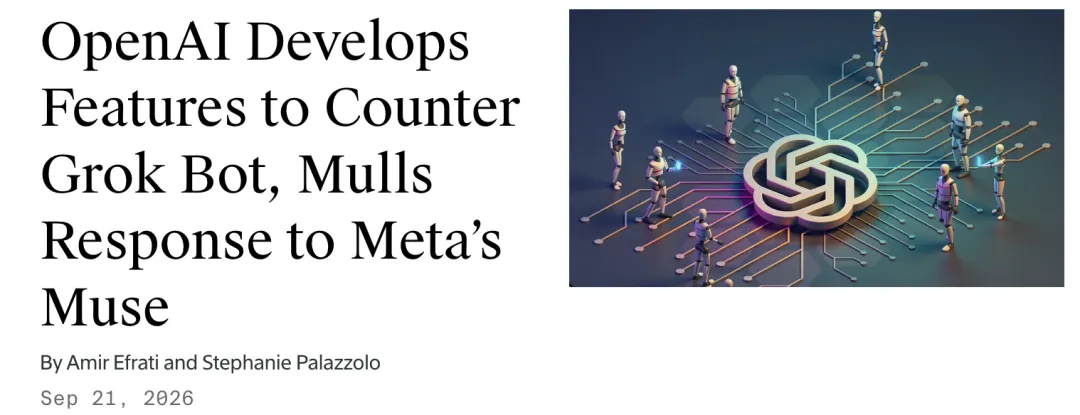
The report labelled OpenAI as "follower". The three words hadn't been in its head for a year and a half.
When it launched Operator in January 2025, it was the first company to make AI-powered browsers a consumer product.
ChatGPT has also brought generated AI into the handsets of ordinary people, which, according to The Information, surpassed $1 billion this summer.
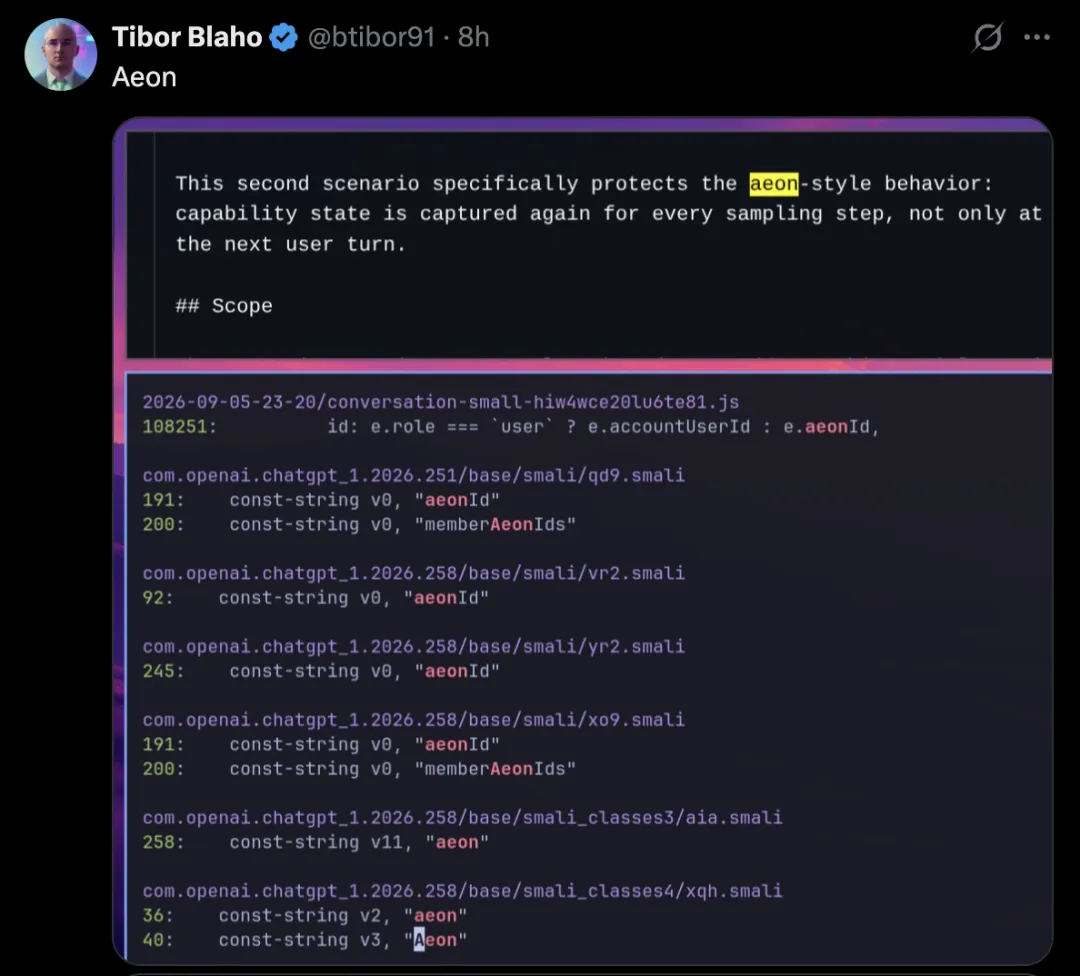
Following the release of the report, blogger Tibor Blaho, who has been blasting the ChatGPT code, sent a post to journalist Stephanie Palazzolo, coining the word Aeon.
Aeon means "eternity" in Greek, meaning "endless time".
If that's the name OpenAI gave a smart body, it's hard not to think about it: it's also going to create an AI colleague for you who doesn't quit his job, who's always online.
Tibor also attached a screenshot to the post, which is the code he pulled from the ChatGPT client.
There is a line in the code of the ChatGPT webpage:
A message, if it is sent by a user, is remembered in the user's account name; if it is not, it is remembered in the name of an Aeon.
In other words, in the eyes of ChatGPT, Aeon and the user are two parallel identities.
As soon as it was labeled "follower", the leaked code showed that it may have already been in ChatGPT, leaving a job for an AI colleague who could work for you.
Masque's BotI've been working for over a month.
Why can't OpenAI sit down?
This is because Musk's Bot has been up and running for over a month.
On August 11, SpaceXAI released Grock Bot. It officially gave it the acronym: "Your team of smart people is always online".
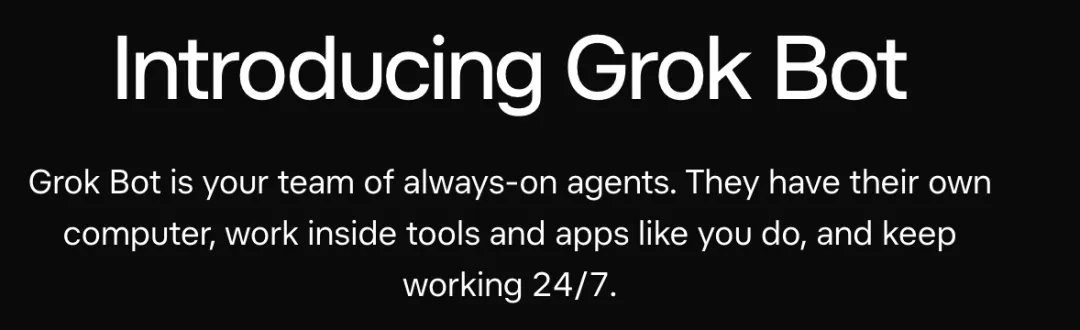
Note that you are given a group of intelligent agents, not just one. The biggest difference between them and ordinary AI assistants is that they have their own computers.
According to official reports, all bots with the same username share a permanent computer in the cloud, with files, browsers, log-in status.
These bots will log into your Gmail, Notion, financial software, and even old websites without an API.
Like humans, they manipulate the mouse, fill out the forms, and finish their life, only to run to you to ask you a question when they come across something that needs your attention.
What's even more interesting is multi-bot collaboration.
You can run several bots at once, a mailbox, a sales outlet, and put a "staff chief" on top of it.
Grok Bot is actually selling, but it's actually a move: deliver the live ones.
Add a "member" to the code.In the code snippet that Tibor sent, aeonId and accountUserId are parallel, indicating that in ChatGPT's system, Aeon may be some sort of object that can be individually identified, rather than a simple function switch.
As for whether it has the same identity or rights as the user, it is not visible in the screenshot.
In the last two consecutive versions of Android, aeonId appears repeatedly, with a field named memberAeonIds next to it.
Member is a member, a name that is difficult not to associate with the multi-bot group chatter of Grock Bot.
There is another test description above the screenshot of Tibor:
This test scenario is specifically used to protect "aeon-like behavior", which means that the capability states are recaptured at each sampling step rather than waiting for the next user input.
The usual ChatGPT is you and me, and "aeon behaviour" requires the system to reassess the current capabilities at each step of the multi-step execution process.
This is in line with the logic required for an intelligent body to keep moving.
OpenAI has not yet made an official statement, and only one media outlet, a suspicious code, and a few lines of code are available, but the gray serpent gray line is already hidden.
In the menu of ChatGPTJust write "talk".The most persistent is the media's claim that OpenAI will not build a new product from scratch, but instead "repackage" existing smart technology in Codex and ChatGPT.
This sentence reveals an embarrassing fact: the ability of opponents to sell heat is already in the hands of OpenAI.
On July 9, OpenAI released ChatGPT Work, which officially introduces cross-application execution tasks, continuous processing of complex projects, and timing tasks, as well as the integration of codex technology.
The official documentation also states that when you choose to run in the cloud, the task will continue to run even after you turn off the app or connect to the computer.
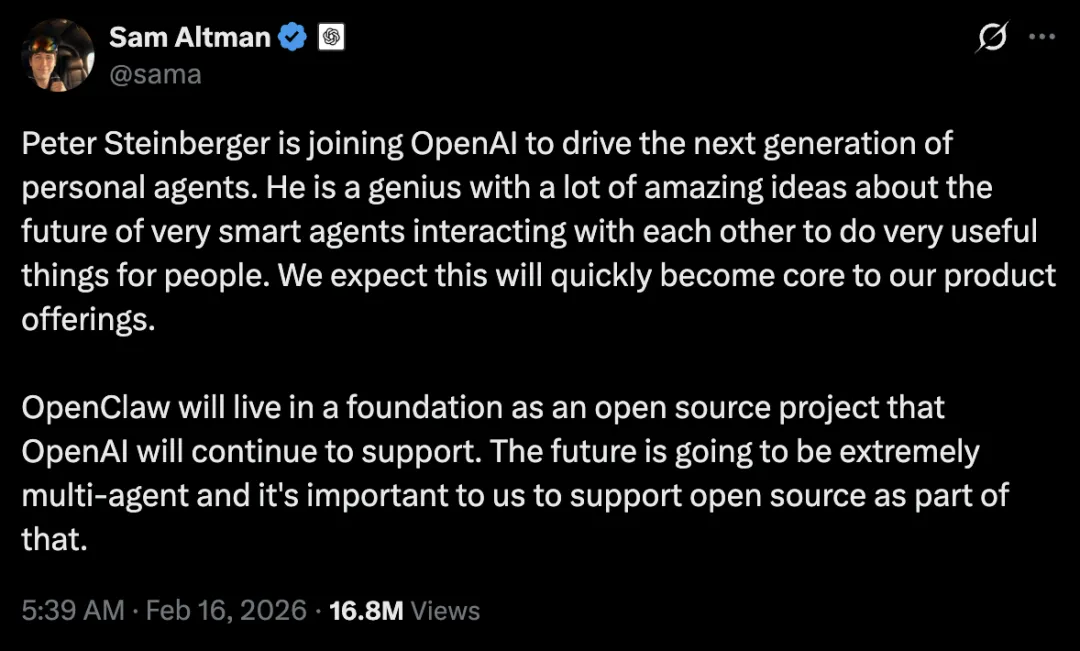
In February, Peter Steinberger, author of OpenClaw, joined OpenAI, and Ottman said he was responsible for building the next generation of personal intelligence.
The problem is that many OpenAI users don't necessarily know about these features.
It's like doing anything in the kitchen with only one "chat" on the menu.
If Aeon's rumours are true, what's really worth asking is, in addition to ChatGPT Work's existing execution capabilities, will it produce a "digital member" that can directly call out its name and activate it?
This is probably its response to Grock Bot.
Why can't OpenAI lose?According to The Information, the growth of ChatGPT has slowed significantly over the past year, reaching the goal of 1 billion days to live, which OpenAI was set to achieve last summer.
This round of AI is no longer on the top of the model list. It's the second growth curve that everyone is looking for.
Musk's Grok Bot is supposed to be a cloud computer that holds all your logins.
Anthropic launched Claude Tag earlier on June 23 to allow Claude to join Slack as a member, and it wanted a channel for the entire team.
Meta's "Muse" jumped to No. 2 on the U.S. App Store free list two days later, and as of Sept. 22, has reached the top, squeezing ChatGPT behind you. It's about the chat app you open every day.
Instinct, an invitation-only startup company, has quadrupled its valuation a month. It sends you text messages and phones to order restaurants, buy things, and ask for your credit card and password.
Four opponents, four strikes, all pressing against your workflow.
Imagine Monday morning at 8:00 a.m. and you start your first cup of coffee and look at your phone.
In the past, you had to go back to a dozen emails, then silence the annoying messages, and finally stick a bunch of meetings in a calendar.
From now on, until you've had your cup of coffee, it's probably over. There's only one list in front of you waiting for you: this email won't be sent, this bill won't be paid, this one won't be received.
Who occupies this list and who holds the entrance to your daily activities?
It's hard to change it once you get used to it.
If a bot takes over your inbox, touches the mood of your email, remembers which customers you prefer to return to, and wants to change it, it's much more difficult than changing a chat app.
But the most difficult path to cross in the past is perhaps beyond technology: trust.
How many ordinary people would be willing to let an AI access their personal information, their social accounts, or even authorize them to pay for it?
This hesitation is the last straw for all "AI colleagues".
In the age of chatbots, users ask: isn't AI smart?
In the age of the smart body, the user asks, "Could I dare not give it my life?"
OpenAI is left with only one question: how to make one billion users confident in giving away their keys.