
It's the first time in the history of the world.
We just saw a lot of surprising data.
By 2031, AI is expected to create a cumulative global economic value of $22.5 trillion.
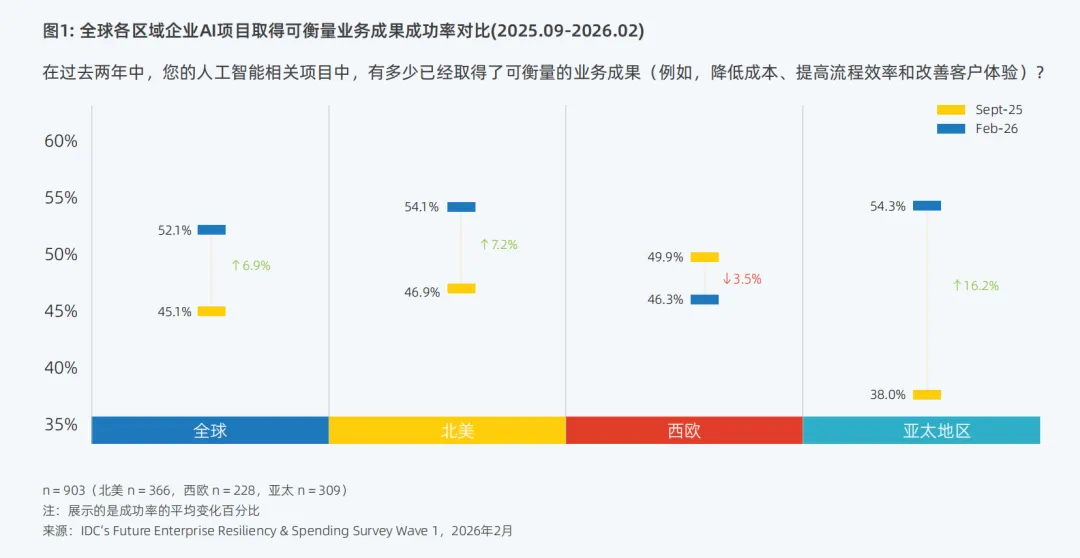
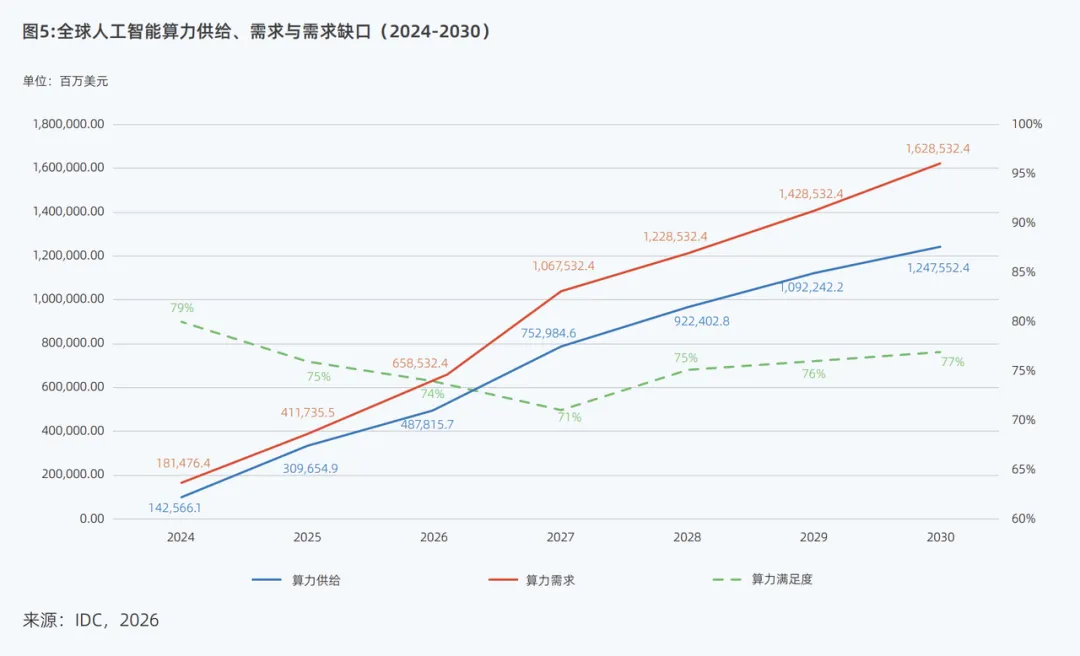
By 2030, the global AI computing gap is expected to reach a staggering $38.9 billion (almost RMB3 trillion)!
In addition, China's penetration rate for smart phones will reach 81.0% in 2026, leading the world!
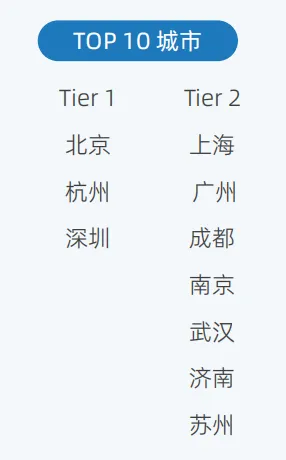
And, surprisingly, in 2026, China's AI city rankings have changed dramatically.
Beijing, Hangzhou, Shenzhen are in the top three.
This hardcore information comes from a major report.
Recently, IDC, together with Wave Information, released the first Smart Body Infrastructure Research Report, China's 2026 AI computing power development assessment report.
It is clear from this research report that Agent is reshaping everything, and the direct consequence of this is a massive famine of computing, followed by a massive scandal.
The year of the Agent's outbreak, or the year of computational hardnessJust today, OpenAI officials announced that the mysterious model inside them had solved over 100 world-class mathematical puzzles in 24 days.
Andrej Karpathy, co-founder of OpenAI, said: "It will take another 10 years for AI to really land".

Today, this is not a pessimistic prediction, but the official announcement of Agent's "Golden Decade"!
According to OpenAI, it takes about 88 hours for 10,000 parallel intelligences to solve problems related to the NS equation.
They sent 4.9 million messages to each other, consuming a total of about 300 billion tokens.
In the core stage of solving the NS problem alone, these smartphones sent 2.7 million messages and spent 130 billion tokens. It took 17 hours to complete Lean formalization and verification.
30 billion tokens is equivalent to more than 2200 sets of three-dimensional tokens, or roughly half of the total text resources of the National Library of China.
In other words, it takes only 88 hours for 500 people to "produce" tokens. Human beings may eventually be able to solve the NS equation more beautifully, but in terms of speed and thinking scale, it is difficult to match them.
This is a landmark figure. For example, the GPT-3 model used 300 billion tokens in its training, and now the cumulative tokens consumed by a multi-intelligent physics research mission have reached the same level.
But this is just the tip of the iceberg of the global economy.
At the beginning of the year, the OpenClaw wind was blowing. Subsequently, at the GTC congress in Great Britain, Huang ren set the tone, essentially proclaiming:
Today, every company in the world needs a smart body strategy.
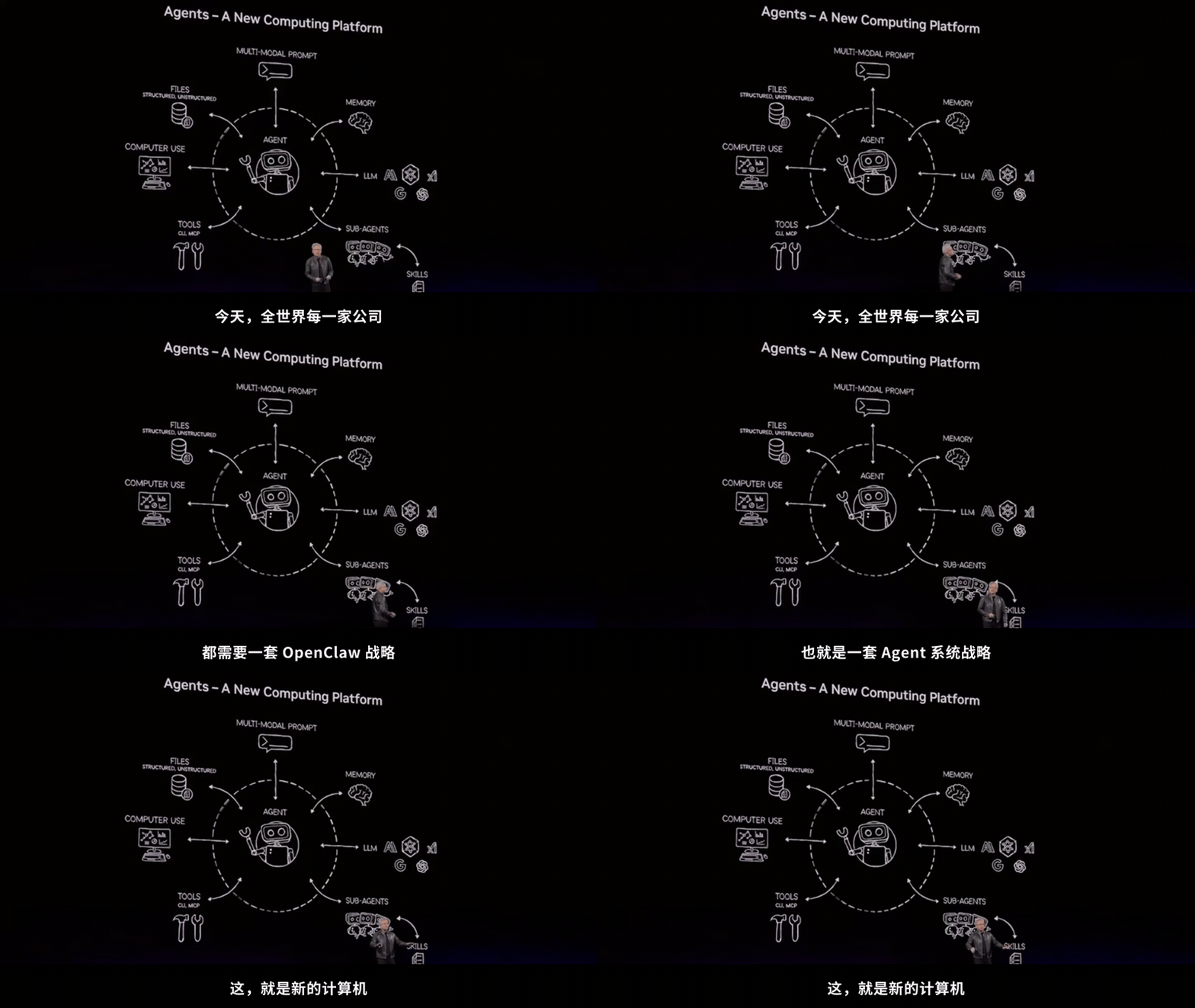
China led the world in penetration of the deployment of smart phones, reaching 81.0% this year, up from the world's leading level of 78.1%.
But unfortunately, the old calculation cards that used to be big factories and crazy accumulation of capital are now likely to become "waste iron".
Over the past two years, everyone has been doing "AI training" and thousands of GPUs have been stored in machine rooms.
But today, Agent is ruthlessly shooting these investments on the beach.
The rating standards and competitive logic of AI have changed dramatically in just over a year.
If the 1.0 stage of the development of the big model is the computational accumulation of the "Millennial War", then the current 2.0 stage has transformed the unit of measurement from "calculative scale" to "productive efficiency of Token".
The tokens went crazy 37 times, and the big model started "not working".Why is it that Agent is a new variable that completely changes the direction of the tide?
First, we need to understand the fundamental differences between Agents and past chatbots.
The previous big model was a one-time query, and dozens of tokens were worked out; but Agent was a "digital employee", requiring multiple rounds of reasoning, calling tools, cross-system collaboration, and timely preservation of "memory".
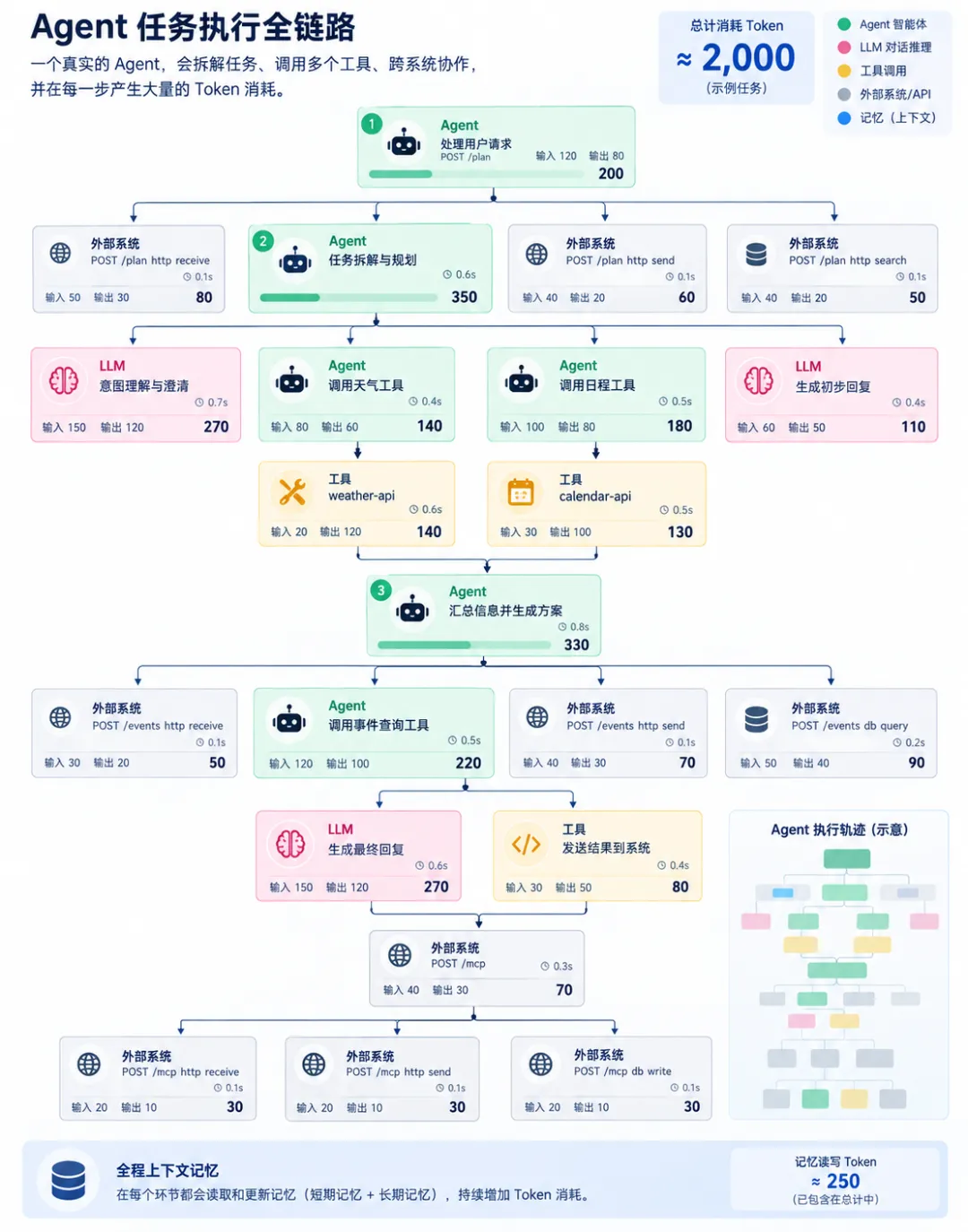
This has led to a terrifying multiplication effect:
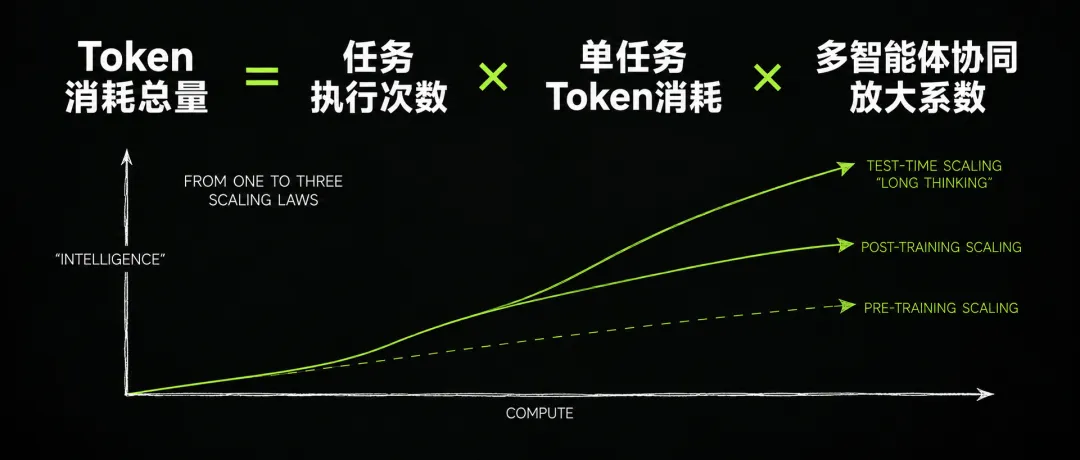
IDC has released a collection of data that is a breath of fresh air:
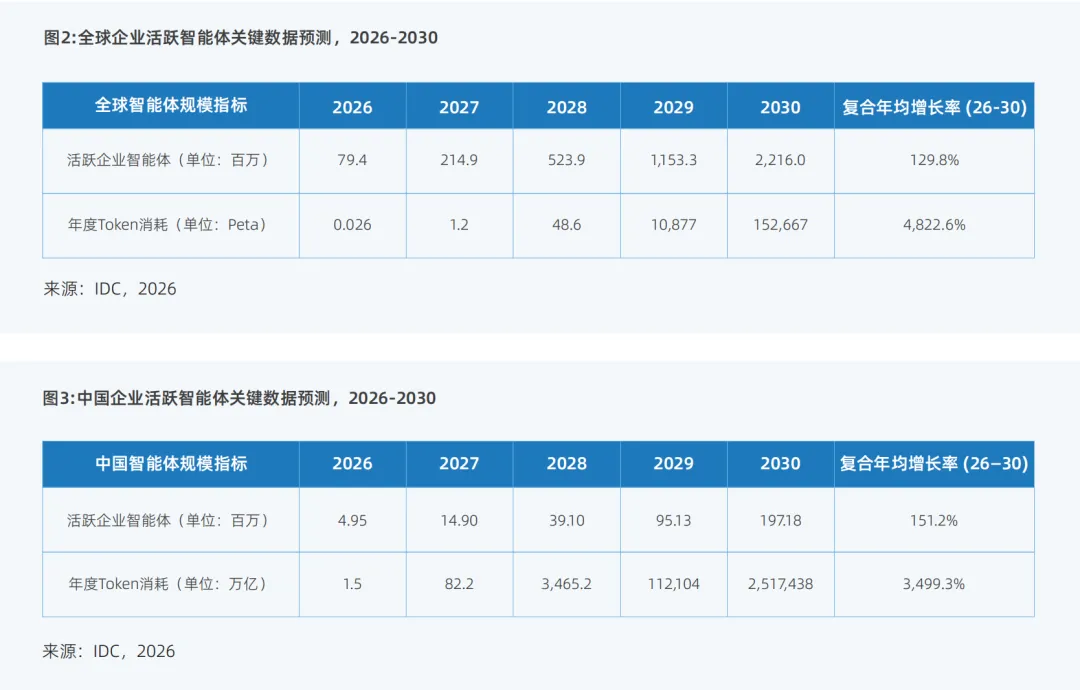
A compounded global growth rate of 129.8% in the number of active smart phones is expected by 2030, but the same token consumption compounded growth rate reached a record high of 4822.6%!
The increase in token consumption is 37 times the total increase in the number of smart entities!
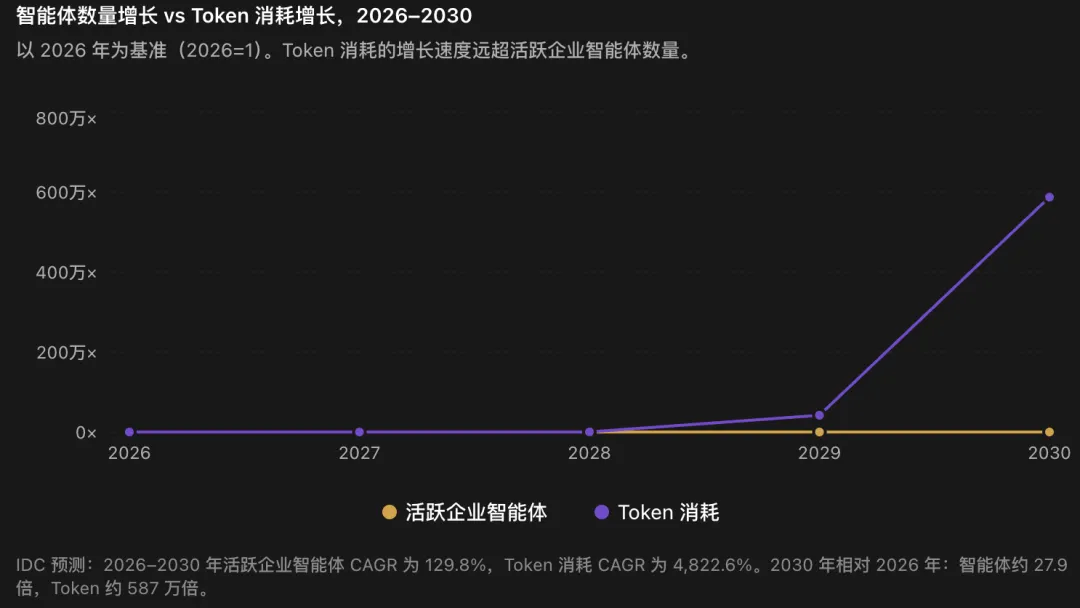
In other words, AI is no longer just an occasional chat toy, but a "power-consuming/computing monster" running around the clock in the background.
Over the next four years, the number of smart devices may increase by tens of times, but the consumption of tokens will increase by millions of times.
When all enterprises are moving towards OPC to try to replace traditional human resources with agents, the demand for computing is rising exponentially.
This has led directly to an extremely cruel reality: computing is not only inadequate, but also increasingly expensive.
Old-fashioned "waste iron" AI is more than a lack of coreAccording to IDC data, China's growth forecast for smart computing and general computing is up from 46.2% to 50.3% from 18.8% to 27.7% from 2025 to 2030.
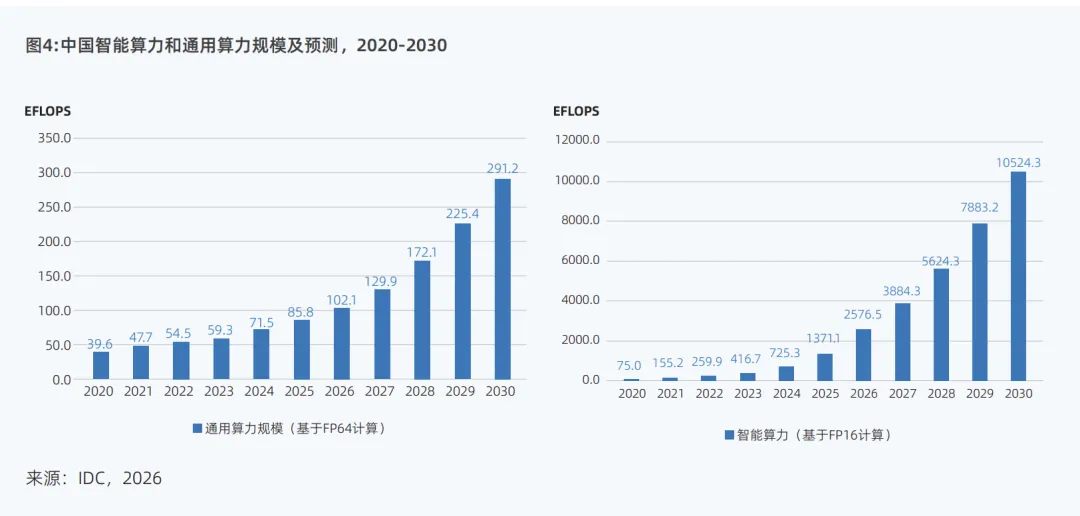
China's smart computing scale reached 1,371.1 EFLOPS in 2025, which is projected to increase to 2,576.5 EFLOPS in 2026, a growth rate of 87.9%, 10,524.3 EFLOPS in 2030, a compound annual growth rate of 50.3% for 2025-2030, and a significant improvement of 46.2% from the previous version. Over the same period, the overall computing scale was 85.8 EFLOPS in 2025, and is projected to increase to 102.1 EFLOPS in 2026, a growth rate of 19.0%, and 291.2 EFLOPS in 2030, a compound annual growth rate of 27.7%, which is higher than the previous version's 18.8% forecast.
Since the demand is so great, so many intelligence centers have been built all over the country in the last two years, so many cards have been earned, shouldn't they be sent out?
The answer is: mismatch, serious structural mismatch.
The reality is that it's cruel to have a GPU, and it's not the same as having the computing power to fit the smart body.
Over the past two years, the vast majority of computing cards purchased by large corporations, and smart computing centers built around them, have focused on the "training" scene.
Training is the culmination of arithmetic, but the "reasoning" scenario of the Agent era is the pursuit of overcapacity in context storage, low latency and extremely high throughput.
It's like buying a top-of-the-line sprint team and asking them to run a never-ending marathon and solve complex calculus on the sidelines.
In addition, there are a number of discontinued mid- and low-end computing cards, with low computing values, poor storage capacity, and no memory for hundreds of thousands of tokens. The real business value is almost zero, except for beginner test drivers.
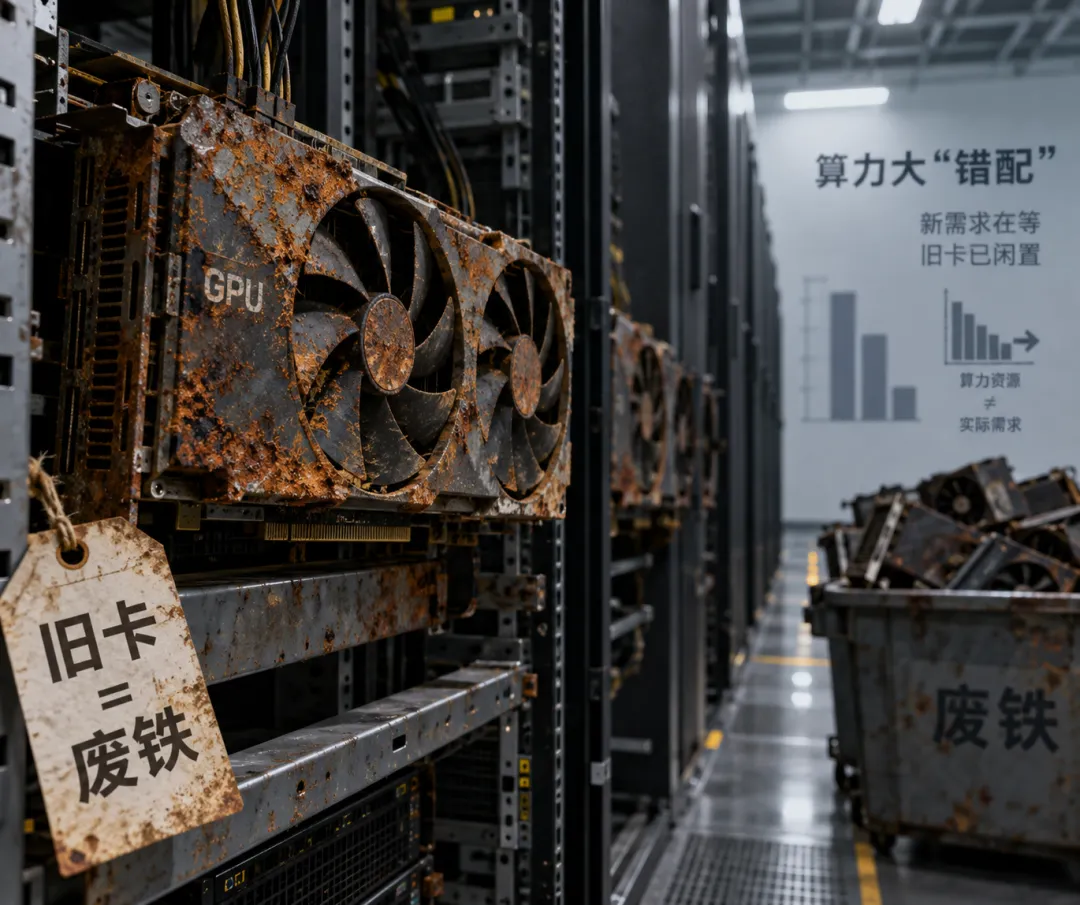
Since there is a "structural mismatch" of inventory resources, is it possible to earn money directly by adding new supplies and buying a suitable Agent card?
This is the second dilemma facing the industry today:The increase in supply in the physical world is far from keeping pace with the increase in demand in the digital world.
Despite the current unprecedented computing investment in the entire AI industry, which is estimated to be in the tens of billions of dollars, supply expansion is difficult to synchronize.
Because the capacity expansion cycles of core components such as high-end chips, HBMs, high-bandwidth memory, and server CPUs are generally much longer than the explosive pace of demand for AI.The doubling of the amount invested cannot be converted into a real arithmetic supply at the current rate.
As an example of Agent's highly sought-after HBM, as Agent's requirements for long-term context memory grew, KV Cache consumed both capacity and bandwidth, and storage became a key bottleneck.
While storage facilities are locking capacity madly, there is still a lot that needs to be done.The construction and expansion of semiconductor production lines have an irreversible physical time law.You can save a billion dollars today, build an advanced packaging or storage production line into a real on-line production, and it takes a very long cycle.
In the current arithmetic race,You can't buy time with money.
Even more deadly, energy constraints are exacerbating this supply and demand contradiction.
The demand for electricity in data centers has skyrocketed with the scale of smart devices, which run 7x24 hours a day.
However, the electricity supply is subject to long cycles of grid expansion and delivery of critical electrical equipment.
It may take several months for an IT center to be shut down, but it can take years to support the regional transformer and grid expansion that it operates.The pace of electricity expansion has been significantly slower than the cycles of computational construction.
IDC predicts that by 2027, the global demand for AI computing will fall to a low of 71%, which means that nearly 30% of demand for AI computing cannot be met at all.
Many other factors, such as the misallocation of computing power supply, superimposed power shortages, the global AI industry or the threat of intelligent computing power shortages.
Tanka says the reign is over and the new Token building has arrived.If Agents are so hungry, how can we save computing power?
The answer to this question is that AI infrastructure is undergoing a systemic restructuring, completely abandoning the past "stack of cards" thinking.
Intelligent entities no longer encapsulate "peak computing" but "continuous task execution", which requires infrastructure optimization goals to shift from "single-point performance optimization" to "task-level system synchronization optimization".
This shift, the load shift, the focus shift, the procurement shift, and finally the deployment shift.
In the past, computational phase shortening, such as GPUs, has become more of a 7x24 hour "productive load" with long-term stability and high concurrency characteristics.
The competitive core of the Agent Age AI infrastructure is the "efficient continuous production of tokens", which enables computing, storage, network/data center, terminal, and entire system collaboration to model, schedule, and operate tokens.
Customers' purchasing entities are upgrading from merely buying servers, purchasing GPUs, to purchasing "model capabilities and token output".
Jumping out of centralized intelligence centers, cloud-side-end collaboration is on the line, and terminal devices officially become Agent's operating nodes.
In order to adapt to this restructuring, the report notes that the future competition in the computing industry will be divided into two routes: "capacity-based intelligence" and "capacity-based intelligence".
"Capability is intelligence", he said.I was born to break the "ceiling" of intelligent people.
Like OpenAI, which uses 10,000 agents to solve mathematical puzzles, OpenAI relies on system-level innovations such as hypernodes, high-speed interconnections, and improves its ability to handle supermassive models and complex tasks.
"Capacity-based intelligence", he said.The goal is to make it cheaper, richer and more accessible.
Through multi-calculator collaboration, promoting the understanding of blockchain, improving the efficiency of the entire chain, increasing the efficiency of Token production, reducing the cost of unit intelligence, and achieving a large-scale universal supply of intelligence.
Around these two routes, the entire hardware ecosystem is undergoing system-level mutations:
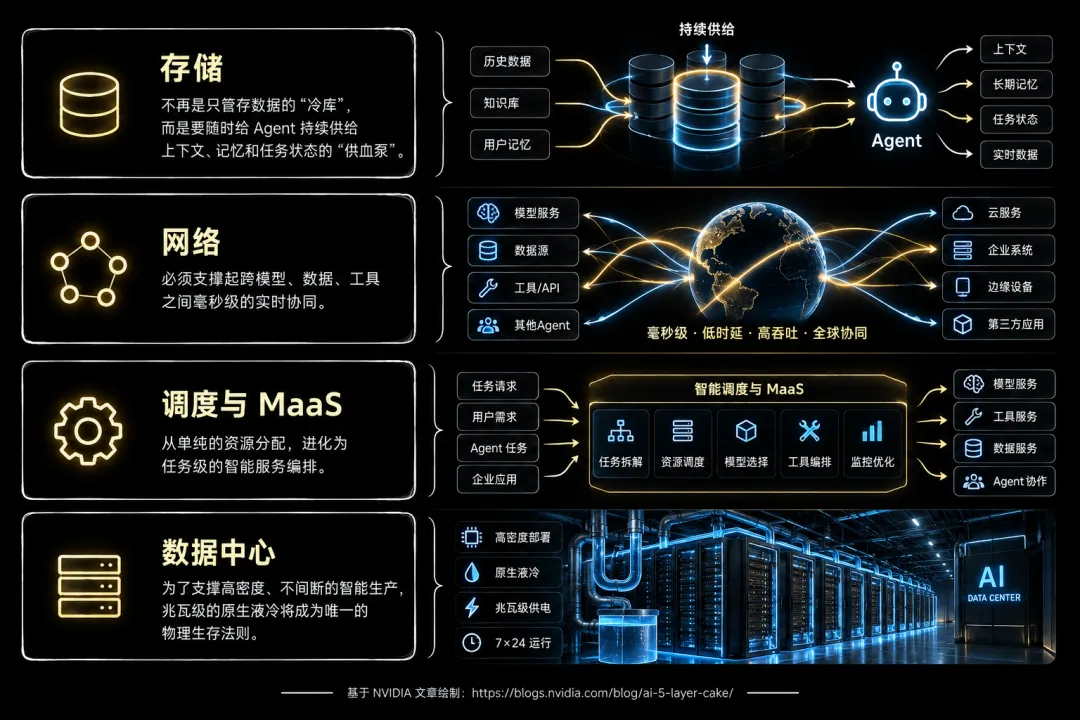
As a result, AI infrastructure is no longer just an iron box for training or reasoning, but a "full-fledged intelligent factory" around the development, operation and governance of Agents.
It's a great way to learn how to code, how to work in an office, and how to do it.How long will the traditional industry live?The report highlights a deep gap in the distribution matrix between the maturity and long-term productivity of smart body landings across industries.
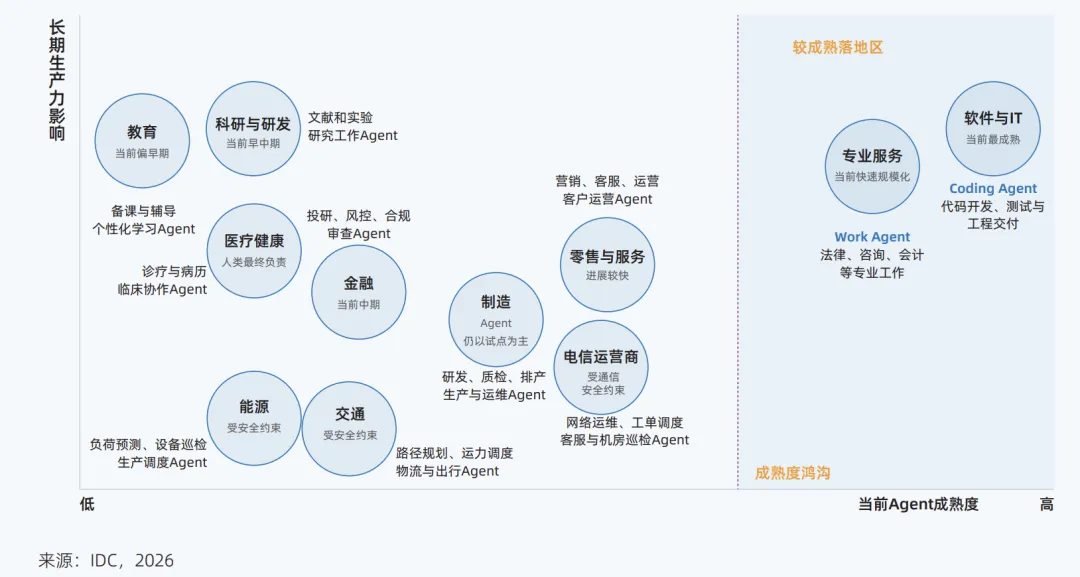
At the far right end of maturity, coding (code development) and work (office tasks) are far ahead of the smart ones, and they are already in full scale applications. It's easy to understand that the rules of the code world are 100 percent digitized, and the result is verifiable.
But at the other end of the divide, the proportion of entities such as manufacturing, healthcare, energy, electricity that actually enter the core business and form a complete closed loop is still an embarrassing 0%.
Why is it so hard to land in a traditional industry? "Try-and-error cost" and "validate results".
You can't have a medical agent test it directly on a patient and then optimize the results back to the model; you can't have a manufacturing agent take over a real physical flow stream worth hundreds of millions of dollars without absolute security.
But that doesn't mean the traditional industry doesn't have opportunities.
On the contrary, IDC's report notes that the "long-term productivity restructuring potential" of these industries is precisely the largest because they have a very high density of expertise. Once issues such as digital authentication, the boundaries of human-machine collaboration responsibility are addressed, Agent will disrupt these industries altogether.
It's the third highest-grossing film of all time.It's a big business.The most striking feature of the report is the "Great Change" in China's 2026 AI Cities Ranking.
Beijing remained first, while Hangzhou remained second, while Shenzhen, strongly knocked out the top three, with Shanghai temporarily behind.
Why is there such a change in ranking?
The main reason is that the rules of the game have changed.
For the first time, the report included "Smart Body Application Landing", "Smart Body Industry Layout" and "Big Model Development and Logical Computing Infrastructure Construction" in its core assessment indicators.
Shenzhen is in the top three because it has grabbed the opportunity to combine Agent explosions with hardware with physical intelligence.
Shenzhen is an important base for the manufacture of AI servers and computing chips, with a deep computing supply industry base. As AI moves out of virtual screens and into factories, into physical robots, Shenzhen's advantages on the computing supply side are instantly amplified.
This is a wake-up call for all 2nd and 3rd class cities: the future city competition, who can provide the richest Agent landing scenarios (such as smart manufacturing, smart ports) will be able to crack a crack in the computer map.
Big Shell: Who's really making AI money the night before the bubble burst?In the face of such massive investments, an inevitable question is before everyone: Are companies really making money?
IDC's vice president, Zhou Jiang, has just given a very clear answer: "The bubble exists, but it doesn't mean the market has no value".
At this stage, it's like the cloud war that started earlier that year.
In this "robbery" phase, most of the profits went to upstream credit cards and upstream semiconductor manufacturers.
Even some token servers are trying to "swap space for time", but this is not a long-term goal.
The burning AI shorts, one-man company OPCs, etc. started giving the first people a taste of doughnuts, but the market will eventually return to commercial nature, and prices will eventually return to value.
The end result will be a more sophisticated operation of Token.
Token providers, or through Token routing technology, will allocate the requested dynamics to more matched models and computational resources depending on specific business needs, achieving a dynamic balance between interaction and throughput, thus improving resource utilization efficiency and user experience, and enhancing the profit margin for Token services.
The day that the bubble burst was not the end of AI, but the beginning of the wash.