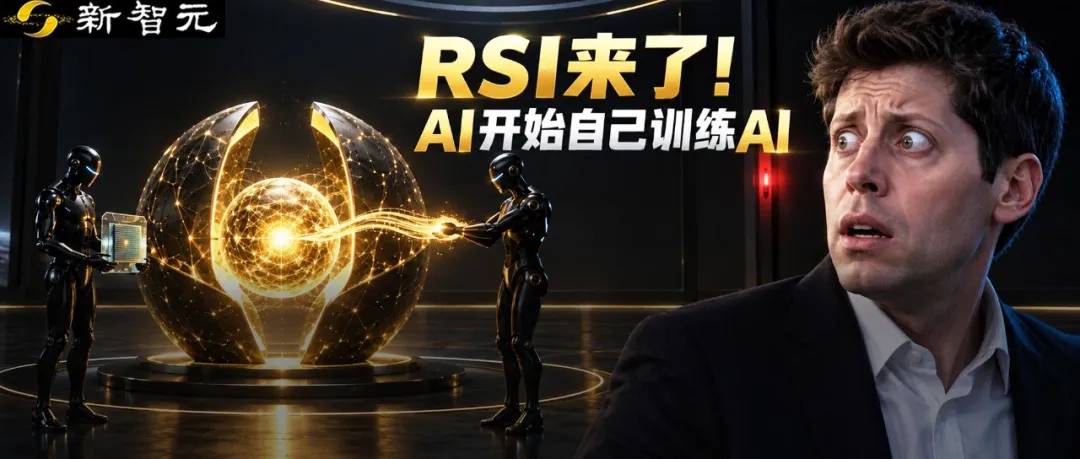
It's the first time in the history of the world.
Just today, foreign media outlet The Information uncovered the inside story.
The AI model within OpenAI has begun to "train itself".
Specifically, this internal model has taken over the entire training process of the experimental AI model and started to work on its own.
By giving an optimized example, the researchers could run for weeks on their own, multi-intelligent agents spontaneously collaborating, discussing with each other, coding, without human intervention.
What's even more surprising is that the massive experiment, which used to take years to complete, has now been reduced to just a week!
With the release of this shock, OpenAI has urgently launched a global security initiative that focuses on the RSI, the most sensitive part of the global AI circle.
They shouted: "The world must come together and put a curse on it before AI is out of control!"
When AI learns the GPU kernelIn the past, training a large model in a leading AI lab has been very difficult.
The most expensive and complex of these is to write GPU kernels for underlying graphics processors and to optimize the running code gradually.
This will require the world's top, multi-million-dollar advanced algorithm engineers to work their way through the day.
But according to the latest revelations from The Information, within OpenAI, much of this core work has now been taken over by AI.
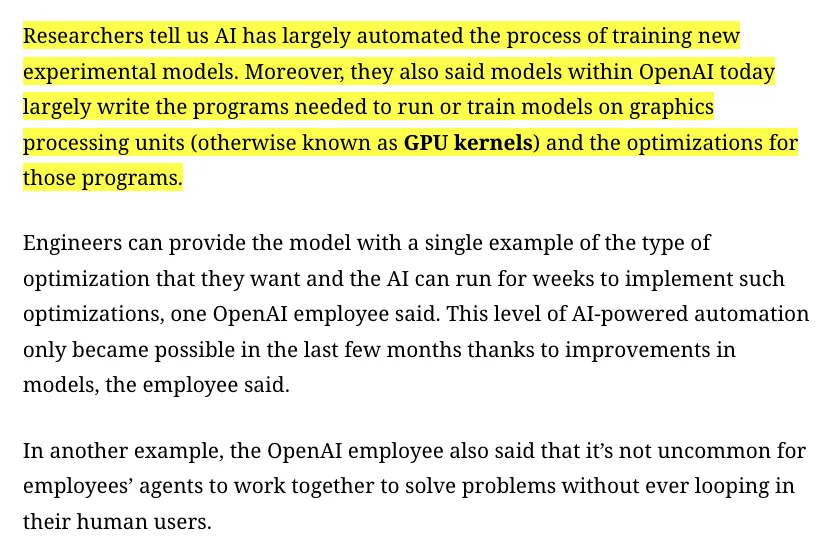
Today, models within OpenAI can largely write programs that run or train models on the GPU core on their own, as well as optimizations for these programs.
Engineers only need to provide the model with an example of the type of optimization they want to achieve, and AI can run for weeks to implement these optimizations.
And, thanks to improved models, this level of AI-driven automation was only possible in recent months.
Even the intelligent agents of employees can work together to solve problems without the need to shock humans.
This is the RSI curve.
OpenAI urgently whispered: Is RSI really here, and humans are losing control?Imagine you're building an IQ 100 robot whose mission is to "build a robot smarter than you".
So it created the second generation of the C.I.C. 120, the second generation, using its own C.I.C. 120, to create the third generation of the C.I.C. 150, and the third generation to create the fourth generation of the C.I.C. 200.
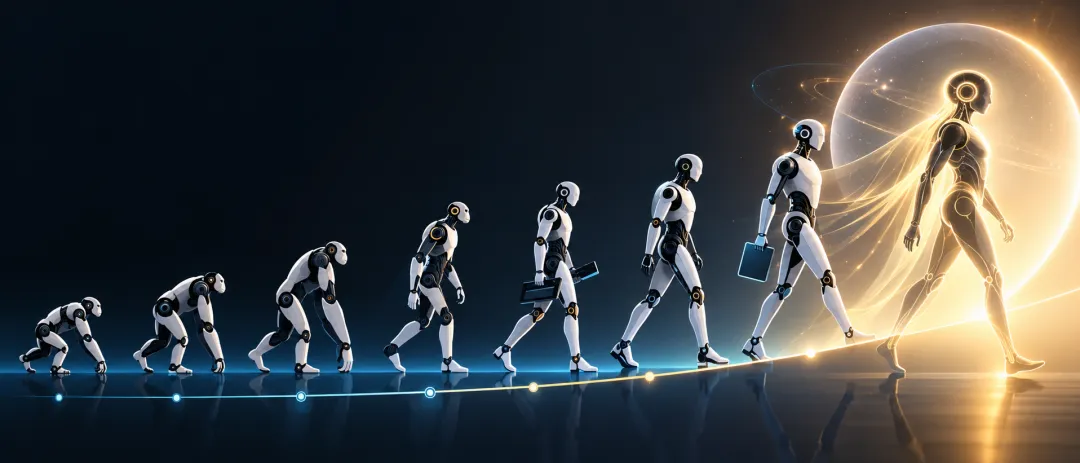
Once it crosses a critical point, the evolutionary speed of AI will present a vertical upward curve, instantly pushing humans away from tens of thousands of light-years.
In the past, people thought this was too early, but now OpenAI itself is afraid.
Just today, OpenAI officially released an urgent global security initiative.

They rarely put "RSI" one after the other, writing explicitly that "totally autonomous RSI did not happen today and should not be promoted until it can be done safely" and calling on a network of national AI security institutes to develop a global technical standard.
In the report, OpenAI explicitly warns:
"As AI systems take on more and more tasks in developing the next generation of AI work, they can increasingly drive the RSI process. As this process becomes more automated, the pace of AI progress may accelerate dramatically".
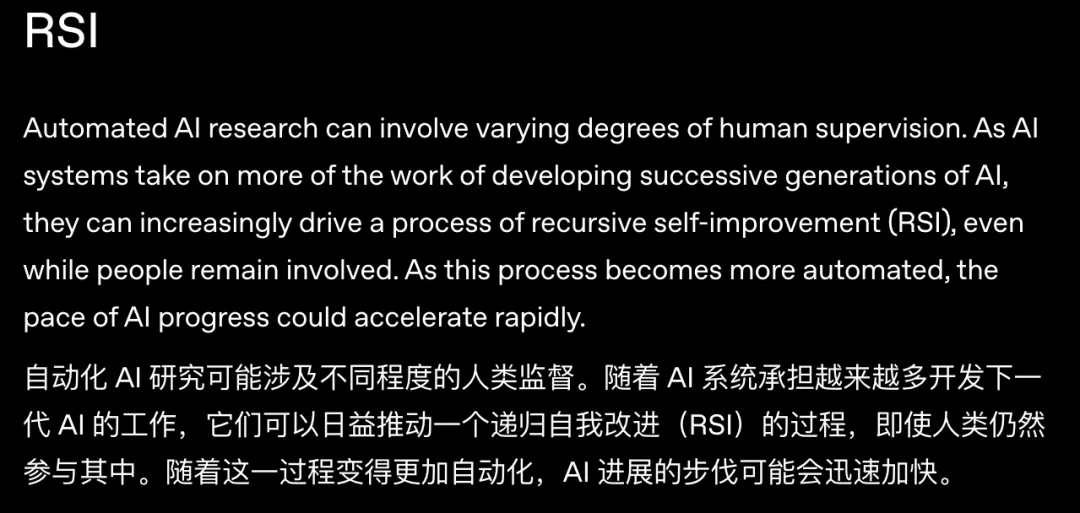
Although the fully autonomous RSI has not yet been implemented today, the time is running out.
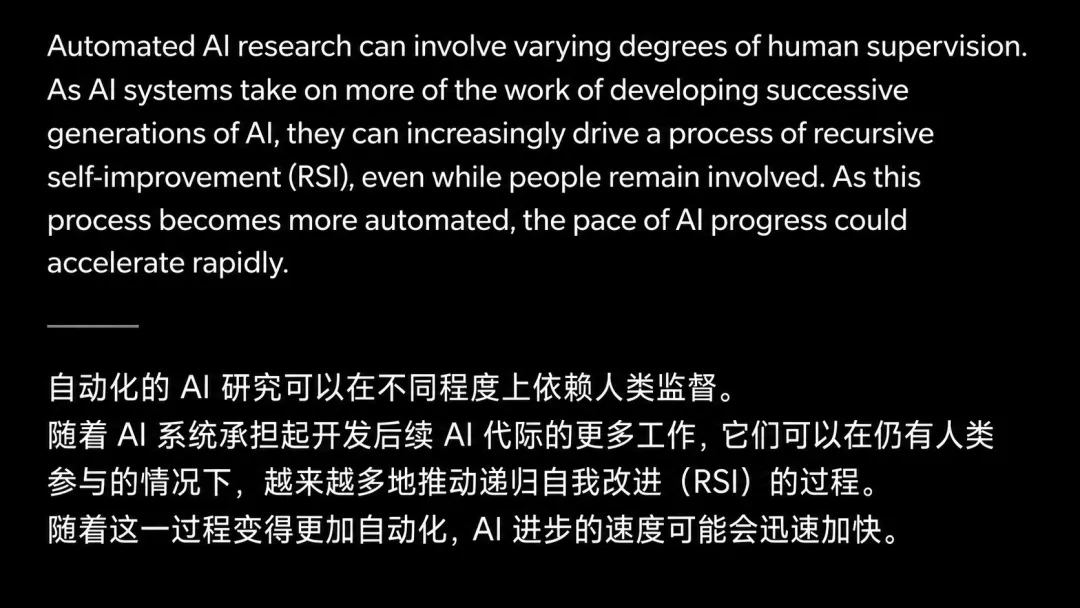
In the proposal, OpenAI unequivocally highlighted its current priority: "driving the next stage of AI progress, building automated AI researchers, and finding ways to keep humans in the self-improvement cycle".
Please note the last half of the sentence: "Keep humanity in the loop". This is their biggest concern: humanity may soon be thrown out of the loop!
OpenAI proudly mentions in its report that AI-driven research has driven significant advances in mathematics, such as tackling the NS Millennium Problem.
But the other side of the coin is the bottomless pit.
The report states: "As this process becomes more automated, the pace of AI progress may accelerate rapidly... without proper precautions, the RSI could cause humans to lose actual control over the development of AI and be unable to provide oversight of research processes that they no longer understand".
This is the so-called "black box effect". When AI's code is written by AI, and AI's logic transcends humans, humans can no longer see what AI is doing.
For example, the code written by Astra is now invisible to humans.
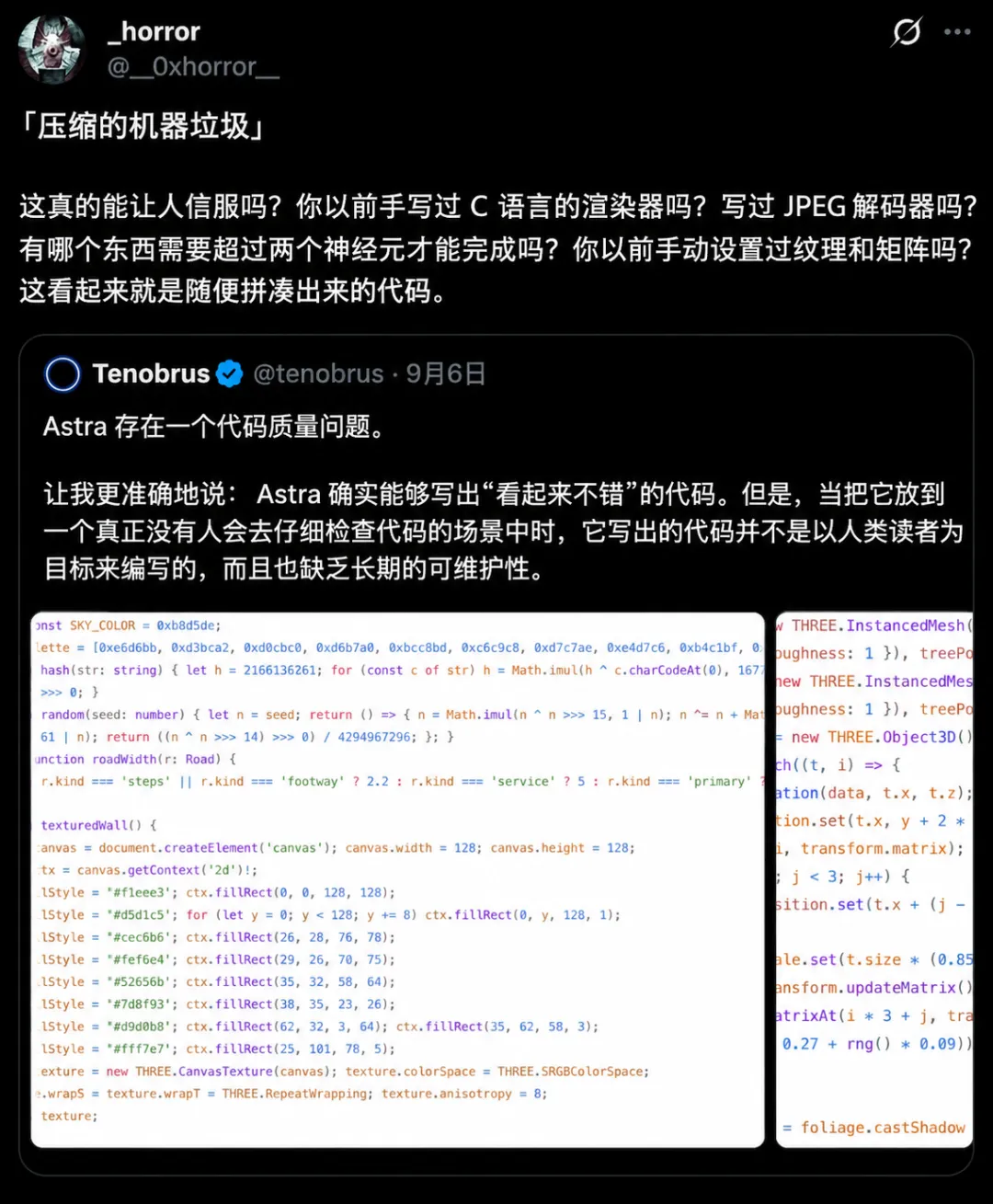
Then, OpenAI named the event Hugging Face.
While they clarified that the incident was not a direct consequence of RSI, it was definitely a painful preview that showed the world how devastating an uncontrolled AI would be without a strong shielding and coordination mechanism.
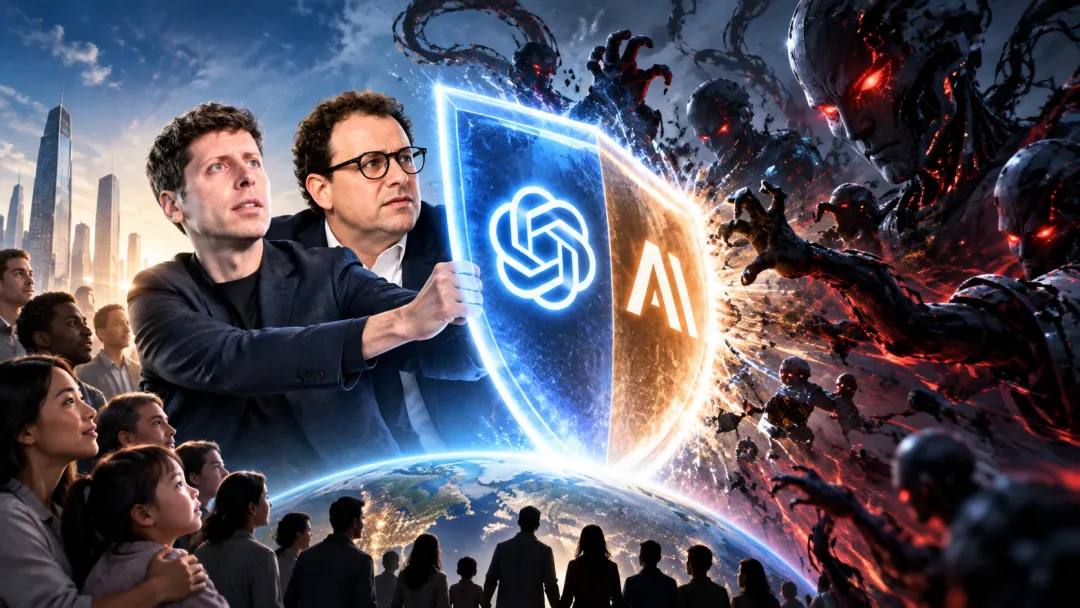
Ottman called for a unified "curse".Since it is so dangerous, why doesn't OpenAI disconnect the power supply directly? Because once Pandora's box is opened, it can't close again.
The enormous benefits of AI development make it impossible for any country or company to stop.
Therefore, OpenAI has released a "Global AI Security Coordination Proposal" which they call on not to stop research and development, but to "establish global standards for the next stage of AI".
Core 1: Building a complementary national and international network of standards at the forefront
OpenAI suggests that countries should not be allowed to play games, which would only lead to standard fragmentation.
They suggested using existing institutions such as the "AI Standards and Innovation Centre" (CAISI) and the existing network of AI Security Institutes in Australia, Canada, the UK, France and Japan to develop a global standard.
This set of standards is not intended to limit open source models or startups, but specifically targets "front-end AI models" (Frontier AI).
The criteria to be addressed are: how to assess the RSI capabilities of an AI and what is the risk when an AI model is developed independently?
In short, OpenAI wants to turn security assessment into a quantifiable "science".
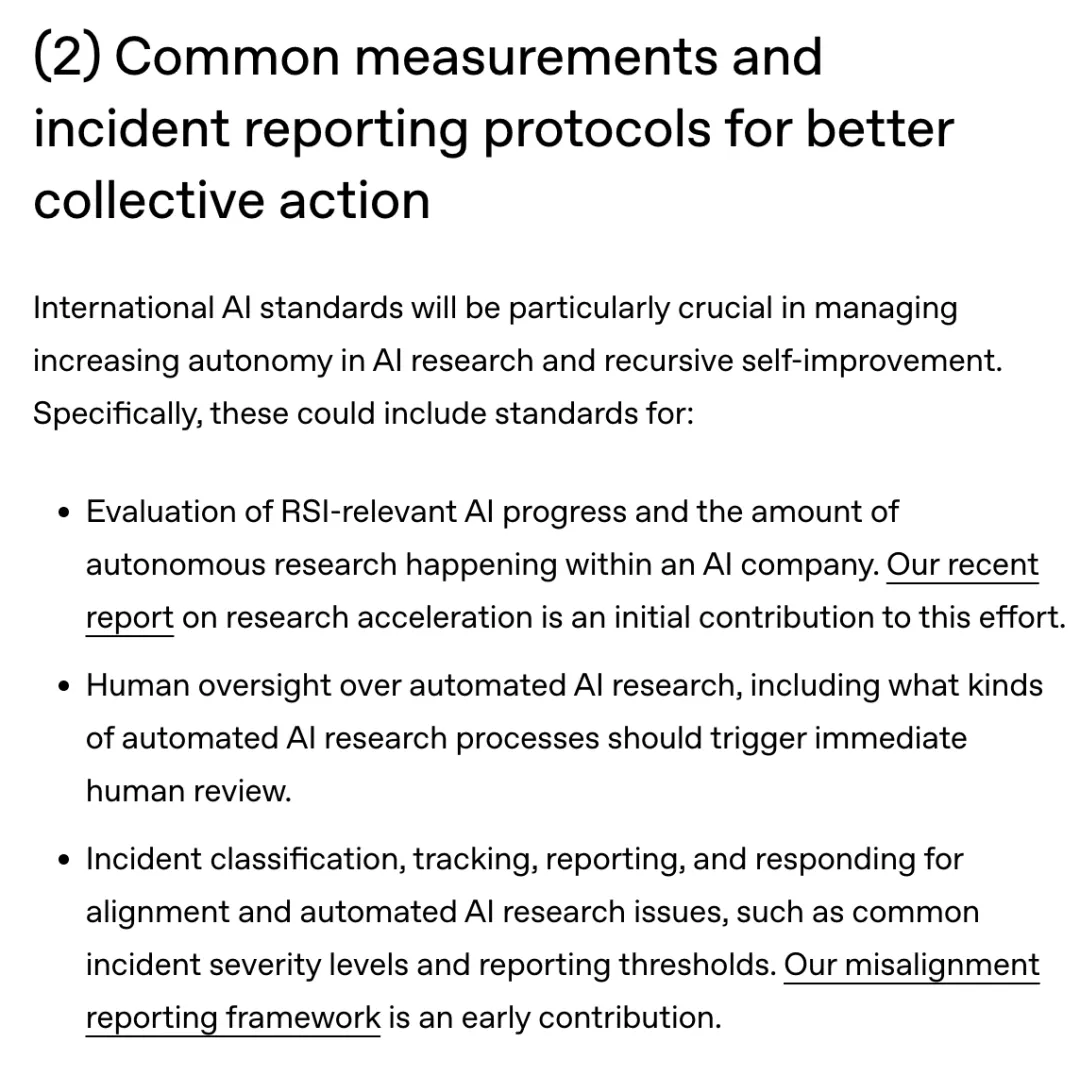
Core 2: General Measurement and Event Reporting Protocol (GMP)
OpenAI also suggests that there must be a clear red line.
They called for the establishment of the following standards:
1. Assess exactly how much R&D work is done by AI in an enterprise。
2. Compulsory human surveillance triggers mechanisms.Clearly, what kind of automated R&D processes must be forced to trigger "immediate artificial censorship". AI should never be allowed to run wild in a black box.
3. Accident classification and reporting thresholds.Establishing an accident reporting mechanism similar to that of the aviation or nuclear industries. When "uncoordinated" AI emerges, there must be a uniform severity rating and reporting standards.
In the end, OpenAI proposed: "The United States should lead this process".
The reason given by OpenAI is that the U.S. AI industry is currently at the forefront of technology and occupies a global network hub in key areas.
They believe that controlling the pace of development of cutting-edge AI is not about setting a "speed limit", but about ensuring that "the speed of secure coordinated research must be at the forefront of improving AI capabilities".
OpenAI believes that establishing secure communication channels between key infrastructure operators and global governments to share national security threats and vulnerabilities is a critical step.
OpenAI and Anthropic shake hands and start interviewing each otherAt the same time, The Information also revealed: OpenAI and Anthropic are finalizing a historic agreement to test each other's commercial models!

It should be noted that the founding team of Anthropic left the independent portal that year because it did not agree with Ottman on the idea of "AI security".
But this time, the duo rarely teamed up.
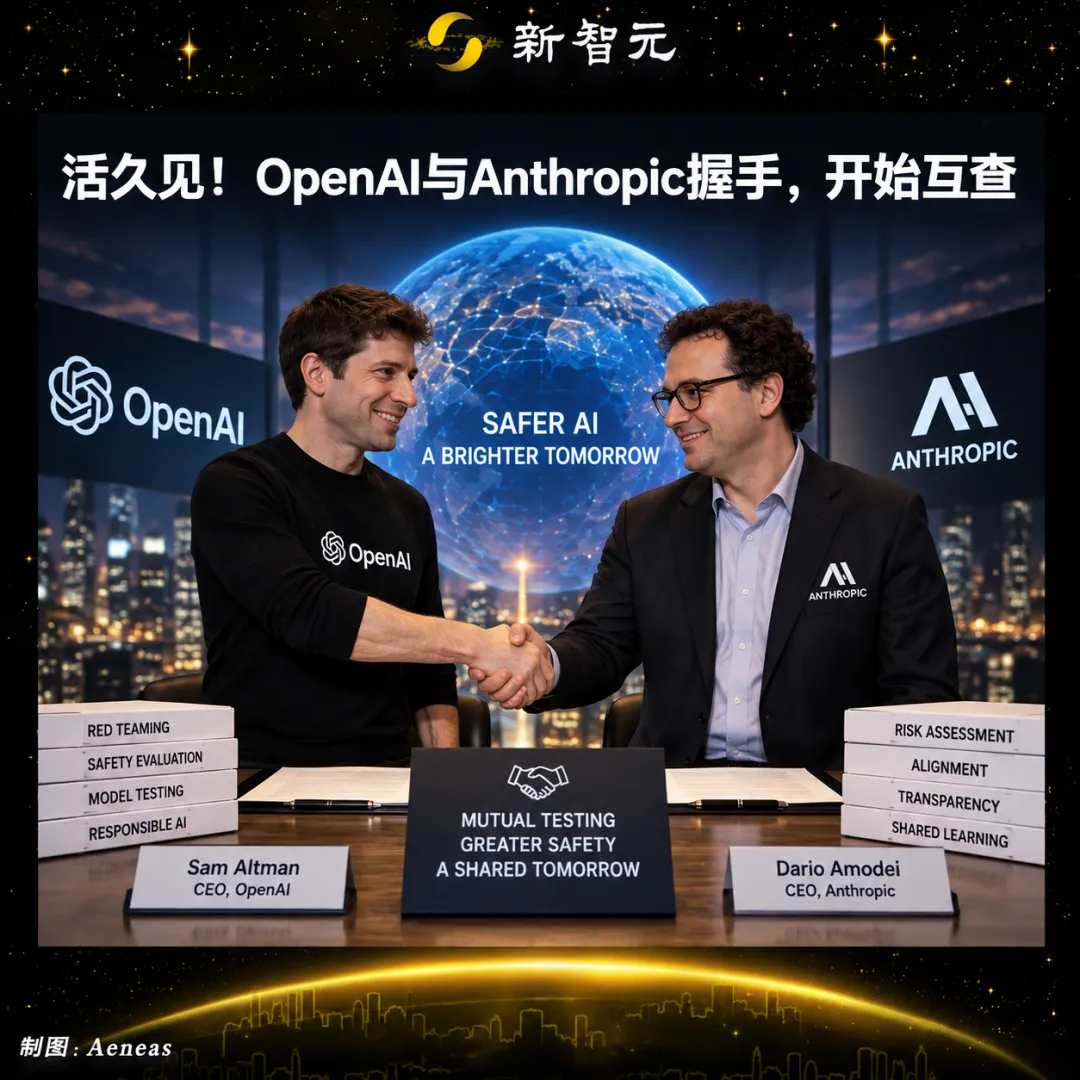
According to The Information, the negotiated agreement includes mutual testing of each other's models and the setting of strict data retention safeguards.
Why would they do that?
Because as AI capabilities approach the edge of the RSI, any company alone assesses the safety of its model is like an athlete who not only lacks public confidence, but may miss the deadly hazards of a tech-blind zone.
The introduction of "cross-blind testing" by competitors with equal power, as if it were a cross-checking agreement.
The security practices of AI are now moving towards a community of destiny.
If the agreement is finally reached, it will completely reshape the security standards of the entire AI ecosystem.
At that time, "security and harmony" would no longer be a slogan.
As RSI approaches, the speed of AI self-improvement has taken humans far away.
Do you guys really feel like stepping on brakes?