
It's the first time in the history of the world.
A software entrepreneur who started with a big software subscription shouted the following idiom:
The software is dead.
On October 11, well-known independent developer Pieter Levels (levelsio) said in a statement that he had withdrawn almost all software subscriptions for work and started to cancel personal subscriptions.
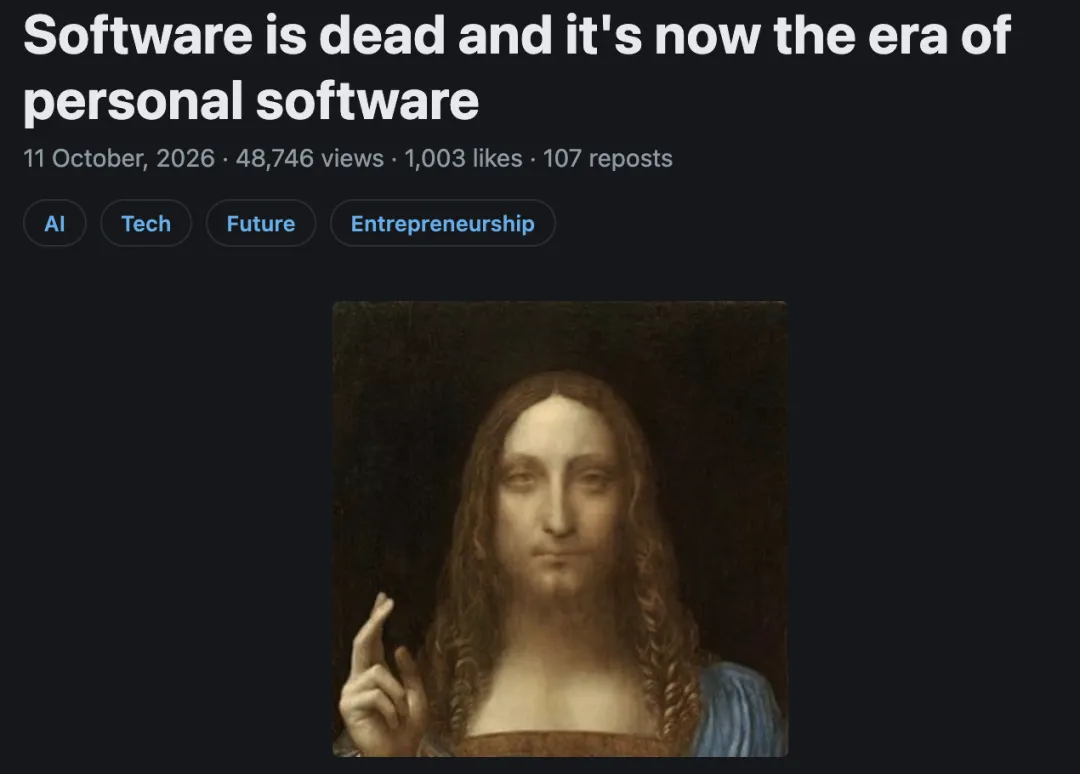
His approach is simple and rough: let AI do what it needs; find the right open source project and let Claude do it himself.
It should be noted that Pieter himself is a representative of "one person to a company" in the independent development circle.
In 2024, Pieter Levels hosted the Lex Fridman podcast.
In 2014, he launched the "12 Months to Launch 12 Startups" challenge.
One of them was a public form that helped her find her hometown, which later became the Nomad List, which is now Nomads.com.
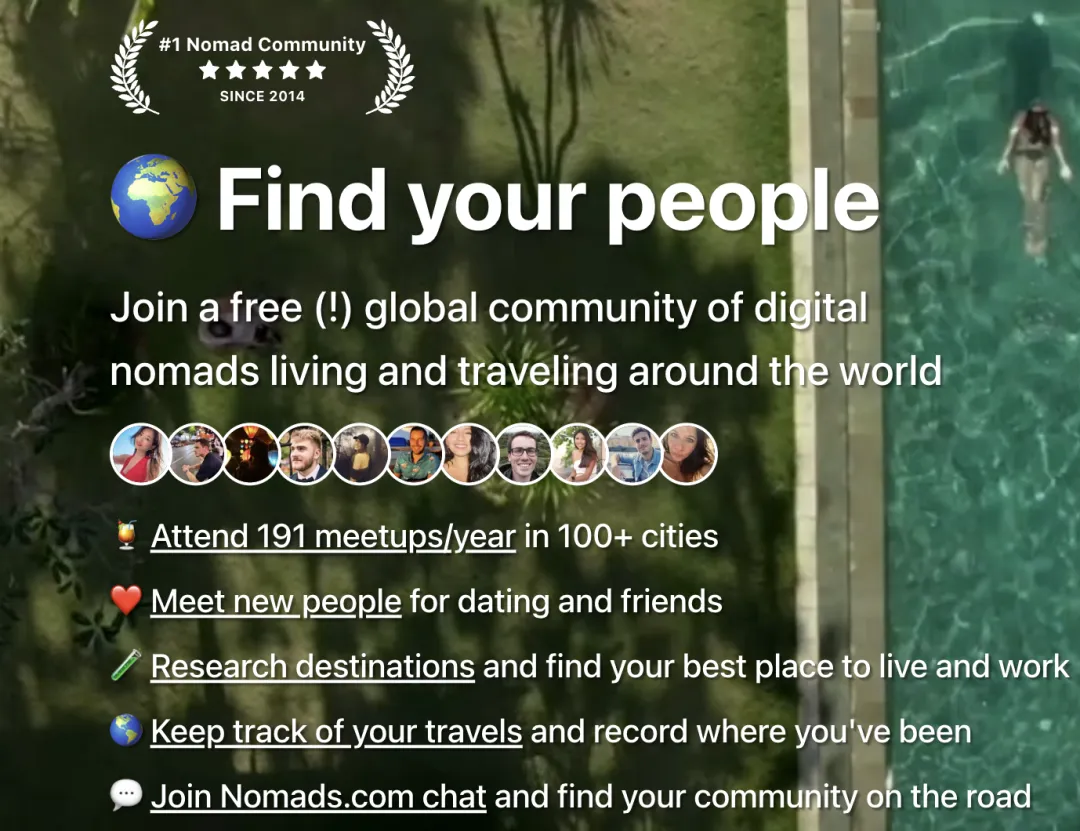
Nomads.com, founded by Pieter, helps people who work on the sidewalk find a livable city and meet their peers.
The remote recruitment website Remote OK, the AI photography tool Photo AI, was also created by him.
According to data he released in March this year, Photo AI alone had a monthly revenue of $105,000 and a monthly profit of $80,000.
Today, even he is starting to replace AI with payment software, and a problem is being raised:
If AI can make enough tools for me, shouldn't I be subscribing to a whole suite of long-term software for unnecessary features?
According to Pieter, the "Age of Personal Software" is coming.
In the past, we used to buy software, then find functionality.
When users start building their own tools, software companies will also face challenges in their business of making money from ongoing renewals.
Software doesn't have to be omnipotentThat's enough for me.When it comes to "self-made software", many people's first reaction is hair follicles: black box terminals, codes for hair follicles, and incomprehensible mistakes.
But in Pieter's conception, you have to talk to AI as usual:
Help me create a weekly newspaper;
It's a good idea to use this data as a benchmark to filter it out.
Give me a bunch of photo shrinking tools...
The process he imagined was simple: when you say you need it, AI makes the tools in the background.
A lot of people don't even realize that the software they use is AI that they just "private ordered".
There are two main practical scenarios here.
One way is to get used to it.
All you need is an analytical report, the AI delivers results, and the task is over.
The other is to stay and use it again and again.
If you want to keep changing the data, adjusting the parameters, making the comparisons, let the AI generate a little tool.
For example, you're renting a house.
In addition to the monthly rent, there are also commuting fees, deposits, intermediary fees and moving costs.
In this way, you can have the AI to make a calculator of rental expenses according to your needs. Fill in the various expenses and see how much money to prepare for entry and how much to spend each month.
If you put the data of several rooms together, it is easier to compare which are cheaper.
It doesn't have to be a whole suite of rental platforms, and it doesn't have to be a complex menu.
This is where personal software is most tempting: the goal can be small enough to say, "I can do it myself".
In fact, this method has long been supported by products.
In June 2025, Claude upgraded its Application Success capability to allow users to chat, create, modify, and share AI-enabled tools.
Pieter's approach is more specific.
He said that he had built an image scaling service using AI programming and that he had made an image editor for Photo AI to replace the previously used Photopea.
The only thing he has to deal with is the need to process the images in his product. To fix this part, a previous subscription had a reason to cancel.
Of course, there's a long way to go between being a useful tool and copying a whole suite of commercial software.
But for independent developers and ordinary users like Pieter, a small tool to solve specific problems is often enough.
Even Word has welcomed open source challengersIf the goal is to create a software that replaces Word and meets the needs of different users, how difficult is it?
On October 8, the ArtCraft team, who had previously launched the photo editing project PhotoCraft, released WordCraft.

WordCraft's official interface, which provides familiar document editing operations.
This time, it is targeting Microsoft's Word.
According to the official announcement, WordCraft was developed with Rust, is free and open source, and supports reading and writing.docx documents.
It can run on desktop and in browsers, and provides an interface for AI intelligent agents to make calls, allowing both AI and human beings to manipulate documents.
It's really easy to be touched when you look at these things: is it possible to use a familiar tool for free?
It's a good idea to replace it with Word, but I've also had file compatibility issues.
Your own small editor can only handle what you're familiar with.
An all-in-one Word replacement is to receive files from colleagues, customers, and partners to ensure that they can be opened, modified, and saved properly.
WordCraft is still in the early stages of testing, and its functionality and stability still need to be improved.
According to the team's self-evaluation, the current completion rate is about 60%, with the goal of replacing Word entirely in real work.
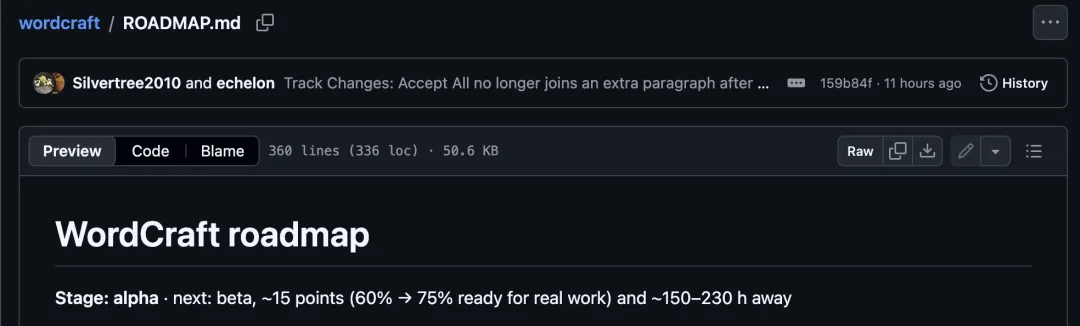
WordCraft's official roadmap: The team's self-evaluation of completeness is about 60%, with the goal of replacing Word entirely in real work.
The next step is to complete, including the compatibility verification of complex documents, the complete preservation of graphs, and the split-page effect consistent with Word.
It's a very specific question to be asked in the daily office:
Can the documents sent by the colleague be opened normally? Can they be sent to the customer, the graphs are still missing? Can the computer, page codes and paragraphs be changed completely?
WordCraft shows the appeal of free alternatives and puts the difficulties of replacing mature software on the table, but the complex problems that users encounter in real work also have to be solved.
After subscribing to SaaSWho else is levelsio paying for?On September 9, Pieter released a list of service replacements, claiming to save about $25,000 a month through AI programming and self-building services.

Among them, he said, the conversion of AI for content auditing saved about $10,000 a month; the conversion of customer platforms with AI customer robots saved about $5,000 a month.
Additionally, software and interface fees are saved for services such as self-build image processing, web scraping, website monitoring.
This figure is tempting, but he calculates the cost of running multiple websites, both software and human resources.
The average user occasionally edits a few pictures, and even if they unsubscribe from the relevant software, they naturally can't change the amount of money they save.
More interestingly, with so many subscriptions gone, what other services is he making money for?
In the same tweet, Pieter also lists services that are still being paid for:
Domain name registration, email, cloud storage, data backups, server hosting, and AI models for its websites.
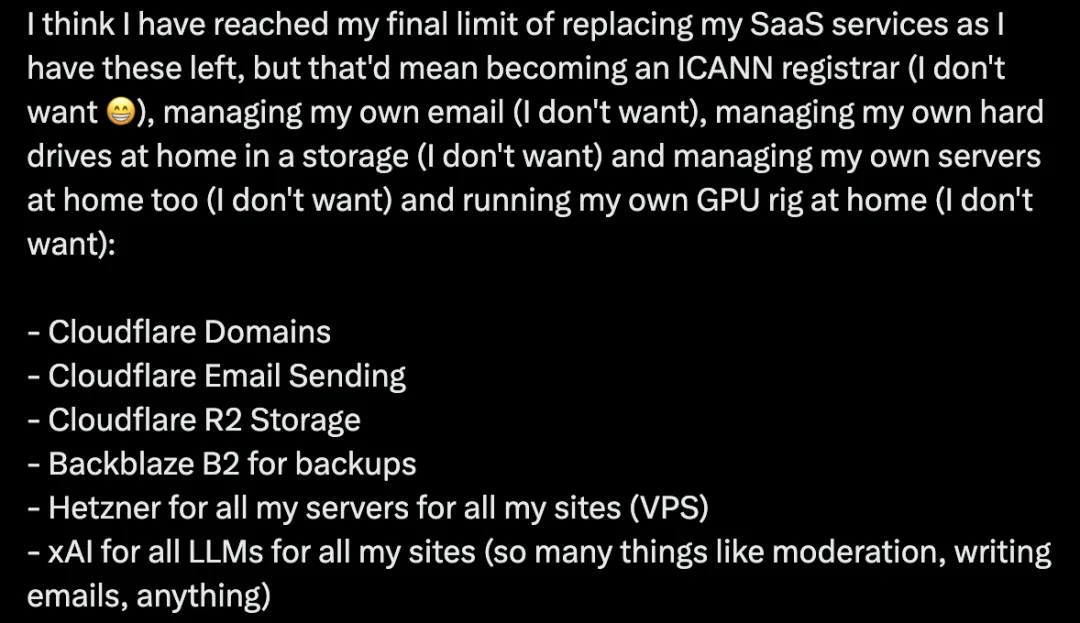
This is because he doesn't want to be a domain name registrar, he doesn't want to maintain email systems, and he doesn't want to manage hard drives, servers and GPUs at home.
These jobs, he is willing to continue to pay for the service providers.
In a blog post on Oct. 11, he also lists reserved personal subscriptions, including services such as Claude Code, YouTube, Spotify, internet connectivity and personal cloud storage.
Tools can do it themselves, but the services needed to generate and run the tools will still cost money. Basic needs such as content, networking, and more will not disappear because they can write software themselves.
Pieter's account is very clear: he can be replaced, he deserves to be replaced, he does it himself; he doesn't want to take the job and keep paying.
So, unsubscribing doesn't mean saying goodbye to payment.
From Pieter's point of view, some of the money may flow from existing software to AI platforms and cloud service providers that create and run software.
Save your subscription fee.Lost a few nights, worth it?For ordinary people, the most enticing moment of personal software is probably the moment when they see the entanglement that reminds them of renewal:
You only pay a few times a month; you only want to change the size of the picture in bulk, but you open a whole complex menu on the screen.
If the requirements are clear enough and the results are easy to check, it's worth a try to get AI to do a little tool.
But there is also a bill behind it.
The tool suddenly stopped working, who's going to fix it?
How do you get the important data back?
If access services change the rules, who will change them?
Even if you keep looking for AI help, describing problems, checking out results, and dealing with problems after a mistake, it will take time.
Pieter was able to make these changes, thanks to his many years of development and operation experience. The average user does not have to have the same experience or be willing to take a "software repair" job after leaving work.
If you save a subscription fee and lose it for a few nights, the bill will be recalculated.
Running stably, continuously updating, problems that can be resolved in a timely manner, are the value of existing software. A portion of the annual subscription fees users pay for is this savings.
AI adds a must-have question to software companies: How much trouble can your product save users when they can make a useful tool for themselves?
And before the next renewal, we can calculate more than one bill: can this need make AI a useful tool?