"LeetCode-like programming interviews are dead! At least that's how it is for my team".
Today, Felix Rieseberg, Head of Engineering at Anthropic, posted: "I can confirm that traditional programming interviews have lost their reference value, and this month I cut it directly from my team's interview process".
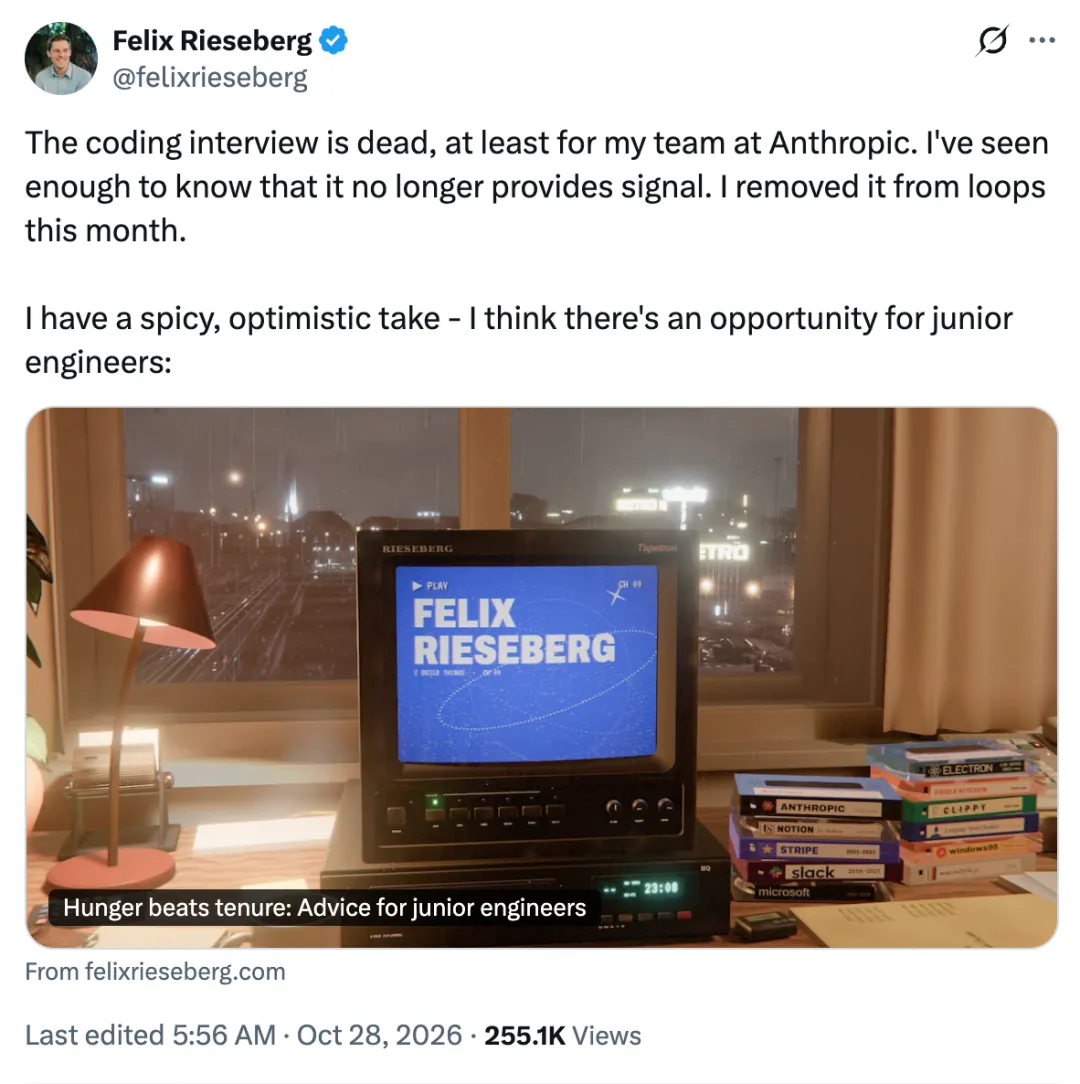
He also published a blog post entitled "Shocking Over Qualification: A Blog for Junior Engineers", written specifically for engineers who have not yet accumulated social capital and the right to speak.
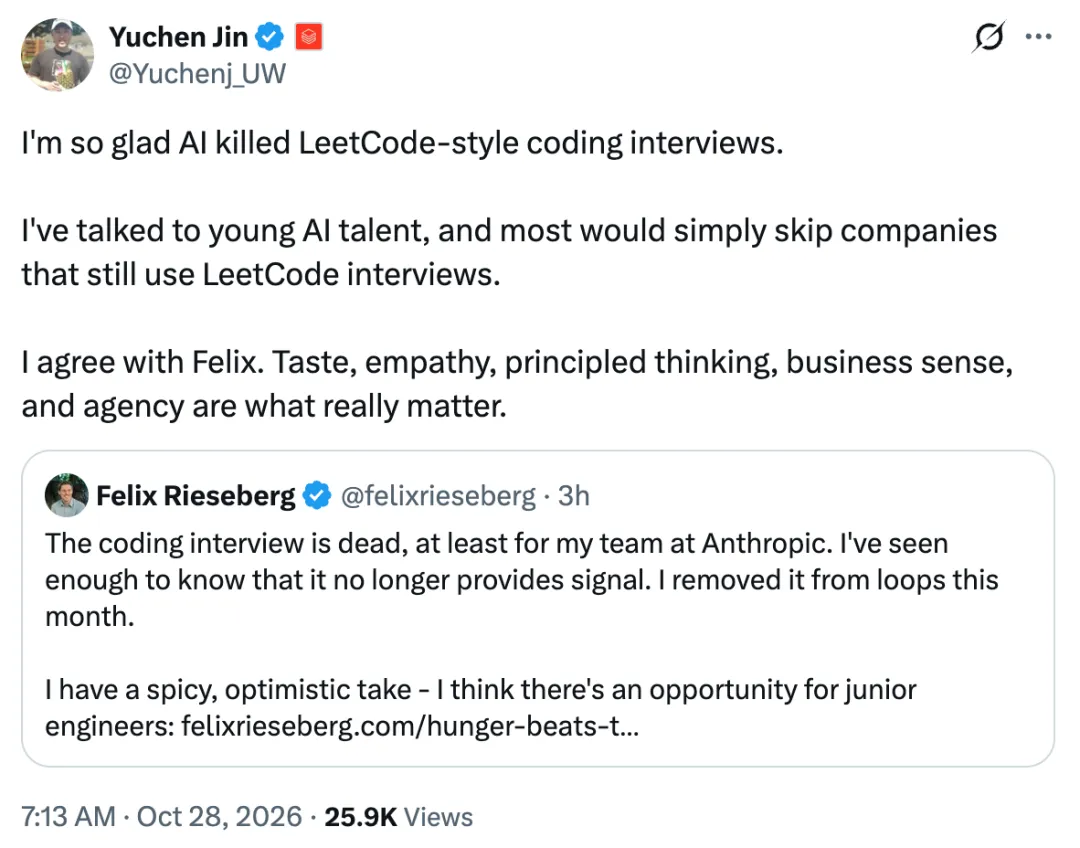
Well-known AI blogger Yuchen Jin immediately commented: "I'm so happy that AI has finally eliminated LeetCode-like programming interviews. I've talked to a lot of young AI talent, most of whom will jump right into companies that still use LeetCode".
Programming interviews, "Death" is in the hands of AI
Traditional programming interviews have played a role.
The ability to quickly define problems and find sophisticated solutions in a limited amount of time has been a rough but effective indicator of whether an engineer can succeed on a team. Small programming challenges that simulate real-life scenarios can also reveal certain real levels of candidates.
But it doesn't work now.
A simple React problem is given to the candidate, which is no longer so different from examining the compilation language, and Claude performs better on both of these tasks. The most influential engineer on the Anthropic team, who does not have to be good at this type of deadline test, achieves a traditional programming problem that makes it difficult to predict the actual performance of a person after entering the team.
Rieseberg also observed a new phenomenon: some early entry-level engineers are rapidly outperforming their long-time counterparts. The latter may have a stronger programming base and are more familiar with traditional development processes, but the latter can use AI to turn ideas into products faster.
In the past, it took years for engineers to accumulate to become familiar with the various frameworks, code libraries and engineering details that constituted barriers for senior engineers. Today, AI can quickly replenish a large amount of specific knowledge, how much impact a person can make, and is no longer highly restricted to professional years.
In Rieseberg's words, "hunger has defeated the working age".
They have eyes, but they don't speak.
Before giving advice, Rieseberg discussed the real situation of young engineers, who often have fresh perspectives but lack the right to speak out.
He cited several examples.
When Rieseberg joined Stripe, founder Patrick Collison reminded all new employees to pay close attention to what makes them feel strange.
Collison believes that newcomers are more likely to spot friction and opportunities within the organization, and older employees may have been used to these issues for a long time.
In 1991, James March, a management scholar, wrote:
The development of the organization depends on "continuing to absorb naive and ignorant people".
When asked why he was confident in trying out a method of filming that no one has ever used before, director O'Neal Wells replied:
Ignorance, pure ignorance, nothing brings more confidence than ignorance. In my opinion, it is only when one really understands an industry that one becomes cowardly or cautious.
Rieseberg's experience with Notion is similar.
At the time, an interview question asked him to design an offline model, which was widely considered by Notion to be a trapped topic because it was almost impossible to achieve an offline model.
One is that Notion's data models are too complex and the entire workspace can't be fully synchronized; the other is that there's an internal rumor that CEO Ivan Zhao can't accept a product experience that only downloads individual pages.
Later, the complexity of the data model was verified, but the statement that "the founders must be against it" was never really verified. Rieseberg, an ignorant newcomer who did not understand the internal consensus, only thought of asking directly.
Shortly after joining Notion, Rieseberg wanted to equip teams with big screen TVs to display real-time data boards, but faced heavy resistance and ultimately failed, and he didn't insist on competing with the organization as a whole.
A year later, Ji Pei, who had just taken office, came up with the same idea. Rieseberg told him not to try again because he had already tried.
Rieseberg realizes that, unbeknownst to him, he has become the old employee who used to say "impossible".
The newcomers are backed by these five tricks.
After identifying his strengths and limitations, Rieseberg gave five suggestions.
First, prioritize the business impact, not just the task at hand.
In 2011, well before the advent of AI programming, Patrick McKenzie wrote:
Companies hire engineers to create business value, not to write programs.
First, engineers need to figure out what the company really wants to achieve.
If you are a large company, you should know the goals of your team or department; at the same time, paying attention to what goals your direct supervisor is pursuing is often an effective reference to the importance of the business.
Second, choose an idea that is bold enough.
Several directions can be proposed, but at least one of them, once successful, can significantly increase the probability of an organization achieving its goals.
Third, get it done on a weekend.
Rieseberg has met small teams of engineers with single-gun horses who have directly built prototypes that can run, bypassing the long process of writing requirements documentation, seeking internal support, lobbying designers or product managers.
A workable prototype is far more convincing than a hundred-page document.
Fourth, focus on getting an idea right.
Underqualified engineers can easily make a mistake by plugging too many ideas into the same prototype, ultimately flooding three good ideas into twenty bad ones.
If a prototype is to create a new programming language, build a backend, or even develop a mobile application, it is difficult to succeed.
The purpose of creating a workable prototype is to express an idea clearly enough to allow management to see opportunities quickly while believing that the engineer has the ability to move forward.
Fifth, take full advantage of fresh perspectives.
For user-facing products, new engineers are more likely to perceive the user's real experience, and more likely to see where the product is useful and where there are problems.
Rieseberg, an old colleague at Slack and Notion, finds it difficult to really interact with an outside user to understand what it feels like to use Slack or Notion.
The same is true for infrastructure or tool development. Newcomers have not yet learned all the reasons why something is "impossible" to explain.
More about taste, empathy, and action
I'm afraid I won't be back for the programming interview.
How many people who have thrown their hands on a thick algorithm and data structure to just knock on the door of a good job, in exchange for a better future, can't help but feel some emotion here?
But Rieseberg also admitted that as a longtime opponent of hierarchy, he could not bear to be optimistic. He has witnessed many products made in this new way.
At Anthropic, engineers have long been accustomed to using the Claude Code in the command line, so few people rethink how it interacts. Two short-term engineers, Anthony Morris and Alice Zhao, worked on a graphical interface prototype that could run in just one weekend.
About eight days later, the first public version went online. This graphical interface designed for Claude Code has now become a popular product.
Rieseberg believes that he may not be the only manager who is thinking about a new way to interview. Businesses need to find people who can make great products with AI, but how to identify such talent is not a mature answer.
He has also not yet found a complete method. However, when browsing through his CVs and collections of works, he will pay particular attention to prototypical projects that are small in size but can reflect taste, empathy and principled thinking.
The link is as follows:
© THE