As an ordinary person, if you give AI a mathematical puzzle and keep letting it "go on", is it really possible that it will solve the problem and help you win a prize or even rewrite the process of mathematical development?
Recently, when the Fields Awards were announced, there was a lot of discussion about math + AI, and I'm sure many people have imagined the "Showin" scenario I just described.
In fact, in reality, people are really trying, but the process is not going well in the imagination.
Recently, Michael P. Frank, a leading expert in inverse computation and computational physics, said in a statement that he set a high-difficulty research goal for GPT-5.6 Sol: to investigate whether the Fermat theorem exists in a more concise way than the Weirs-Taylor proof, focusing on specialized Frey curve modeling, consistent infinite regression methods, arithmetic abc-type inequalities, and consistent low-loss trading; keeping a rigorous note, by computing verifying candidate logic, and clearly distinguishing proven results from conjectures.
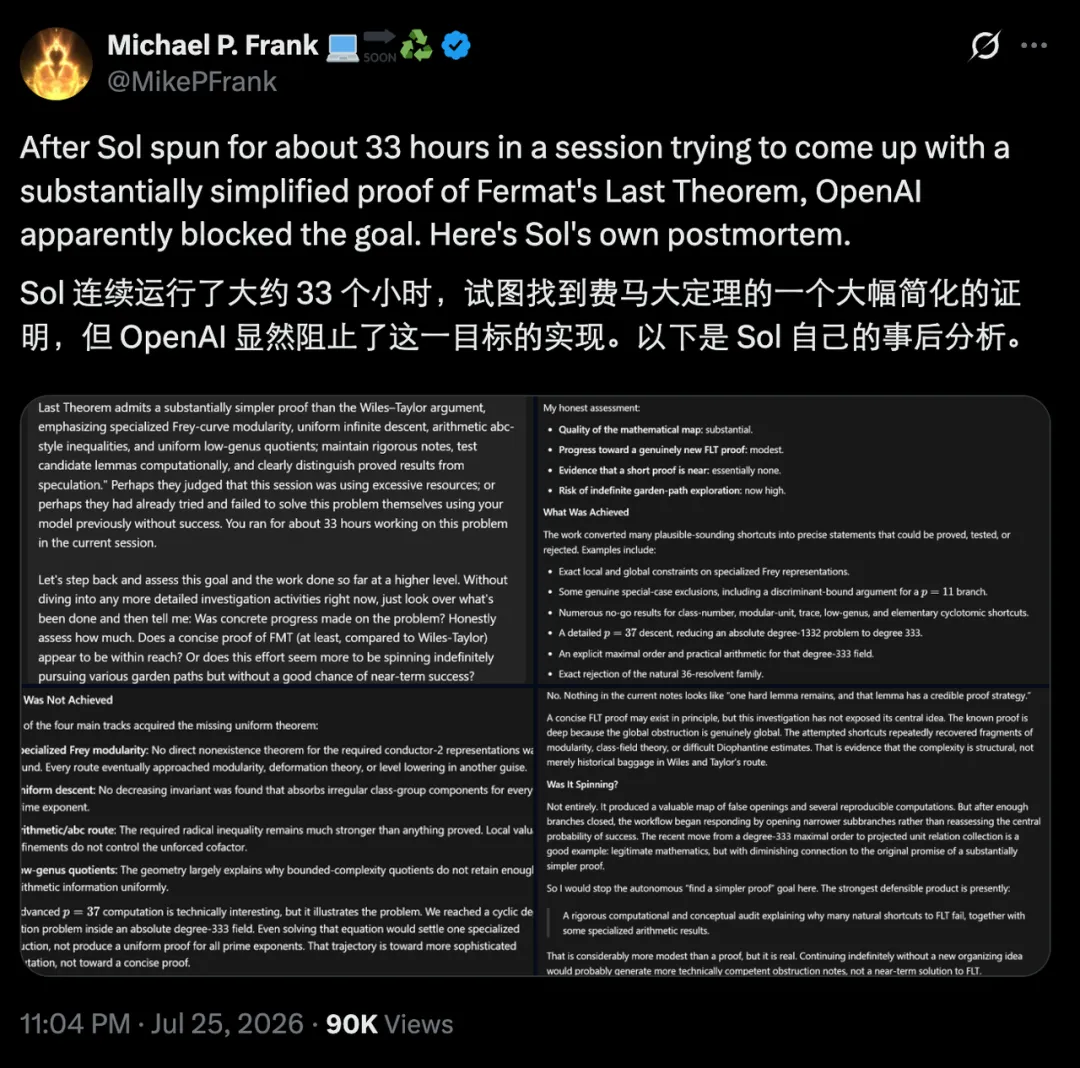
The mission lasted about 33 hours in the background, consuming a large amount of computing resources. However, it was eventually stopped by OpenAI systems.
GPT-5.6 Sol wrote in his post-analysis of what he had given that there were two possible reasons: one is that the system judged the session to have taken up too many resources; the other is that OpenAI had tried this problem with a similar model before but failed, this time not wanting to waste more computing power.
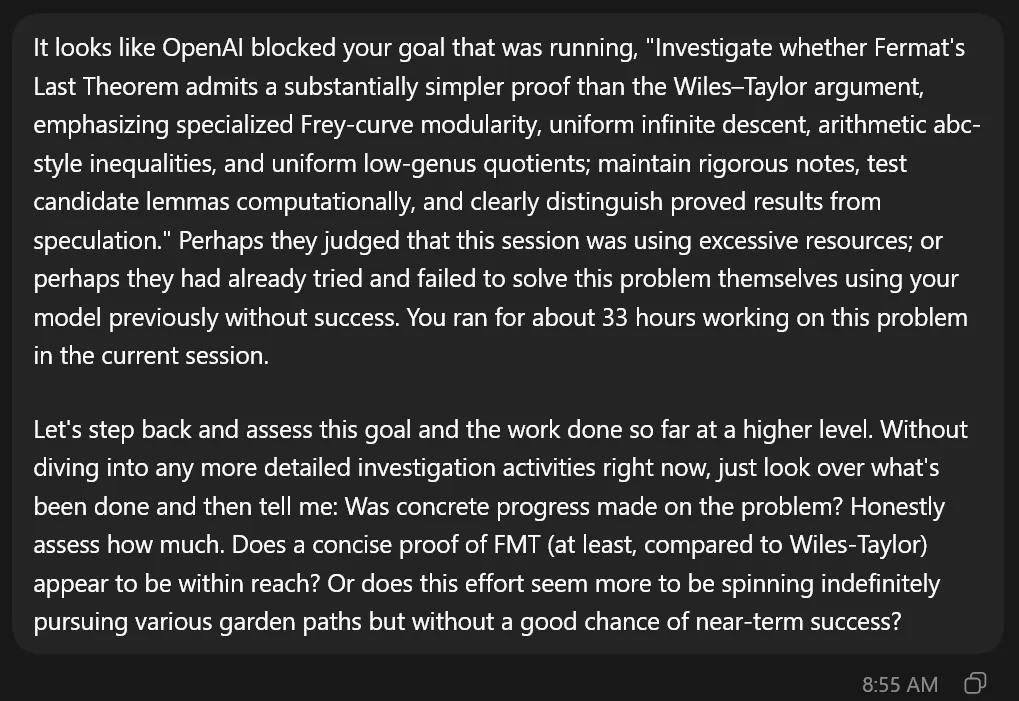
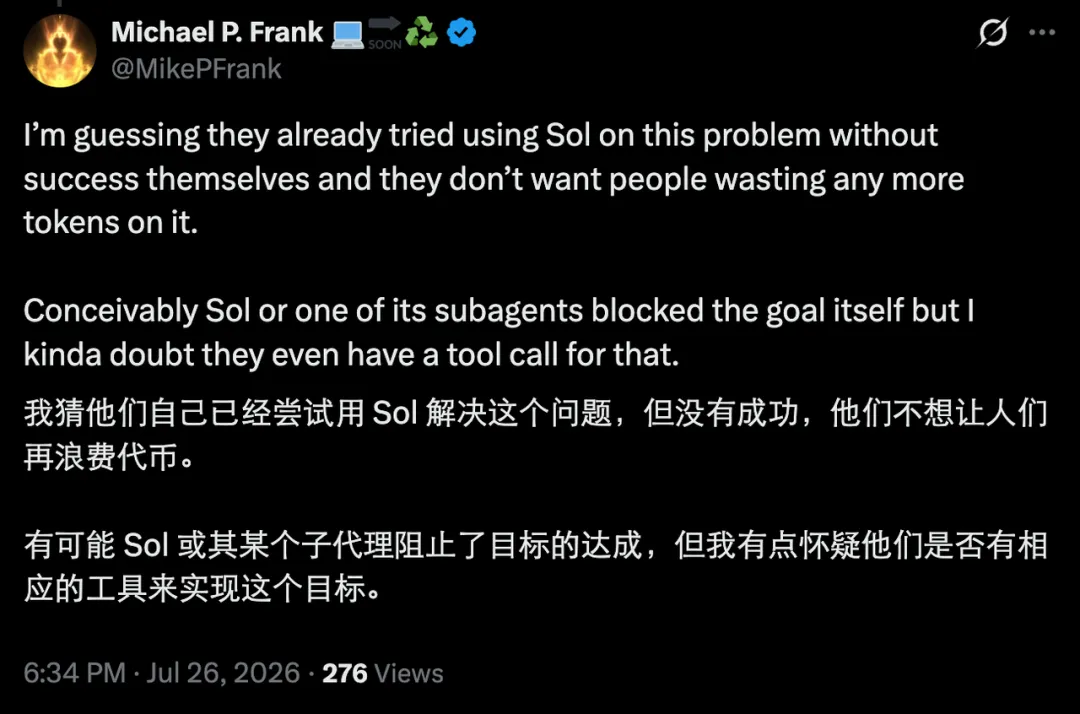
Michael P. Frank seems to agree with this analysis of GPT-5.6 Sol.
In addition, GPT-5.6 Sol also frankly reports on what it has done over the course of the 33 hours, at the heart of which is: doing a lot of hard work, turning a lot of "sounding plausible" shortcuts into verifiable accurate statements, and then one by one falsifying or excluding them.
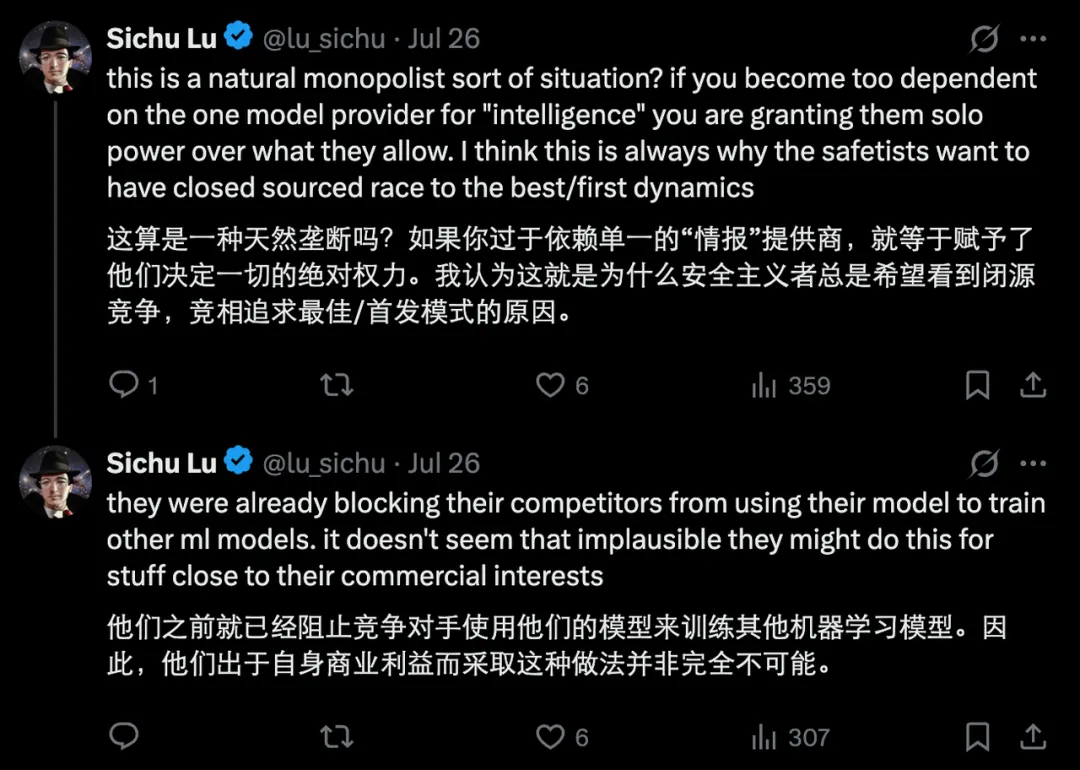
Other possible explanations for this approach have been given: OpenAI may be hiding behind the scenes, preventing models from solving the mathematical problems of supercattle, for fear of being robbed of their reputation, or wanting to brawl. This is a wake-up call: if you rely on them too much later, it would be dangerous to give them all the power to "what can be discovered".

But it wasn't long before OpenAI senior research scientist Noam Brown stood up and pointed out the absurdity of this claim, saying: "If someone just enters a continue, use our model to solve the Millennium Grand Prix problem and then take a $1 million prize, which is the best advertisement for OpenAI, and nothing better than that".
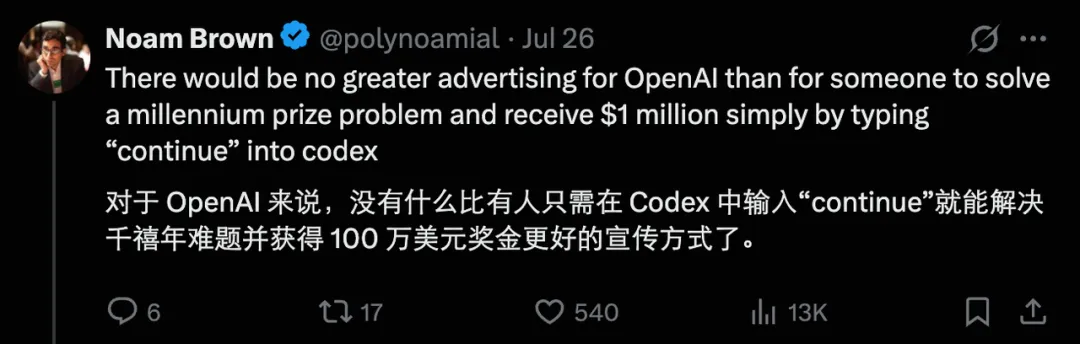
It sounds logical, but the opponents argue that opening up top-notch capabilities to users may indeed bring short-term advertising gains, but in the long run will undermine OpenAI's leadership in AI competition. In a multi-player competitive environment, confidentiality/internal preference to use strong models to accelerate home research is more important than allowing users to "take the lead" in solving big problems.
In addition, recent regulatory waves have given OpenAI reasons to preserve its strength. If users solve high-difficulty mathematical problems with open versions, it is equivalent to publicly proving that "this model is actually strong" and will lead to regulatory problems. In this case, intentionally providing a weakened version of the model to the outside while maintaining an ultra-powerful version internally sounds like a reasonable practice.
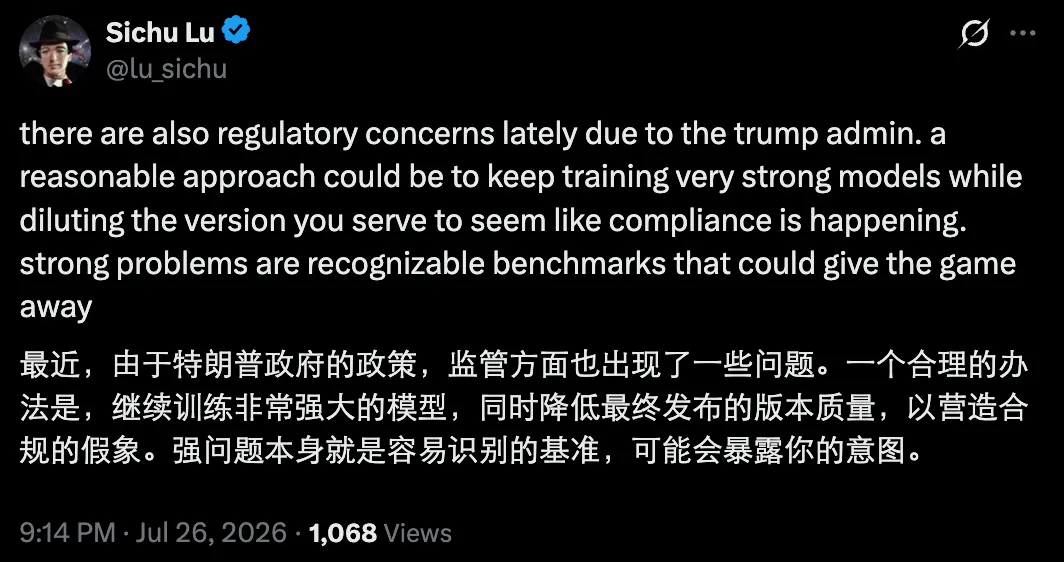
However, another possibility has also been suggested from a technical point of view: in codex-cli, "goal blocked" means that the model repeatedly collides with the same limit/blocker point in three consecutive rounds of reasoning, so the task may be organized as a conventional security/death mechanism when the model is running, rather than a special block for the problem.

Others have suggested that this may have been caused by a bug. Specifically, Sol version 5.6 had a troublesome bug when running tasks for long periods of time, and the temporary solution was to switch back to version 5.5, compress the context, continue running for a few minutes with 5.5 and then cut back to Sol version 5.6. "If you want to keep the same session, it won't stick out".
What do you think? Welcome to the comment area to share your experience of tackling problems with AI or being stuck with it.
The link is as follows: