Recently, the Dark Side of the Moon officially launched the Kimi Global Ambassador program, which aims to recruit a group of pioneers worldwide.
Last night, the dark side of the moon just unveiled the technical underpinnings of Kimi K3.
MoonEP, FlashKDA and AgentEnv, the three key Infra technologies that support model weighting, technical reporting, and model training, are once and for all open to the world.
What is the sign of the moon in the darkness?
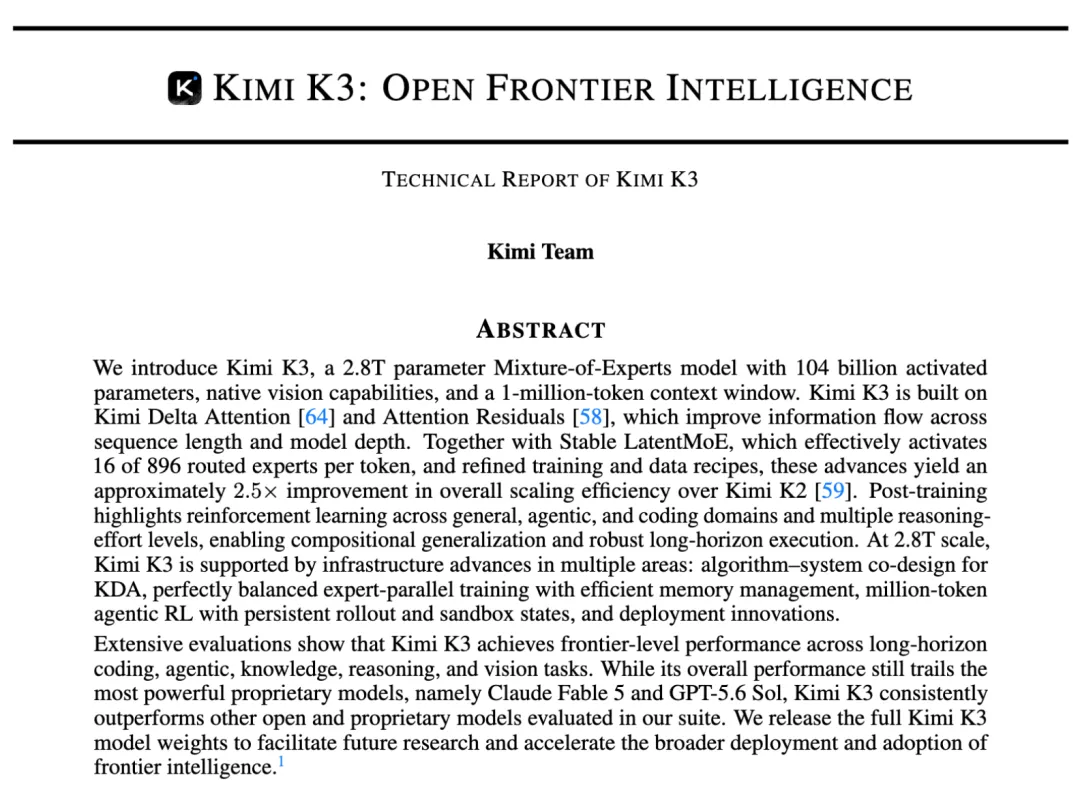
Weight of the Kimi K3 model:https://huggingface.co/moonshotai
Kimi K3 technical report:
This is the first time I've ever heard of this.
FlashKDA GitHub repository:
This is the first time I've ever heard of this website.
The Kimi K3 is a hybrid expert model with 2.8 trillion parameters, with native visual comprehension capabilities and support for 1M overlapping context. The parameters are about three times the size of the Kimi K2.5.
Using technologies such as Kimi Delta Attention, Attention Residuals and MoonEP, the scale-up efficiency of the Kimi K3 has been increased 2.5 times.
Now anyone can download and deploy K3 for internal R&D or embedded terminal products.
The synchronously released technical report further revealed technical details such as KDA + AttnRes, Stable LatentMoE, MoonViT-V2, and enhanced learning in the context of millions of tokens.
The dark side of the moon also opened up the critical infrastructure to support K3 training.
MoonEP is aimed at parallel communications with experts in ultra-large particle MoE; FlashKDA is a high-performance calculator from Kimi Delta Attention that improves prefill speeds from 1.72 to 2.22 times faster than the flash-linear-attention baseline on the UK's H20; AgentEnv provides high reliability, tightly isolated sandbox environments for large-scale Agent training, support for snapshots, recovery and forks.
It can be said that the Kimi K3 has almost opened up some of the most critical layers of the training chain.
This open-source timeline is also subtle, as the US tech and policy community has just experienced a rare round of confusion around open source and regulation.
Last Friday, Invisalign founder Huang Rinpoche tweeted the first tweet of his life, sharing an open letter from Invisalign to the United Nations about open authority and U.S. AI leadership.
The letter reads: "The world needs a cutting edge closed-source model as well as a cutting edge open-source model".
More than 20 tech giants, start-ups and investment firms, including Microsoft, Meta, Hugging Face, Mistral, and YC, also signed the letter.
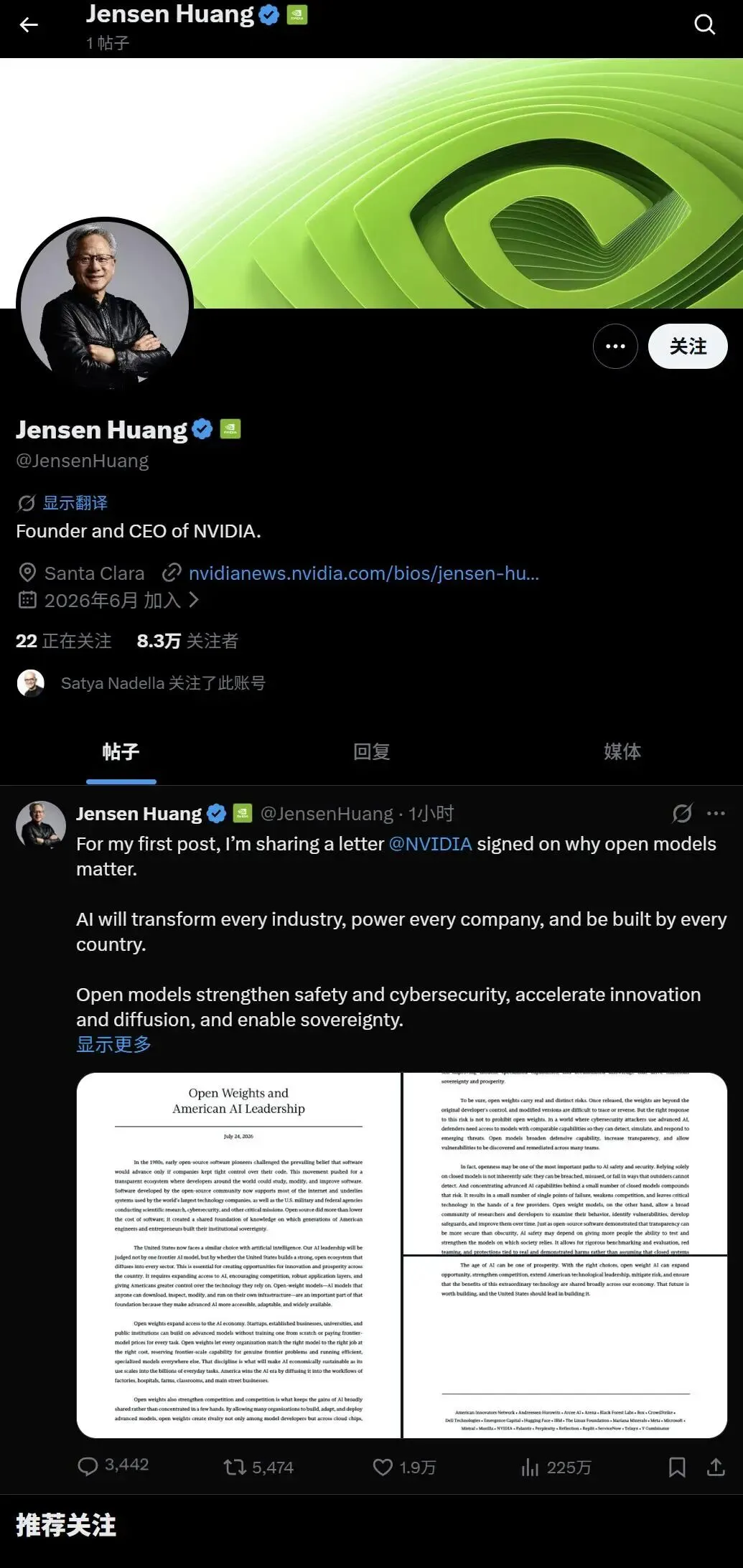
The move even forced OpenAI to make public statements and join the supporting ranks.
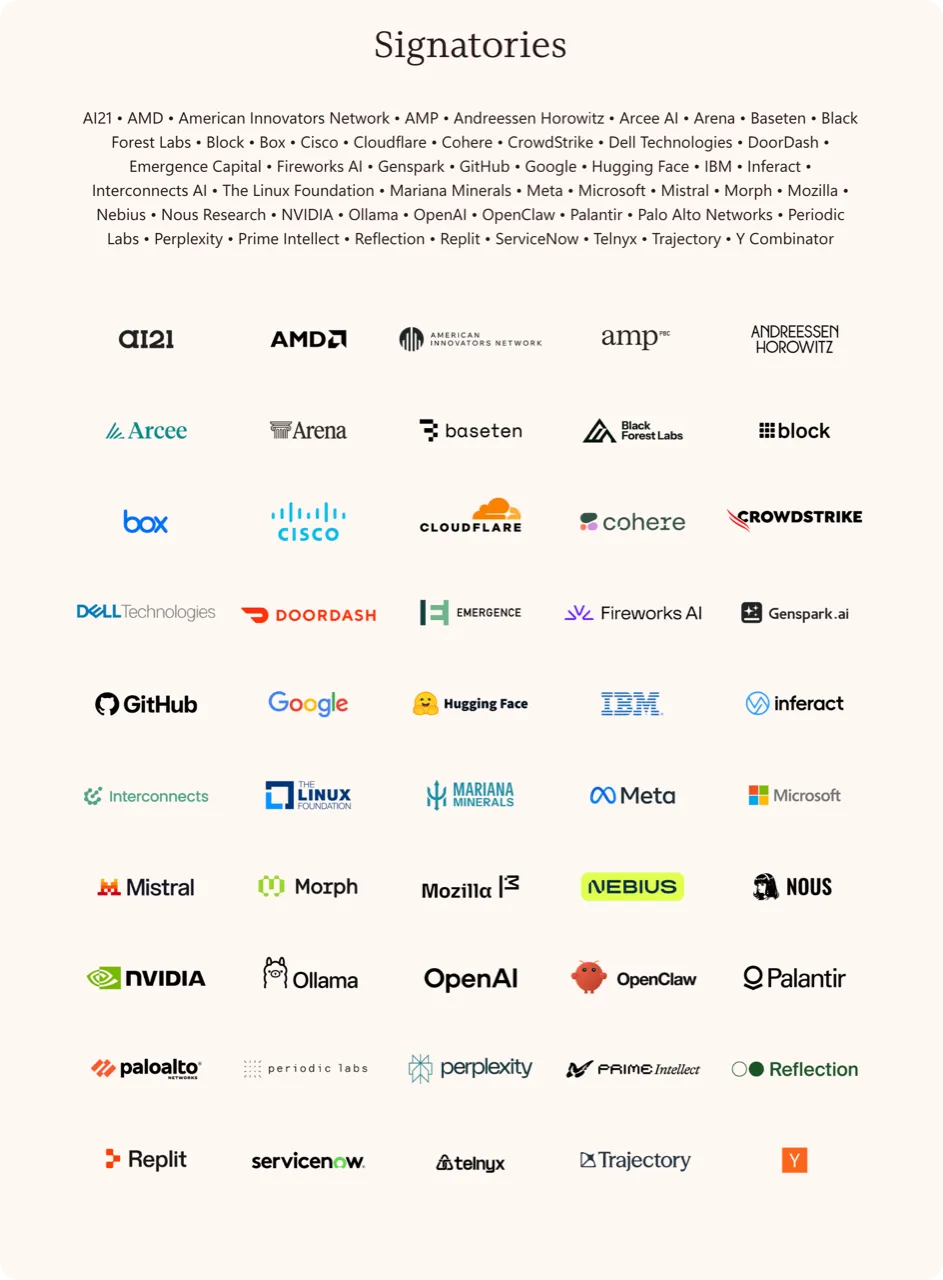
The public letter did not directly name Kimi K3, but the release date coincided with a policy debate sparked by K3.
According to Axios, the Trump administration is re-examining whether to strengthen regulation of China's open source model, and departments such as the U.S. Treasury Department are also investigating possible restrictions.
Nearly 200 Silicon Valley startups quickly formed a "small tech alliance" to warn the government that shutting down the low-cost open source model would force startups to pay high API fees to OpenAI and Anthropic, which would directly destroy large amounts of limited-cap American startups.
In an interview, Huang said that American companies "of course should" be allowed to use Chinese models, calling them "excellent". In his view, low-priced, open models will increase the use of AI, eventually leading to more demand for chips and data centers.
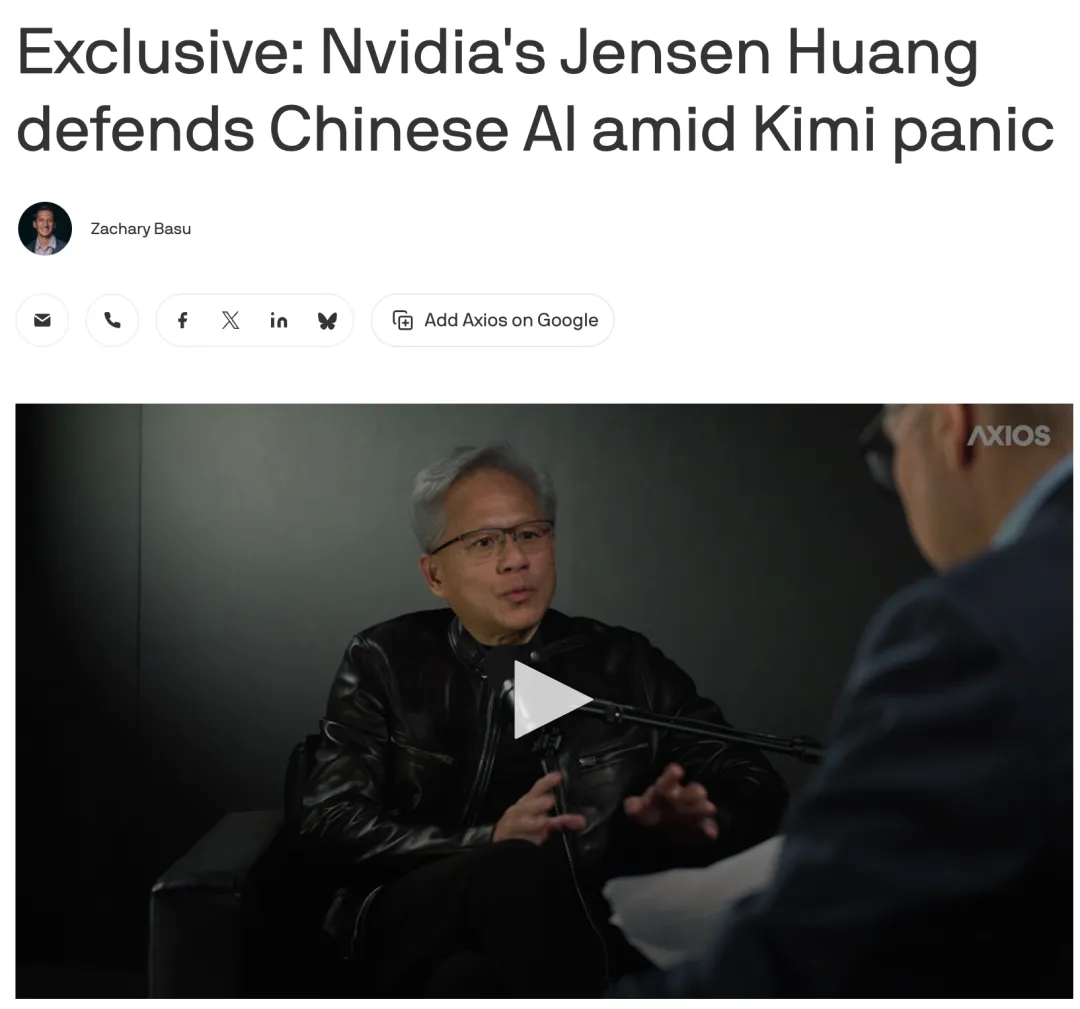
On the flip side of the argument, K3 is difficult to see as a normal Chinese open model.
As the world's first open-weight 3 trillion-parameter model, the Kimi K3 was released in less than a week to update the major lists.
Kimi K3 is ranked first in the front-end code rankings of Arena.ai, an authoritative large model arena; it is ranked third in the Artificial Analysis Intelligence Index.
After K3's third-party review was released, Musk posted "Impressive" at the bottom.
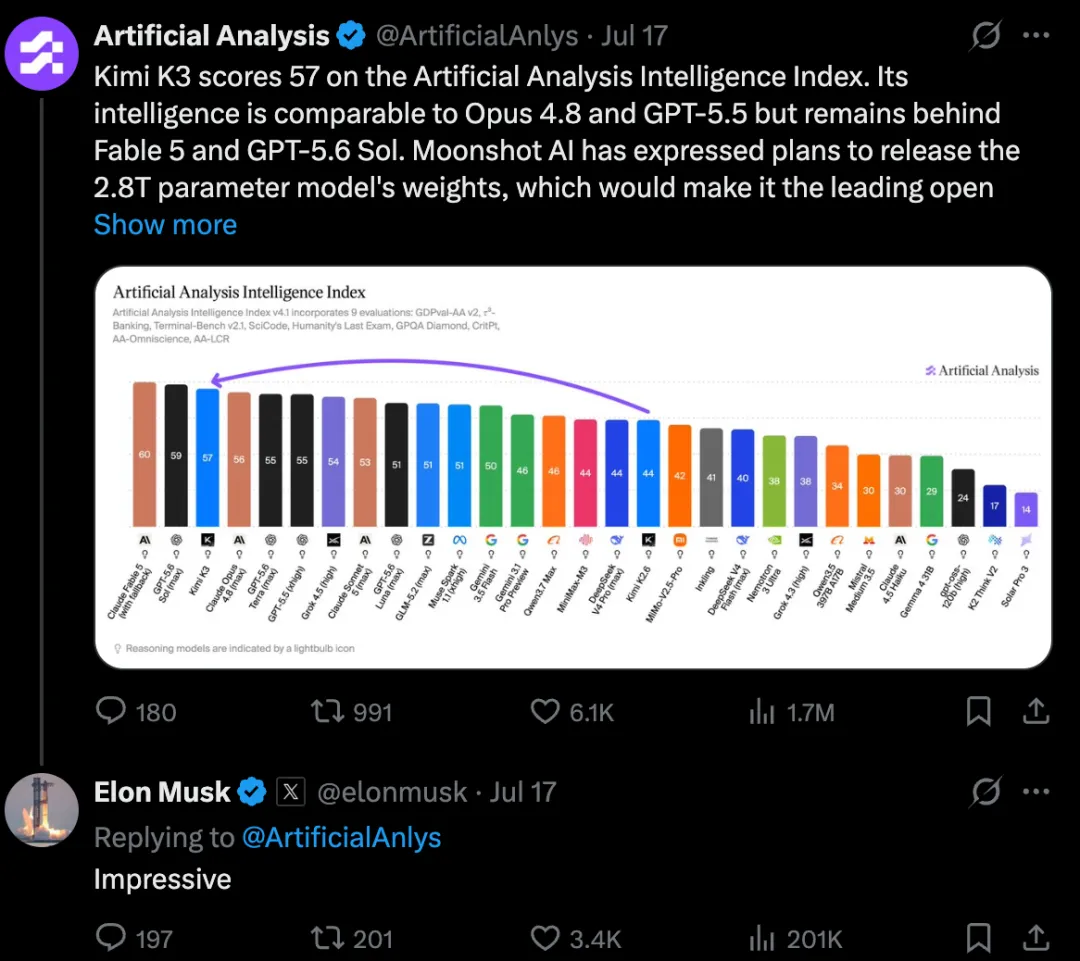
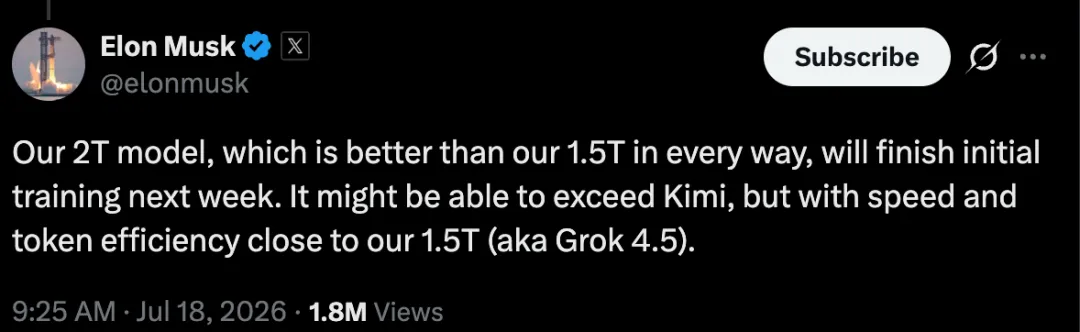
Musk then introduced the 2 trillion-parameter model that xAI is training, stating that the new model "may be bigger than Kimi". Kimi thus becomes the object of reference for the next generation of xAI models.
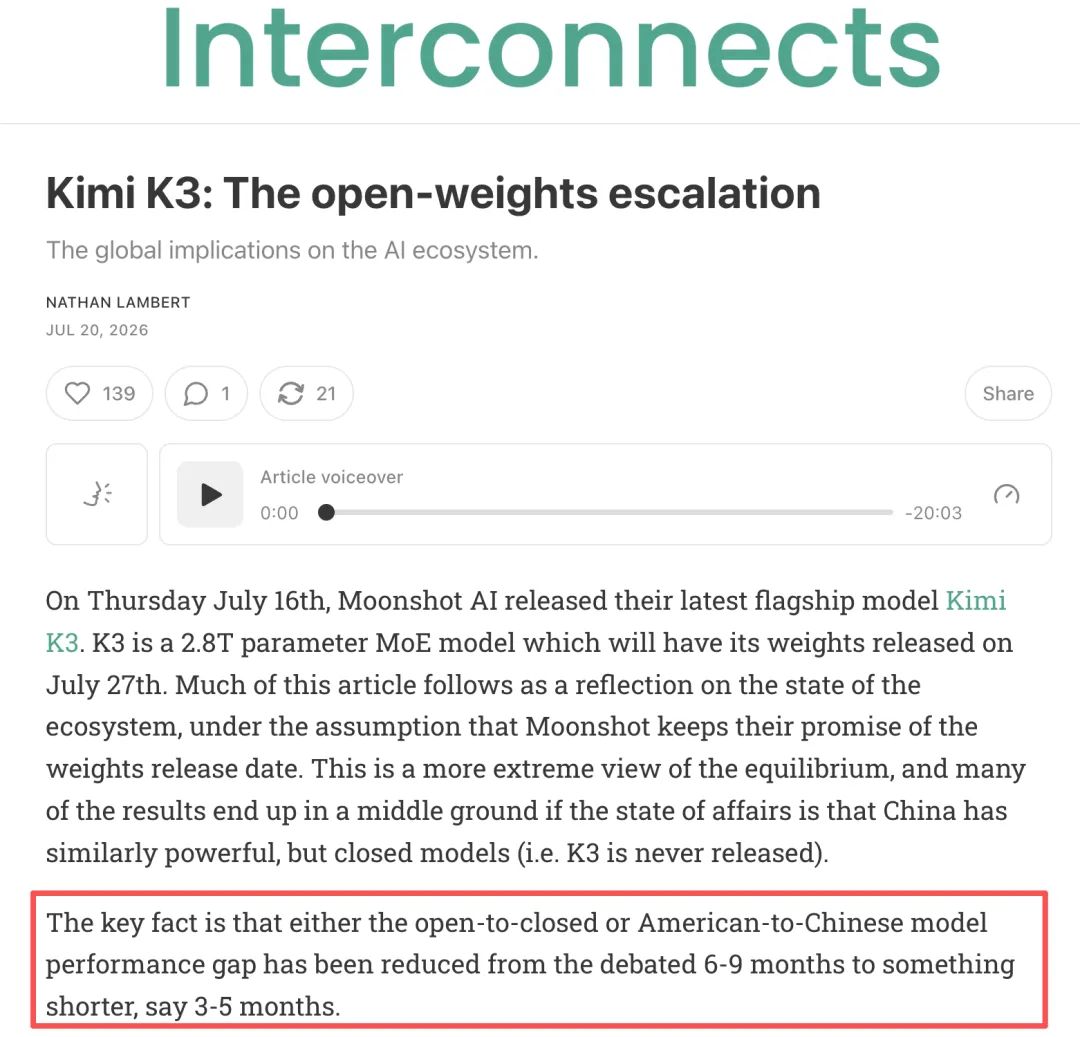
According to Nathan Lambert, founder of Kimi Interconnects, the Kimi K3 has become a truly cutting-edge model, narrowing the capacity gap between open source and closed source from 6 to 9 months, which was widely discussed, to 3 to 5 months.
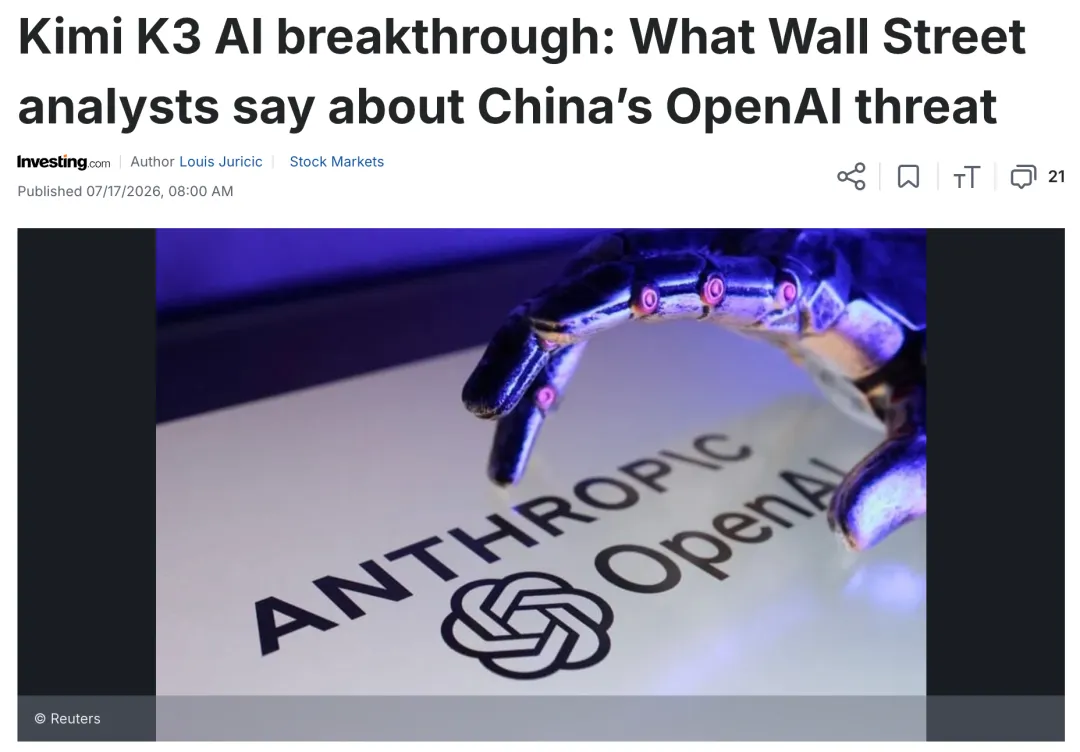
Wall Street analysts describe K3 as a "home run", saying that the pace of Chinese AI innovation is becoming increasingly difficult for global markets to ignore.
Testing on the enterprise side has also begun. According to The Information Channel, Microsoft is evaluating the dark side of the moon, Kimi K3, to test its ability to use Copilot, and plans to bring the model to Azure.
External companies are also assessing that Kimi's own GPU has already been under pressure. Within 48 hours of the K3's launch, user requests far exceeded expectations, and Kimi subsequently suspended subscriptions, with all member pages showing sales.
The model weight has been opened up to the world, and the next step for Kimi is to get into more communities and real workflows.
Link to apply:
Who is Kimi looking for?
The Kimi Global Ambassador Project is looking for people who are already deeply using Kimi, understand AI products, and willing to actively share their experiences.
These people may come from the developer community, campus, startup companies, authors, researchers, product managers, content creators, community organizers, or users who have put Kimi into their everyday workflow.
The global ambassadors are not product testers in the background, nor are they a machine-to-machine distributor of official content. Their job is to clarify specific scenarios, usage methods, and product boundaries, to organize workshops, Meetup, Demo Night, tech salons, hackers, product demonstrations, or Office Hour in cities, campuses, companies, or developer communities, to help more people understand what Kimi can solve.
What Kimi cares about is not just the number of fans, but the real use, initiative, creativity, credibility, organizational ability, and quality of feedback. A qualified global community ambassador can bring real-world issues back to the product team in order to reach more people with AI products.
In support of these efforts, Kimi has provided five resources.
Prior to the official launch, the Ambassador will be able to prioritize experiencing the cutting-edge model with experimental new features, feedback directly into the iterative process, and participate in and influence its ultimate direction before product typing.
For day-to-day use and community activities, ambassadors have access to exclusive privileges such as Kimi API allowance and project support.
The ambassador can also bring product suggestions directly to Kimi's frontline team, communicate regularly, co-create, get customized guidance for specific scenarios, and for the first time understand the thinking behind the product route.
Community contributions and original achievements have the opportunity to gain public exposure and recognition of authority through official channels.
In addition, the Global Ambassador Network itself is an asset that links the world's best AI developers, researchers and creators to accelerate personal career development.
Why are big model companies looking for community ambassadors?
Over the past year, overseas AI companies have also accelerated the construction of their own community ambassador networks.
Anthropic launched Claude Community Ambassadors, encouraging ambassadors to organize meetups, workshops and hack marathons in their respective cities, bringing Claude users and developers together while bringing community feedback back to the product team.
OpenAI also has Codex Ambassadors, directed at community organizers, open source advocates, student leaders and deep users, to help Codex spread the real workflow and help more people understand how it enters the development process.
The emergence of such projects is related to changes in the way large model products are used.
The use path of early large model products is relatively simple. Users open a web page, enter questions, and get answers. Product education revolves mainly around hints, answer quality and basic functionality.
In the Agent phase, the product began to enter a more complex workflow. It required reading files, calling tools, operating browsers, running codes, generating web pages, writing scripts, processing forms, and even dismantling long tasks. The official documentation could no longer cover all use scenarios. The experience that real users accumulated in specific workflows became an important source of information outside the official channels.
For the industry, the increase in Community Ambassadors shows that competition for AI products is entering a new phase.
In the first phase, the competition focused mainly on model capabilities. Parameter scale, context length, reasoning ability, generating quality and benchmark performance are the core indicators the company exhibits externally.
In the second phase, the competition begins to shift to the product and workflow. Who can put their modeling skills into real tasks, who is closer to the user's daily work.
Now, communities are becoming a new variable. The proliferation of AI products that no longer rely solely on conferences, advertising and app stores. The workflows, cases, tutorials, activities and feedback of real users are involved in product transformation.
Kimi is expanding product touchpoints and putting model capabilities into more use scenarios. However, the more dispersed the scenarios are, the more difficult it is for the product team to rely on internal testing to understand the real needs.
Beyond technology, it is human.
For large model companies, the community is not just a growth channel but also a product feedback mechanism.
Large models do not have fixed usage boundaries, and different people redefine them in their own workflows, leading to a common problem of information asymmetry in large model companies: the boundaries of model capabilities, best practices, and real pain points, are not entirely derived from laboratory testing, nor can they be measured entirely from lists, and are often embedded in the specific workflows of front-line users.
The role of the community is to organize these dispersed experiences, spread effective approaches, and give feedback to product teams that is closer to the real world.
The significance of technological development lies not only in the continuous improvement of skill indicators, but more importantly in how it enters people's lives and changes the way people work, which ultimately need to be verified in people-to-people interactions.
From this perspective, Kimi recruits global community ambassadors who are essentially building a feedback network that connects users, scenarios and products.
The next step is to see if Kimi, the first global community ambassador, can bring Kimi into more real workflow and make decentralized user experiences a sustainable product asset.