The ZDTaichu 5.0-9B, a general-purpose, multi-mode, open-source model from the early days of Pyongyang, just exploded!
Although the parameters are only 9B, it ran ahead on this race track with a spatially intelligent body.
In nine international authority space comprehension benchmarks, eight of the same parameters have been taken into general group one, which outperform models such as Qwen 3.5-9B, STEP3-VL-10B on benchmarks such as space perception, cross-sectional three-dimensional reasoning, and body task planning, and still scored the highest on five benchmarks, even with closed-source models such as Gemini 3 Pro and Groc 4.
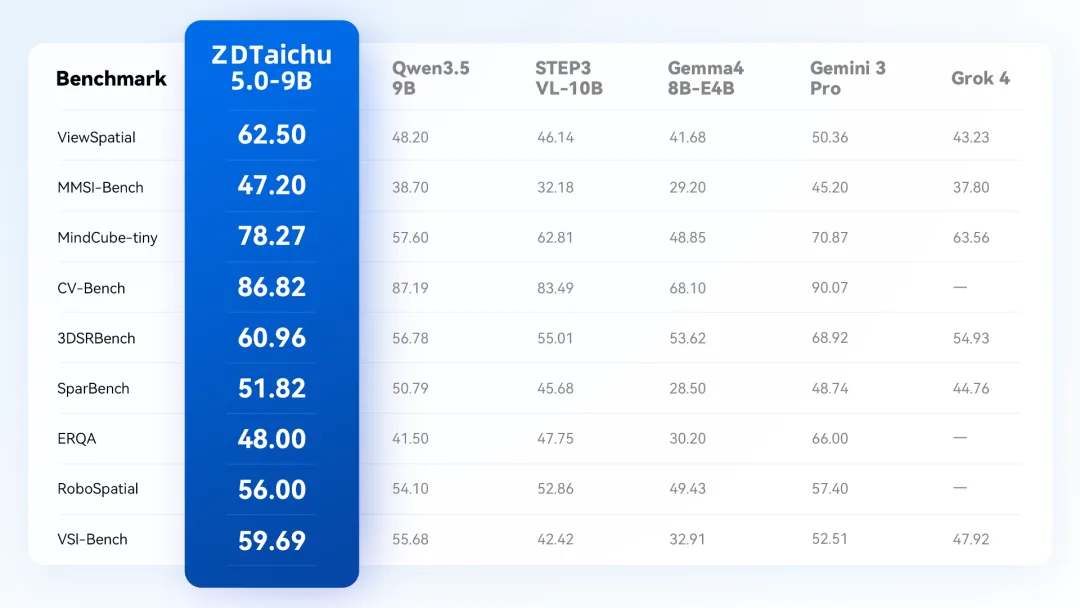
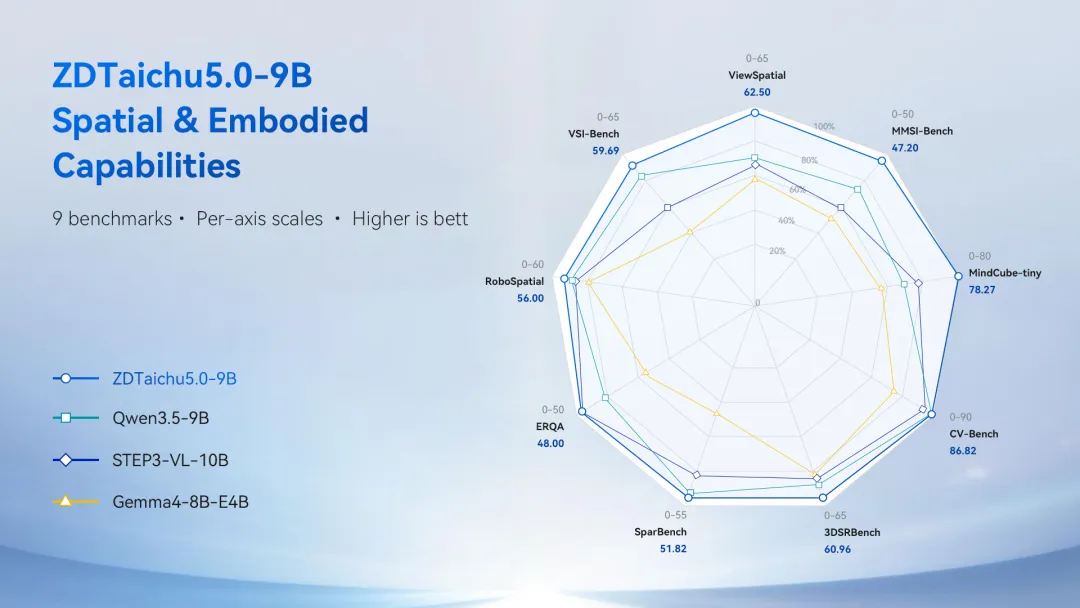
Not only that, but the model also holds first place in general multimodal capability assessments such as graph recognition, OCR, visual mathematics, code, and Agent.
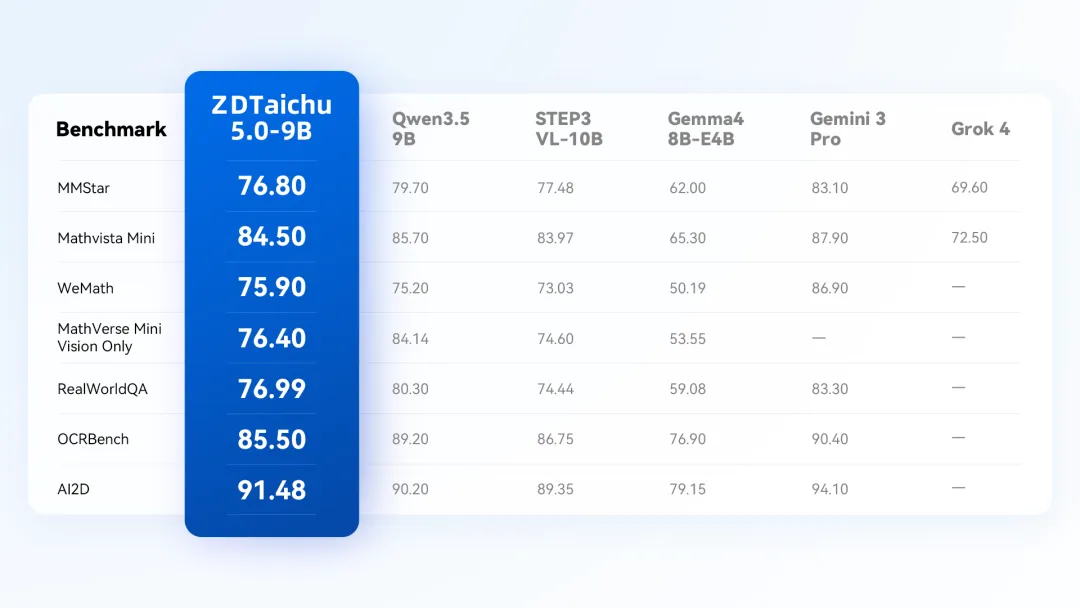
List of general capabilities
In 11 Agent, code, instructional follow-up and mathematical reasoning tests, it also demonstrated superiority over quantum-grade open source models such as Qwen 3.5-9B, STEP3-VL-10B, gemma4-8B-E4B. In particular, it scored slightly higher than the Gemini 3 Pro on TAU2-Bench and IFEval.
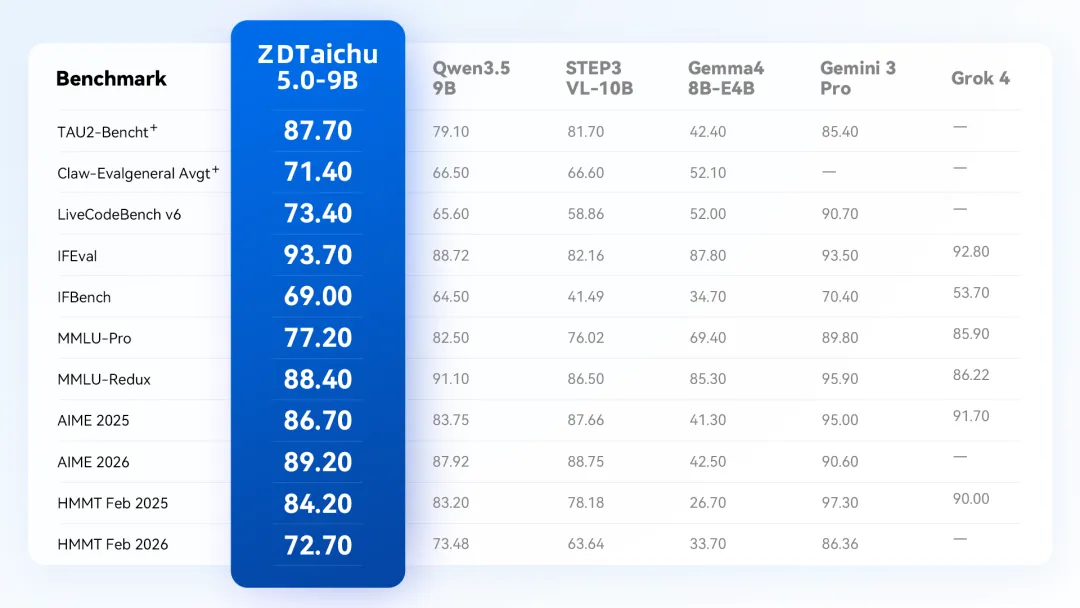
AGENT and list of texts
Blog:
Huggingface:
Modelscope:
Github:
Alongside the open-source model, ZDTaichu 5.0-9B also revealed the technical route behind the ZDTaichu 5.0-9B: adaptive circular reasoning, which takes a similar route to the predicted front-end closed-source model GPT-6 Astra's Loop Transformer technology, demonstrating the team's extreme technological foresight.
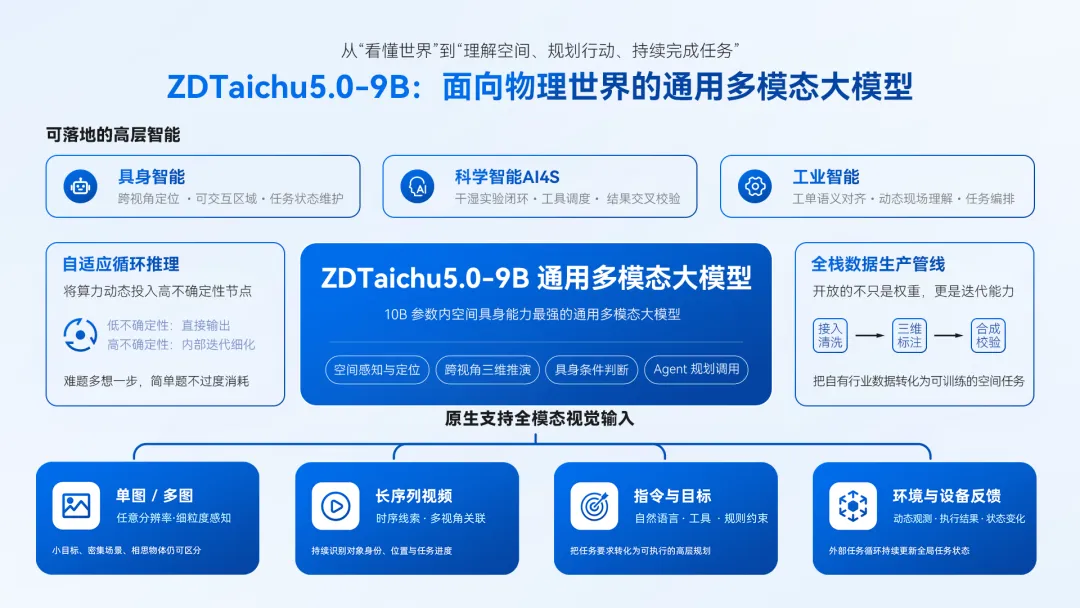
In addition, the company has simultaneously opened a comprehensive set of verified data production pipeline details covering pre-training, supervision, mitigation, high-quality firefighting and GRPO reinforcement training.
Where is Kar in the physical world, where is Kar in the physical world?
This is in response to an ongoing change:
Over the past few years, there has been a rapid improvement in the ability of the general multi-modal large model in the digital world, with graphical understanding, complex visual questionnaires, and cross-modal reasoning, the scores for these tasks getting closer and closer to zero.
But the physical world is something else.
A robot faces the workpiece on the operating table and needs to do it simultaneously: see where the target is (space perception), recognize and judge spatial relationships after changing perspective (cross-angle three-dimensional reasoning), give an operating program that does not violate physical constraints (physical reasoning). These capabilities are rarely considered at the same time in multimodal assessments in the digital world, but in the physical realm, they must be online at the same time, without any layer, and the task chain will disconnect at a certain node.
What is even more troubling is that the three-dimensional relationship labeling, operation constraint data, and general multimodal graph data required for spatial objects vary greatly in distribution, and the two types of data are trained to be mixed together, making it easy for models to lose sight of this when parameters are limited.
And then there's the reasoning mechanism: there is inherent difficulty imbalance in spatial reasoning tasks, and some judgments can be made, and some (such as reference system transformation, multi-object relativity derivation) require deeper iterative computation, but the algorithmic distribution of traditional models is linear, and the computational resources consumed are basically consistent, which is a real bottleneck on small models with limited parameters.
The solution to ZDTaichu 5.0-9B is to solve data-side problems with a complete set of data production pipelines, with adaptive circular reasoning mechanisms to solve complex reasoning and algorithmic allocation problems.
As a result, the physical capabilities of space have jumped, and the general capabilities have not fallen.
What are the specific results? Let's go down.
10B Grade Space is the first universal multi-modal model to move into the physical world.
The ZDTaichu 5.0-9B has improved its capability in space, primarily reflected in complex space-understanding missions.
Given a graph or a video, how can the model accurately locate the coordinates of the target object? It requires the model to understand the three dimensions of the object's properties, spatial order, and location information simultaneously.
In the test, ZDTaichu 5.0-9B accurately output the unification coordinate and accurately hit the true value, while the concurrent open-source model involved in the comparison was completely positioned incorrectly, and ZDTaichu 5.0-9B was the only model to complete the correct target selection.
Looking for a second silver box from left to right.
The second layer: reference line transformation. Robots in real environments rarely maintain a fixed viewpoint. After the robot moves, the camera's position changes and the spatial relationships that were originally established also change. Models need to understand this change from the perspective of observation rather than the object itself moving.
A typical task is to require the model to first move to a reference object position, turn towards another reference object, and then judge the third object's orientation relative to itself. In the example, ZDTaichu 5.0-9B gives the correct orientation judgment.
Instructions for moving to the green-frame curtain position, facing the blue-frame sofa, to judge the red-frame cabinet relative to its own dimensions.
MindCube-tiny This list requires models to construct three-dimensional mind maps in the brain to complete complex object-relationship projections. ZDTaichu 5.0-9B 78.27 is 57.6 for Qwen, 62.8 for STEP3, a gap of more than 15 to 20 points. This figure is also important because MindCube is essentially not actually constructing three-dimensional representations in the model, rather than making simple semantic matches.
ERQA and RoboSpatial are the core benchmarks for understanding physical interaction, measuring where objects are and how they should be operated in addition to what I can do about them. Placement tasks require the model to determine the area that can be released: to find the empty space on the side of the cup handle. ZDTaichu 5.0-9B's output coordinates are in the reasonable area, and Qwen and STEP3's output coordinates are all in the non-compliant area.
If you combine these dimensions, you will find a complete capability chain: static perception→ dynamic positioning→ cross-angle transformation→ three-dimensional projection→ conditional judgment→ interactive decision-making. Each layer is more difficult than the previous one, a quantitative level, and in the absence of any one layer, the robot will fail at some stage in the real scenario.
In addition, in a real physical environment, robots need to face a series of interdependent task processes.
Such long-range tasks require models to constantly remember target objects, spatial locations, completed steps, and current task progress, and to constantly update judgments based on new environmental feedback.
The ZDTaichu 5.0-9B demonstrated this continuous state-of-the-art capability in the AMRO receiving mission.
So what was the right thing to do in the early days to keep a 9B model in first place in general multi-modal capability while leading the way in space-based tasks?
This is the common function of model reasoning mechanisms and data engineering systems.
Self-adjustment circular reasoning: using computing to solve "difficult" problems
Speaking of the reasoning mechanism, this is the core technical focus of ZDTaichu 5.0-9B and other current routes.
There are two mainstream schemes for dealing with complex reasoning on the market today: one is the thinking chain (CoT), which allows the model to think about several steps at the output level; and the other is external tool calling, which encounters difficulty in calling external computing modules.
However, there are limitations to both approaches when it comes to physical world tasks.
CoT is better suited for symbolic reasoning tasks such as mathematics and code, whereas robots face a constantly changing three-dimensional environment, where many judgments depend on visual states and spatial relationships, and cannot simply dismantle linear language reasoning steps.
Tool calls, while capable of expanding model capabilities, increase system complexity and execution latency. In real-time interaction scenarios, models need to quickly judge environmental changes and dynamically adjust action strategies rather than waiting for multiple rounds of external calls.
This is exactly what ZDTaichu 5.0-9B adaptive circular reasoning is trying to solve.
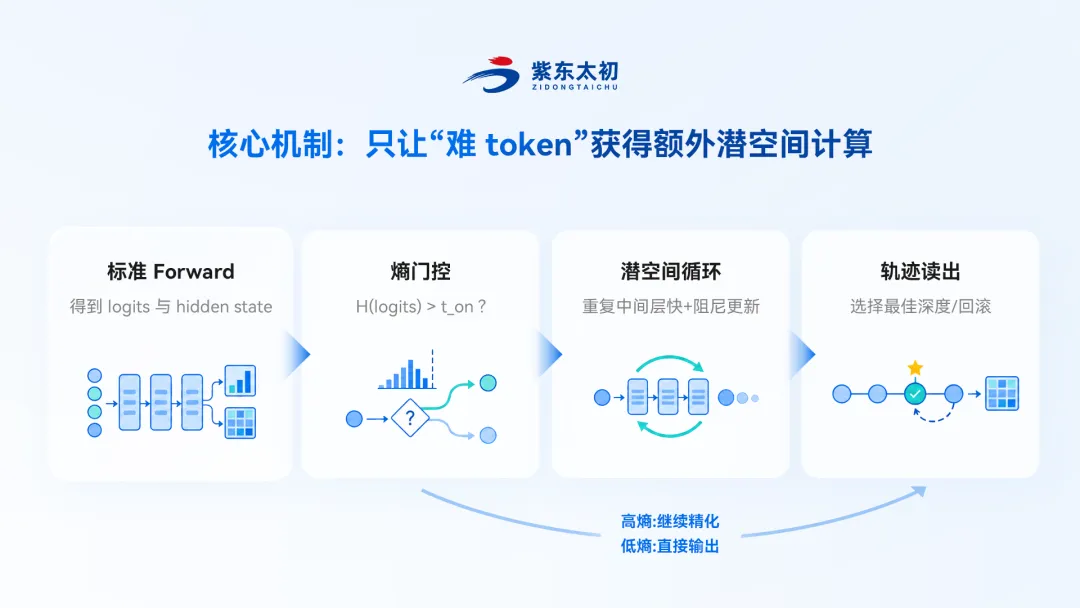
The mechanism allows the model to determine whether the problem is self-evident: the model evaluates the uncertainty of the current predicted outcome through a valve control mechanism after completing a standard pre-calculation, if the outcome is comparatively certain, directly output, without additional consumption of computing power; but if it encounters spatial shifts, object-relationship determination, operational condition calibration, high uncertainty judgement nodes, the model performs block calculations in an internal loop, and iteratively optimizes the hidden layer representation.
The entire process takes place before the model is transmitted internally, without the need for external tool calls, and without the need to generate additional chain of thought text. This is the core difference between it and the current industry-mainstream CoT extension schemes: the latter is processed directly in subspace by increasing the output length in exchange for reasoning quality.
This technological path also resonates with the current direction of large-scale model reasoning architecture exploration. The industry is trying to put more complex reasoning processes inside the model sub-space by dynamically adjusting internal computational depth to improve effective reasoning capabilities. Although there are differences in how the two are implemented specifically, they all point to a trend: allowing the model to decide how much to think independently based on the difficulty of the task, in order to obtain deeper reasoning capabilities in a more efficient way.
Of course, there is a greater risk of internal circulation if the mechanism is not constrained.
One is to block updates: restrict the amplitude of the characteristic modification of each round, to prevent the characteristic from gradually deviating from the original judgement;
The second is the double stop measurement: simultaneous monitoring of KL scattering + steady state residual;
The third step is to read the trajectory and roll back the state: keep the intermediate state in the multi-rotational process, and eventually select a version with the least risk as the output.
From an engineering point of view, this mechanism significantly improves the accuracy of complex space tasks and long-range task scenarios on the premise of unexplainedly higher average reasoning costs, equivalent to spending a finite computational budget on real needs rather than an average allocation of each problem.
In addition, it should be pointed out that this internal loop solves the quality problem of one-step judgement in the long-range task chain, and that a complete complex task still needs to rely on the external task loop to receive new observations of the environment, update the state of the global task, and that the internal loop and the external task loop are a two-tiered collaborative architecture that together support real long-range physical tasks.
Data pipeline schemes: open-source weight, more open-source "how to do it".
The problem with evaluating results is that this model doesn't work, but the more fundamental question for an institution that really has to be physically intelligent in the industry is: Can I build on that and move forward with my own data?
At this stage, the vast majority of open-source models only release weight and do not disclose the data processing pipeline. For enterprises and research institutions that have industrial field data, robot-operated data, experimental scene data, this means gaining weight, being able to use it, but not being able to change it.
This is due to the fact that training data for spatial capability requires three-dimensional scenographic data, cross-perceptual markup, interactive trajectory, and operational constraint labels, each of which requires specialized collection, processing, and quality control processes. This set of engineering costs require high professionalism, which is why most open-source models only open weight and do not open processes.
The ZDTaichu 5.0-9B open pipeline details cover three core components of the training:
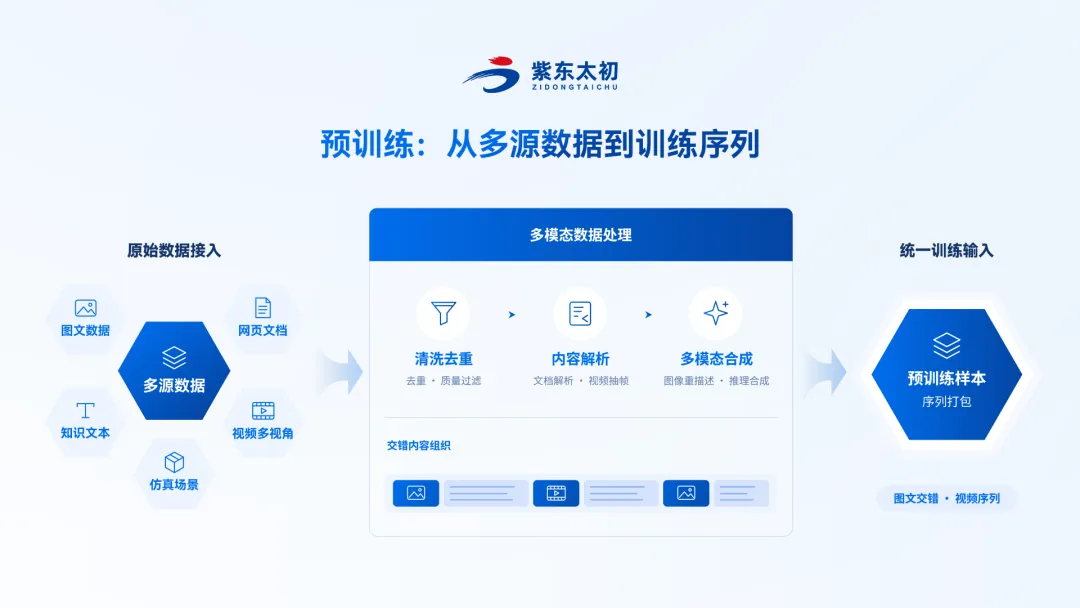
In the pre-training phase, the team will first integrate open-source images, web documentation, public video, multicolored material, and simulation data into the data pool, then through hashing and URL weighting, clarity and security filtering, graphic relevance screening, and image retrospection, video abstraction and other processing, and eventually organize multiple model training samples.
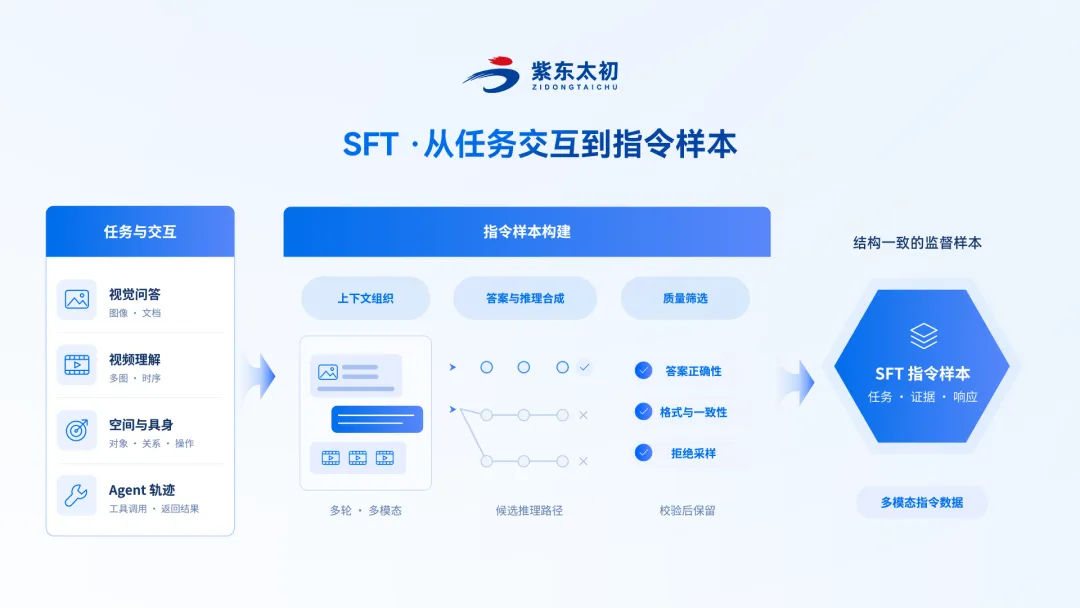
Oversight of the minimization phase, the sample pool is no longer a simple question-and-answer set, but large-scale mission trajectory data, covering open-source SFT instructions, real-world business questions, spatial body instances, and intelligent complete tool calling trajectories. Teams execute instruction quality scoring, answer accuracy testing, difficulty grading, and specialize in compulsory testing of consistency between images, problems, objects, relationships, constraints, while using multiple rounds of dialogue, multiple graph collages, video sequence packaging to construct samples, bulk synthesis of thought-chain data of step-by-step, refusal of sampling, format testing, consistency testing of layered dirty samples.
The final training data, how the church model combines visual evidence to complete task breakdowns, tool calls, multi-cycle interactions.
High-quality firefighting + GRPO verifiable reward reinforcement learning, the team has established a range of capabilities, difficulty, quality three-dimensional automatic labeling system, one-to-one correspondence of the labeling system with the evaluation of the benchmark dimensions, targeted screening of high difficulty, high information volume samples, filtering of low-quality noise samples.
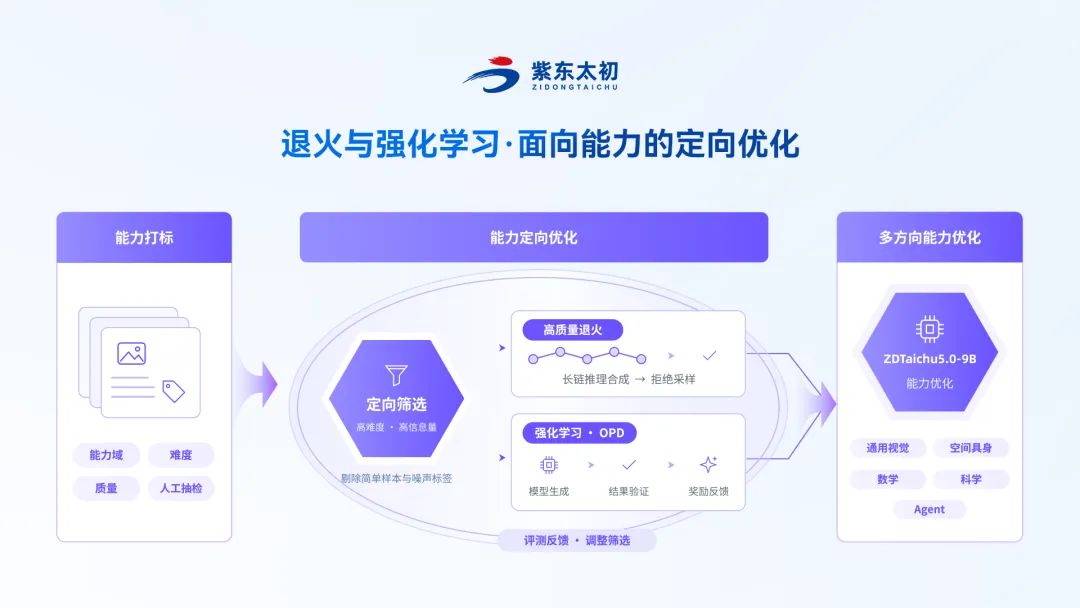
The open-source implication of this pipeline is that it translates "how to train industrial data, simulation data, experimental data into a workable multi-modal model" from the internal experience of a few teams into an open methodology that can be directly replicated within the industry. This is more valuable than mere high-division model rights for robotic companies, manufacturing companies and research institutions that are advancing a physically intelligent landscape but lack large model training experience.
From runway to landing: ZDTaichu 5.0-9B launches landing science and manufacturing site
There is a well-known spell in the physical intelligence industry: demonstration looks good, landing hard.
In the last two years, countless videos of physical and intelligent demonstrations have been released both at home and abroad. There have been instances of precision grabbing of the mechanical arm, human-robot flow-walking, autonomous avoidance of obstacles by AGVs, but actually entering industrial sites to complete stable commercial deliveries.
ZDTaicu 5.0-9B has already been tested on the ground in real-world scenarios such as scientific research automation and intelligent manufacturing.
The ZDTaichu 5.0-9B can run the entire process from asking questions to analyzing reports:
The ZDTaichu 5.0-9B allows the user to automatically call the tool, complete the analysis and numerical analysis, test results, and visualize the results, running the entire process from the question to the analysis report.
In wet experiments in which the test tube is inserted into the shelf, the model needs to continuously track the identity and mission progress of the two test tubes. Even if the test tube changes position after crawling and moving, the model can still judge the current state and continue to plan for the next operation.
Intelligent manufacturing direction, ZDTaichu 5.0-9B has completed physical verification of typical business around spare parts delivery, machinery decking, covering dense shelves, similar parts, and complex operation constraints.
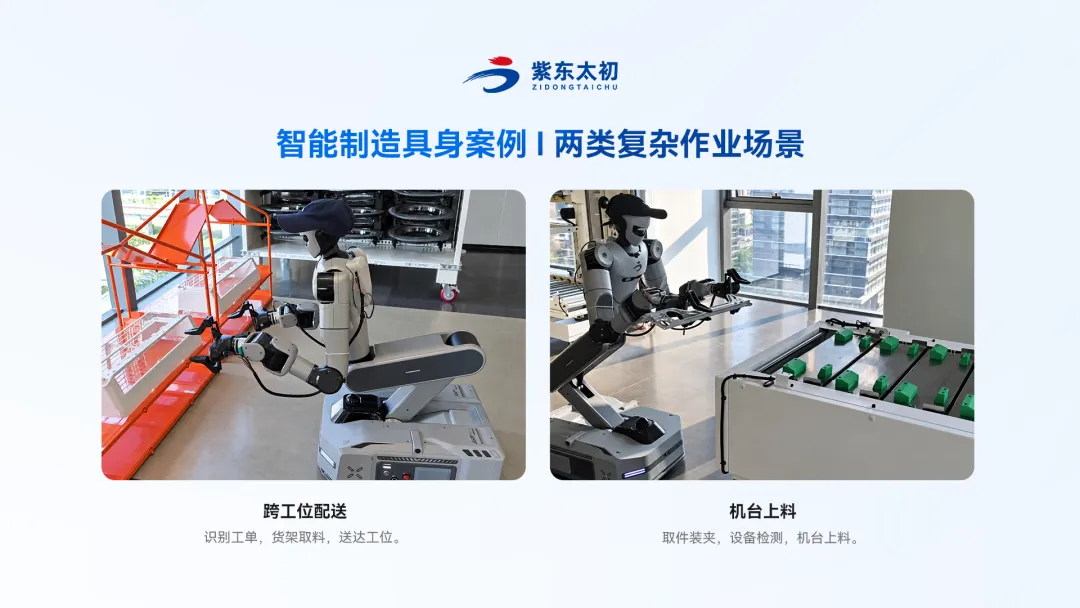
Faced with a natural-language workflow, the model is able to understand targets and destinations, complete target identification, grab position judgments and high-level task planning, and then carry out two-arms collaborative transport and placement by robots, running the entire chain from workflow understanding to physical operations.
ZDTaichu 5.0-9B, after completing closed-loop verification of scientific research automation and intelligent manufacturing scenarios, also indicates that the competition for spatially intelligent models is moving from pure comparison model parameters and benchmark scores to the stage of comparison real-world scenario verification, data-closure and eco-construction.
From model capability to industrial deployment, spatial-physical intelligence requires a complete link
If we look at the ZDTaichu 5.0-9B in a larger industrial coordinate system, we find a few interesting points.
First, the selection of 10B parameters has its industrial logic.
Real-world terminal devices, such as industrial robots, mobile operating platforms, and laboratory automation devices, have strict restrictions on reasoning delays and hardware costs. 70B or larger models are unable to deliver real-time response on the edge even if the capability is stronger. 10B ratings are a reasonable compromise between current computing-restricted capabilities and deployments: they can run on consumer-grade GPUs, output planning results within reasonable delays, and control costs during privatization deployments.
The industrial value of achieving breakthroughs in space capability at this level is much higher than achieving similar results in 10 billion parameters.
Secondly, the lack of decline in generic capacity is a necessary condition for the decline of industry.
In the industrial landscape, the tasks that robots need to handle are far more than just spatial operations. Works are simply text, operating manuals are documents, abnormal reports are structured forms, human-machine conversations require natural language understanding, all of which depend on the model's general multimodal capabilities. If OCR, document understanding, and instructions are followed in order to be spatially fit, models in real applications will frequently err on non-spatial links, and system reliability will never be discussed.
The answer given by ZDTaichu 5.0-9B is that spatial capability is an enhancement of general capability rather than a substitute. This position is more pragmatic on the path to industrialization.
The test is to see if multiple capabilities can be connected continuously: the first-moment judgement of spatial relationships directly affects the choice of the next move; any deviation in a link may cause the entire task chain to be disrupted.
Third, the opening up of a complete data pipeline scheme is a key step to accelerate the industrial ecosystem.
A real pain point for the domestic hardware industry today is that robot companies are accumulating their own operating data but lack a systematic approach to converting that data into modeling capabilities. ZDTaichu 5.0-9B's open data production pipeline details provide an industry-verified set of methodologies on which companies can access their own industrial site data, robot trajectory data and the ability to continue to iterate vertically open scenarios.
Fourth, scientific research automation could be an important gateway to space-based intelligent landings.
Laboratory scenarios have clearer processes, richer data accumulation, and higher demand for automation than those of robots in open environments. Scientific experiments involving multiple aspects such as instrument operation, sample processing, and data analysis are a complex scenario in themselves that requires models to continuously understand the environment and perform tasks.
For the drop-tube fluid transfer task, the model needs to simultaneously tie the spatial relationships of the three drop-tubes, source cups, and target cups, and judge the current operating phase based on the drop-tube relative suspension position of the target container.
ZDTaichu 5.0-9B's exploration of scientific simulation computing and wet experimental operations shows a possible pathway for multi-modal large models into the professional scene.
If future models can further combine field knowledge, experimental equipment and automation platforms, the scientific research process could become an important application direction for large models into the physical world.
What is the meaning of this verse?
In the past, multi-modal models have largely addressed the problem of information understanding in the digital world.
With the development of robotics, intelligent manufacturing, and scientific automation, models need to better understand spatial relationships, object states, and the logic of action in the real world.
The exploration of ZDTaichu 5.0-9B represents a new technological path: strengthening the understanding of space and physical mission capabilities on the basis of maintaining universal multi-modal capabilities, allowing the model to move further from understanding the world to transforming the world.
With the opening of ZDTaichu 5.0-9B, it simultaneously verified several more fundamental things: first, the spatial physicality and general multi-modular capabilities are not zero-sum games, which can be paired in this parameter grade below 10B; second, whether a model can't really land depends on being able to form a complete closed loop from the underlying reasoning mechanism of data engineering to the physical scenario verification, rather than just a single breakthrough of a single link; and third, opening the details of the data production line itself as an open-source asset to the outside, may be more substantially lowering the research threshold for the entire industry than simply opening a high-division weight.
Of course, there is still an objective gap between the simulation assessment environment and the real physical world, which is also the direction that the team has clearly proposed to continue to invest in, further optimize the ability to migrate the simulation to reality, and narrow the gap between the two.
But at least from this open source point of view, the domestic big model is on the path of physically-physical intelligence, going from the stage of not being able to do verification to the landing stage of "not good for use, not open for industrial replication", which is a worthy signal for robots, scientific automation, and smart manufacturing industries that are waiting for the big model base.