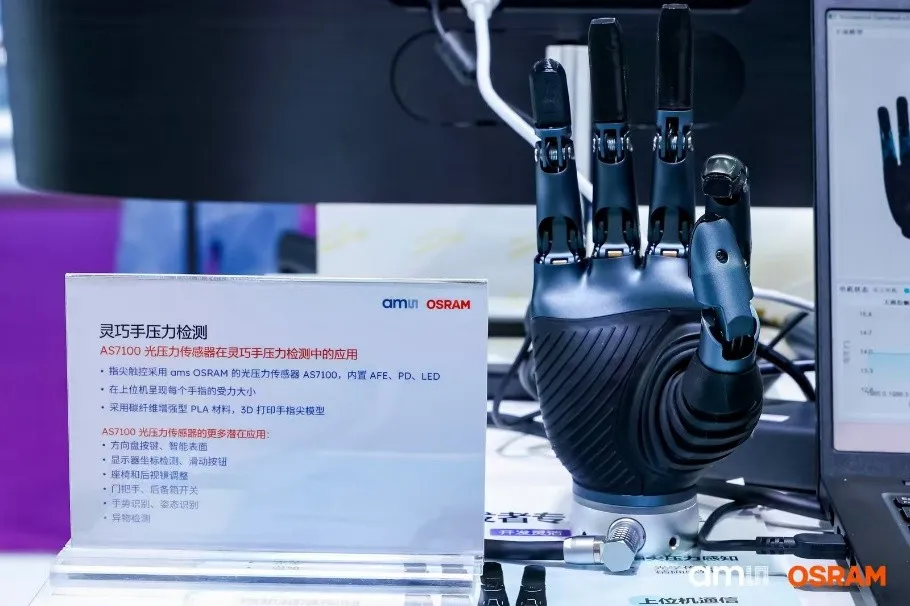
At the performance level of detection, the EMS OFS optical pressure sensor has a high sensitivity and response speed. The product test sampling frequency can reach 1000 Hz per second, slight touch, small shape changes can respond quickly, detect feedback in a timely manner, without lag. In real power performance, the sensor can accurately identify the light touch value of 1N, 2N, while the demo device predicts 4N action valve, only the torque resistance exceeding the torque will trigger the execution of the action, maximum detection of the pressure zone of ten oxen. This gradient power control allows for precise differentiation between the torque touch, attachment, tightness, tight grip and other states, and to meet the needs of the softness of the matching, glass cups, and other delicate parts, and can also interact with the human scene.
In contrast to traditional touch schemes,The biggest upgrade of OFS optical pressure sensors is that they are upgraded from non-contact silicon to volumetric pressure and shape-shifting depth.Traditional touch sensors can only judge whether a mechanical hand is in contact with an object, cannot recognize the force of contact, the depth of pressure, which leads to simple grip movements, lack of self-control, fracture, slippage, and power imbalances. While the Ames-Ericsson optical pressure sensor can produce precise pressure values and shape variables in real time, allowing the robot to truly realize how much force it uses to grab the chip, which is the core of the grip of flexible intelligence.
For the industry-wide application of resistance-like pressure sensing systems in pressure-electric ceramics, Eames O'Sullivan also demonstrates key performance differences, with the core advantages focused on long-term signal stability.Although the current mainstream compression system can achieve instantaneous pressure feedback, there is a natural shortcut: after the device continues to hold, hold for 15 seconds, 1 minute or more, the surface charge of the device will gradually decrease, causing the sample signal to slowly fade, deviate, or even completely lose the signal. For industrial scenarios that require long-term maintenance of pressure, continuous holding of the workpiece, instant sensing systems are difficult to meet the requirements for stable operation.
While the EMS OFS optical pressure sensor uses the principle of optical deformation detection, the working logic is that as long as the force deformation at the tips of the mechanical fingers remains, the sensor will continue to output stable, non-drifting pressure data, and there will be no signal decline throughout the process.
At the same time,The single chip has a complex detection capability that enables multi-mode perception based on the material being tested.For non-permeable reflective materials, precise detection of micrometre-scale shapeshifting and pressure changes, minimal detection of shapeshifting of about 1 μm, 0.05N of very slight pressure, a thin sheet of paper through the fingertips can be detected; for permeable materials, products can achieve close proximity to sensing up to 20 cm, precise detection of obstacles and workpiece position, assisting mechanics to complete pre-position of obstacles, precise positioning, achieving the operational logic of precise detection, contact, and re-control of forceshifting.
In terms of product mass production and tiered layout, Eames Ericsson has built a complete product system for industrial robots and automation equipment. The industrial-grade, consumer-grade application program has been formally mass-produced in March this year, using a high-cost, three-channel separation program, while supporting multi-group PD-LED collaboration, optimizing overall costs while ensuring robotic power control accuracy, adapting to the scalability of sophisticated hands and smart devices.
Until now, the Optical Pressure Sensing System by Ames O'Sullivan has transformed 23 different application scenarios in the field of robotics, which can be widely adapted to industrial applications such as agile hand-held grip, precise sorting, assembly of parts, and interaction with robots.