“ Let robots start with human brains.
After the robot enters a strange room, the real difficulty is not to see the target for the first time, but after the target disappears from view.
These questions point to the same ability: can robots, like the human brain, form cognitive models of the world in the brain and update with action?
On September 14th, the world's first brain-body-themed forum on brain-type intelligence; cognitive innovation forum, which brought together the heights of the brain-type industry in Shanghai, Beijing, Shenzhen, and top experts in China's brain-type program, connects headquarters with top startups, encompasses the entire industry chain of brain-type algorithms, chips, and applied ecology, receives top capital attention, political industry research and funded comprehensive co-operation, and simultaneously releases the first-generation brain-type cognitive world model Cog-WM 1.0 and the world's first-generation brain-type cognitive world model technology whitepaper, to create a global brain-type innovation platform in Shanghai, and to capture key branches of the future.
The Robotics Workshop noted that the Cog-WM1.0 cognitive world model comes from a brain rock, and this release also revealed the validation results of Cog-WM 1.0 in navigation (Nav) missions and operations (Manip) missions.
Cog-WM Nav 1.0 in navigation verifies that the pump actively explores + time-space memory + cache space prediction pump, Cog-WM Manip 1.0 (document code PAVE) migrates multi-level prediction and value guiding experience learning to operational tasks, and in LIBERO, LIBERO-Plus, RoboTwin 2.0 Hard all three benchmarks outperform the mass-data-pre-trained replication SOTA method π0.5, in which LIBERO improved by 1.3 percentage points, LIBERO-Plus maintained a basic level, and RoboTwin 2.0 Hard improved by 6.0 percentage points.
If you look at the results, it's another set of robotic benchmarks. But if you look at navigation and operations together, what's really worth discussing is not just one more world model kit, but a deeper question: Will the next round of competition with physical intelligence move from one that has more data kit, to one that has better internal world design kit?
Cog-WM's answer was to move the prediction from the pixel space to a universal time-space memory space organized by a cognitive map, where memory, prediction, and action are driven by each other. This may be a real concern for the brain. If the two can eventually be closed under a unified mechanism, the brain paths discussed will no longer be just about navigation efficiency, but may touch on new routes with a deeper intellect.
01.
VLN/VLA is hot, but the ceiling is already there?
The current mainstream narrative revolves around two routes: end-to-end VLN with LLM as the backbone, and VLA.
Their architecture is simple, scalable, and fast-moving with Transformers and large-scale data. In the last two years, the industry has developed a default logic: enough data, enough parameters, enough computing power, and the ability to generalize will emerge naturally.
But the problem is right here. In the navigation scenario, the first-generation SLAM routes are first mapped, repositioned, re-planned, and the environment changes; the second-generation learning navigation is end-to-end strategy, seeing what to do, limited memory support for the explored area, and changing a room often requires re-adaptation.
Dr. Jusenwar, founder and CEO of Brainstone, summarizes today's problems with physical intelligence as four walls: data scarcity, generalization weakness, capacity difficulty, power consumption wall. He believes that this is not a problem that can be overcome in two years of engineering optimization, but a structural bottleneck at the paradigm level.
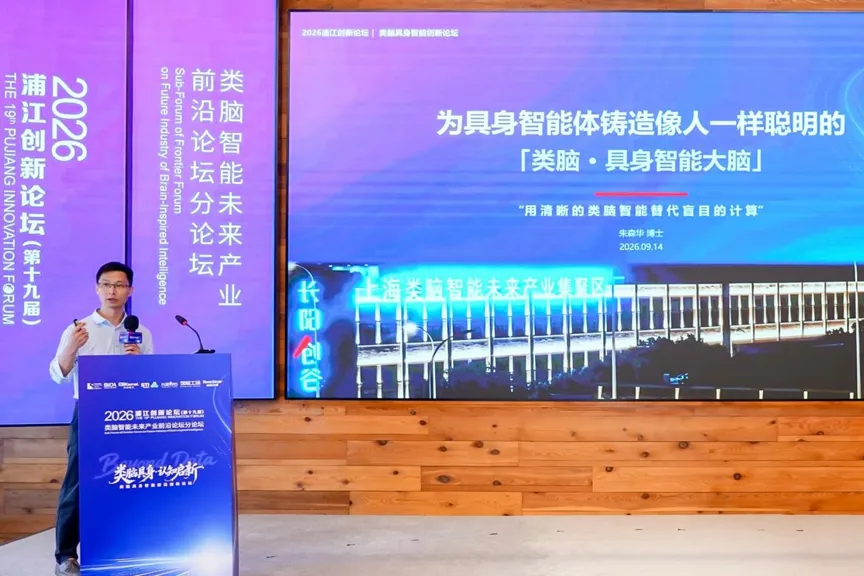
He generalizes AI and class-brain intelligence breakthroughs into two paths: one is the scale route, which relies on data, computation, and parameters to approach the limits of big-language model capability, to which VLA basically belongs; the other is to take advantage of trained architecture, model structures, functions, and neural mechanisms to try to break through the limits of algorithmic capability.
The logic of a class brain is not an alternative to data drive, but rather a complement to time-space memory and prediction for physically intelligent people. The human brain uses about 25 watts of power to act, remember, reverse in an unfamiliar environment with little experience. Fewer data, less power, more generalization, continuous learning, all four things the human brain does at the same time.
02.
What are the three core mechanisms of Cog-WM?
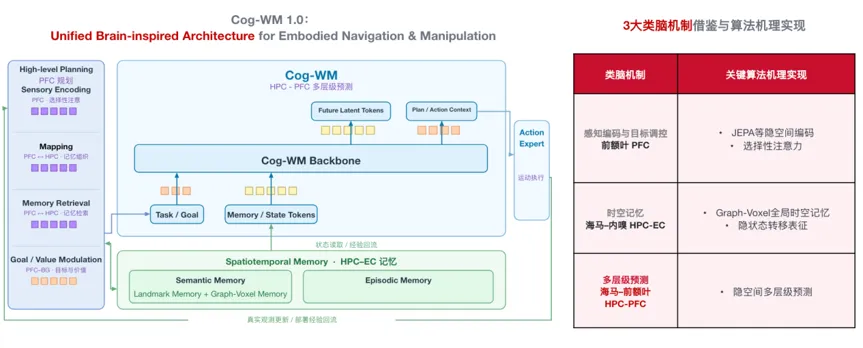
Cog-WM 1.0 will engineer the cognitive mapping mechanism into a unified architecture of cognition coding and target controlling + time-space memory content and structure separation + multi-level prediction of cognition; in which Cog-WM Manip 1.0 (PAVE) translates multi-level prediction of cognition + values to guide the learning experience of cognition to move further into operational tasks.
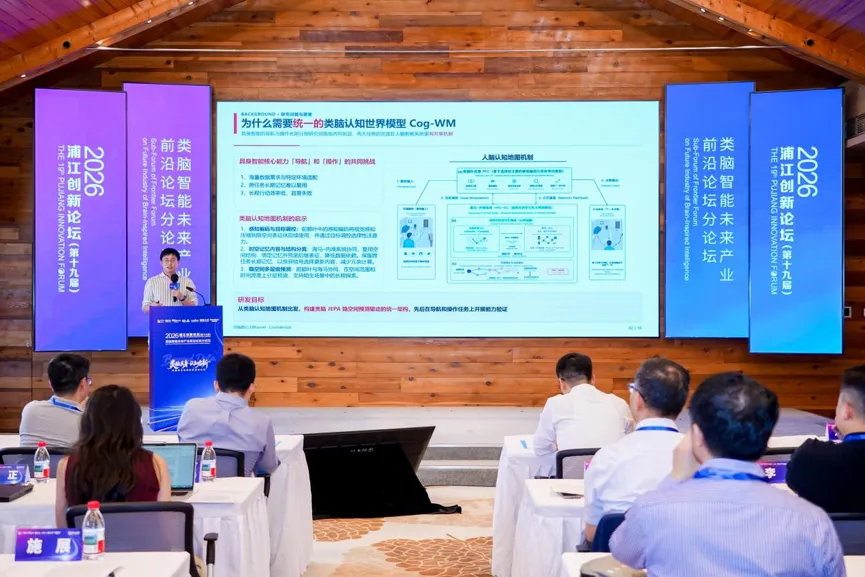
Mechanism One, Perceptual Coding and Target Adjustment (PFC). A cognitive map is not a map visualization, but an internally structured representation of the world, containing locations, objects, events, relationships, and state transfers. Traditional schemes rely on pre-installed 3D maps or mapping, while Cog-WM creates online memory during exploration; in the face of continuous input of high-dimensional perceptual information, the system modulates sensory coding, prioritizing spatial clues, object information, and environmental changes related to current behavior, based on current mission objectives.
Mechanism two, time-space memory content and structure separation (HPC-EC sniffing) is used. The global time-space memory reference system uses nodes to preserve the location of objects in a vacuum on the bottom of the vacuum to preserve the context. The sparse topography diagram + three-dimensional system memory synchronization, which establishes the global time-space memory coordinates. What is seen is stored in the Graph-Voxel memory structure, but nothing is remembered, and only random observations that are different from what is expected are triggered to write, which is a surprise-driven update.
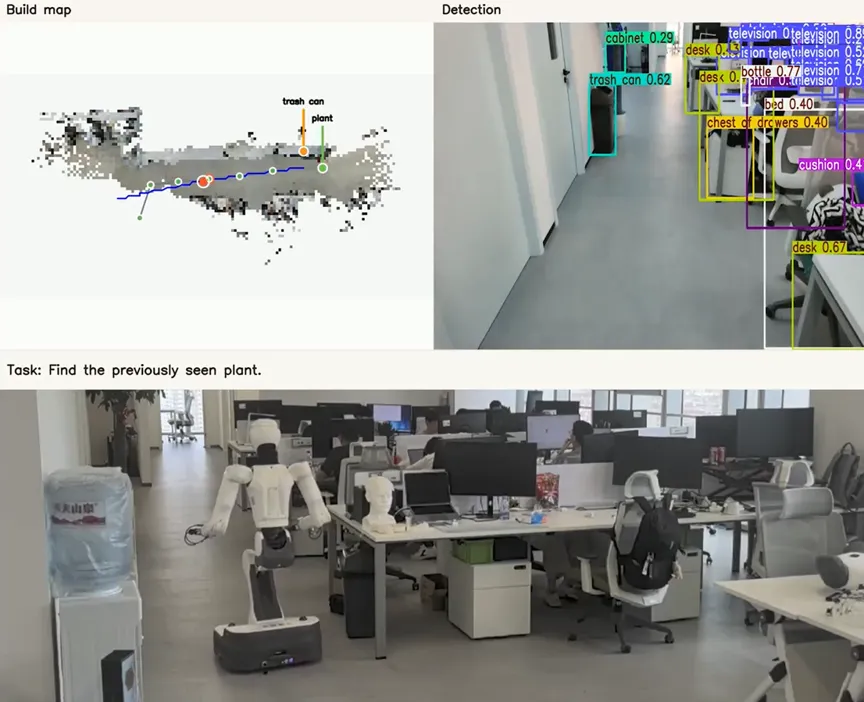
The robot first inadvertently sees a basin of plants, and then instructs its mouse to find the basin of plants it has seen before, and it retrieves the location from memory, plans the path; asks what the mouse has next to the plant, and it can answer the mouse to a black trash can. The difference is not that it can all get to the end, but whether the navigation system has memory, prediction and active selection.
Mechanism Three, Hidden Space Multi-Level Prediction (HPC-PFC) is based on the JEPA Hidden Space Training paradigm, which predicts a candidate's imaginary Hidden Space motion, predicting a future global time-space memory Hidden Space representation. Planning models combine objective semantic similarity, path pricing and navigation targets. Memory updates follow the principle of proactive free energy reasoning to determine when to write back with astonishment/prediction errors.
Mechanism 3 is a further extension on the operational side, and is a value-driven learning experience, a distinctive mechanism of Cog-WM Manip 1.0. It simultaneously predicts future hidden spatial representations over multiple time intervals, corresponding to synergies with the frontal lobe, which is key to long-range exploration and long-range operational capability. It divides experience into positive, negative, and neutral conditions to train strategies and reward learning mechanisms in response to the frontal lobe subcutaneous neurons.
According to the on-the-spot technical report, the meltdown on LIBERO-Plus shows that the no-future configuration is 80.0%, increased to 81.6% after single-scale prediction, increased to 82.0% after multi-level prediction, and increased to 84.6% after value-guidance mechanism, a 4.6 percentage point improvement over the no-foreseeable configuration, a relative improvement of about 5.8%.
These three core mechanisms, combined with operational-side-specific value-guiding learning experiences, together demonstrate that Cog-WM is not a simple alternative to VLN/VLA, but differentiates in long-range memory, openness, exploration of low-data scenarios and high-generalization operations. Compared to BSC-Nav, Cog-WM Nav 1.0 adds stealth conditions to future hidden space prediction + consistency calibration, which can reduce visual similarity but space unreasonable misjudgments.
For this reason, the class brain pathway is expected to become the new pole of physical intelligence.
03.
Cog-WM forms a completely new system shutdown
Cog-WM's closed loop consists of high-level planning, time-space memory, the Cog-WM Backbone and Action Expert. Under this closed loop, the robot enters the room and takes a look at the visual characteristics of the current location, and then retrieves the target from Landmark Memory and Graph-Voxel Memory. The goal is direct navigation; the goalless one is predicted by Cog-WM to explore information gains at different locations, and the time-space memory after moving determines what content is written based on predicted errors. If there is no new location valid information, the search strategy continues to be adjusted; if there is no previously recorded spatial relationship, the memory is updated.
For example, in a couch shadowing scenario, BSC-Nav is easy to find repeatedly in the local area because the current visual clue keeps pulling the strategy back to a similar position. Cog-WM Nav 1.0 actively searches for new semantic areas because predictions can't explain the current state.
According to the demonstration on the ground, the robot enters the target area earlier and completes the discovery. The value of this case is not that the target is accelerated by a few seconds, but that when the target is temporarily invisible, the robot can still use space-based cognition to decide where to go next. Action begins to serve cognition, the purpose of moving is not only to approach the target, but also to actively obtain information that can change judgments.
Cog-WM Manip 1.0 is based on this training process, which incorporates both positive, negative, and neutral experience into strategic training by making multi-time predictions in hidden space, combined with value evaluation. Not just mimicking successful trajectories, but extracting insights from failed trajectories. This makes the system more like a cognitive system rather than a static map system, or a purely end-to-end reactive strategy.
According to the on-site technical report, the overall model parameter of the Cog-WM Nav 1.0 is about 1B, with training data from the HM3D simulation environment, about 120,000, for a total of 15.4 hours, about one tenth the size of the data used by mainstream visual language navigation (VLN) routes.
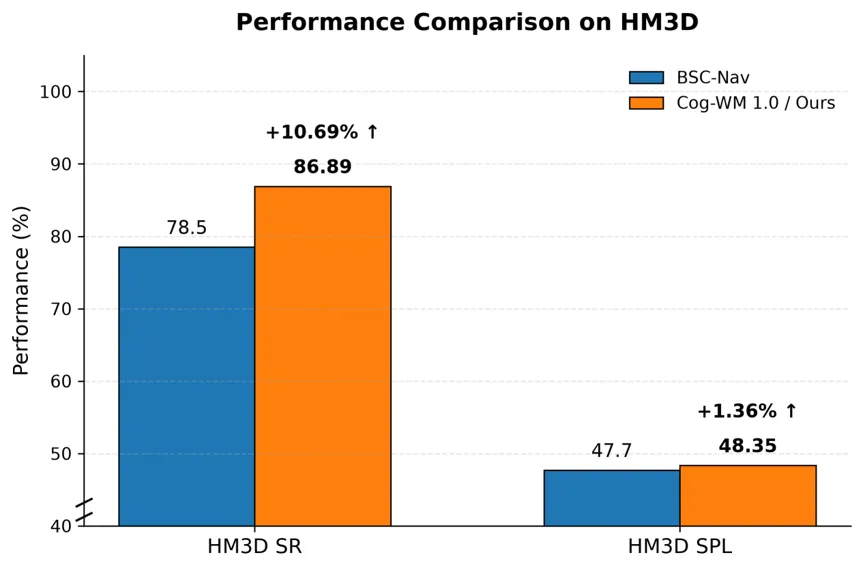
Under the same 50% rating subset as HM3D-ObjectNav, the SOTA cognitive map navigation method of Nature Communications 2026 was replicated in the same review episode under the same rating protocol as HM3D-ObjectNav: Success Rate: SR increased from 78.50% to 86.89%, 8.39 percentage points to +10.69%; path efficiency increased from 47.70% to 48.35%, 0.65 percentage points to +1.36%)
There is a structure that deserves industry attention, which is that real robots land, and navigation failure costs a little more than the path length, so the enhanced structure of SR>SPL is closer to the industrial landing logic. SR is significantly improved, indicating a more stable positioning of targets and completion of tasks.
In terms of real machine verification, according to a live demonstration, Brainstone deployed the Cog-WM model to the Astribot S1 twin-armed humanoid robot, demonstrating the core capabilities of navigating to plants without a pre-built map, judging what's next to plants, finding plants seen earlier, building online cognitive maps, time-space memory retrieval, and answering space-target questions.
In terms of operation, Cog-WM Manip 1.0 ((total parameter about 1.3B) is better than the mass-data pre-trained replication SOTA method π0.5 on LIBERO, LIBERO-Plus, and RoboTwin 2.0 Hard on three operational benchmarks: LIBERO increased from 96.9% to 98.2% and 1.3 percentage points; LIBERO-Plus increased from 84.5% to 84.6% and remained essentially flat; RoboTwin 2.0 Hard (tasks 37.20) increased from 37.2% to 43.2%, improved from 6.0 percentage points to a relative increase of 16.2%.
The RoboTwin subset with the highest difficulty and the strongest randomization gains the most, demonstrating that the advantages of brain-type mechanisms are more pronounced in open, disruptive environments. This demonstrates that brain-type mechanisms and model architectures have been implemented from mobile extension to operation.
Navigation verification is the smallest closed loop of the most complete cognitive world model, and operational verification is the ability of the same set of mechanisms to migrate to another mission domain. If only navigation were possible, the type of brain path could be just a vertical scheme; with operation, it would begin to have the underlying meaning of a new polarity equipped with physical intelligence.
04.
How did brain technology land?
Based on Cog-WM Manip 1.0's performance, the typical advantages of the Cog-WM 1.0 brain-cognitive world model, the first generation of the brain rock, lie in four areas: low data, high generalization, lifelong learning, and low power consumption.
Low data compression training costs and delivery cycles. If less data is used to achieve the same effect, the costs and cycles of entering new scenarios are expected to decrease significantly. High-compression deployment costs are expected to decrease significantly.
Low power consumption was the next priority, and Leon made it clear in his speech that he would take advantage of layered encoding and surprise-driven adaptive computing to reduce the cost of reasoning, thus reducing the cost of terminal BOM.
In business strategy, the brainstone will gradually transform the ability to verify maturity into customer-perceivable products and solutions, while the technologically mature part will become part of it, i.e. the eggs will hatch along the way, and continue to drive model research and development through real-world feedback.
In the long run, physical intelligence is just an application path for brain types, and the future of the integrated system can also provide support for all-end AI, smart homes, and healthcare systems. Subsequently, the BrainRock program combines navigation and operating mechanisms with training, supports long-range mobile operations, and explores larger model parameters with greater data efficiency. The future will also take advantage of active exploration and reward discovery mechanisms to allow robots to continue to grow in dynamic environments.
05.
In the meantime, we're going to have to learn a new way to be physically intelligent
When robots no longer learn to read dead maps, but instead learn to memorize as humans do, physical intelligence really begins. When the same set of brain mechanisms move from navigation to operation, from active exploration to value-oriented experience learning, brain pathways are no longer just physical navigation poles, but new ones with physical intelligence.
At the heart of this is the choice of a path that few people follow under the consensus endpoint. The consensus among investors is not on the technological path itself, but on the industrial endpoint: whether robots can be used at a lower cost, with less energy, and at a real scale in the open physical world.
The mainstream pathway also supplements memory, typical of which is out-of-the-box, such as in context, retrieval enhancement, and patching on statistical learning skeletons. The brain class approach is inherent, with memory, prediction, and action driving each other in the same closed loop. Both pathways can improve performance in the short term, but the difference in the long term: patching will only play more, but the closed loop will grow itself.
As physical intelligence moves into the depths of industry, the competition is ultimately not a battle of attrition, but of who can first turn the mechanism into a verifiable system. Cog-WM 1.0 gives a new answer. Next, it is necessary to observe when the unified model starts, when the long circuit closes, when low power consumption can be measured, and when the whole body synergy extends from mobile and single-handed operation. These answers will determine whether the new chip can actually run.