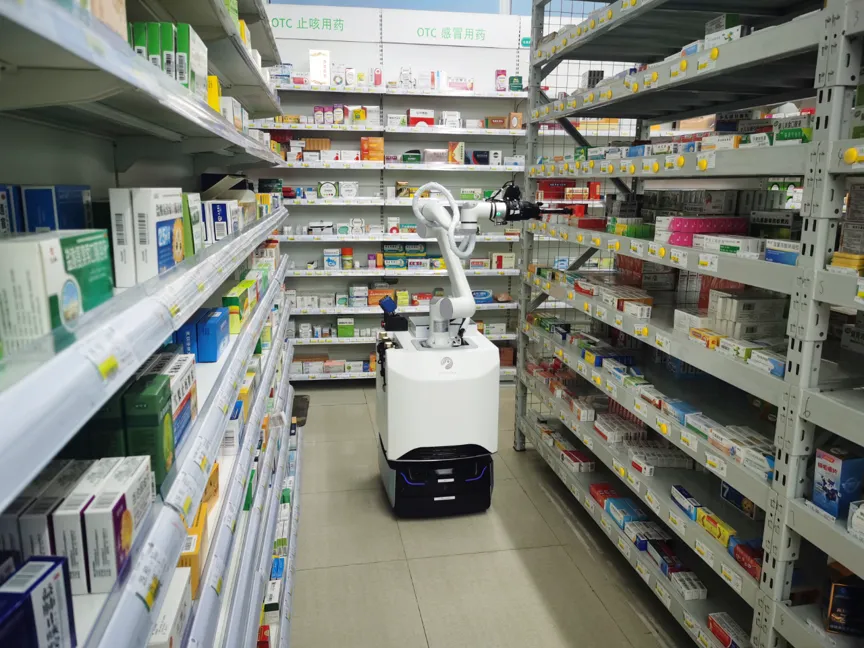
“ From world models to real-world action, physical intelligence is crossing the next threshold.
In 2026, the most significant change in the physical intelligence industry is the shift of the industry's focus from focusing on the body to focusing on the brain.
Capital flows are the most obvious signals, with relevant data statistics showing that in the first half of this year, more than half of domestic investments in the smart car racetrack were directed towards companies that focused on smartphones. Capital is no longer merely paid for the appearance of smartphones, but focused on the real performance and cost-effectiveness ratio of smart cars in complex scenarios.
At the same time, the most ambitious judgments in the industry, from authoritative academic institutions to leading manufacturers, have almost simultaneously pointed to brains.
This raises a more substantial question: Why do robots need a brainwasher?
Traditional automation equipment would be enough if only pre-set instructions were executed. But if robots were to really get into the real scenes of uncertainty in pharmacies, supermarkets, hotels, and homes, they would need not just a handshake and a footshake, but a cognitive system capable of understanding the environment, inferring its consequences, and making their own decisions.
Burning Consultancy recently released a white paper on the body-to-brain industry that attempts to answer this question.

The White Paper notes that the body brain as an important component of body intelligence is responsible for higher-level big model cognitive decision-making, multi-modal environmental understanding and task reasoning, the formation of autonomous decision-making capabilities, the generation of action planning and execution strategies based on task objectives, and supporting cross-scenario generalization and continuous learning.
In other words, the problem with the physical brain is to move robots from executing instructions to making decisions on their own.
Of course, to really understand why the human brain is being pushed forward today, we need to go back to the context of technological evolution.
01.
From VLA to WAM, robots need to take a step before they can learn how to move.
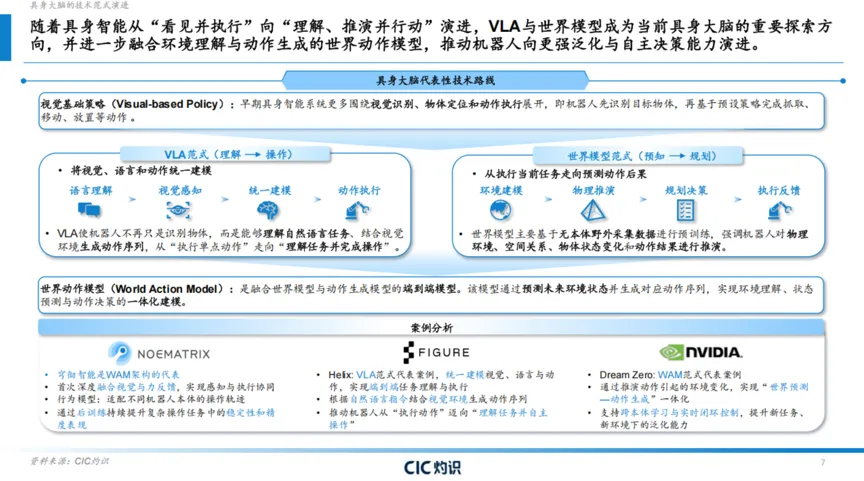
Over time, VLA has become almost one of the most mainstream technical narratives of large-scale intelligent models.
It modeled vision, language, and movement, allowing robots to evolve from identifying objects and performing single-point movements to understanding natural language tasks and combining visual environments to generate sequences of movements.
Figure's Helix and Google's RT series have both chosen this path. The fact that this path can be followed also proves it. After being fully trained, robots are able to grab, arrange, fold, move, or even complete tasks consisting of several movements.
Figure Helix 02, released in early 2026, has been able to complete the entire process of unloading the dishwasher with a single neural system.
However, VLA has its limitations. Its capabilities are based more on current observed environmental states and precedents of action. The model learns to map directly from instructions and images to action, focusing on what to do right now, and how the physical world will change after the action is performed, lacking explicit predictions and projections. In complex tasks that require continuous contact, fine energy control, and dynamic response, this type of reactive mapping is easily exposed to limitations.
So the model of the world began to come to the round table of intellectual discussions.
The core value of the world model is that it gives the system the ability to simulate the consequences of the physical world internally before action, thus predicting the changes that different actions will bring, with a greater emphasis on the environment, spatial relationships, the state of objects and the derivation of the results of the actions.
It's actually an upgrade to the smart paradigm. To give a simple example, a person doesn't actually perform all the possible movements one at a time before picking up an egg; the brain anticipates judgement, direction, object state, and possible outcomes based on experience, vision, touch, and environmental information.
Of course, the model of the world has its own ceiling. Because it can predict the world's turtles and it can operate reliably in the world, it's still two things.
After further development, the industry began to focus on the World Action Model (WAM), which is also where the White Paper really comes in.
WAM attempts to integrate the production of hydrogen and hydrogen into the same closed loop by predicting the future state of the environment and generating a sequence of corresponding actions to achieve environmental understanding, state prediction and integrated modeling of action decisions.
VLA, the relationship between the world model and the three WAMs, is more like a layered superimposed capability dimension: VLA allows robots to learn how to move their hands, World Model allows robots to learn how to make predictions, and WAM allows robots to go through the consequences in their brains before they move their hands for the first time.
As WAM is rolled out, the most critical competitors for the next phase of physical intelligence are demanding: not the strength of a single model, but whether it can form a complete loop from perception to understanding, from prediction to action, and from action to replicate the model.
From seeing to understanding, from understanding to predicting, then from predicting to acting, ultimately re-breeding the model through the results of action.
And this is the fundamental reason why the industry continues to talk about body brains today.
02.
The struggle for data goes from "the more the better" to "the more real the more valuable".
In addition to the model architecture, data is also a frequent topic of discussion in the body-intelligent industry. The former determines the upper limit of the body-brain, while the latter determines whether the body-brain can actually reach this limit.
In a white paper on the brainstorming industry, Burning Consciousness gives a clear judgement. Brain training data is evolving from general Internet data to a multi-source real-world data system.
With the advancement of modeling capabilities to complex real-world scenarios, the mere pursuit of data sizes is no longer sufficient to explain the improvement in modeling capabilities, and the authenticity of data, physical interaction information and scenarios diversity are beginning to become a new competitive dimension. For example, Internet video data, despite its significant scale and low cost, is often overlooked in training due to a lack of deep information and causal laws in the physical world.
The focus of competition has shifted from pure data throughput to the density of interaction between the physical reality of the data and the physical density of the data. Therefore, the competition for data with physical intelligence is essentially the competition for data from the physical world.
The White Paper notes that training data is divided into pathways such as Internet graphic video data, simulation data, robot real-machine data, and real-world scenario data, in which real-machine data and non-material data can provide real-world physical interaction information.
But the problem is that real machine data, while valuable, is expensive and difficult to scale.
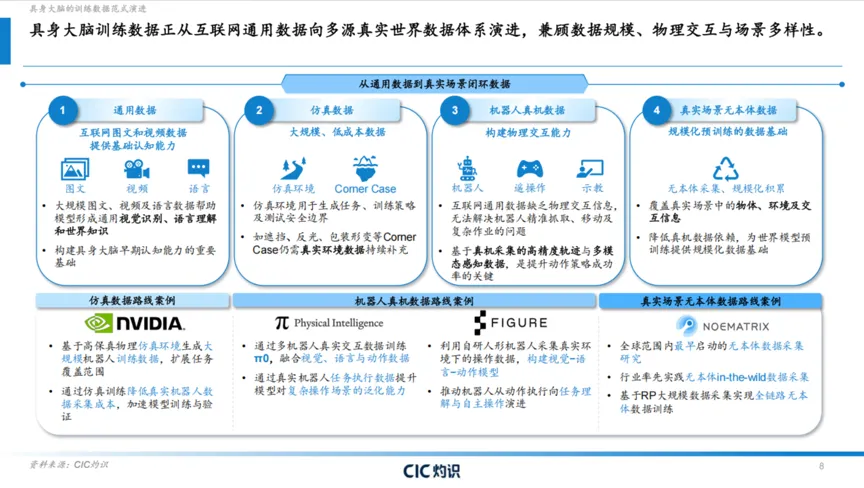
The industry has also been embroiled in an embarrassing data paradox: to train general models requires large-scale real-machine data; to obtain large-scale real-machine data requires large-scale real-machine deployments; to deploy large-scale real-machine deployments requires reliable models.
As a result, no-body data, cross-body learning, and real-world data locks are becoming another industry focus.
Specifically, by pre-training the collection of data that does not have to be attached to a specific robotic form, the model first understands the laws of operation of the physical world and then migrates to specific entities and tasks.
The real value of data is whether it is real enough, diverse enough, close enough to the laws of nature in the physical world.
When a robot understands from a set of motion data how a mouse normally behaves in the face of such environments, such objects, and such tasks, it is possible for a model to truly form the ability to migrate across devices, across tasks.
03.
Exploring Consciousness: A cross-section of the WAM route
It is precisely during the evolution of the paradigm of the body-brain paradigm that cognitive intelligence has become one of the most discussed cases in the body-brain industry.
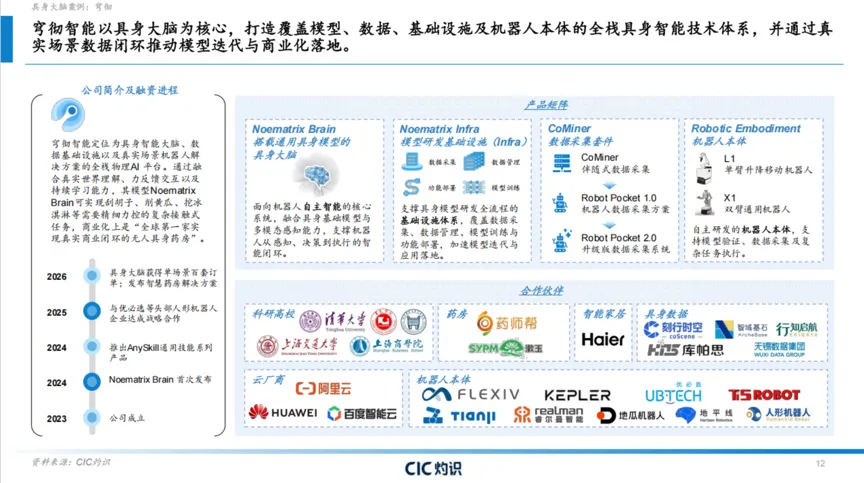
Established in 2023, it is a full-fledged AI platform with a physically intelligent brain, data infrastructure and real-world robotic solutions.
From an industry point of view, the value of Intelligent Design lies in the path it has chosen, which corresponds to one of the key questions facing today's physically intelligent industry about how to really get models into the physical world.
At the technical level, Noematrix has released its core product, Noematrix Brain, which provides robots with complete decision-making capabilities ranging from instructional understanding, task planning to environmental perception and feedback execution. Its core product, Noe-0 uses the World Action Model architecture to input sequential historical images and robot states, simultaneously predicting future images and robot movements in order to learn real-world objects, movements and state changes, and transform them into robot executable movements.
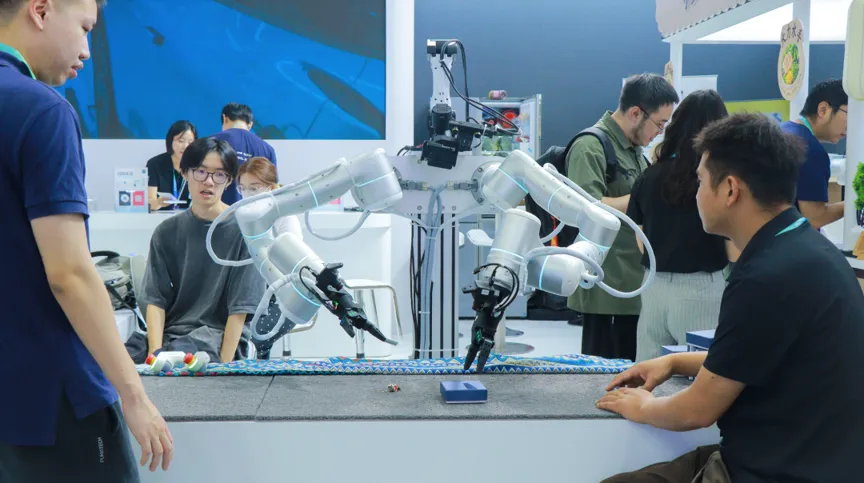
The accumulation of total intelligence in the kinetic perception and force control circuits constitutes another cornerstone of its technological path. In the White Paper, Consciousness Consulting notes that the evolution of the ability of the brain to have a physical body inevitably experiences the transition from simple low-frequency instantaneous contact (such as ground scraping) to complex high-frequency continuous contact (such as scrubbing, sorting, fine-tuning) circuits.
At the data level, Chevrolet Intelligent Exploration reduces the reliance of model training on large-scale real-machine remote-operation data through non-material data. Chevrolet Intelligent Noe-0 uses non-material data collection throughout the training chain, based on 100,000 hours of home scene data conducted in 47 cities across the country in 2026, and officially verifies the feasibility of non-material technology collection routes.
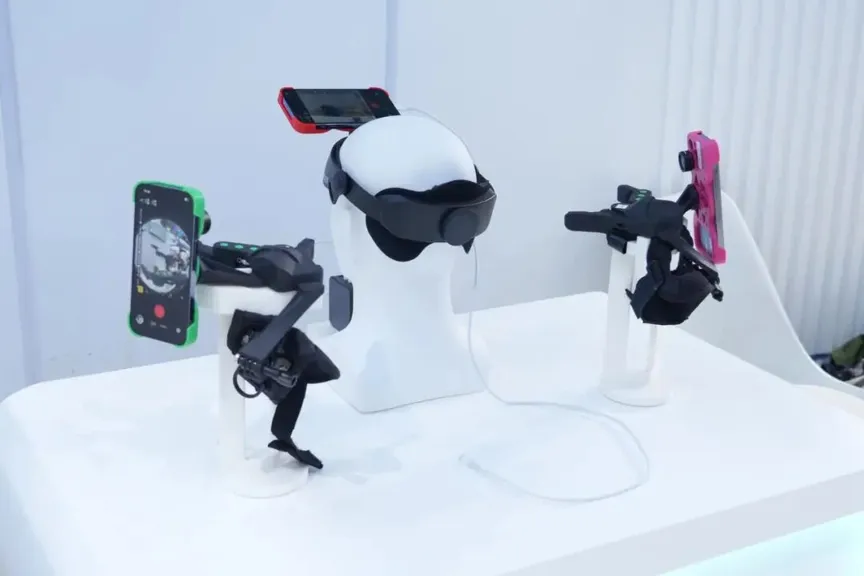
To support this data strategy, Chevrolet Intel created an efficient, natural, and design-optimized data collection device, the RoboPocket, that can be used to collect and distribute data to a large scale. At the 2026 World Artificial Intelligence Congress, Chevrolet Intel demonstrated this technological path with the theme of World Action Model with 0 Teleop Data. At the subsequent World Robot Congress, the true Noe-0-powered robot completed the gift box task, fully demonstrating the technological loop from visual perception, mission understanding to action execution.
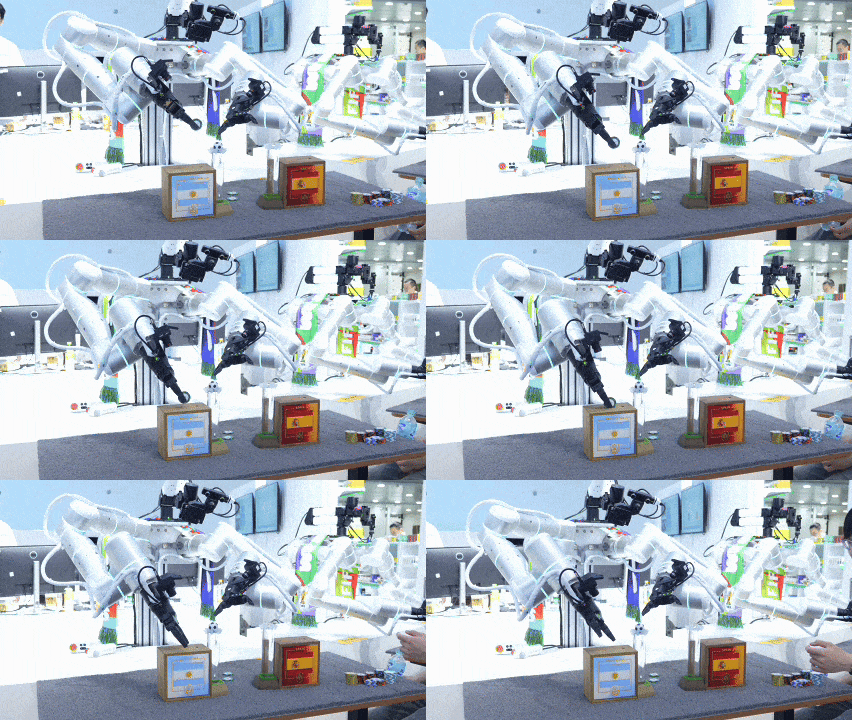
It should be noted that one of the biggest misconceptions about being physically intelligent today is the ability to make demos into demos when addicts already have demos.
In fact, once robots actually enter the commercial scene, they face continuous tasks, abnormalities, personnel interference and a large number of Corner Cases. This is why the White Paper emphasizes that commercialization with a physical brain cannot be understood as moving a laboratory demo to a fixed scene, but requires the formation of generalizable, iterative, and movable operational capabilities in the real world.
With its technological advantages, it has achieved large-scale application verification in pharmacies and pharmacies, and has a significant advantage over leading automakers in terms of commercial maturity.
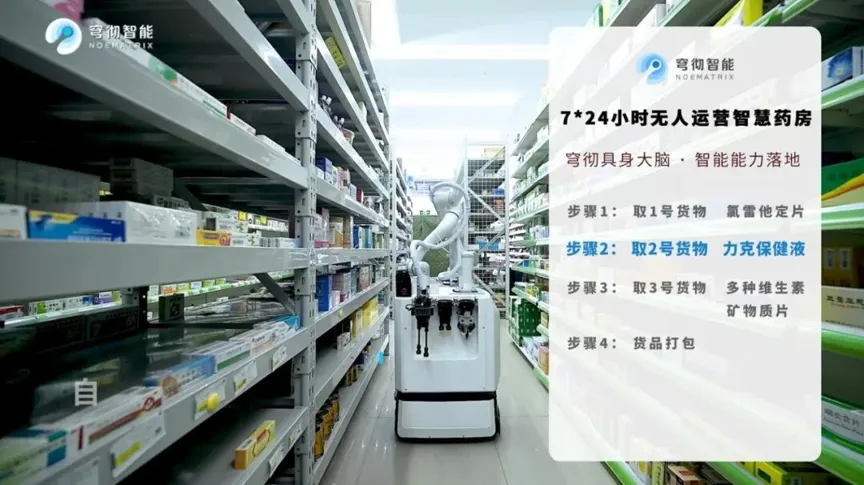
The Burning Knowledge Consulting White Paper indicates that the company is the first in the world to implement a truly commercial closed-loop unmanned-pharmacy solution. It has established a pharmacy as its core business gateway, achieved bulk landing scenarios, and completed closed-loop verification from identification, seizure, sorting, to mission execution; the future will shift more scenarios based on brain capacity to convenience stores, supermarkets, hotels and home services.
04.
Link to the Future
In the coming years, a new evaluation system is likely to emerge in the body-smart industry, with a focus on the ability of the body-brain to migrate.
The White Paper has illustrated this evolutionary path quite clearly: Commercialization with a physical brain will not go beyond a fully open home environment, but it is more likely to start with immediate access to tasks such as seizure, placement, sorting, then expand to complex service operating scenarios such as hotel services, logistics, retirement, and ultimately to a more open home service, personal care, and human-machine collaboration environment.
In other words, what the robot industry really needs is a brain that can continuously abstract the experience of the task and transfer the ability to the next task, the next machine, the next scene.
That's why world models, WAM, non-material data, etc. are being rolled out at the same time today.
A real brain tumor is never a victory of a model, but a systematic synergy of models, data, controls, and scenarios.