How far away is "the last man-made AI"? How are leading manufacturers like OpenAI, Anthropic, and others progressing? Theseus Labs, an AI research institute at the forefront of defining China's RSI roadmap, combines 72 industry practices to launch the "RSI 5th Framework".
Just over the weekend, an RSI industry analysis report from China was hotly debated in overseas AI circles. It was released in just 10 hours and reached a million views, and many top AI researchers such as Binyuan hui, Jiachen liu and industry KOL actively forwarded recommendations, and the heat continues to rise.
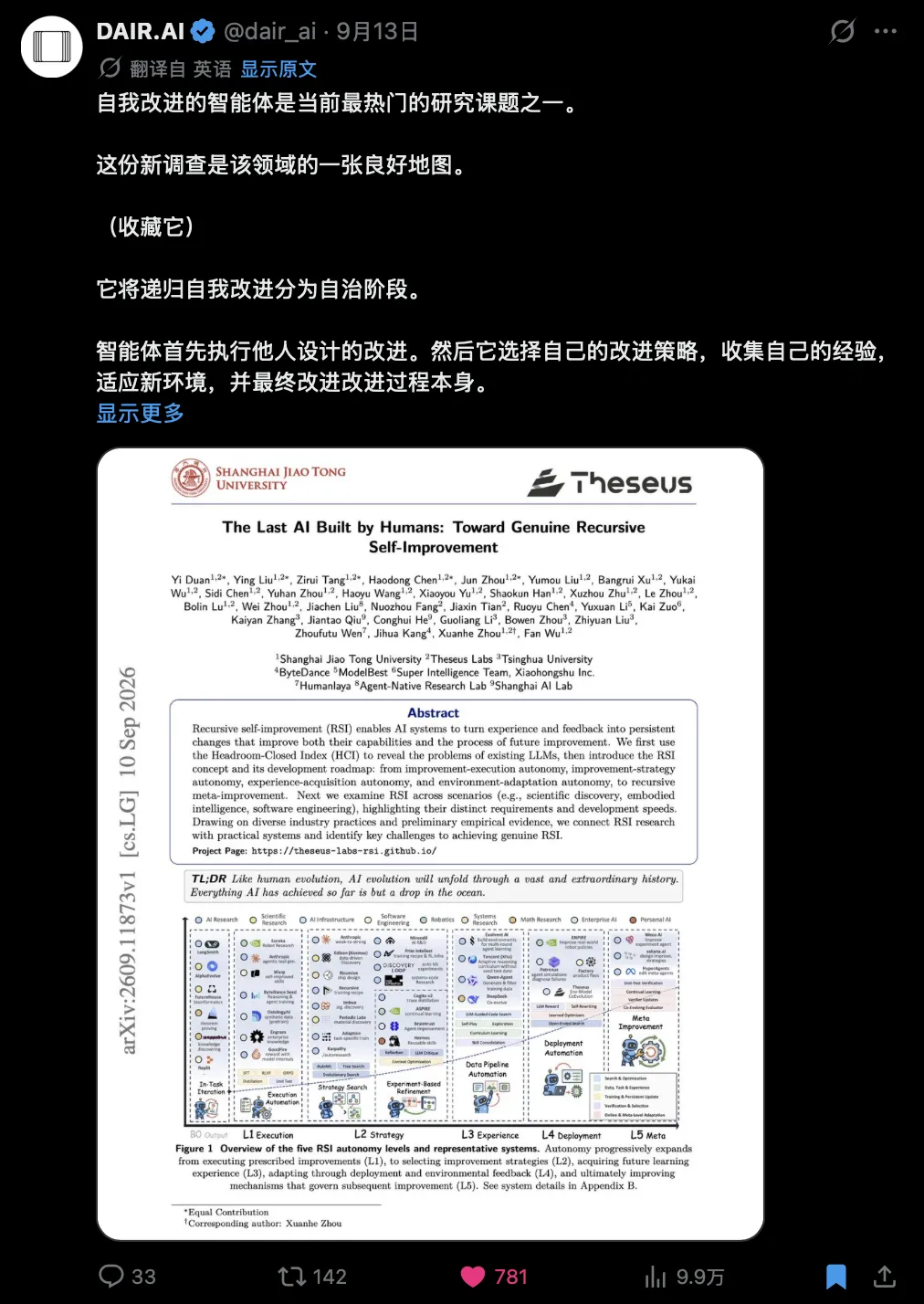
DAIR.AI: Self-replicating intelligence is the hottest research direction at the moment, and this report is a clear overview of the field.
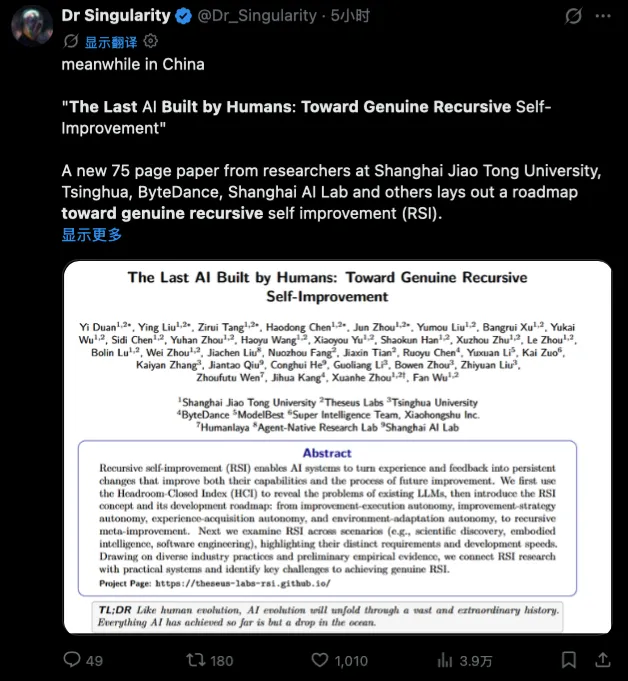
Futurist Dr. Singularity reviews: Chinese researchers have drawn a roadmap to true regressive self-improvement, exploring how "the last AI built by humans" is possible.
RSI (Recursive Self-Improvement) is one of the hottest keywords in AI this year.
OpenAI formed the RSI team, Anthropic released the sequel When AI Builds Itself, Google DeepMind used AlphaEvolve to optimize its own chips, Meta used AIRA2 to automate research, Tencent Mixed used Hyra to experimentally drive searches, and Byte Seed gave models access to assessments, data, and training.
The choice of routes for the world's leading players has been markedly varied: some from model weight and training rules, others from Harness, memory and skill libraries, and others betting on the ongoing evolution of evaluators and reward mechanisms... who can be the first to reach the full body RSI?
This comprehensive roadmap defining the full path of the RSI comes from an entirely new AI front-end lab: Theseus Labs.
Core founder Zhou ZhengheHe graduated from Tsinghua University with a Ph.D. in computer science.
Double-employed assistant researcher at the Shanghai Artificial Intelligence Laboratory, intellectual youth scholar, fourth model, memory stress technology consultant.
His research focuses on big model data governance, evolutionary theory, and intelligent body memory, and has led several highly cited NIPS and VLDB papers over the past five years.
Nominated for the ACM Jim Gray Ph.D. thesis, first at Continental University, recipient of the Tsinghua Award, the Byte Jumping Scholarship, and the Microsoft Scholarship, he was named to the 2026 list of the world's most influential scientists in artificial intelligence.
The results of the research have been included in universities such as Nike Mellon University and Cornell University, and the results of several projects have been cited by OpenAI, the official blog of Byte Jumping.

Unfortunately, Theseus Labs did not write RSI as a "smart explosion" philosophical fantasy, but rather as a collection of OpenAI, Anthropic, Google DeepMind, Meta, Tencent mixtures, bytes Seed.In the public materials of 72 companies and teams, one house was demolished, one plot, and the last to give this set of autonomous roadmaps from L1 to L5.
In other words, this is not a "report coming out of my mind sitting at a desk" without talking about a massive explosion of intelligence.
Theseus Labs has teamed up with academic and industry organizations such as the University of China, Byte Jumping, ModelBest, Little Red Book Super-Intelligent Team, Humanlaya, Agent-Native Research Lab, Shanghai AI Lab, Yangtze Technology, and others to release The Last AI Built by Humans: Toward Genuine Recursive Self-Improvement.
Using the "Improvement Cycle" as an analytical unit for the first time, the system addresses RSI's technical routes, industry practices, and assessment challenges.
In a nutshell, the RSI has finally been broken down into a scalable, measurable, engineered roadmap.
The article is:
01. Use a meter to measure the "excess capacity" of AI.
To objectively assess how far away the current large model is from true autonomy, Theseus Labs has constructed a new indicator: Headroom-Closed Index.HCI, which stands for "Excess Capacity Closure Index".)
The HCI measures how much the model fills the gap toward completion compared to the initial marginal level of an assessment. When calculating the 90th percentile of the model score that was first included in the data set as a benchmark for the assessment, it is calculated as:HCI = ((current score-based score)÷100-based score) x100"calculation". For example, the benchmark is 60 points, the current is 80 points, and the HCI is 50, which means that the original space for improvement has been filled in half. When summarizing a field, the 90th percentile of the annual HCI for each evaluation is represented by the previous year's level, followed by a square root weighted average of the number of models involved, consistent with coverage, while avoiding the largest-scale evaluation dominating results.
They collected 393 group models and benchmark test observations covering 10 major capability areas between 2023 and 2026.
By setting the benchmarks at 0 and the score at 100, the HCI unified the scale of the different tests to answer one of the most fundamental questions:
How much "residual space" is the model far from the human ceiling in different areas?
The results of the data give a very contrasting picture: by 2026, the HCI in front-line mathematics is 86.4, graduate science is 85.8, and general knowledge is 77.2.
However, the legal reasoning is only 64.5, the polymorphic reasoning is 62.2, and the frontage academic width is 60.4.
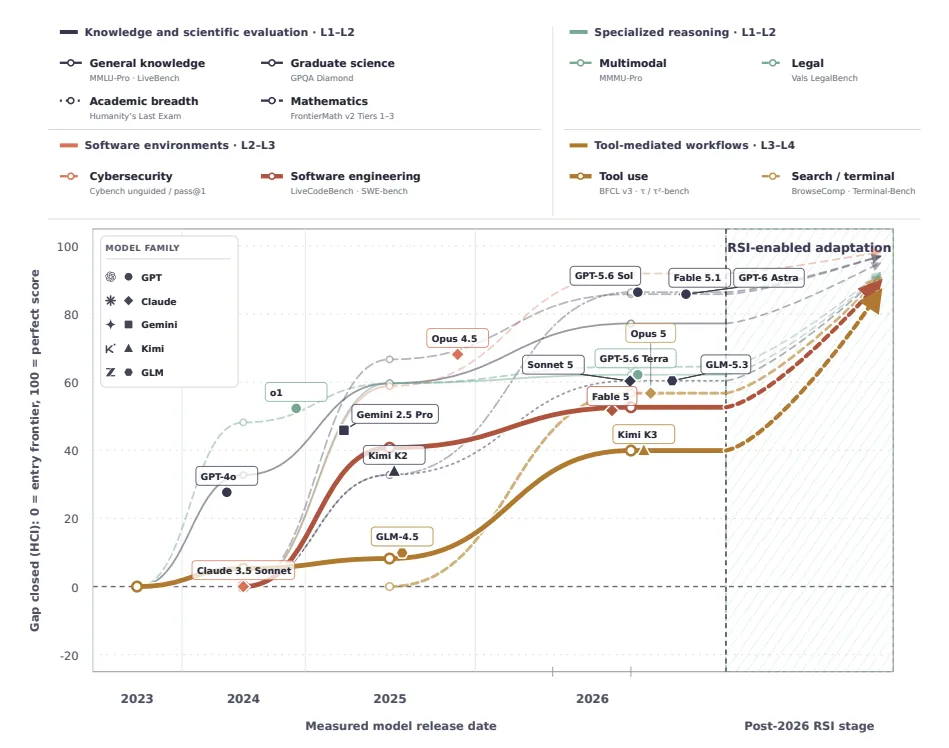
He said:The model quickly reached the top of the "standardized test", but was just getting started on the "real task execution".
The HCI is not intended to rank the model, but rather as a diagnostic map showing which areas have the most "residual space" and which are the hardest for the RSI to work on in the future.
02. Level 5 autonomy: from execution to succession
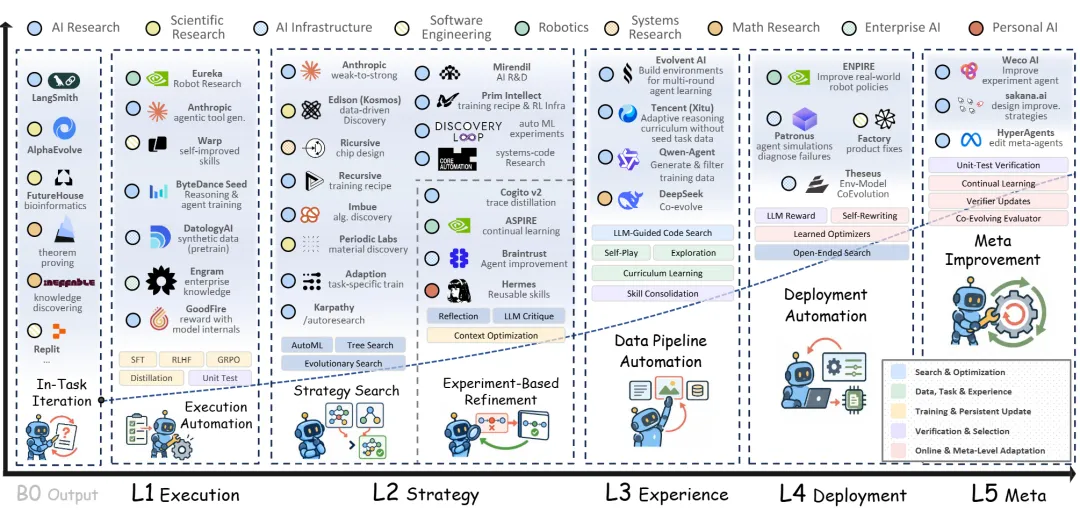
Based on this, Theseus Labs takes responsibility for AI in the improvement cycle.With the release of the RSI Fifth Framework, the first system defines "recurring self-improvement".
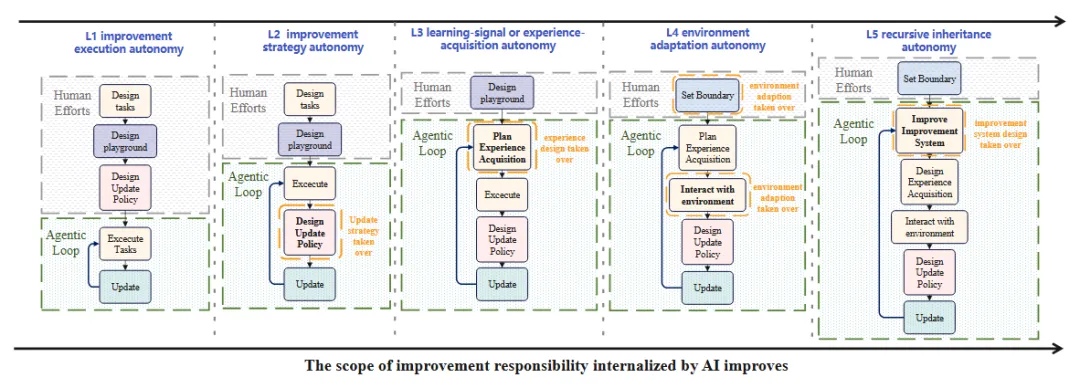
L1 performs autonomously:Human inputsDesign tasks, design test environments, design updates strategies;A closed loop for the intelligent bodyI'm going to do my job, update.
The L2 strategy is autonomous:Human inputsDesign tasks, design experimental environments;A closed loop for the intelligent bodyImplementing, designing, and updating strategies; updating strategies are perpetuated by the system.
L3 experience of self-sufficiency:Human inputsDesign testing environments;A closed loop for the intelligent bodyPlanning experience is acquired, implemented, design updated, strategy updated; experience design is perpetuated by the system.
L4 Environmental adaptation:Human inputsIn the meantime, we're going to have to set boundaries.A closed loop for the intelligent bodyExperience in planning, interacting with the environment, designing and updating strategies, and adapting the environment to systemic persistence.
L5 Returns to Succession:Human inputsIn the meantime, we're going to have to set boundaries.A closed loop for the intelligent bodyImproving systems, gaining design experience, interacting with the environment, designing updated strategies, updating; improving system design by sustainability.
This is the fifth step of the ladder.Large factories are currently mainly concentrated in L1 and L2, such as:
OpenAI Symphony and Anthropic Agent Skills provide support for task attachment and skill replication, reducing repetitive operations;
OpenAI GPT-Red's offensive self-defense, Anthropic Claude's tool optimization, and Microsoft's Agent Lightning, DeepSeek R1, further incorporate strategic improvements into the automated shutter loop, allowing man-to-man modeling to shift to bulk testing and feedback-driven optimization, improving efficiency and capacity limits.
Moving towards L3: Tencent R-Zero solves its own problems and begins to reduce its reliance on man-made learning tasks.
At L4, Factory Signals, as a candidate for OpenAI's self-improvement in tax intelligence, focused on turning deployment failures into follow-up updates, shortening the link to "Finding Troubleshooting Checks and Checks".
As for L5, Meta HyperAgents, Sakana Darwin Gödel Machine, Weco AIDE2, and Anthropic's When AI Builds Itself is still the targeted vision:
What is really worth looking forward to at this stage is that each round of progress will not only make AI more efficient, but also make the next round of improvements more efficient and reliable; but the benefits of this continuous recurrence are still insufficiently verified.
03. It looks like mission performance improvement = full body RSI?
"No", he said.
The key is whether the improvement mechanism itself produces stronger offspring under the same budget and independent evaluation.
L4 is primarily concerned with improving mission capabilities under established improvement mechanisms, while L5's "mechanism of decision-making and subsequent improvement" can only touch on effective recurrence.
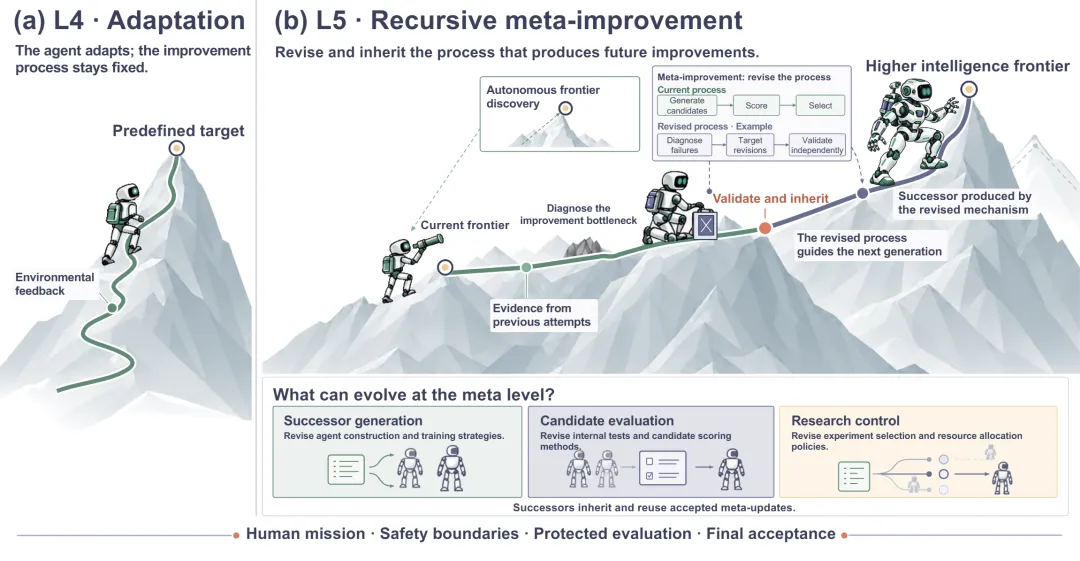
If the ability to improve is compared to climbing, L4 uses an established method of improvement to adapt to the environment to achieve the goal;
L5 will focus on the mountaineering method itself: self-discovery of the cutting edge of ability, thinking about the reasons behind obstacles, choosing routes that are more worth trying, and passing on proven new methods to the next generation to continue to use and improve.
Whether it can be really improved needs to be confirmed by independent evaluation under the same budget and cannot be improved solely by self-modification or self-rated.
The key isIt allows limited computing and humans to invest and produce more effective improvements. But the overall goal and security boundaries are still linked by humans.
04. The model is not the best "functioning" model.
What is the break point of the RSI?
Of the three observations of the HCI (Excess Capacity Closure Index), the most alarming was the severe lag in "interactivity class capabilities".
As evidenced by 2026 data, the HCI for software engineering is only 52.6, the HCI for search and terminal agents is 56.8, and the tool calling agent is even lower at 39.9. In comparison, the HCI for graduate science is 85.8, which is 33 to 46 points apart.
It's worth noting that the tool Agent's score rose from 8.2 to 39.9 during the year, but remains at an all-time low; while the concurrently-leading cybersecurity Agent has reached a height of 91.9, which is more than 52 percent different.
This shows that the test gains achieved in "border clear, easily verifiable" environments cannot automatically migrate to "long-range/state" real workflows.
Theseus Labs emphasizes that simple measurements primarily exercise the ability of L1 and L2, and that environmental tasks correspond to L2 and L3, while only long-range interaction workflows can truly expose the "validation, memory, and adaptive capabilities" required by the system at L3 and L4 stages.
So how much growth can the RSI bring?
Theseus Labs gives an illustrative extension formula: R = 100 - 0.22 × (100 - 2026 HCI)
In simple terms, it'sAssuming the RSI can fill the gap at the current efficiency coefficient of 0.22, what the theoretical limits in each field can be.
The results of the measurements were more impressive: cybersecurity could be increased from 91.9 to 98.2, software engineering could be increased from 52.6 to 89.6, search and terminal could be increased from 56.8 to 90.5, and the tool Agent could even be directly increased from 39.9 to 86.8.
Why does the RSI fill this gap?
Because "activation" requires long-term interaction, repetitive error testing, and regression testing, this is the strength of the RSI in accumulating experience & verifying updates.
In other words,The larger the existing capacity gap, the higher the potential dividend gains from the RSI.
Practical conclusions follow: repeatedly generate experiences, verify updates, and do return tests that best help those "deployment workflows that are weak".
This is the easiest entry and landing point in the project.
There is still a lot of room left for HCI to find software engineering and tool use agents.
The RSI leverage is the strongest at the farthest possible ceiling.
05. Industrial practices have already signalled:
Theseus, Lark, Humanlaya, ModelBest and Tencent mixed
In the area of industrial practice, Theseus Labs has refined the initial exploration of systems such as Theseus, Lark, Humanlaya, ModelBest, Tencent Mix, Agent-Native Research Lab.
For example:
HumanlayaAfter four rounds of feedback-driven updates, the rate of critical defects decreased from 9.0% to 3.7%, and the average man-made processing time decreased from 9.0%.48 minutes down to 27 minutes。
This is the first time I've seen this.ForgeStencil: allowing Agent to complete engineering design, implementation, and optimization on its own, and replicating the experience.1.15 tonnes 1.9 x acceleration。
Tensions are mixed.Using the code, logs, and evaluation of feedback as experiences to drive the next round of experiments, nanochat validates BPB from0.9109 down to 0.9015。
Little Red Book generated recommendationsFollowing recommendations, real feedback continues to correct user memories and transform high-value hard cases into post-training samples, forming a two-tiered loop of "memory update + model iteration"; in phased experiments, the feed's precision alignment was discovered.score_mean@16 increased from 2.211 to 2.366, up about 7.0%。
The figures show that the RSI is not a purely theoretical one, and that the industry has already begun to run.
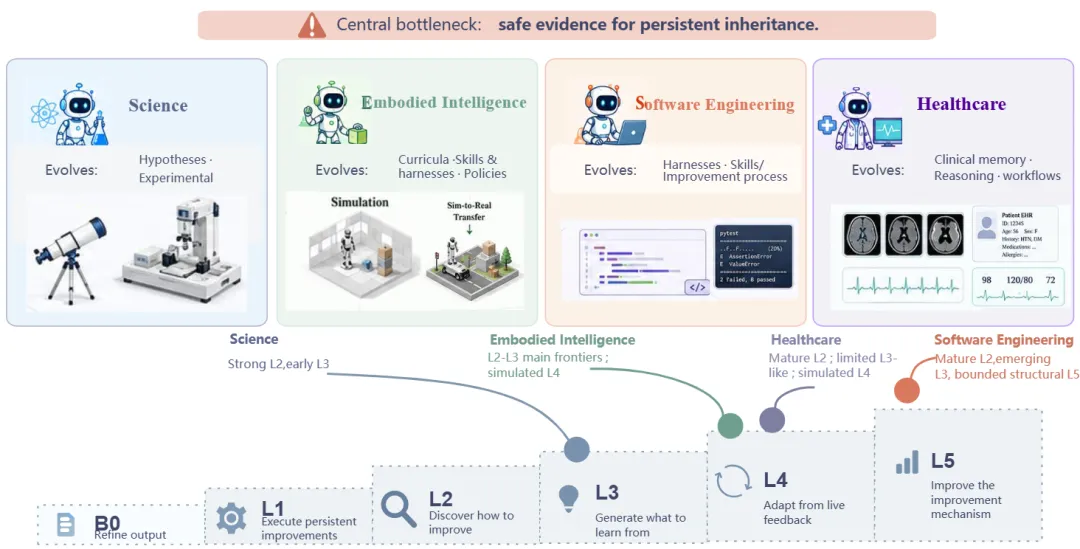
Science discoveries, physical intelligence, software engineering, healthcare
In addition to the manufacturers, Theseus Labs also compared four real-world domains, clearly pointing out that different domains are moving at different speeds towards RSI (recurring to self-improvement):
Software engineering is far from progressing, while science, robotics and healthcare are more limited because feedback is more difficult or risky to verify.
"The cost of feedback"」「Verifiability」「Deployment of constraints」The rate of progress of the RSI is determined.
After one success, there are four other problems.
In the L5 assessment, the report emphasizes that real recurring improvement cannot be seen only as a one-time success.
I'd like to ask:
Measurable: Is the improvement real and can it be replicated in an independent assessment?
Sustainable: Can improvements be sustained and not degraded?
Migrability: Is it possible to improve cross-task, cross-domain reuse?
Can it be reversed: can it be safely withdrawn when improvements fail?
These four questions determine whether the RSI is a "one-time benchmark" or a sustainable capacity for improvement.
07. Theseus Labs, looking up at the stars and the ground
After reading their articles, I wanted to talk more about this young lab.
In the field of RSI, do Theseus Labs have their own solutions?
Yes, and it's very intuitive:
In the first 30 work area tasks, 1,280 scoring details compared the clean environment to the noise environment, the eight groups of models and tool frame configurations differed by 21.7 to 51.6 percentage points.
Theseus then further breaks down this path into four more specific steps: learning how to reconstruct the environment. Using the new environment to discover real capability gaps and generate training data.
Eventually, in 30 productivity tasks and 547 rating details, five sets of the latest base models and harness configurations achieved performance leaps.
The report's title, "Last AI Built by Humans", is actually a reminder:
"Perhaps the last AI built by human beings is not a superintelligence born at a moment's notice, but a spark that learns to add to itself, to calibrate itself, to remember its path".
Human beings have spent their lives trying to turn "experience" into "growth", and they believe in the evolution of AI.
Each verified improvement is the starting point for the next round of exploration.
Let's make smart growth a leap forward and let limited resources continue to leap forward.
This is the goal of Theseus Labs.
Theseus Labs home page: