It's the first time in the history of the world.
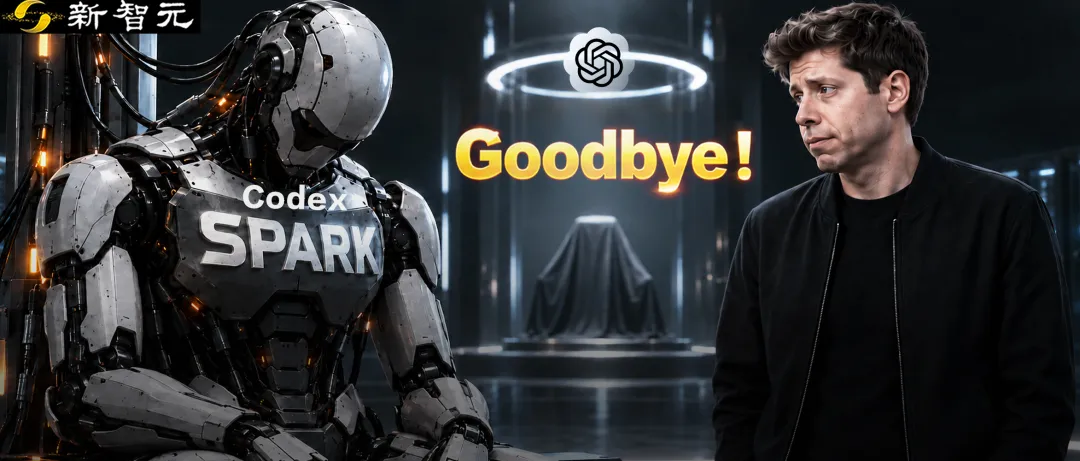
The fastest model in OpenAI's history is dead.
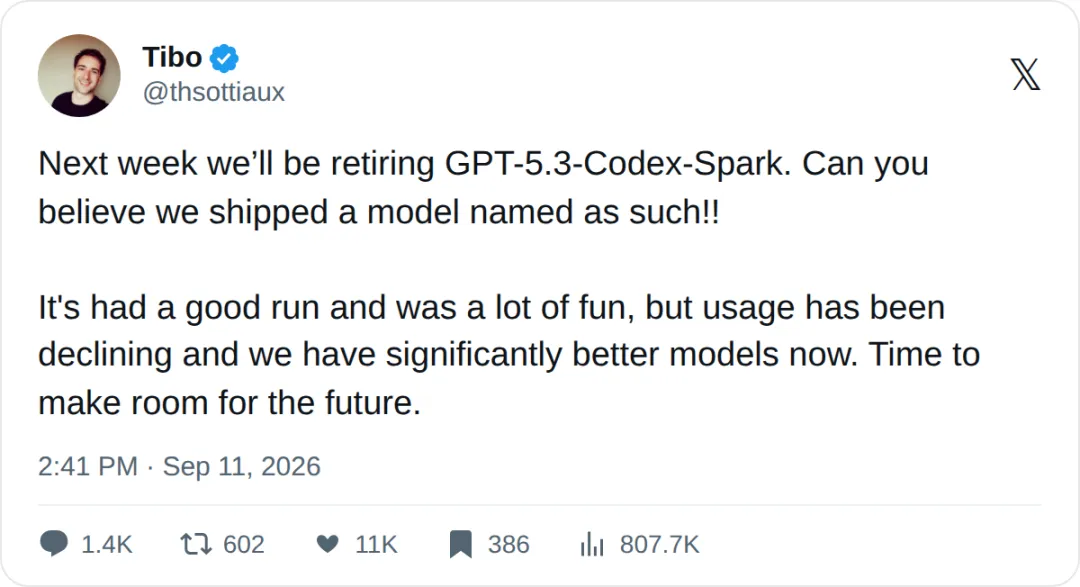
It's just that Tibo, the head of the Codex, posted,GPT-5.3-Codex-Spark, retired next week.
Every second, 1,200 tokens, OpenAI's first model to escape Great Britain, the first delivery of the 750-megawatt Cerebras order, only lasted seven months from release to download.
The reason given by Tibo is simple: the volume has been declining and there are already significantly better models on hand.
Then he added a knife to the bottom and said, "I can't believe we ever published a model with such a long name!"
In the farewell speech, all we care about is the "reserved quota".
Spark walked quietly, even seemingly awkward.
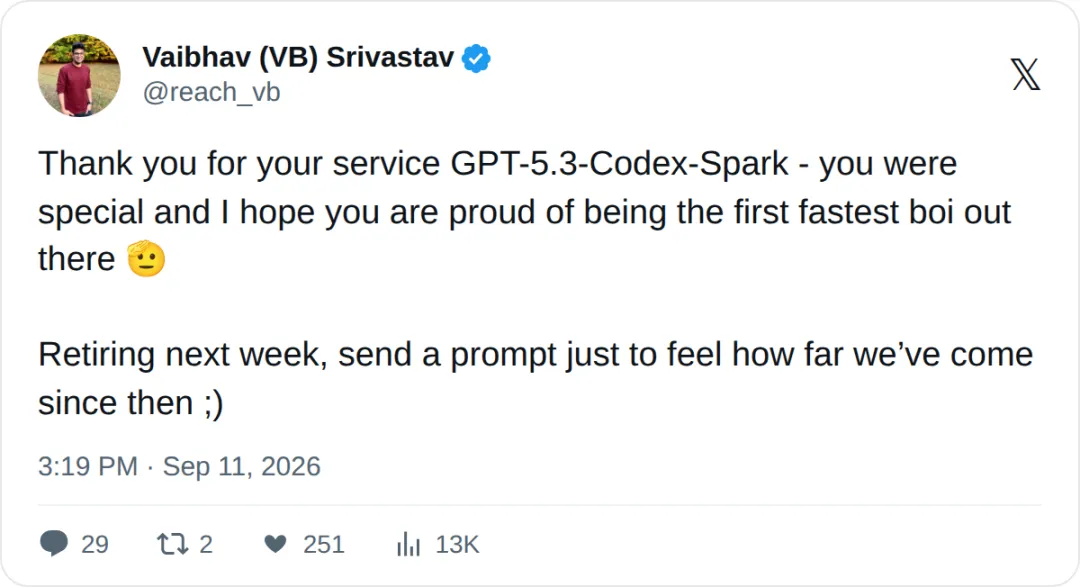
Hugging Face's Vaibhav Srivastav is trying to leave some warmth in the commentary area.
Thank you for your service, you're special, and I hope you're proud to be the first "fastest kid".
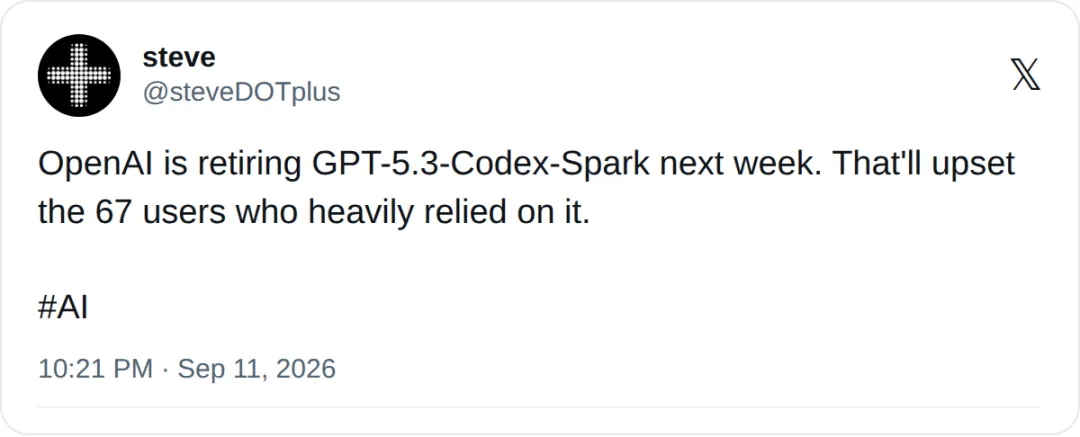
In the wake of the heated criticism, the painting instantly became sharp.
I've been discussing this with my colleagues for the last couple of days.
OpenAI is retiring from Codex-Spark, and the only remaining 67 heavyweights should be saddened.
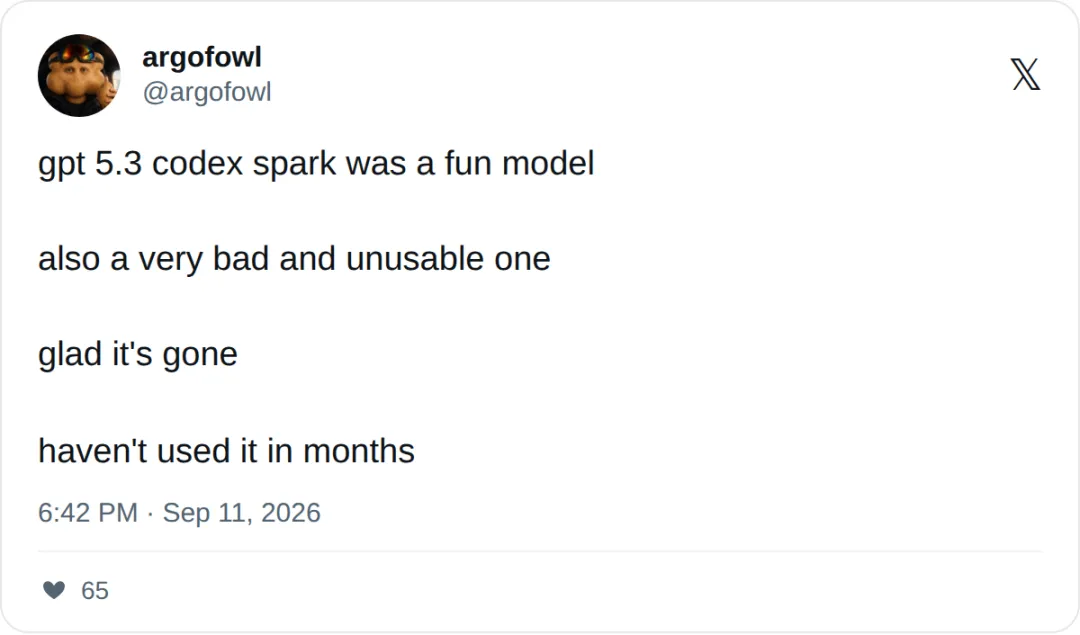
A more lethal review comes from the developer, Argofowl."Spark is a fun model, but it's also a very bad one, and it's not working at all. I'm glad it's gone, and I haven't touched it in months".
Other developers said that in several small projects, he had barely used Spark, and that even understanding the context of the project, such as the basic task of analyzing logs, would quickly fill the context window, forcing him to open another conversation.
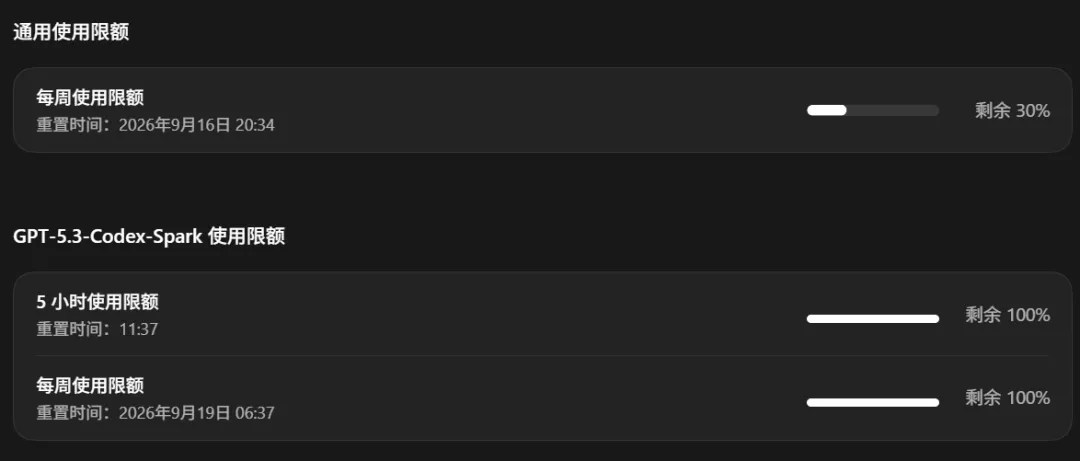
In fact, the real regret about Spark's retirement is that it's not the model itself that's regrettable, it's what's attached to it.Independent quotas。
A well-known developer, Chubby, confessed that he wanted a "GPT-6-Spark" because Spark had a standalone package that didn't have a master allowance.
At a time when the Astra quota is extremely tight, many developers are looking to use Spark as their main quota to top the "back-up tank" after it runs out.
Seven months ago, the "future" beat the "race of mind".
Taking the time back to February 12th of this year, the launching date of the Spark online can be said to be huge.
It was the first model designed specifically for real-time programming by OpenAI, and generated over 1,000 tokens per second in 128k context.
According to official figures, back and forth between clients and servers decreased by 80% and processing costs for each token decreased by 30%, and the first token delay was cut in half.
The code is no longer one line at a time on the shelf, and the entire piece of code is poured all over the screen.
The first group of good developers, the reaction was really exciting.
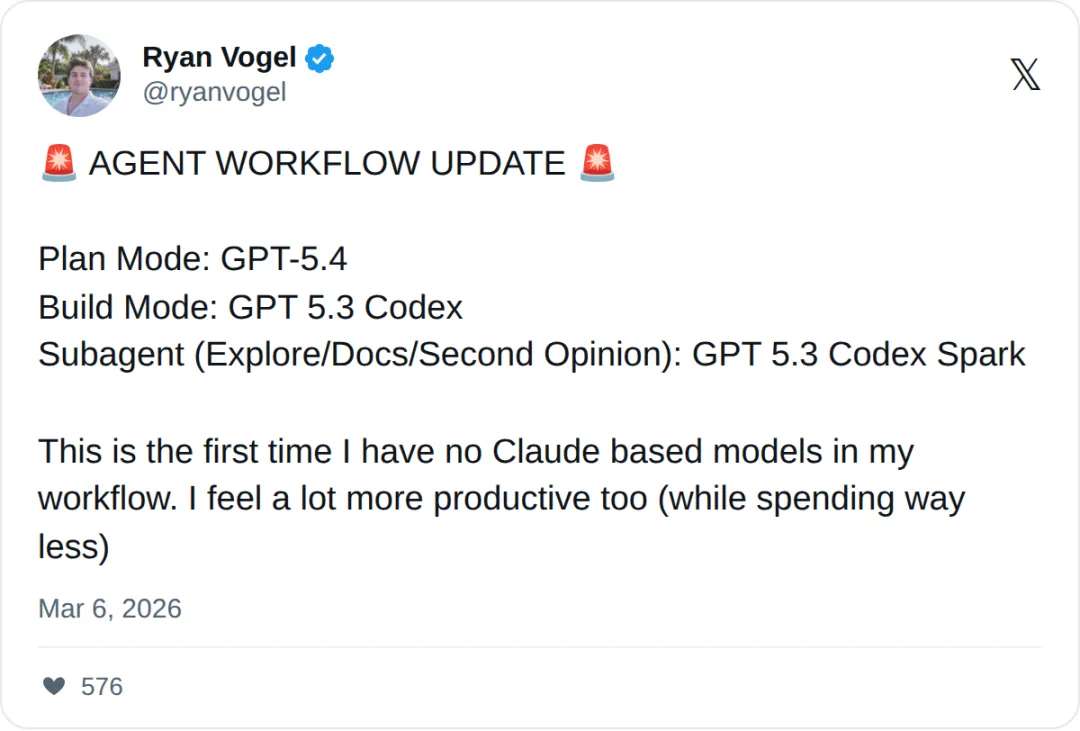
Developers Ryan Vogel directly compiled it into the official workflow, GPT-5.4 was responsible for planning, GPT-5.3-Codex was responsible for building, Spark was responsible for exploring code libraries, checking documents, giving second opinions.
He said it was the first time in his career that he didn't have a Claude model, "more efficient, less expensive".
Jason Liu, author of Instructor, directly launched 20 Spark sub-agents to search the file system, declaring "RAG is dead".
He then joined OpenAI's Codex team shortly thereafter.

More importantly, Spark carries the ambition of OpenAI to break free from a single hardware dependence.
It is the first OpenAI production model to run outside of the Invidia technology hub, with underlying computing power coming from the Wave-Class chip WSE-3 from startup company Cerebras.
It marks OpenAI's first response to the 750 MW calculation order signed with Cerebras, worth more than $20 billion in total.
But the heat recedes faster than it does.
Spark's deadly wound wasA wavelength that does not fit the flagship model, it is essentially a "small distilled model" that is compromised for extreme speed.
In the Terminal-Bench 2.0 rating, Spark received an accuracy of only 58.4%, well below the 77.3% of the full version of the GPT-5.3-Codex.
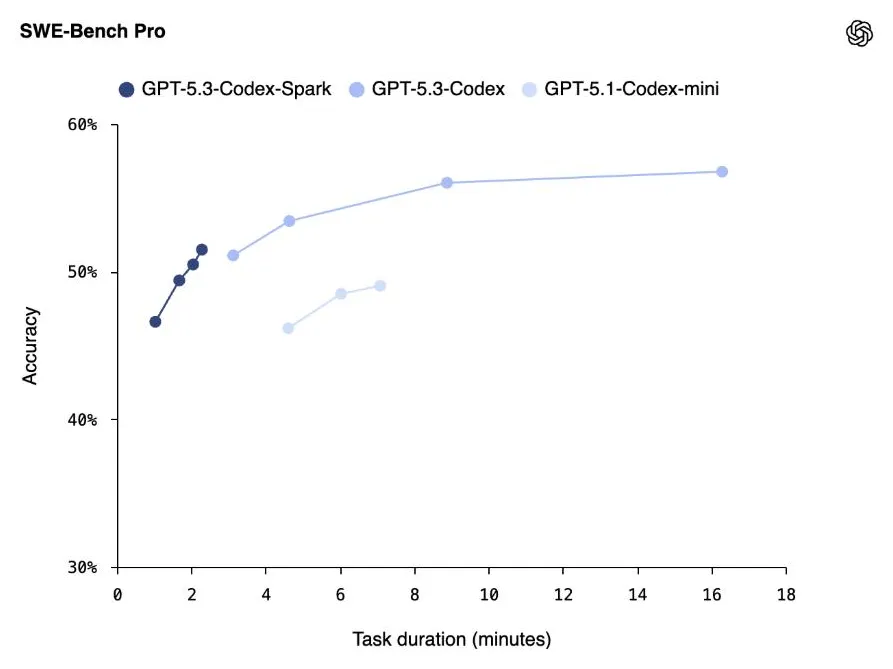
The SWE-Bench Pro curve released by OpenAI itself also shows that while Spark can compress the task time to 1 to 2 minutes, the accuracy rate stops at between 47% and 51%.
By comparison, the full version of the GPT-5.3-Codex started at 51 minutes, went up to 9 minutes, was 56 minutes, and 16 minutes could go up to 57%.
In other words, the few minutes spent in Spark's province were five or six points downwards.
The campaign's "15 times faster" has also been dismantled.
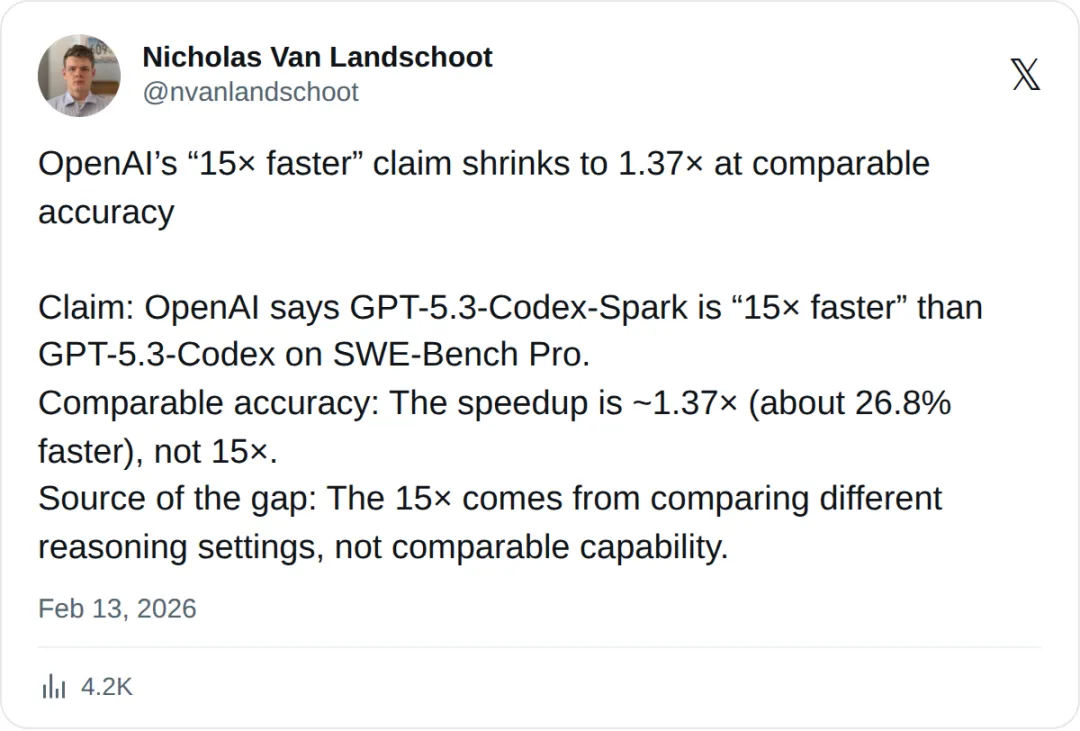
The day after its release, developer Nicholas Van Landschoot posted an excerpt on X, adding the contrasting conditions of OpenAI, so-called 15 times, to Spark compared to the GPT-5.3-Codex with the highest reasoning intensity.
With the same accuracy, Spark is only 1.37 times faster.
In the actual coding scene, its flaws are infinitely amplified, with empty API endpoints being invented, JSON formats unstable, and multi-step tasks very easy to run.
Turing College, a training institution, has a bloodthirsty summary of its findings."Without the speed of intelligence, it's faster to fail".
For a programmer, it's better to spend 17 minutes running a code than two minutes getting a whole bunch of bugs.
So this model of dominant speed is destined to be marginalized.
Ultrafast has terminated Spark after the launch of the flagship.
The real death sentence for Spark was the Ultrafast model released by Cerebras on August 13.
This time, running on the waves was no longer a scaled-down version of the Spark, but a flagship model.GPT-5.6 Sol in the name of honor。

By layering the massive flagship model into layers to form a flowline at multiple CS-3 nodes, the Ultrafast model delivers 750 tokens per second at a terrifying rate under the assumption of "equivalent intelligence to the standard version".
Cerebras's comparison is that Ultrafast is 14 times faster than standard, with a Priority in the middle, only 2.5 times faster.
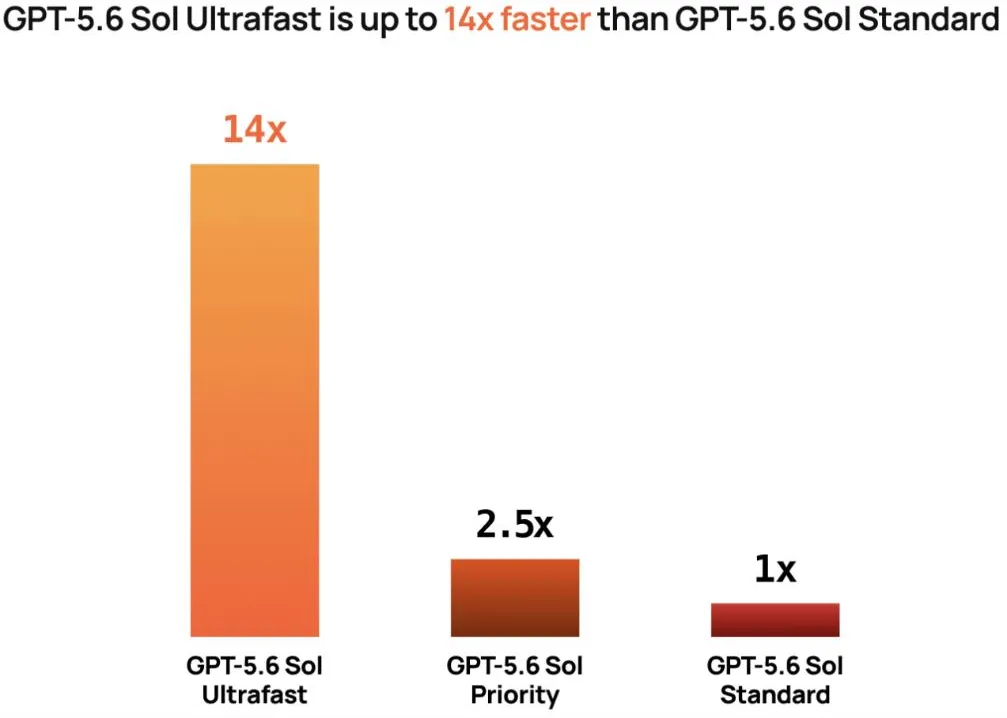
Andrew Feldman, CEO of Cerebras, has been quoted as saying:"Speed and intelligence are no longer mutually exclusive".
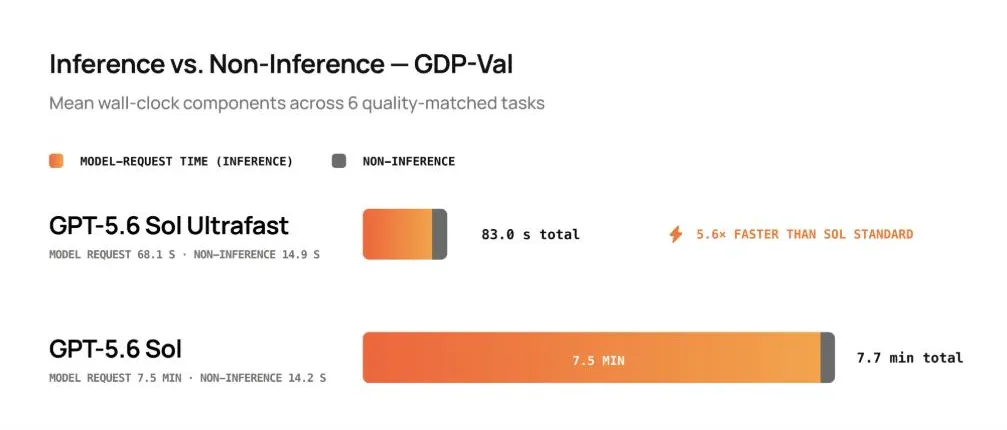
They made a series of time-consuming comparisons using six quality-coordinated tasks in the GDP-Valley.
The standard version of Sol takes an average of 7.7 minutes to run, of which 7.5 minutes are spent on model generation. Instead of Ultrafast, the same task takes a total of 83 seconds, with the model generating 68 seconds, and the remaining 15 seconds are non-reasoning expenses such as tool calls.
In other words, end-to-end speed is 5.6 times the total, and the quality of the answers is almost unchanged.
The phrase not only proclaims a technological breakthrough but also directly drains the full meaning of the existence of Spark.
Spark's initial design goal was "to change the speed of intelligence", and just six months later, the company's full-fledged flagship model was running on the same wavelength, only a quarter of the way slower and no less capable.

Cerebras' capabilities are limited.
When no one asks about the "shortened version" and the "flagellated version" that line up clutching at the same wavelength, the answer is obvious.

Speed is no longer an "exclusive model" but a "paid grade".Spark is not the only historical package that has been cleaned up.
Over the past three months, OpenAI's model library has been undergoing a radical "big blood exchange".
- On 2 June, GPT-5.2 was retired with the GPT-5.3-Codex.
- On 31 August, the GPT-5.4 and 5.4 Mini were retired, with the overall user migration to the 5.6 generation.
- On September 11, it was GPT-5.3-Codex-Spark.
Along with the departure of older generations, the Codex ushered in a new era of solar, terrestrial, lunar, astral, and stellar naming.
The "GPT-5.3-Codex-Spark" with a redundant version number and product line name is indeed a legacy of the previous era.
It's a lot more logical than that.The "fast" attribute is evolving from an independent exclusive model to a flagship model designation "grade".
Just like the Light-to-Max logic, OpenAI's current speed has dropped from Standard to Ultrafast. Speed is linked to computing, and the pay-as-you-go business model is in full swing.
In retrospect, Spark has perfectly accomplished its historic mission.
As a transitional explorer, it proved that the wavelength of Cerebras was sufficient to contain the production-level flow of generated AI, and that the reasoning task could be completely detached from the ecosystem of Ingrid.
When the expedition ended, the force officially entered, and the mission of the expeditioners naturally ended.
The idea of "changing the speed of intelligence" has been officially closed today.
As major platforms begin to compete against the extreme utilization of underlying hardware, the rules for the next round of the arms race have been completely rewritten.
It's not about who can make the fastest sorting model, it's about who can make the fastest sorting model.Who can run the strongest flagship model at the fastest speed?
RoboInd editorial channelResearch, robotics companies and market intelligence for cross-border sourcing.Explore the channel ↗
Share this
End of editorialExplore more from Global Robotics News ↗