2026 is defined as the year of commercialisation of humanoid robots.
According to data from the Institute of Advanced Robotics Industry (GGII), in 2025, the global shipment of humanoid robots reached 188,000,000 units, with a market size of over 3.8 billion yuan; global shipments are expected to exceed 90,000 units by 2026.
The racetrack is hot, but a more practical bottleneck is emerging: current humanoid robots can walk, see, and talk, but there's still a certain distance between them to work fine on industrial production lines.
At the heart of the bottle is the finer handle, the closest end-user to the human hand.
There are three industrial problems, and smart people haven't really entered the factory yet.
There is a consensus in the industry that the technical difficulties of the skilled are concentrated on three interrelated levels.
The inherent contradictions of hardware architectureAccuracy, dexterity and load capacity are hard to match. The frequency of the rope scheme is good, but the transmission gaps and distortion errors accumulate over time, and the repetitive positioning accuracy decreases significantly, not suitable for precision assembly; the connector transmission rigidity is strong, but the load capacity of the fingers is heavy, the angles of activity are limited, the pull-out, the throughput etc. are insufficient; the direct drive scheme faces problems of heating and turning of the motor while continuously gripping, and the stability of the long-series operation is questionable.
The three routes have their lengths and their ceilings. What the industry lacks is not a better mode of transportation, but a whole new architecture that can find a better balance between the three dimensions.
Dimensions of perception are lackingIn industrial settings, materials are complex, such as metal, plastic, glass, threaded beams, bubbles, and textiles, and the process of crawling requires the simultaneous perception of contact position, pressure, friction, micro-shifts, and sliding trends. Currently, most agile hands have insufficient touch perception in both abrasion resistance and high frequency responses, and are prone to over-pressurization damage in the face of fragile materials, and are often sliding off due to lack of grip.
More importantly, tactile, joint position and visual information are often transmitted independently, and the timing is difficult to coordinate. Perception has become short-lived, fragmented perception further weakens the model training value of data.
Systematic rupture of industrial chainsFlexible hardware manufacturers, data service providers, and algorithm teams operate independently. The factory deploys a sleek set of operational schemes that require simultaneous three-way matching, and the modeling cycle runs for more than half a year. Simulation data differs significantly from real-world industrial operations, and purely virtual-trained models often fail after being deployed to the production line.
The three problems overlap to form a situation: the industry is not lacking in single-point breakthroughs, what is lacking is a complete loop from hardware to data to models.
This is where the robotic switch is coming in.
Starting at the bottom of institutional learning and building a full-fledged technological closed loop
Unlike most startups that cut from a single module, the robot chose a full-featured path that covered institutional design, touch perception, dedicated control, operating systems, and vertical models.
First of all, start with the most basic institutional education.
Flexible mobile architecture directly determines the boundaries of its accuracy, flexibility and load capacity. The R&D team did not do the selection of the three existing routes of rope, connectors, and direct drive, but went back to the bottom of the institutional design and reconstructed a system of mechanical simulation. At the design stage, the clutch robot has incorporated joint coupled forces, structural changes, and transmission gaps into a unified model for measurement, completing multi-purpose optimization before modeling, from the design source to mitigate the conflict between the flexibility of the clutch and load accuracy.
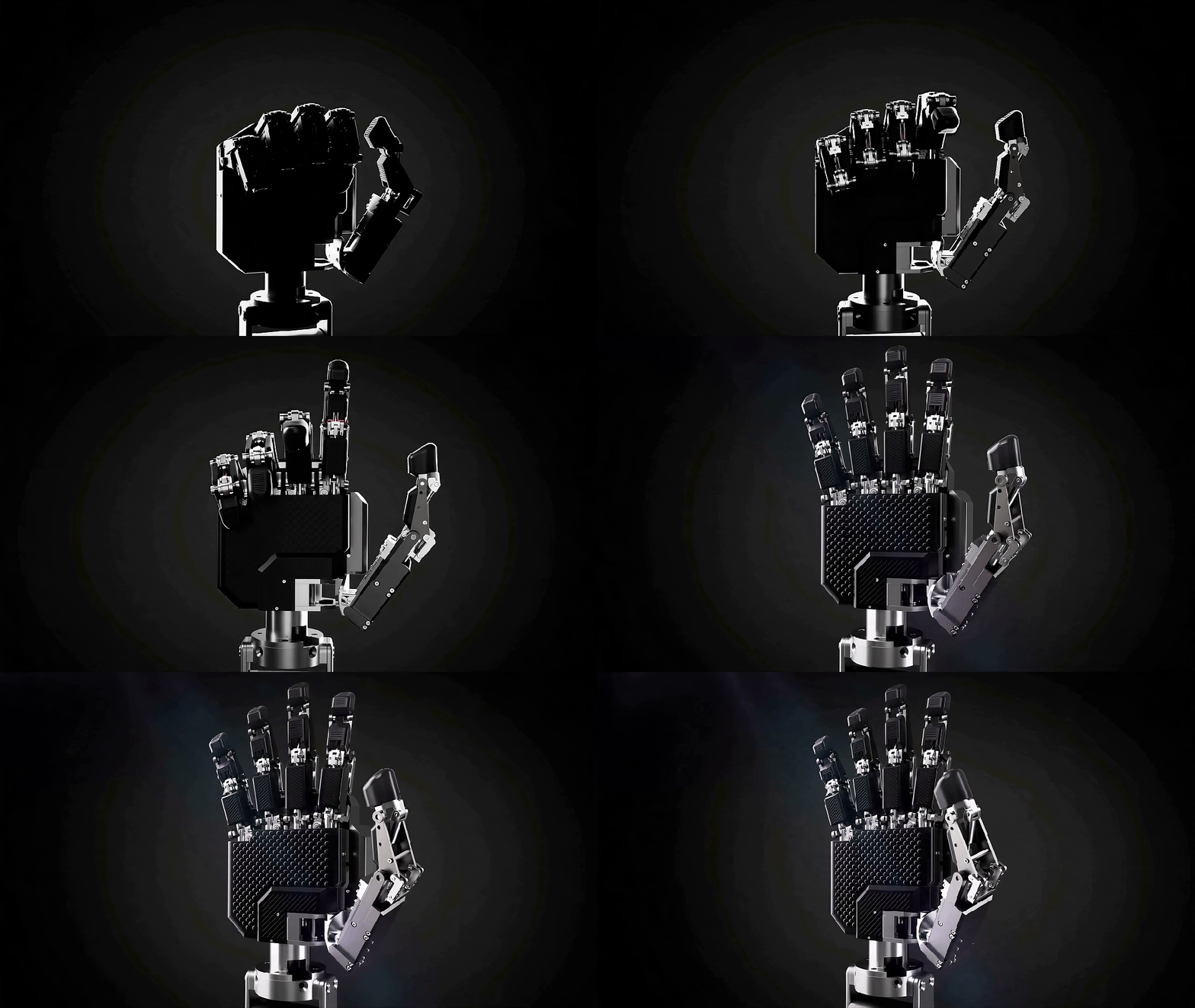
Based on this simulation system, the Torch Robot introduced the first industrial five-finger brushstroke product Torch Hand 1 Series. Its core mechanism innovation is known as the Torch-space brushstroke-brushstroke-brushstroke-brushstroke-brushstroke-brushstroke-brushstroke-brushstroke-brushstroke-brushstroke-brushstroke-brushstroke-brushstroke-brushstroke-brushstroke-brushstroke-brushstroke-brushstroke-brushstroke-brushstroke-brushstroke-brushstroke-brushstroke-brushstroke-brushstroke-brushstroke-brushstroke-brushstroke-brushstroke-brushstroke-brushstroke-brushstroke-brushstroke-brushstroke-brushstroke-brushstroke-brushstroke-brushstroke-brushstroke-brushstroke-brushstroke-stroke-brushstroke-stroke-brush-stroke-brush-stroke-stroke-stroke-stroke-stroke-brush-stroke-stroke-stroke-stroke-stroke-stroke-stroke-stroke-stroke-stroke-stroke-stroke-stroke-stroke-stroke-stroke-stroke-stroke-stroke-stroke-stroke-stroke-stroke-stroke-stroke-stroke-stroke-stroke-stroke-stroke-stroke-stroke-stroke-stroke-stroke-stroke-stroke-stroke-stroke-stroke-stroke-stroke-stroke-stroke-stroke-stroke-stroke-stroke-stroke-stroke-stroke-stroke-stroke-stroke-stroke-stroke-stroke-stroke-stroke-stroke-stroke-stroke-stroke-stroke-squequequeque design that was designed to be used to be used by the team to replic to replic that was designed to replicly

Modularity is another design consideration for industrial scenarios. The fingers and joints of the Torch Hand 1 use a standardized rapid disassembly structure, and if individual parts are damaged on the production line, they can be quickly replaced on site without having to be repaired manually at the plant, reducing downtime losses.
The second is the touch perception layer.
A high-density distributed multi-mode touch sensor array is installed throughout the abdomen. The array can analyze three-dimensional information, real-time feedback on the object's hardness, friction coefficients, and shape change, and the force grabbing can be adjusted in milliseconds. The sensor material has a high wear resistance, and can be adapted to a 7×24-hour continuous operation in a factory and oil and dirt dust environment.

More importantly, tactile signals are synchronized with the angles of the joints, and the visual image is synchronized in time sequence to form a complete multimodal interactive data stream. This provides structured perceptual material for subsequent industrial data collection and model training.
The third is dedicated controllers.
The robot itself has developed an industrial-grade handheld special controller that integrates motion drive, multi-modal touch pre-processing and local real-time reasoning. The controller can complete the closed loop operation independently at the edge, without relying on the high computing power of the machine, and has high-low temperature and anti-electromagnetic interference capabilities, and can be directly deployed in complex factory environments.
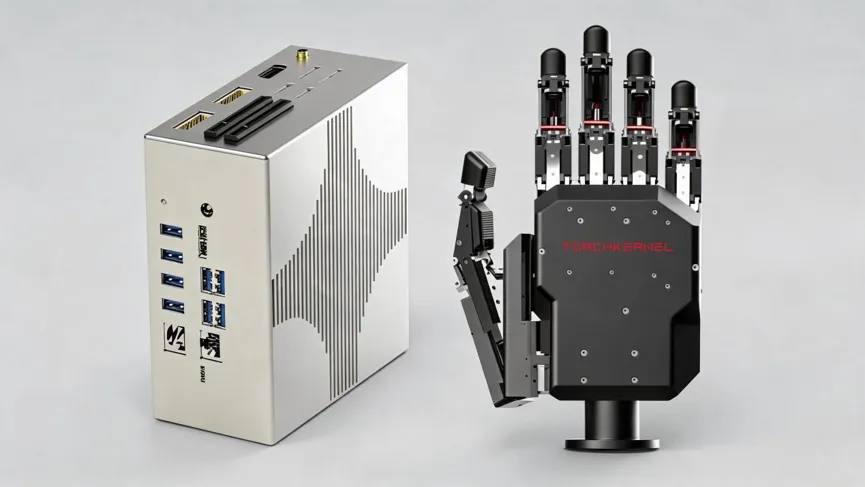
The three layers of organization, perception, and control have been passed through, and the chip robot has completed the entire installation of the hardware.
Aluminum production is the extraction of aluminum, replacing it with real data-driven models.
Hardware capability determines the execution limit of a skilled hand, while data quality determines the extent to which this limit can be implemented by the model.
There is a structural dilemma with the current data mining industry: there is a clear distortion of simulation data in mechanical feedback, and a large migration gap between Sim-to-Real (simulation to reality); remote-operated data mining, while real, is extremely low-efficiency, and costly.
The idea behind the robotics is to combine two into one.
It integrates multi-mode touch, joint position and visual synchronous collection modules, without the need for additional external tracking equipment. Through its self-developed convenient OS (with more than 50 built-in general industrial base operations libraries, including common procedures such as grabbing, unplugging, assembly, sorting), it can automatically record visual images, finger movement trajectories, full-area touch pressure distribution and material displacement, while completing normal production work.
The convenient OS is also equipped with a proprietary data engine that can automatically filter inefficient duplicate data, unify multi-modal data formats, and automatically classify workpiece materials, processes, and load types. When deployed in new scenarios, standardized actions can be directly replicated, with only the addition of differentiated interaction data, and the overall collection cycle can be compressed by more than 70%.
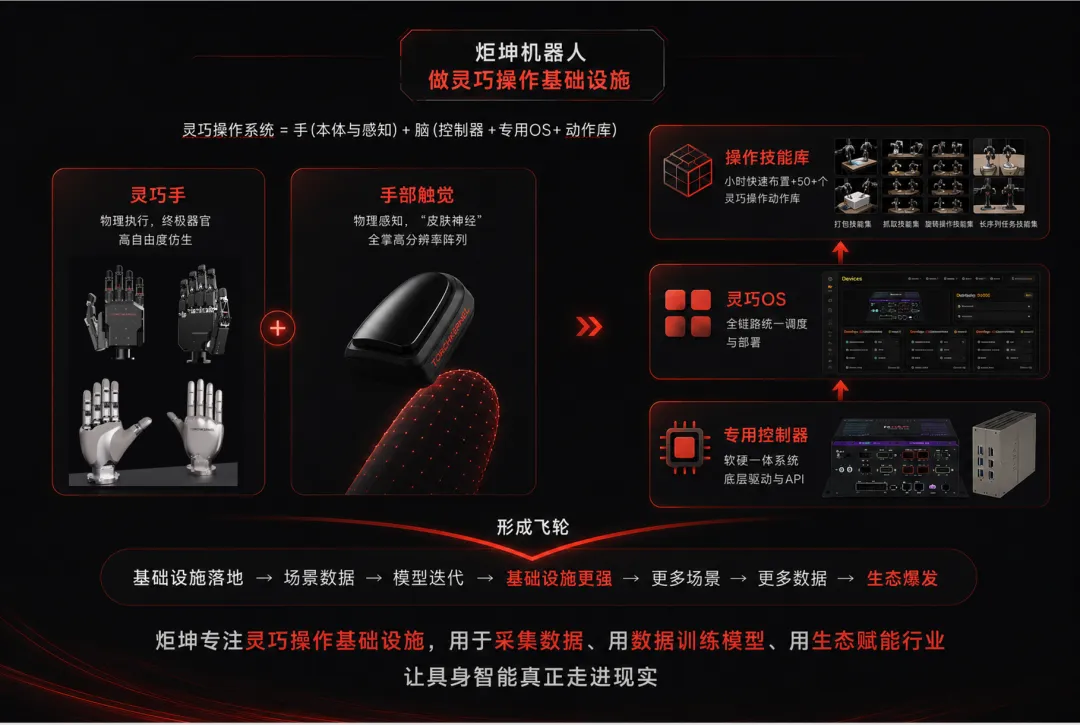
This constitutes a self-reinforcing data loop: the output line collects real industrial data→ input vertical industrial large models→ model optimization operation strategies and then sends them down to the controller→ robots to perform their tasks more optimally→ continuous collection of new state data. The more rich the data set, the higher the operation accuracy; the higher the operation accuracy, the more effective data can be collected.
For small and medium-sized manufacturing enterprises, this model reduces the barrier to independently building numerical laboratories, with only the dexterity of robots on existing flexible production lines to accumulate real industrial crawling and operation data sets in normal production.
At the model level, the robot chooses a different route from the general visual language large model. The training material for the general model is mainly based on household items and simulation scenes, lacks precise assembly, irregularly flexible materials, vertical data on the interaction of large loaded workpieces, and is largely lacking in real multi-modal touch inputs.
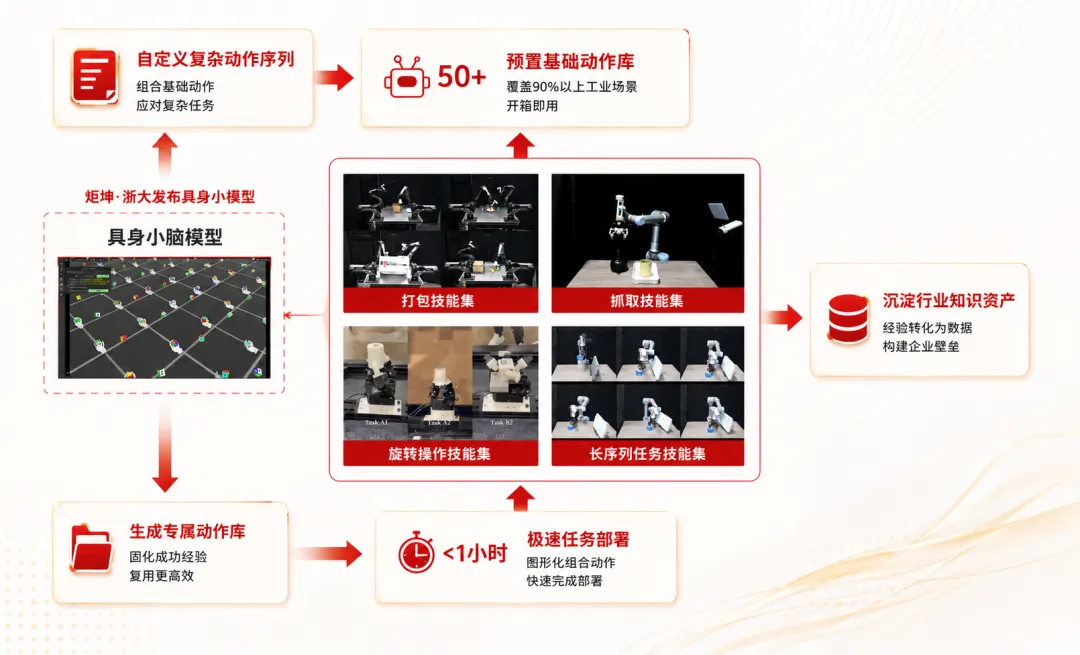
The training material for the industrial model of the silicon robot is all from real-world production lines, covering tens of thousands of different hardness, shape, weight and material industrial workpiece interaction samples in scenes such as 3C manufacturing, intelligent logistics, and precision processing. The model can understand the mechanical and tactile characteristics of different materials such as metals, plastics, glass, beams, bubbles, and so on at the raw level.
In actual deployments, production line workers can use natural language to achieve task instructions, industrial models can automatically dismantle process goals, match standardized action libraries, combine real-time multi-modal tactile feedback to plan hand movement trajectories, and are driven manually by controllers to complete tasks. This process does not require the writing of complex movement control codes, the deployment cycle of new processes can be shortened from a few months to a few days, and ordinary production line engineers can independently complete modeling.
In addition, the model is divided into a cloud deep training version and a lightweight reasoning version for local controllers. The factory does not need to purchase high-end computing servers, relies on supporting controllers to complete reasoning locally, and produces data from non-factory areas, taking into account data privacy and millisecond real-time response requirements.
The pace of commercialization from the laboratory to the production line
Established in June 2025, it relies on the talent and scientific resources of Zhejiang University, and its founding team has accumulated more research in the three areas of sophisticated institutional science, touch perception and operating planning.
In terms of commercialization, the pace of robotics is relatively tight, and many of the leading automakers have already expressed their intention to purchase, and some collaborative orders are underway.
In the application scenario, the applications of robotics are currently pursuing a three-pronged approach: high-difficulty precision processes in the industrial field focusing on small parts insertion, spatial workpiece sorting, flexible fiber sorting; service scenarios exploring soft security grappling in healthcare; and scientific research to provide a standardized verification platform for multi-body tactile and agile operating algorithms.
From institutional transmission, multi-modal touch, dedicated controllers, to operating systems, vertical large models, robotics chose a path of wider coverage, with higher technical difficulty. Whether this path can be followed depends on the speed of subsequent product conversion, customer delivery quality and cost control capabilities. But at least in terms of the integrity of the technical architecture, it provides a systemic way of thinking that is different from single-point improvement for the handsome to enter the industrial product line.
In 2026, the human-like robot industry is in the transition from walking, talking, and talking robots to sensing, fine-tuning, and energy-producing robots. If human-like robots' attempts can be verified in more industrial scenarios, the one-year-old company may be able to occupy a worthwhile position at the level of intelligent operating infrastructure.
 —END—
 Recent Activities
KELDA's net profit grew more than 10 times in the first half of the year, and China's largest shipping company is launching a four-legged autonomous mobile welding robot.