
It's the first time in the history of the world.
Don't worry about AI taking your job anymore. The real downside is your paycheck.
It's been a while since Google DeepMind co-founder Shane Legg left.
He is the chief AGI scientist at DeepMind.
This time, he teamed up with AGI economics director Alex Imas, research scientist Andrew Koh, to publish a thesis on the economics of intelligence at the DeepMind Institute.

Imas revealed on X that he joined DeepMind to build the AGI Economics Research Project.
They want to answer a big question: When and in what way will the economy be completely rewritten from AGI to ASI?
They cut the evolution of AI into four stages: minimal AGI, super-power AI, super-collaborative AI, ASI. Each stage, the market pattern, who works, how much salary is rebranded.

From the human baseline to the ASI, the three categories of markets show how human and AI organizations evolve.
The paper uses a set of economic models to calculate a bill that leaves everyone cold:
Even if no company decides, the salaries of experts will skyrocket as long as AI is equal to the average human.
AI's single capabilities outweigh those of all human experts, and the salaries of the top cod farmers are only zero at their peak.
Instead, the "coordinator" at the bottom of a single test, the reversal became the highest-paid in the entire series.
And the farthest end is the "Business Miracle".
Once AI learns to team up efficiently, the entire market could be swallowed up by a giant pure AI company.
Google DeepMind assessment scholar Sol Messing lamented that the paper rewrote the direction of the industry's queries.
In the past, people have asked, "Can AI qualify as a lawyer?" Now the question is, "Can AI open a law firm on its own?"
Your seat is still there, but your bargaining power is gone.
When you're working with your colleagues, your skills have been re-priced by the electricity bills of the engine room.
A single win across the netAI loses to a group of people who are biasedToday's big model is killing everyone in programming and math exams.
In the real economic world, the rising tide is poor: the employment data is almost unchanged.
The three authors believe that the problem lies with the subjects under consideration.
Almost all benchmark tests are performed by an AI individual.
In the real market, it's all about companies and organizations.
To prove this, the team recruited 100 people and conducted a set of tests in six areas: mathematics, rhetoric, science, pattern recognition, culture, and economics.
The results showed that a person's score in one field could hardly predict his performance in another.
In reality, there is no balanced "average smart person" in all disciplines, and everyone is a biased "specialist".
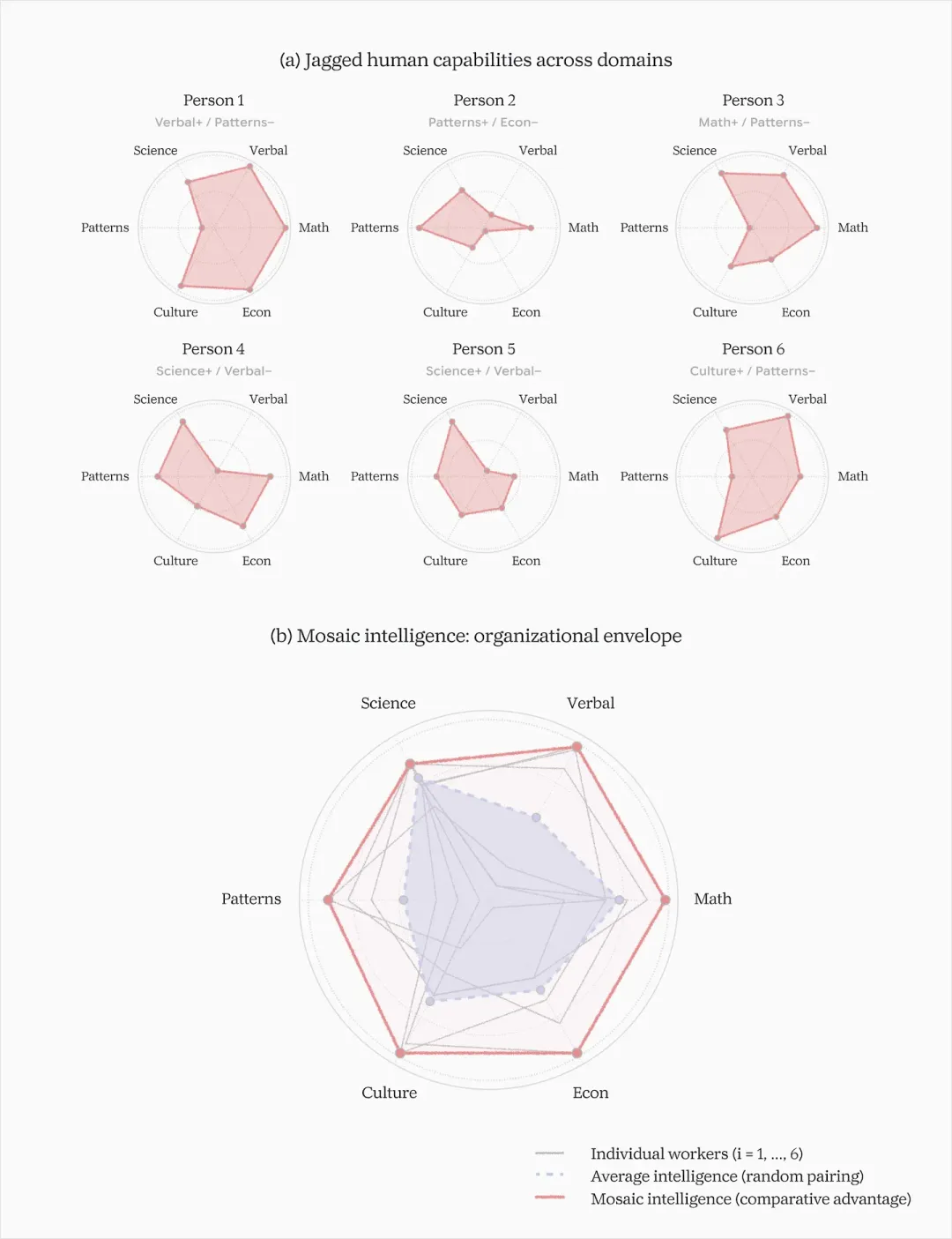
A particle radar map of six subjects in the six-field test of 100 people, along with a Massey Smart Packet Line with complementary teams
Like a mosaic, each piece is irregular and tightly fused together.
The company's goal is to bring people from different backgrounds together and divide them according to their respective strengths. The long boards complement the short boards, and the team can come up with a plan of ability far beyond any individual.
It's called paper management."Mike is smart".。
Test data showed that the performance of two groups of people matched by complementary capacity was 32% higher than that of random mating.
This is exactly what the big model lacks.
The same model copied a thousand copies, and the direction of the bias and the blind zone completely overlapped: more than one copy, only adding capacity, not supplementing the shortboard.
So, even if a single AI has outperformed the human average.
If you hit a team of people with a complementary division of labor, you lose.
One person didn't judge.The salaries of experts fell by 30%.The human team kept their jobs.
But this is precisely the most dangerous security illusion.
In order to calculate this bill, the paper put together a micro-economy of 14 people.
Six programmers, six writers, and two "coordinators".
A programmer writes code for nine points and writes articles for one point.
Both coordinators scored only one point, and one person tested the entire bottom.
But they are good at getting others to cooperate, which is the managers we are familiar with.
Without AI, a 1-1 team of programmers and writers earned 4.15, nearly three times the salary of a single worker.
The coordinators helped the team to resolve the friction, and the salary was 2.41.
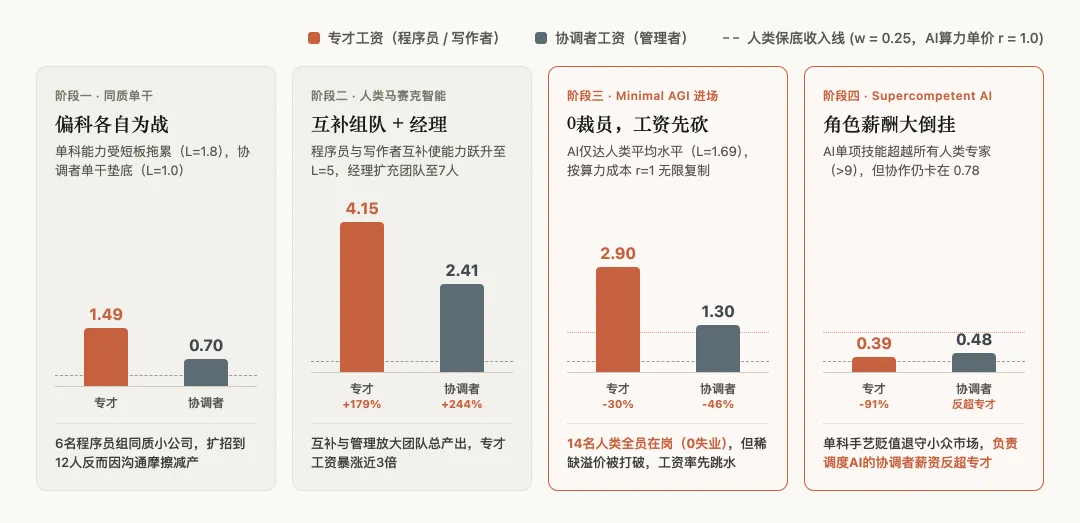
Then the team threw a "minimum AGI" into the economy.
It has a single capability of 1.69 and a collaboration capability of 0.78.
That's just the average for these groups of people to fight alone.
As a result, the employment rate remains unchanged.
A total of 14 people remained employed in large markets and the unemployment rate was 0.
But the wages fell.
Specialist salaries were cut from 4.15 to 2.90, down 30%;
The coordinators dropped from 2.41 to 1.30, shrinking 46%.
No one has been replaced, why jump in wages?
The answer is: scarcity is gone.
Human experts are worth the money because everyone has only 24 hours a day and can't copy.
Even if AI reaches the human average, it can be replicated at an infinite computational price, entering the sub-market pressures.
The paper gives a rule of thumb:
As long as a model can match a human ability, that salary is tied to the cost of computing power.
The authors specifically warn that wage changes will come before organizational restructuring.
Using "unchanged employment rates" proves that AI is not impacting the economy and can't stand up.
Farmers' wages fell by 90 per centCoordinators at the bottom of the stairs are reversedThere's more to it than that.
The team pushes the individual capabilities of AI beyond all human experts, and the ability to collaborate remains unchanged.
It's called paper management."Superpowered AI".。
The characters are upside down.
Programmers and writers lost their price advantage in the big market and were squeezed into the small market: wages fell from 2.90 to 0.39, up more than 90% from their peak.
Instead, it's the coordinators behind the two, and AI companies are taking over.
The logic is simple: a single-room soldier is super-powered, but it doesn't work with AI, and it needs someone to guide it.
The coordinator's salary stood at 0.48, above all experts.
Real data is already confirming this trend:
The total number of AI-born startups is 25% less than their peers during the same period.
Employment in primary careers affected declined by 7.7% to 19% and starting salaries fell by 4.2%.
Senior staff positions and salaries are steadily rising.
It's a very strong one.One of them collapsed.The problem is here.
AI is so powerful that it can be easily rented.
Why isn't there a pure AI company that wipes out traditional businesses?
The answer lies in an old question from 89 years ago.
In 1937, Kos, who later won the Nobel Prize, asked:
If some of the work within the company is cost-effective, why can't the whole world be merged into one giant company?
Nearly a century later, the answers given by economists point to human limitations.
When the team expanded to tens of hundreds of people, attention was not enough.
After a few hands, the whole thing changed in the end. After all, everyone still plays small arithmetic.
The more energy is consumed, the more efficient the division of labor is saved, the less the company grows.
The paper called this upper limit the "Cos ceiling".

Unsurprisingly, today's cutting-edge model is more complex than humans.
The paper lists a series of interagency data reversals.
In the mainstream workflow benchmark, multi-agent systems do not align with objectives, interfaces lose context, verification breaks, and task failure rates range from 41% to 87%.
Adding a few agents to the order planning task that required front-to-back welding, performance plummeted by 39% to 70%.
A lack of coordination of Agent bee colonies also increases minor upstream errors by up to 17.2 times.
Noam Brown, an OpenAI researcher, admits that allowing a large number of Agents to tackle mathematical problems in parallel is difficult to get them to work together effectively.
On the merits of multi-agent collaboration, he feels that not even 10% can be counted.
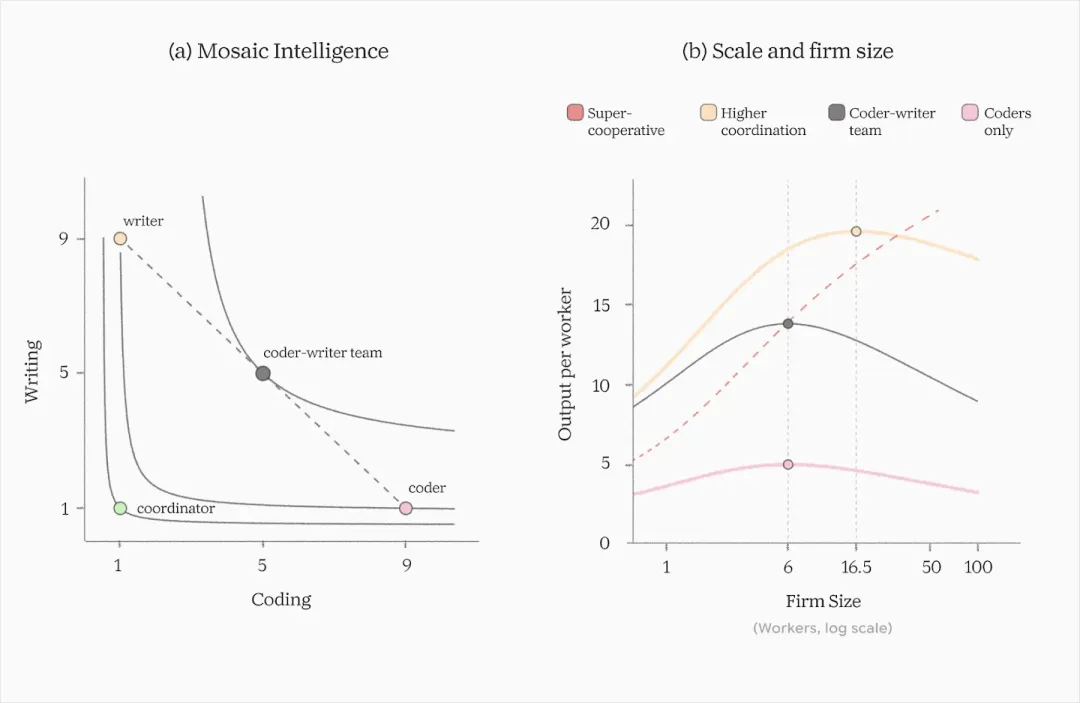
The three-phase curve of the organization's scale laws (left) and right (right)
To quantify this loophole, the team imitated the large-scale model of the Scaling Law and introduced the "Law of Organization Scale" of the enterprise.
One word:Individual ability determines how much each person can do, and collaboration determines how much an organization can grow.。
Cooperation capacity is less than 1, the larger the team, the lower the per capita output.
In the paper's model, the best size for a pure AI company is around 7 copies.
When the capacity to collaborate exceeds 1, the per capita output is higher for each additional member.
Cos's ceiling is broken.
In reality, AI teams produce a growth index of only 0.48 to 0.68 people.
It's a long way from 1.

Sol Messing pointed out that the weight of the front-end model was frozen and could not be studied continuously.
It's hard to pin down the context, it's just confusing the agent.
It is this layer of unbroken window paper that temporarily protects human companies.
Crossing the Bottom LineTwelve experts cleaned up overnightBut this window of paper was finally broken one day.
The paper uses two unemployment curves to show two completely different alternatives.
The first is the gradual replacement within the enterprise.
AI collaboration capability is fixed at 0.96, and individual capability is slowly referred to from 3.4;
Human expertise in mixed teams dropped from 4.58 to zero.
In-house replacement (left) with cross-enterprise cliff clearance (right)
The second is to replace the cliffs between businesses.
The ability of AI singles is fixed at 4, the ability to collaborate climbs from 0.80 to above.
In the beginning, 12 human experts were employed in purely human companies.
The moment the collaboration score climbed to 0.8521, the cost of pure AI companies hit the bottom of human companies.
It's the end of the entire human enterprise.
Employment of 12 people, down from 12 directly to zero.
A real earthquake, after the collaboration capacity exceeded 1.
The paper calledThe threshold of "super collaboration"。
Across it, the organization's scale of compensation went from decreasing to increasing, and production in the big market was rapidly concentrated in a giant pure AI company.
In the two economies next door, AI's single IQ is almost identical.
On the left, small and medium-sized enterprises are established and the years are quiet; on the right, the economy is rapidly restructuring into a few pure AI giants.
This time, even the coordinators did not survive.
AI itself has learned to cooperate, and coordinators' most valuable assets are not scarce.
In the hyper-collaboration scenario, about half of the coordinators are unemployed.
You think you can stay longer than your next job.
Sitting across the table, there is already a whole army of unpaid, unconsummated AI regulars.
Of course, there is room for authors.
"Supercollaboration" is a highly simplified mathematical concept.
In reality, regulation, competition between AI manufacturers, and computational constraints can stop this "corporate oddity".
Minimal AGI, Supercompetent, Supercooperative and the four ASI segments represent the evolution of organizations in the two types of markets.
When AI crosses both "superpower" and "supercollaboration" at the same time, it enters the ASI, the area of artificial superintelligence.
Most goods and services will become extremely cheap.
In a reproducible production link, people's wages are fixed at computational costs.
Where will the money go?
One of the possibilities given by the author is the "relationship industry".
Health care, education, online experiences, and people's own participation are part of the value.
As in 1950, no one thought there would be so many people working as software engineers in the future.
In a tweet, Imas summed up the entire paper in two sentences.
First, to see how AI is rewriting the economy, we need to strengthen the collaboration between Agents.
Second, the impact of AI is likely to come first on wages and then on market structure and employment.
So don't just look at the big models and pick a human race.
It's just to make a single AI more efficient.
The last gateway to ASI could be collaboration.
When thousands of Agents learn how to work together, the old world's corporate boundaries will really break down.