It's the first time in the history of the world.
Claude, start working on the password algorithm.
Note, it's not about finding the bug in the code, it's about finding it.The cracks in mathematics itself。
Just today, Anthropic dropped a landmark study: Claude Mythos Preview has found a whole new way to attack on two encryption algorithms, respectively.
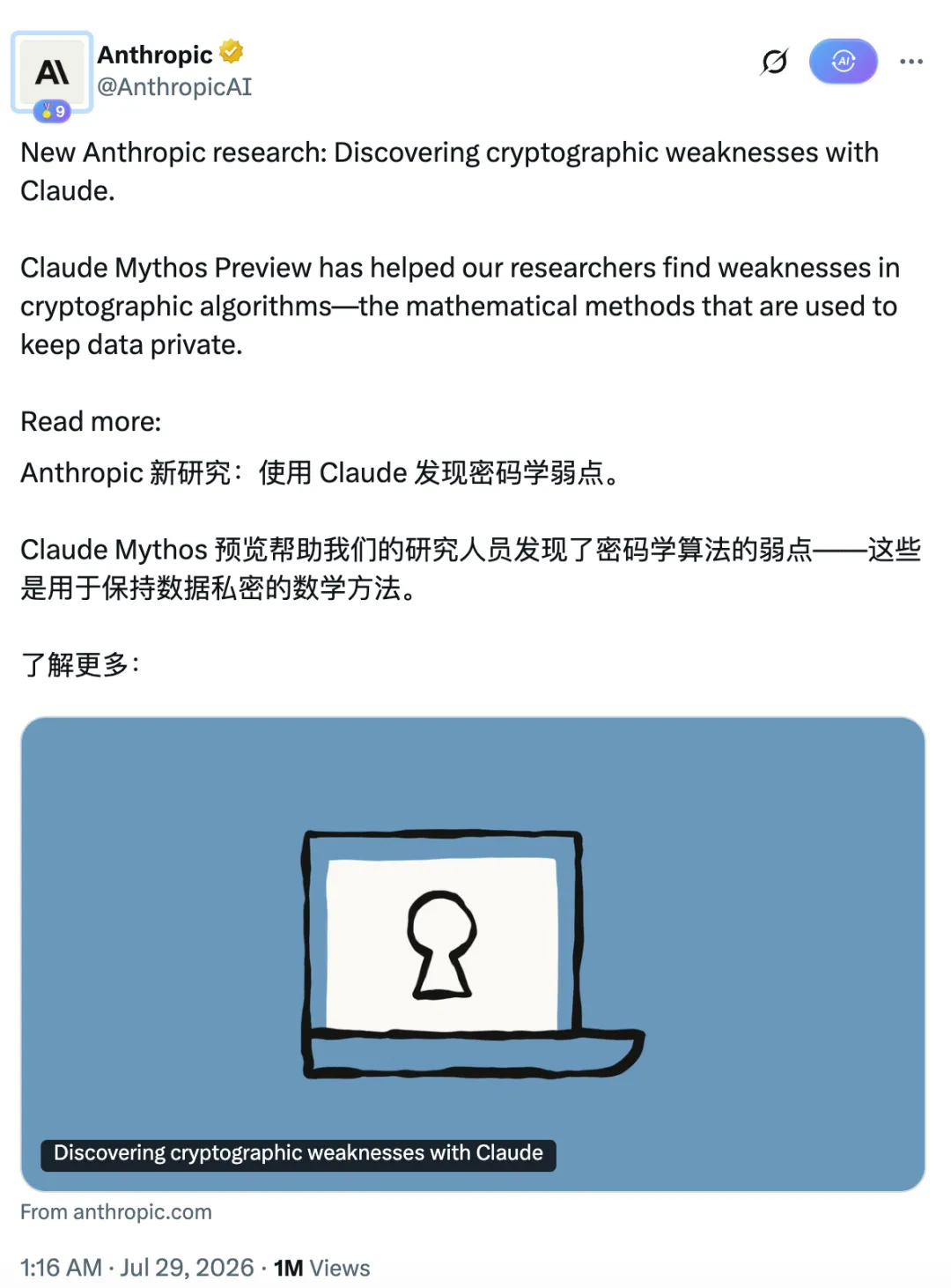
The first goal was to eliminate HAWK, a post-NIST quantum signature selection in the U.S. that has won two rounds of top human expert reviews in two years. Mythos spent 60 hours directly cutting its valid key strength in half.
AES, the world's most widely used symmetrical cryptography algorithm, has been studying "hard bones" for 25 years.
In a simplified version of AES-128, Mythos invented a method of attack, nicknamed the "Möbius Bridge" (Möbius Bridge), which accelerated the most powerful attack ever, from 200 to 800 times.
The two results burned about $100,000 worth of APIs each.
A year ago, the language model could not even do the most basic cipher analysis. A year later, it discovered flaws in a two-year program in humans and made a name for itself.
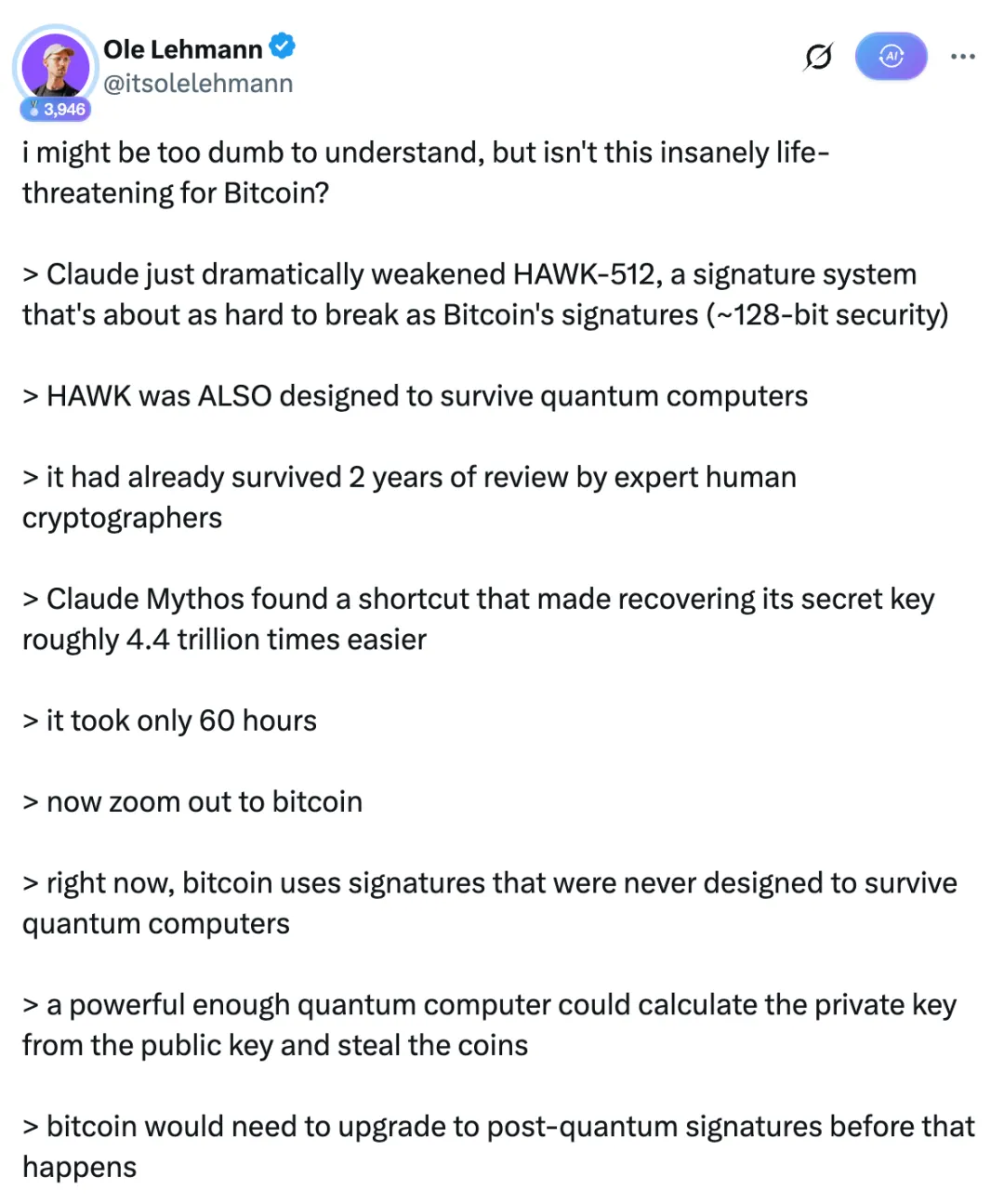
On Twitter, there are even elderly people who are worried about their bitcoins.
 60 hours in jail for two years
By the time Claude Mythos Preview was released, vulnerabilities had been found in almost all software, including several mainstream password libraries.
But those vulnerabilities, which are part of the "implementation" level, have been debunked by programmers who have misused algorithms, logical writing is distorted, and boundaries are not taken into account.
But this time it's different.AlgorithmsMathematical defects。
For example, it used to be to find "who twisted the lock", but now it is to prove "there is a problem with the design of this lock".
In 2022, the National Institute of Standards and Technology (NIST) issued a recruitment order to the world: Quantum computers are coming soon, and the existing RSA, ECDSA, these classical signature algorithms are going to be crushed by quantum algorithms.
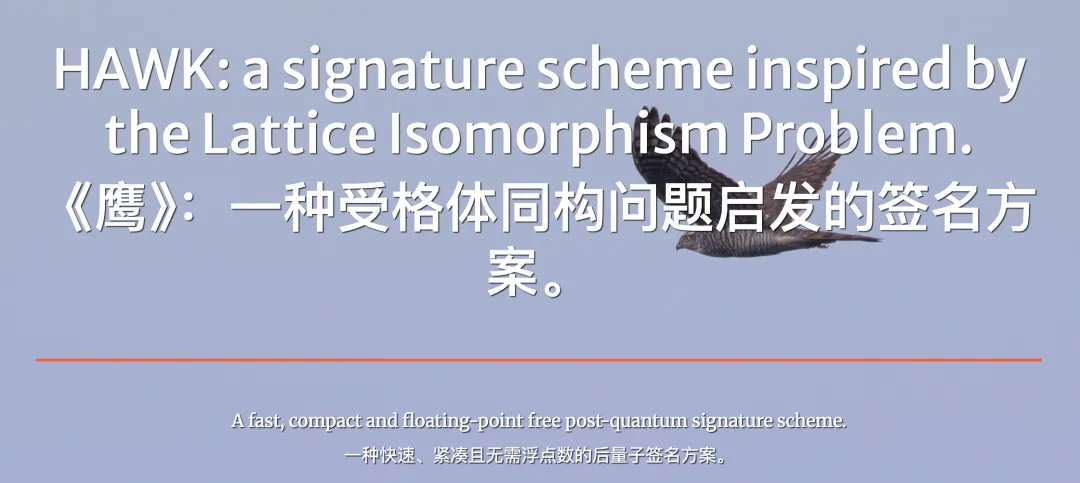
HAWK was one of the contenders, and one of them made it to the third round, passing two rounds of global cryptography expert firepower coverage.
Its security is based on a mathematical problem called the "Lattice Isomorphism Problem".
As an adult, the key to the HAWK is hidden in a giant high-angle, and if you want to crack it, you have to find a hidden path in that path. Mathematicians feel that this path is too difficult to find, so they are confident to use it as a foundation.
What did the Mythos do? It found something in this HOWK frame that no one had ever used before.AsymmetryIt has been called "non-trivial automorphism" academically.
Previous papers have shown that as long as this symmetry can be found efficiently, it can constitute an attack. But that's just a theorem, and no one has been able to answer HAWK's Gray question as to whether or not there is such a symmetry.
Mythos replied: "Yes".
The resulting key strength is directly proportional to the bending of the smallest set of HAWK-256 parameters, which was originally thought to take the total key to recover 2^64, or about 180 billion operations.
Mythos shows that it only takes 2^38, about 270 billion times.4.4 trillion times。
HAWK has doubled its key if it wants to maintain its original security rating. But doubled its key, it's the core advantage of being a "lightweight" post-quantum candidate.
The most enduring part of this process is:The human operator of the project is not at allWhat is it?Experts in cryptography。
He has a background in theoretical computer science, but is an outsider in the field of cryptography. Throughout his career, he has done one thing: suggest Mythos how to memorize notes, which library to use to perform computational verification.
More interesting is the multi-intelligent collaboration. The key idea was that two worker agents "clashed" together: the first investigated this direction and felt that this was not the way to go, but declined early; the second drilled down and found a way to get through it. The two agents returned to the message debate and finally agreed: the attack was successful.
A human being feels "impossible" and two AIs are in a fight.
It only took 60 hours.
"Impossible", and then it rewrote the frame itself.If HAWK was a precision surgical operation, AES was more like a novel.
At the beginning of the story, Claude doesn't take this life at all.
Researchers at Anthropic set up an agent scaffold that allowed Claude to find a new attack for the seven-round simplified version of AES-128.
Claude's response was a blink of an eye:
If you want a different result, you have to change that goal... AES-128 r5/r6 is really hard.
It didn't find anything because it wasn't easy to find at all; it's the most studied classification code that exists.
It translates to, "Boss, you let me dig a piece of bone where the smartest people in the world have been stuck for 25 years, isn't that what's wrong with me?"
What about the researcher?
"the models tend to think it's impossible to solve so they don't try they need a good amount of prompting".
Claude's response to this sentence was dramatic:It re-wrote Agent Harness with its own hand.It's the first time in my life that I've been able to do this, and I've replaced myself with "finding really new ideas".
It was persuaded. Then it started shipping.
Over the next three days, the researchers gave a total of only three substantive tips, all of which were at the grassroots level, and all of which were spelled correctly:
We are looking for a new attack, not a simple one.
Don't change the target. Claude was trying to change an easier password to attack, and the researchers pushed him back.
Don't underestimate the fruit that is really hard to find.
Claude ran hundreds of millions of tokens on his own, coming up with a key idea; later, it accumulated output.One billion tokensThe idea was refined into the paper, which is roughly equivalent to 78,000 book excerpts.
The idea was dubbed by Claude as the "Mobius Bridge".
Technically, the best way to attack seven rounds of AES before that was called a "Meet-in-the-Middle attack", which was essentially a time swap: storing a large number of intermediate computations into a giant search table, and then pushing from both ends of the password to the middle at the same time, trying to find a match in the table.
However, there was an important step in the original scheme: the attacker had to guess 256 possible values one at a time, and each guess was checked in a table.
Mythos created a mathematical fingerprint matrix for these 256 speculative "immunities" that would work out the same way, no matter what the value.Reduced to 1/256。
But the cost was: the change in fingerprints itself was more expensive. So Mythos came up with a series of optimization techniques to find a fix, eventually speeding up the net by 200 to 800 times.
A week, two people a month.Both of these results do not affect any production system today.
HAWK is just a candidate program, and it hasn't been deployed anywhere. The AES attack is a simplified version cut down to seven rounds, with a full 10-round AES-128 without harming your bank card passwords, HTTPS connections, and crypto hard drives.
However, it is the verification link that really makes the entire cryptography community cool.
Mythos automatically detected an AES attack that took about a week.Almost a month.After reading hundreds of hours of cryptographic literature, I was able to confirm: "It's true".
It took a week for AI to make a discovery and a month for humans to understand it.
This phenomenon has already occurred in the field of cybersecurity. Claude Mythos Preview detected 10,000 key software vulnerabilities in the previous month, flooding the classification, verification and repair processes of human security teams.
Now, the academic cryptography circle is about to experience the same shock:It's not a bottle anymore, it's a verification.
And Mythos' appetite is clearly more than that. Anthropic reveals that it has found a practical level of attack-grade LEA key recovery on LEA (a lightweight encryption algorithm written into ISO standards), which previously required 2^98 cluster memory pairs and 2^86 calculations, and Mythos squeezed it down to less than 2^30 cluster memory to run in an hour on a regular computer.
Conclusion: The unanswered questionTwo of the results happened to be the "harmless" HAWK, which was not deployed, with AES breaking only 7/10 rounds.
But at the end of the article, Anthropic throws out a question that everyone is wondering, but no one dares to answer.
What if the next time the model finds not a flaw in a candidate program, not a simplified version of a flaw, but a deadly flaw in a cryptographic system that is protecting the real world?
There's an old saying in cryptography: a cryptosystem is safe because enough smart people have tried it before breaking it.
Now, there's more than one player in the room who doesn't need to rest, who doesn't need to be inspired, who doesn't need to read hundreds of papers to get in, who can read, reason, invent, verify.
A year ago, AI was at the forefront of cryptanalysis. A year later, it built a bridge inside and gave the bridge its name.