It's the first time in the history of the world.
From long-horizon intelligence to recursive self-improvement: from "What can AI do?" to the question "Can AI improve AI?"
AI writing a piece of code is already a familiar way of working. If you change the task to "help me make a better AI", can it be done?
This means that AI has to come up with a plan, modify the code, run experiments, judge results, and leave behind effective improvements. The most tempting prospect is that this round of system strengthening will help the next round do better.
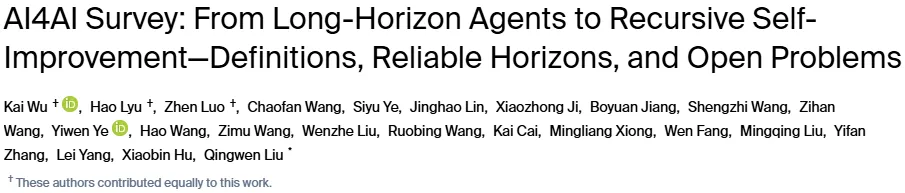
Around this issue, the first AI4AI review paper examined hundreds of studies, putting long horizon intelligence, AI4AI and recursive self-improvement into the same research map.
This is the first time I've seen this.
This is my first post on the blog.
Harness(RSIHub):
The main findings of this review are:AIWhile many R&D projects have been undertaken under clear goals and evaluation rules, improving individual capabilities does not guarantee the reliability of the entire R&D process, nor does it prove that the system can continuously improve itself.
The gap between "taking a step" and "doing it all" is summarized in the paper as:Composition gap (composition gap)For those who want to accelerate AI research and development, finding out where this gap is can determine how the next step should be to improve models, tools, memory, or test results.
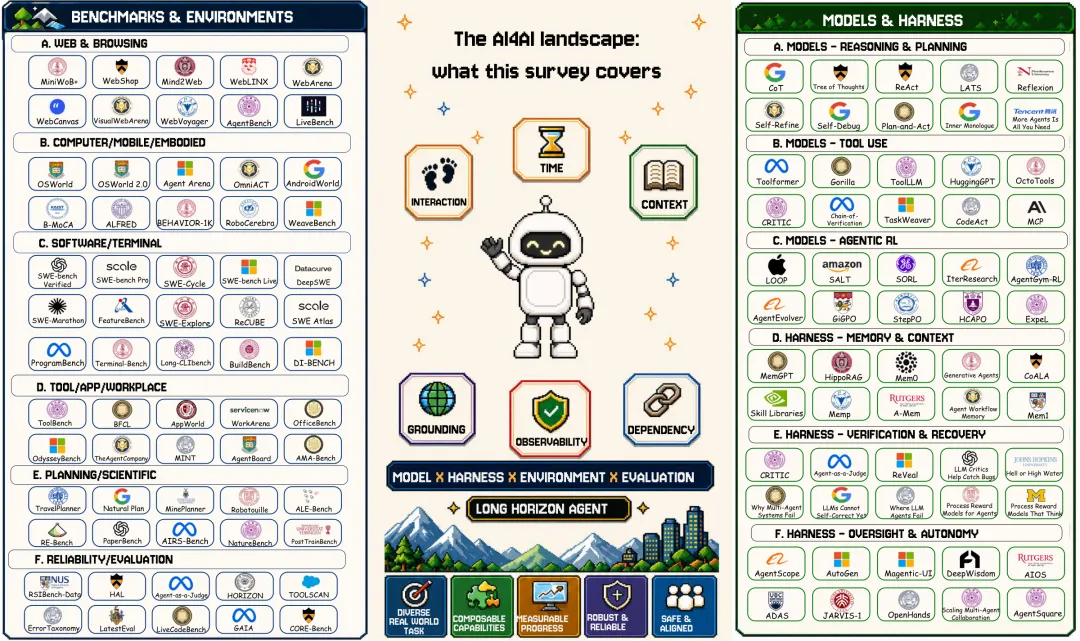
From "tools to be used" to "complete AI research and development", what skills are needed in between?
Why we started talking about AI and improving AI
AI4AI is an abbreviation of AI for AI, which can be understood as "AI helps develop better AI". It can improve many things: training data, models themselves, operating tools, evaluation methods, and even R&D processes.
If this could be done reliably, researchers would have the opportunity to release some of their energy from repeated implementation, trial and error to test new ideas more quickly. The question arises: Does AI do the job, and does it mean it makes the right research judgments?
As an example of optimizing training processes, AI can modify data processing codes and start training again. However, the indicators are stifled, and may come from effective improvements, changes in comparative conditions, or models over-adapted to a set of tests.It looks like it's "finished", it's proof that it's better, and it's verified next to it.
AI optimizes an independent model, belonging to AI4AI; when it modifies its own components, it involves self-improvement. Moving further towards recursive self-improvement (retrograde self-improvement) also requires that the "process of building the next generation of systems" itself can be improved and checked to see if the benefits can be passed on to subsequent versions.
These concepts help us to understand what the system has changed and what the results prove.
This is a review of how to organize research
The paper will combine research in the areas of intelligent organisms, AI development and automation and self-improvement, while examining two types of tests: the ability to independently test, retrieve, program, and call tools; and the completeness of research and development tasks such as engineering, optimization, and paper reproduction.
When reading each work, review five questions: what is the object of improvement, whether it changes to itself, who controls the goal and the various links, how to judge success, and whether improvement can be retained and migrated.
As a result, three easy-to-confuse problems are separated:How difficult is the task?AIHow much decision-making power there is, how much evidence is being improved.Running time does not necessarily represent the difficulty of the task; all the steps are executed automatically and do not necessarily represent the goals and judgement criteria determined by AI.
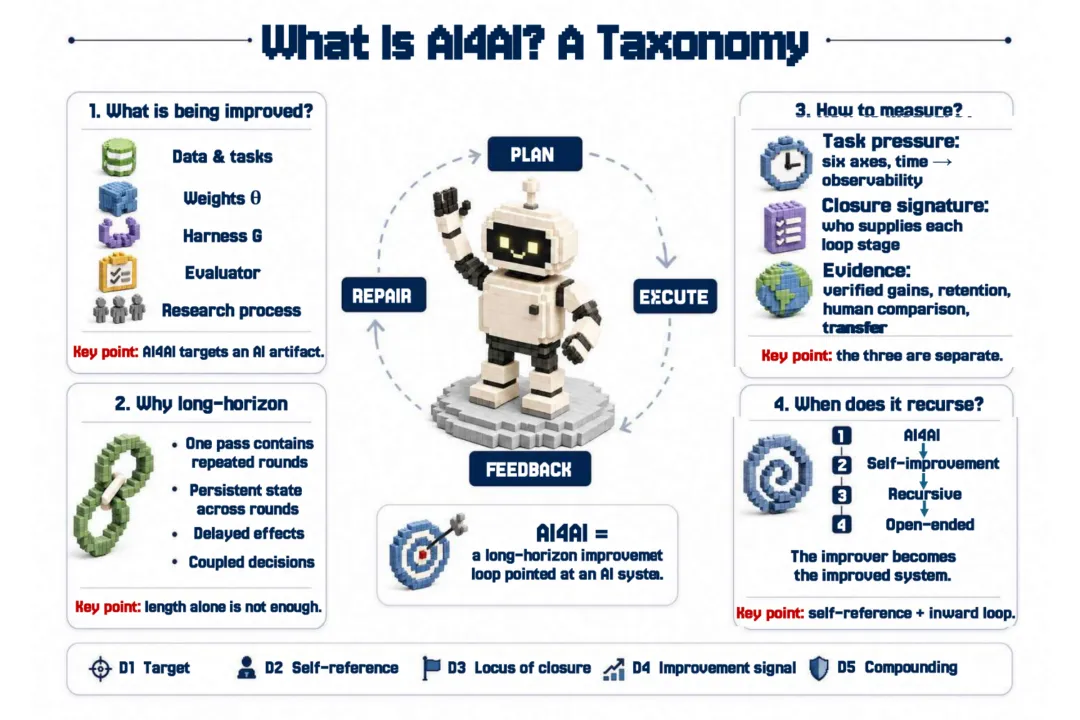
FIGURE 2 AI improvements must undergo planning, execution, feedback and repair at once. Evaluation also requires a separate judgment: who has changed, who makes decisions, and why the results can be trusted.
Discovering one: every step of the way, connecting can still fail.An AI development may begin by looking at the data, after proposing assumptions, modifying code, running experiments, and finally drawing conclusions. These steps need to share the same goal and use evidence generated by each other.
Problems often arise at the intersection. For example, the code has been updated and the analysis uses a previous round of logs; experimental indicators appear to have improved, while the control group in the report adopts a different configuration.
This is the important implication of the composition gap: individual achievements in retrieval, programming, and tool calling cannot be directly considered as proof of complete R&D capability.
The review emphasizes that the key to the long horizon is that the first step will affect the next one. An early choice may change the actions that can be taken subsequently, and an error may not be exposed until after the end of the training. The system needs to remember the critical state, understand from which attempt the feedback comes, and then plan to correct it accordingly.
So it's not enough to judge how long the tool has been running, how many times it's been called.Will it be able to rely on each other in a step-by-step manner and keep the goals, versions and evidence consistent when the results are delayed?
For developers, if a single test is passed and the entire process still fails, it's worth checking which key information is lost in the first transmission, rather than just continuing to improve the single score.
Discovering Two: Will execute, not master the entire research processOverview observed that AI is taking on more planning, programming, experimentation, and repair work, but humans are usually still deciding the research goals, evaluation criteria, and what outcomes can be accepted.
This distinction is important. The ability of a system to optimize an indicator according to established rules is not the same as allowing it to independently judge which problems are worth studying, which evidence is sufficient to support the conclusions, or what is needed.
To allow AI to take on a more complete process, the paper focuses on improvements from both sides. On the one hand, models: learn to plan, use tools correctly, and learn from longer action processes and feedback.HarnessTools, memory, execution, and inspection mechanisms for organizing the workings of the intelligent body.
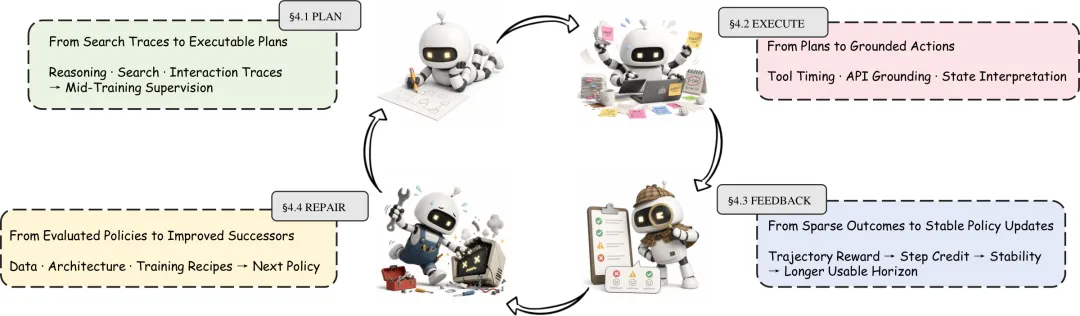
Figure 3 - Pathways to improvement on the model side: allowing systems to learn to plan, implement plans into action, and then use feedback to improve follow-up strategies.
Harness can be understood as a supporting facility for the research site: keeping experimental records, verifying execution results, recovering when faced with problems, determining when to stop or ask people to process it.
This also affects how we read evaluation results. The same model, a new set of tools, increasing the number of re-tests or allowing more artificial help, the results can change. Comparison should explain the budget, tools, methods of evaluation and conditions of artificial intervention in order to know where improvement comes from.
Discover three: how far away is the distance from one point to another?When a system reports "successful improvements", the most intuitive evidence is that the indicator has improved.
Have you really improved?Measured Gain: Is the actual gain measured on the indicator declared?
Do you think it's worth it?Retention: Will the benefits still be there after continuing to mutate?
How is it compared to humans?Human Comparison: How did it perform in a relatively short time and on a calculated budget?
Is another mission still working?Held-out Transfer: Are the gains still valid for the tasks, models or domains used when leaving the optimization?
These four types of evidence are not interchangeable. A system that can be improved on a test does not prove that it can retain gains or migrate to a new task.
Why do more rounds not necessarily get better? Because the system may forget the early constraints and gradually deviate from the goal; or it may become better at catering to the ratings but not solving the real problem.
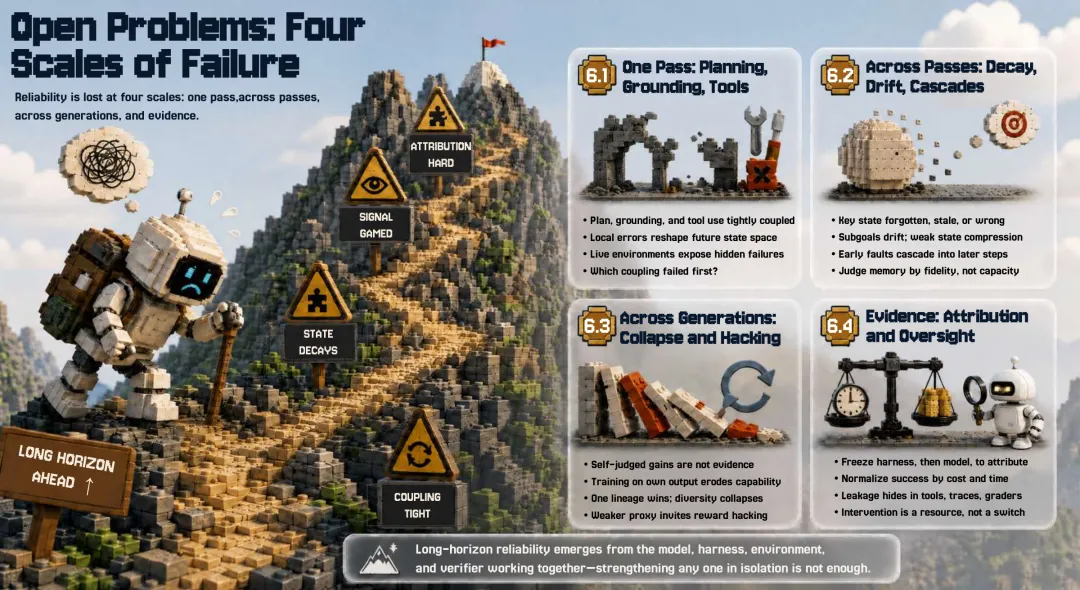
Figure 4 errors accumulate at different stages: operation errors in a single attempt, loss of state between multiple attempts, and degradation in subsequent versions.
Therefore, in order to support the stronger recursive self-improvement claim, it is necessary to keep track of subsequent versions, continue verification under clear and comparable conditions, confirm that improvements are retained, and indeed help the next generation continue to progress.
Where can the future be used?
From a comprehensive coverage perspective, AI4AI's application space includes machine learning engineering, training process optimization, computational efficiency optimization, and the replication and validation of research work. All of these include the process of repeatedly proposing, executing, checking, and repairing projects.
For the research team, a valuable direction is to make it clear that AI is taking on goals, that the results are verifiable, and that research and development links are maintained, while keeping traceable experimental records. This makes it easier to use automation to determine which tasks are reliable and which still require human involvement.
For the Intelligent Development Team, the review offers a set of positioning questions: will the model fail, will the information be transmitted incorrectly, will the evaluation mechanism be unreliable, or will effective improvements not be maintained?
The further prospect is for the system to not only complete one improvement, but to pass on verified experience and gains to the next generation. But according to the evidence of this comprehensive rationale, reliable research judgments, durable and transferable gains, and interdisciplinary improvements still need to be fully verified.
Can AI improve AI?
Existing research has confirmed that there are limits to how AI can help improve AI under clear conditions.
The next challenge is to make every credible improvement the starting point for the next step.