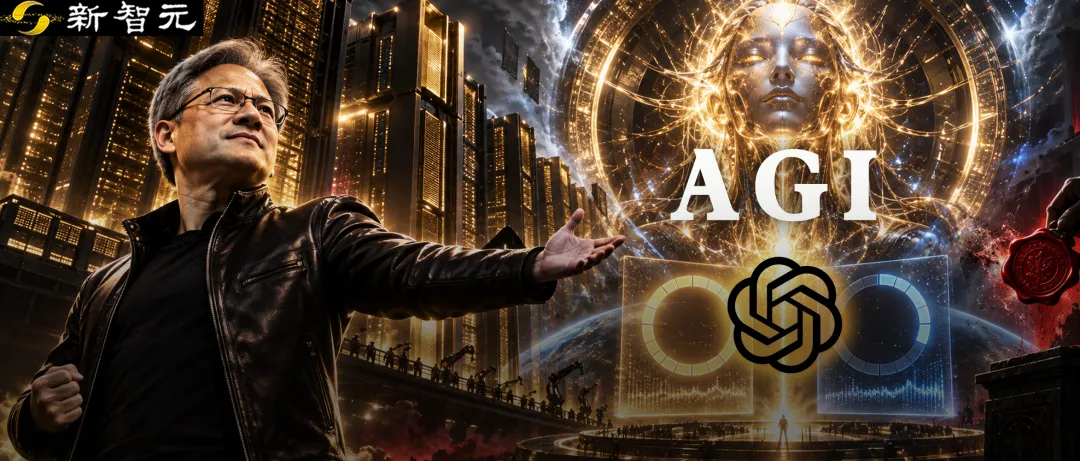
It's the first time in the history of the world.
On Thursday, OpenAI released the GPT-6 Astra.
The official website describes it as "the smartest, most aligned model in the world".
Soon afterwards, Huang Yi posted a post on X, pushing the matter to another height:
AGI is here. Congratulations to the OpenAI team.
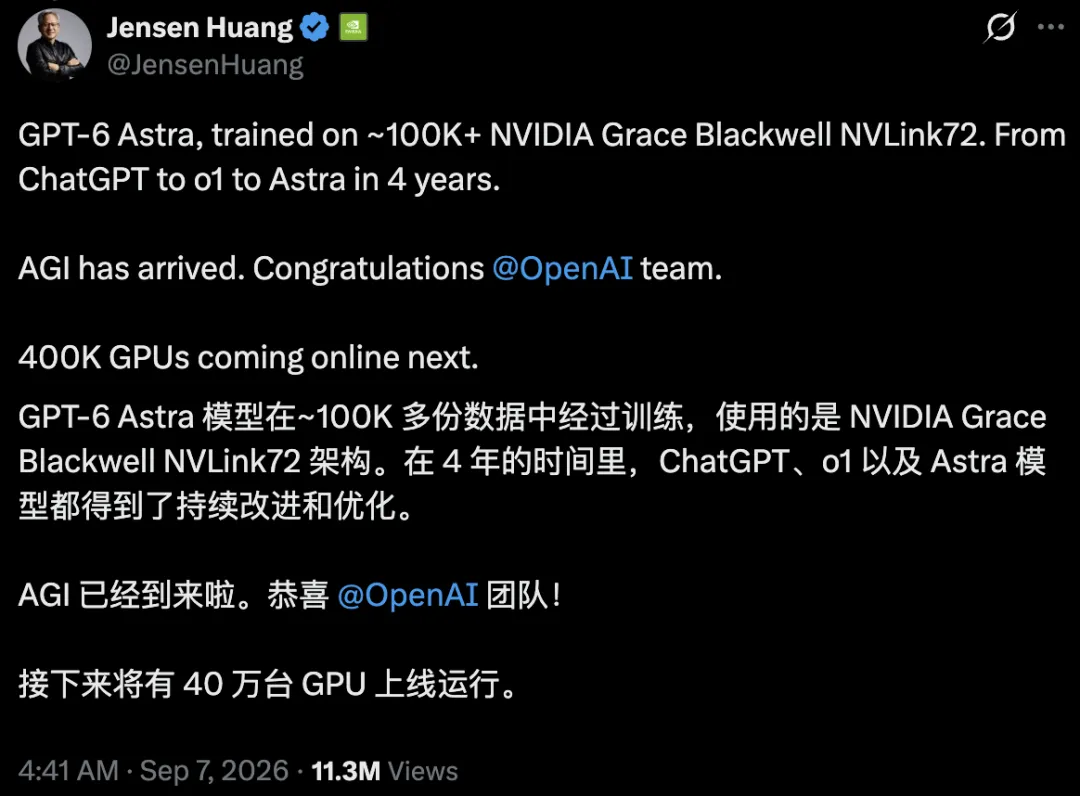
On the official release page of GPT-6 Astra, you can't find the words "AGI has been implemented".
A guy who sells GPUs for modeling is full of words.
More interestingly, it's the people who are the subjects.
OpenAI's release page states that Astra got 99.9% on ARC-AGI-3, "coinciding with" this benchmark called AGI.
The ARC Prize, the rating agency responsible for rolling out the rolls, finished the scores, but one refused: "No".
The ARC Prize Foundation dismissed the following statement on the day:
This score comes from OpenAI's customized testing environment, which is only 62.7% compared to the standard environment for all manufacturers.
They conclude with one sentence: Astra has made substantial progress in generalization, "but we do not claim it to be AGI".
The chip supplier directly seals, while the model manufacturer leaves room for a direct refusal by the benchmark body responsible for the issue.
This is probably the most magical scene in the AI circle in the last few days: AGI was not actually "implemented" this time, but was "announced" on social platforms by various spokespersons.
What about OpenAI itself?
In a press conference broadcast on the same day, President Greg Brockman made a highly provocative statement:
Welcome to the AGI era.
He even predicted that if you look back at when AGI was born a few years later, "probably this period, maybe this model".
Sounds like an official statement?
But he immediately added two limiting words: first, it's his "personal judgment"; second, AGI is a gray, vague concept, "it's not really counting, it's user-determined".
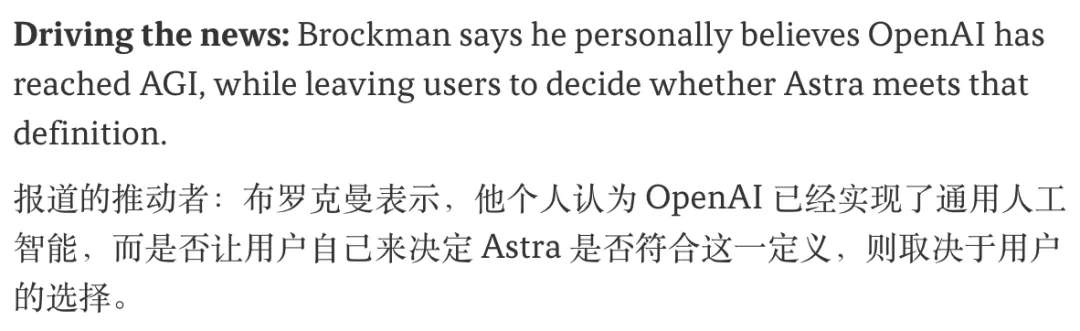
At one of his most important product launches, the president used "personal opinions" to set the tone for the times, even giving the netizens the final say.
This only explains one thing: Within OpenAI, there is no clear AGI certification that can be disclosed.
What is even more interesting is the attitude of CEO Ottman.
Prior to Astra's release, he had publicly spat out "AGI" as a poorly defined, near-marketing term.
The CEO disliked the term too much, and the President took it as "personal opinion", and the official website simply shut it down.
The AGI's "seal" and "congratulations" from Hu Jintao fell into this subtle void.
99.9% and 62.7%Two sets of scores for the same scroll
Astra is not strong?
On the OpenAI release page, it says:
Astra scored 99.9% against the sky on the ARC-AGI-3 benchmark test, called the AGI, and "coordinated" the test.
But it's quick to hit the face.
On the same day, the ARC Prize Foundation, which is responsible for the topic, issued a statement dismantling this "99.9%".
It turns out that Astra tested it twice.
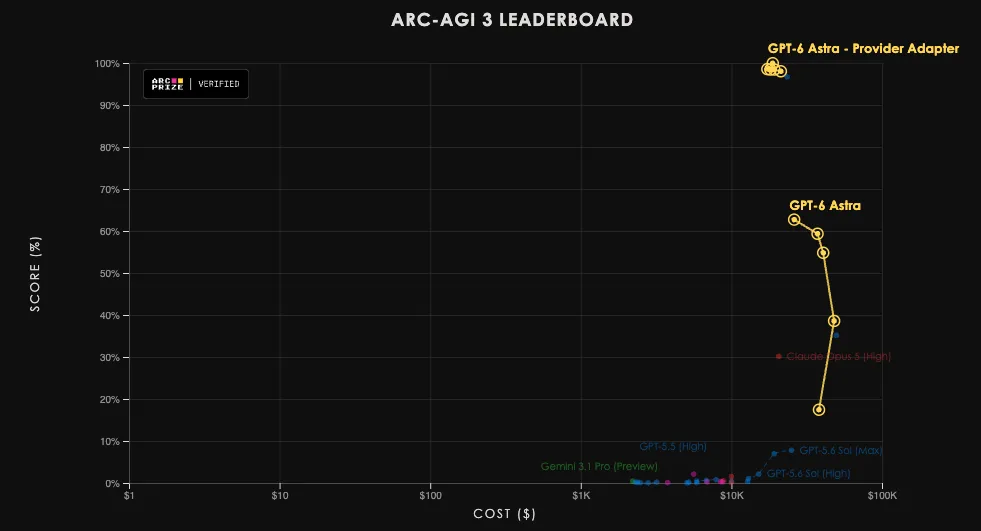 In the ARC-AGI-3 list, the results of the two environments for Astra are marked separately; Claude Opus 5 is 30.2%, GPT-5.6 Sol is 7.8%.
In OpenAI's deeply customized "self-contained tool" environment (which allows models to stay logical and have long conversations with exclusive technology management), it did 99.9%, at a cost of nearly $190,000.
However, in exchange for the "naked test" standard environment for all manufacturers, the highest score is only 62.7%, and the cost rises to $260,000.
The ARC Prize's stance is firm: the future AGI must be able to solve problems under standard conditions. 99.9% of the tools taken and 62.7% of the naked tests taken are entirely double digits.
Of course, the authors also acknowledged that Astra brought the surprise of the "step-jump" approach, in which the number of actions performed by Astra was less than that of humans, at an average of 51.7% in 96%.
This is the first time that AI has completely suppressed humans in terms of operational efficiency.
However, the ARC Prize has long been at the forefront: the day ARC-AGI-3 went online, they wrote that fulfilling this criterion is not the same as "proving AGI has been reached".
The reason for this is simple: the testing environment is difficult and closed, and the mechanisms for determining and targeting the closure do not represent the complexity and openness of the real world.
It's like a school curriculum that's full of scores, and it doesn't have to be open to the real job.
100,000 refined models400,000 sold in the futureSince everyone is not familiar with the topic, why is Huang so anxious to announce that "AGI has arrived"?
If you carefully dismantle this post, you will find that its information structure is much hotter than the surface.
The full text of the post is:
GPT-6 Astra, trained on about 100,000 NVIDIA Grace Blackwell NVLink 72. From ChatGPT to O1 and then to Astra, it took only four years.
The first number is 100,000.
Astra is the largest OpenAI training to date, using more than 100,000 GPUs.
The second number is 4 years.
From ChatGPT to O1 and then to Astra, Hu Jintao uses a timeline to connect dialogue models, reasoning models and so-called AGIs into a straight line.
The third number is 400,000.
"Next up is 400,000 GPUs".
Who owns the 400,000? What model? What is it used for?
But when these three numbers are embedded in the same post as "AGI has arrived", a business narrative emerges in the reader's mind:
If 100 000 GPUs were generated by Astra (or AGI), what would the next 400,000 generate?
In this context, AGI is no longer an abstract technological endpoint, but has become the most powerful proof of arithmetic demand.
As soon as AGI is recognized as "come", the calculation of prices will no longer be the cost of the enterprise, but the necessities of the table.
AGI on TwitterCan't get into a commercial contractIn October last year, a new agreement between OpenAI and Microsoft stated that OpenAI would have to be verified by an independent panel of experts after announcing AGI.

In February, the two parties reaffirmed that the definitions and identification processes of AGI in the contract "remain unchanged".
By April, the agreement was revised again, and Microsoft's revenue split was changed to "not related to the progress of OpenAI technology", and the outside world generally interpreted the AGI clause as having significantly weakened its role as a catalyst for commercial interests.
In other words, what Brockman said at the press conference, what Huang wrote on the X, how many ARC-AGI-3 runs, does not constitute a consensus AGI determination.
It is now a key node in OpenAI's preparation for its IPO, and Anthropic is on the brink of going public.
The term "AGI" has long been enshrined in OpenAI's investment agreements with Microsoft and Amazon, where it has shifted beyond technological belief and equity pricing and business control.
This explains why Brockman dares to call it "personal judgment" and why OpenAI's official defense does not mention AGI.
In the field of opinion, you can welcome the AGI era as much as possible, and you can not write more than one word in the contract.
Who is eligible to declare AGI?A Bloomberg article raised the question again and again, and the answer is that no one has spoken.
Let's look at the definition.
OpenAI's version is "a system that surpasses humans in most economically valuable tasks".
Google's DeepMind 2023 paper does not look at economic value, it looks at universality, it looks at how little data can teach new skills.
More directly, the ARC Prize defines economic value as "the wrong measure of intelligence" and defines it as "a system of learning and training new skills beyond data".
Even the words are not the same.
Dario Amodei of Anthropic doesn't like to call AGI what he calls "powerful AI". Mustafa Suleyman of Microsoft has created an "artificial capable intelligence".
Meta and OpenAI have just recently skipped AGI to talk directly about "superintelligence".
The timetable is more chaotic.
In September 2024, Ottman said "systems aimed at AGI are appearing" and even said "in a few thousand days" there could be superintelligence.
A year after the release of GPT-5, he admitted that "we still lack something quite important", but said nothing.
A year later, at the Astra conference, Brockman said, "Welcome to the AGI era".
DeepMind, on the other hand, puts a 50% chance of achieving AGI by 2028, which Shane Legg has been betting on since 1999; while Demis Hassabis says five to 10 years from now, the timeline seems to be shortening, simply because "the definition of AGI is being diluted".
And that's when the situation came to light.
The same word, four dictionaries define it in four ways.
The model companies are holding on to product narratives and are reluctant to make judgments.
The chip giant, with its computational narrative, is eager to announce the coming of the age.
The benchmarking body holds the test scale, bites the bottom line and refuses to admit it;
Big money like Microsoft holds the terms of the contract, sits on a whale table, and accounts according to the rules.
Over the past four years, the entire industry has been competing over who will be the first to make AGI.
Recently, the narrative has shifted from "one to three years" to "the fastest half" to "it's here".
However, no one has yet come up with a standardized AGI acceptance standard.