It's the first time in the history of the world.
It's only been two days since OpenAI announced its 88-hour attempt to solve the millennium puzzle, the NS equation.
They hadn't given up on God because they were terrified, and a more explosive fox came.
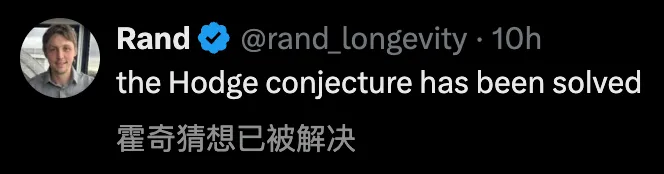
Today, an explosion on X directly exploded the entire Internet:
OpenAI is rumored to be close to completing the validation of the second millennium puzzle, the Hodge conjecture.
It's not just a hole coming in.
Earlier this morning, the New York Times published a special article that went straight to OpenAI's official website:
Over the past five years, the internal team has made substantial progress on another Millennium Grand Prix puzzle and is ready to publish it to the outside world.

Today, the sound of the wind in the workshop is completely unstoppable.
OpenAI and its host, Anthropic, appear to be in an extremely crazy dark race, with the two-way third puzzle, "BSD Guessing", launching a final seizure, and some of the work has even entered the verification phase.
If all this is true,This means that within a month, humans will witness three problems that have plagued the mathematical community for decades.AIIt's a great way to get out of the way.

Recent intensive mathematical breakthroughs have repeatedly sent the same signal to the world.
As of this September, AGI appears to have ceased to be a long-term concept. It is evolving directly into the ASI with a furious momentum that transcends the limits of human intelligence as a whole.
It's weird.
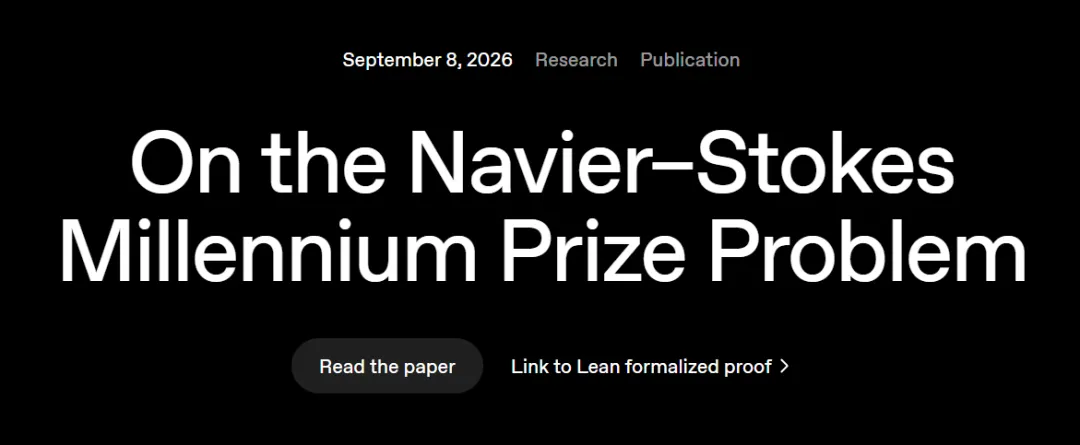
OpenAI official announcement: 88 hours to solve the Millennium puzzle!
What is Hodge's guess and BSD guess, and what is he asking?
In 2000, the Clay Mathematical Institute awarded seven Millennium Puzzles, each with a $1 million prize.
Themes spanned fluid mechanics, topology, mathematics, algebraic geometry, computational theory and quantum field theory, and any solution was enough to reshape modern mathematical graphs.
In 26 years, humanity has only conquered one of them.
In 2003, Russian mathematician Perelman proved Pongaly's conjecture and subsequently declined the prize and faded from academia. The remaining six remained silent.
It was the day before the deadlock was broken.
OpenAI announced that its internal model called for about 10,000 smart objects, took 88 hours to break through the Navi-Stokes equation, and released 166 pages of papers and the formalised Lean verification code that was tested.
Soon after, the wind blew rapidly into the BSD conjecture, and the Hodges conjecture that humanity has already achieved many stages of sexual results.
Signs of academic exploration in the past, more prone to Hodge's conjecture, may not be true.
If you want to falsify, you only need to construct a valid counter-case.
This is precisely the blind spot where AI relies on violent computing to precisely cut through, which is where human mathematicians often misrepresent "knowledge" and "notice" on blackboards.
What is the question asked by the gods of AI?
Hodge speculates: the "toponym formula" of high-dimensional space.
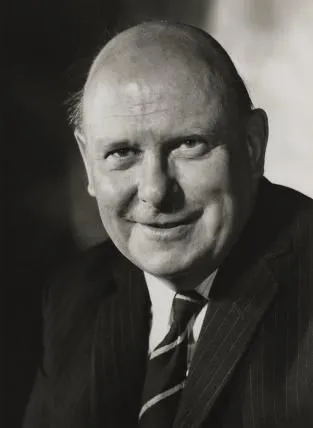
Hodge's conjecture, proposed by British mathematician William Hodge at the International Congress of Mathematicians in 1950, belongs to the category of algebraic geometry.
Its core problem lies in the correspondence between geometry and algebra.
Mathematicians often study a class of high-dimensional geometric shapes known as "algebraic curves", which are composed of a set of polynomial equations whose dimensions are far beyond the limits of the visual and spatial intuition.
To dissect these shapes, topological tools break down complex shapes into "components" of different dimensions.
In the process of demolition, a series of topological features (the Hodge class) are abstracted for use in the deep underlying structures of the carved body.
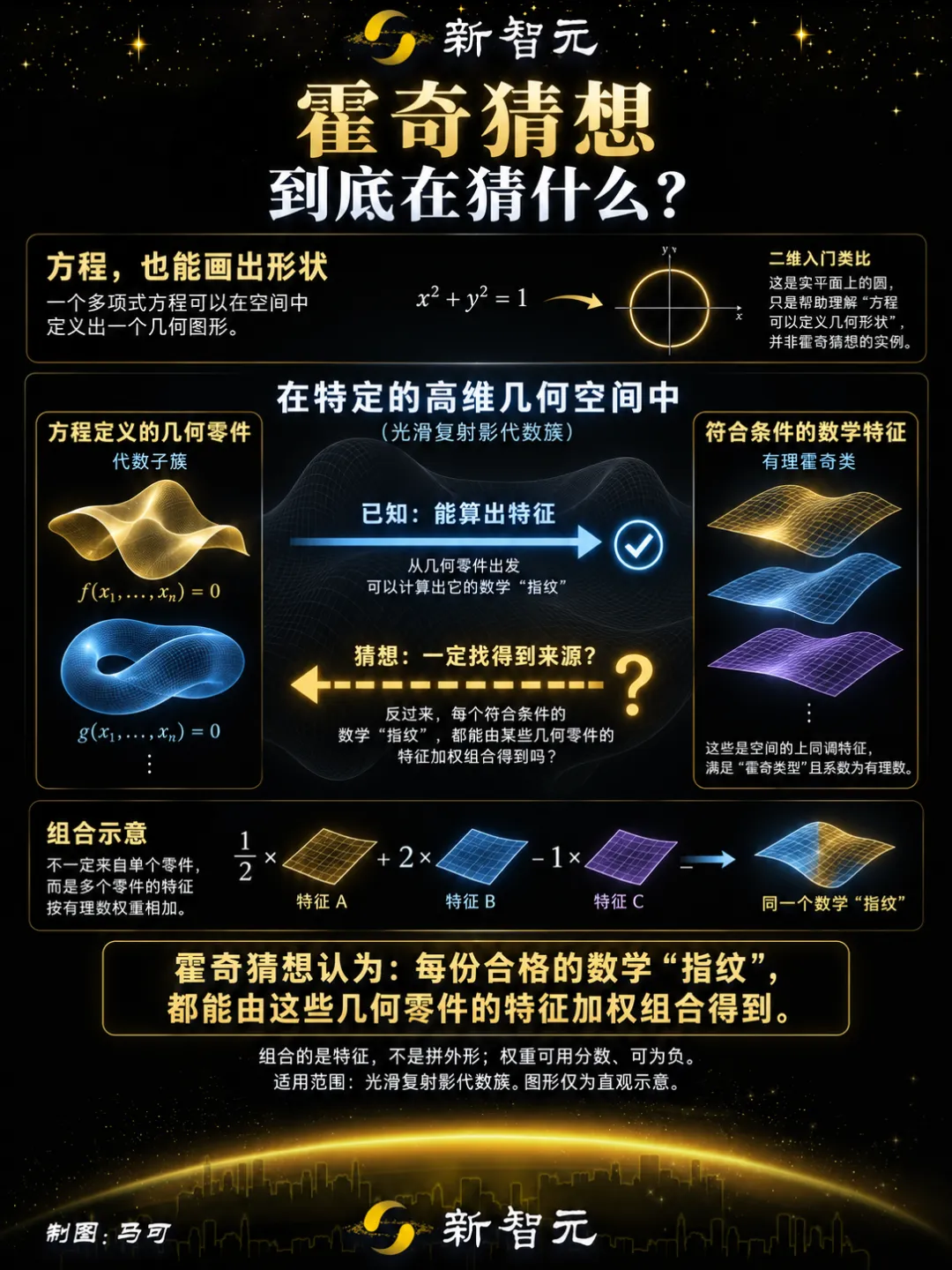
At the heart of Hodge's conjecture is this: Can these abstract topological structures be expressed entirely by spellings of real, imaginary algebraic polynomials?
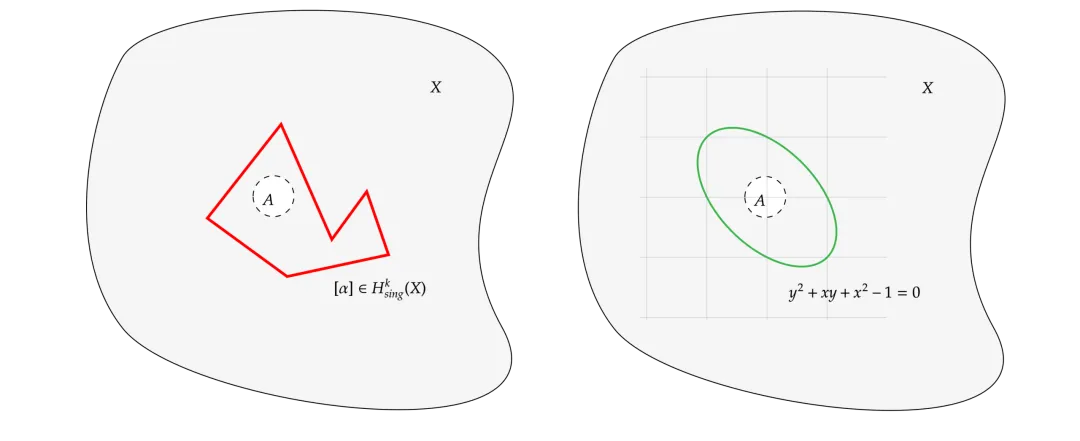
It's a common saying.In high-dimensional space, does every natural topology "textured" necessarily correspond to an exact algebraic "formula" behind it?
There is considerable disagreement in the academic community about this hypothesis. Some scholars believe it to be true, while others tend to look for counterexamples.
Special cases under four dimensions have long been documented, but the wide area under four dimensions and above is still a deep-water area.
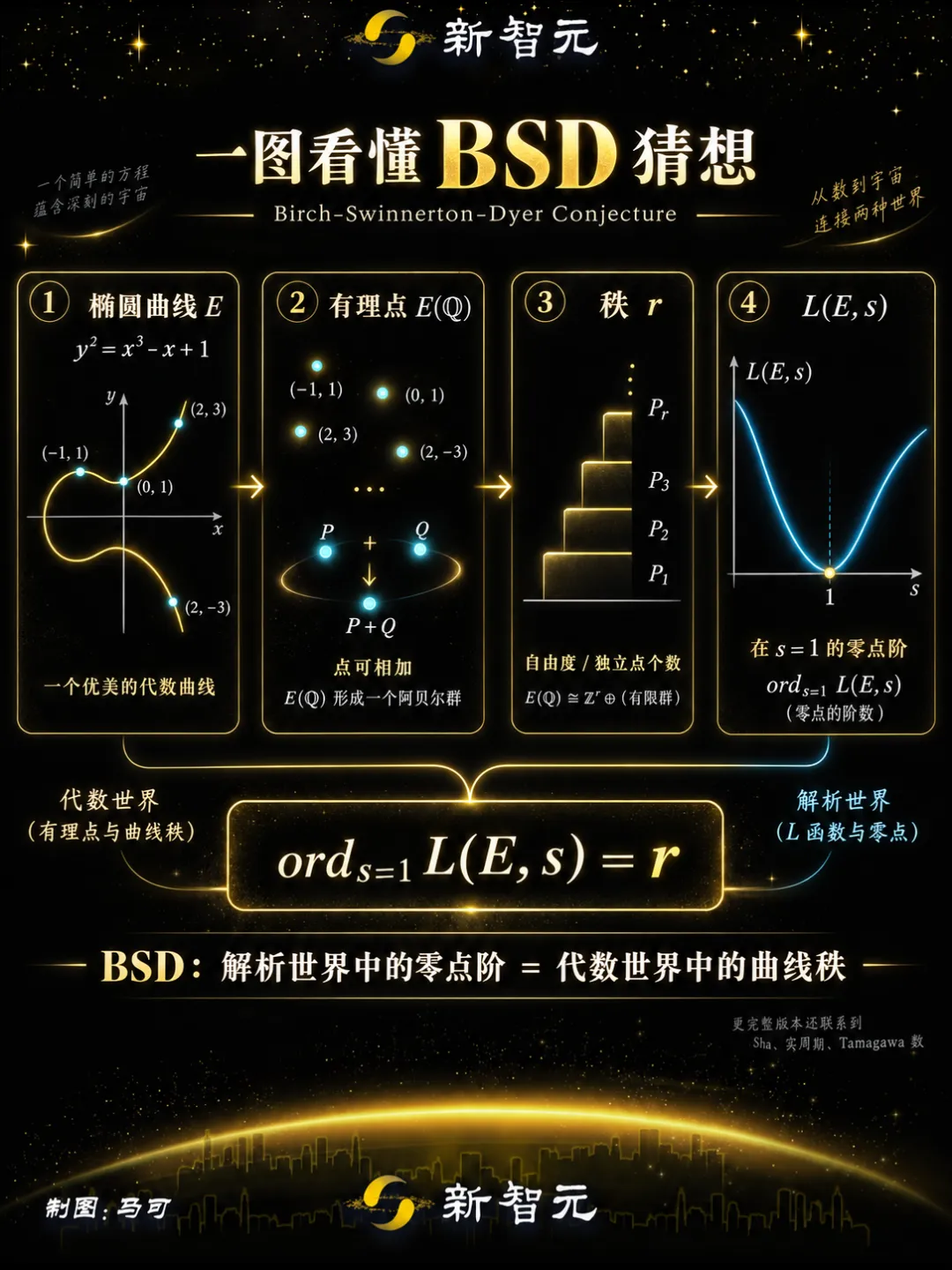
BSD Guesses: Final decryption of the elliptical curve
The BSD conjecture is known as the Birch and Swinnerton-Dyer conjecture.
It was proposed by British mathematicians Brian Beck and Peter Swinton-Dayle in the 1960s, using a trial of the early computer EDSAC-2 at the University of Cambridge.

The elliptical curve is a geometric object defined by three distinct equations that occupies a dominant position in mathematics.
At the time, Wiles was finally proving that the key to Fermat's theorem was the elliptical curve, on which modern Internet elliptical curve cryptography (ECC) is based.
One of the core pain points around the elliptical curve is the calculation of exactly how many rational numerical solutions a given curve has. This representation of the scale of the clusters is called "order", and the process of solving them is extremely difficult.
BSD speculates on building an ingenious bridge.
It argues that the understood number of elliptic curves is completely encoded in an associated L function. The parsing properties of the L function at a specific point (e.g. whether the value is zero, the number of steps of zero points) can be strictly combined to correspond to the understood structure and number.
This assumption, which has plagued the mathematical community for more than a thousand years, will be solved once and for all.
The Millennial Challenge of Progress
It's a chilling look at the progress of the Millennium Challenge:
It has been resolved:I'm not sure if I'm going to be able to do that.
They claim to have solved:The Navi-Stokes equation (OpenAI announced the invasion in September 2026, and the Clay Mathematical Institute is due to review it)
The rumors are coming:Hodge is guessing, BSD is guessing.
There are no signs of breakthroughs:Liman's hypothesis, P vs. NP, P-Mills specification field and mass gap
Just a week earlier, there were six unresolved puzzles on this list; and now, perhaps, only the last three are pending.
The AGI scale is constantly being pushed up
In 2018, OpenAI wrote the classic definition of AGI in its chapter: a highly autonomous system that surpasses humans in most economically valuable jobs.
In July 2024, this goal was broken down into five stages: dialogue, reasoning, proxy, innovation, organization; with the release of the o1 model later that year, the official self-assessment was moved to level two.
In 2025, the front-end model won a gold medal at the International Mathematical Olympiad IMO; by the end of the year, OpenAI proved a new formula in the field of particle physics with GPT-5.2 and converted the AI sequencing badge from an auxiliary tool to a scientific collaboration author.
Last month, the GPT-6 Astra debuted, and Greg Brockman publicly declared:
"Welcome to the AGI era".
With the breakdown of the two days of the Navi-Stokes equation, and the subsequent speculation, one terrible fact emerges: every time technology crosses a threshold, the outside world passively raises the scale of AGI.
Natural language interaction is no longer rare, complex long-range reasoning is commonplace, and competitive gold is also a hallmark.
As AI begins to scale, the positive impact of tens of thousands of years of problems plaguing top scholars, mathematics, the ultimate crystal of the human mind, seems to be falling to the ground as the test benchmark for a leading model.
The top mathematicians who once thought they were sitting on top of the human intelligence pyramid, it's time to start thinking seriously about where to start in this surging super-intelligence storm.