“ Knowledge is not a static library, but a continuously growing network of entities.
In September, two big things happened that we all know about.
One of the World Labs, co-founded by Lifeifei, across the ocean, has officially released the world's first multi-modal world model, which successfully integrates text, images, video, camera images and 3D depth information into the same framework, both generating images and reconstructing space, and training robots to simulate.
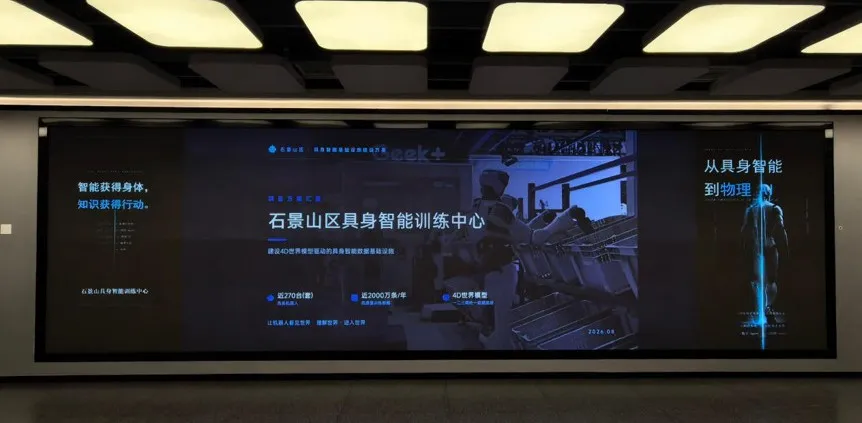
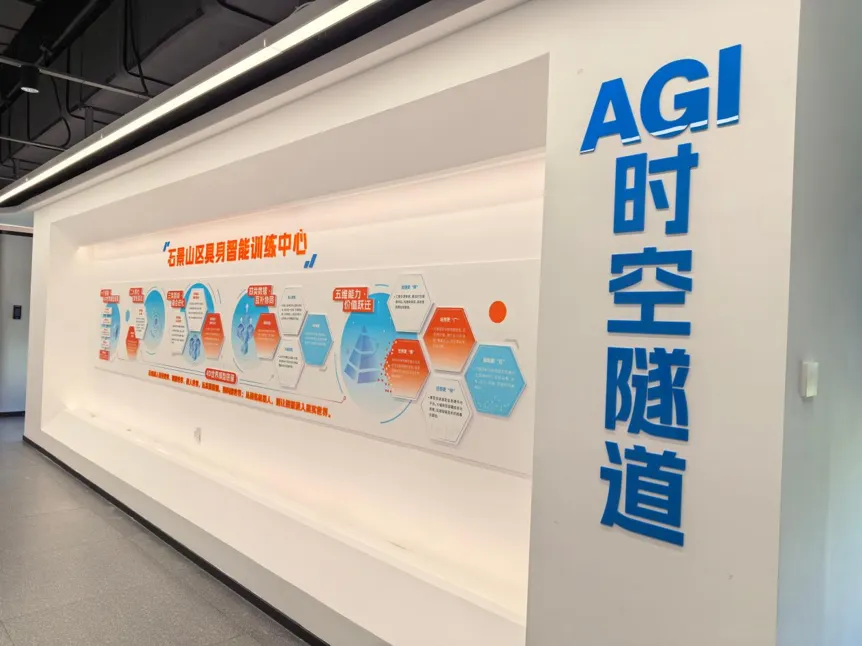
Another is Beijing's 3,000-square-metre-square-metre Shijiazhuang Fishing and Intelligent Training Center, which has completed a thorough upgrade from underlying logic to technical architecture and will make its official debut at the China Trade Fair.
More interestingly, this upgraded technology route coincides with the misdirection of Li Fei-Fei Atlas's Zhongs World Model. Two events point in the same direction: competition for physical intelligence is shifting from Zhongs for robot simulation to Zhongs for robot understanding of the world.
From more than 100 real-time remote control machines to 4D field 80 view matrix+Ego+ high-precision optical motion capture, collecting real-life HOI and object-environment interaction data, what's the trade-off?
01.
What's the matter with the shutdown?
Before discussing the upgrades to Beijing's Shijiazhuang AI Training Center, let's answer a more fundamental question: Why is it so hard to train robots?
In the last two years, the heat of the physical and intelligent circuits is visible to the naked eye. But in the real factory production lines, warehouse logistics, household service scenes, the performance of robots is often discounted. Poor generalization capabilities, poor reliability, untraceable pace of operation, the problem behind this is that most robots are still stuck in the phase of simulation and lack the ability to autonomously understand the physical world.
The traditional training ground is based on 2D video and action trajectory data, which essentially allows the robot to observe video-based movements, fixed lighting, single scenes, no real-world random disturbances. What the robot learns is that the robot can make specific movements in a specific environment, and another scene fails instantly. More accurately, the traditional data can only answer the question of how to make these movements, and cannot solve the question of what the decision-making process should be done after environmental change.
The key to solving this problem is a growing consensus within and outside the industry. That is, data dimensions must be upgraded from 2D video→ 3D static space→ 4D dynamic world.
But the construction of the world model is based on one of the most fundamental questions: where did the data come from? simulation data is detached from the real physical scene, single-dimensional single-point real-image data, high-quality real 4D data collection costs are extremely high, standardization is extremely poor.
So when Lifeifei said that the biggest bottleneck of a robotic pump is a data pump, she didn't mean that there wasn't enough pump, but that the pump was able to match the needs of the world's training models, almost empty pumps.
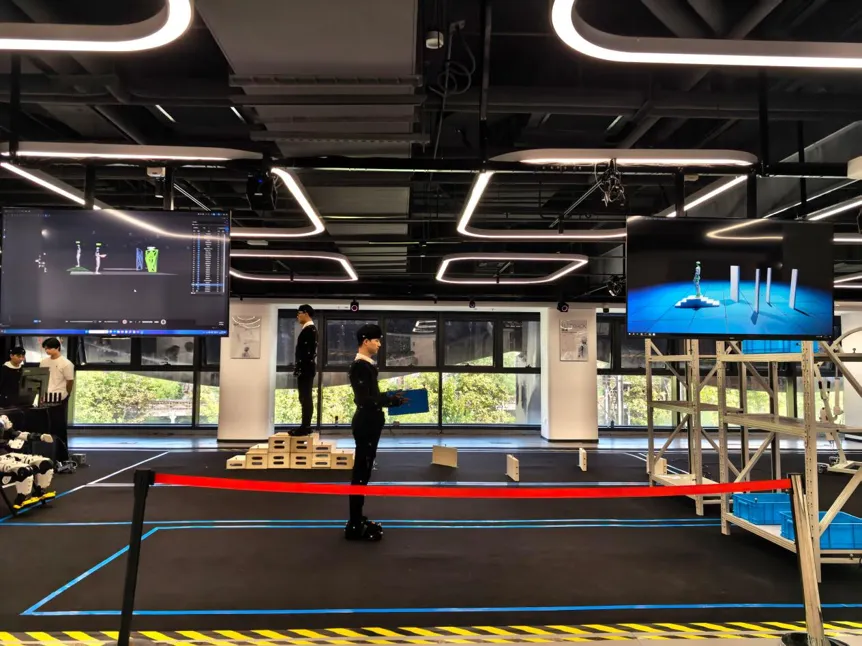
In March 2025, Beijing's first personal-shaped robot data training center was unveiled at the 3000-square-meter-square-foot Stone Mountain Steel Park, deploying more than 100 robots, building ten real-world scenarios such as home care, automotive assembly, 3C electronics plants. As the country's first large-scale data training site, it completed verification from 0 to 1, accumulating tens of millions of levels of trajectory snippets.
However, in the course of the operation, a problem has become increasingly clear: although this model has taken the first step, it is still a long way from the real needs of the industry.
What is the problem? There are two main bottles.
Bottleneck one is an environmentally unstable clean sheet. Laboratory scenes are not a real production line after all. Lighting is constant, materials are standard, interference is predictable, and the real world is full of material gaps, light interference, unequal unpredictable physical variables. Data cleanliness is good, but too clean is a problem. Models are trained on such data and are severely unable to generalize to real scenes.
According to industry estimates, it costs about 200 yuan to directly collect an hour of interactive data, completing a million hours of collecting a total cost of up to 200 million yuan. To train a truly universal smart model with a body, at least tens of millions of hours of data are needed, and the current gap is more than 99%.
The two bottlenecks essentially point to the same conclusion, which is that using a model of remote control + laboratory scenarios, it is not possible to scale up the mass and high-quality data needed to train a world model. So, in August this year, the operator made a key decision to initiate a thorough technological upgrade on the ground.
The core idea of the upgrade is no longer to allow robots to simulate their actions, but to allow data systems to understand the world around them.
02.
A restructuring of the underlying logic of technology
The difference between upgrades and upgrades is not so simple as replacing a few devices. It is a complete reconstruction of the philosophy of data collection to the technical architecture.
In the laboratory, the operator controls the robot to complete a movement, the camera is recorded, and the model is learned. The problem is that the robot learns only to simulate a pattern of specific movements in a specific light, a specific angle, a specific environment.
The new model is to allow robots to understand the world. After the upgrade, the training ground will no longer rely on more than 100 real-time remote controls, but will build a new multipoint 4D Gaussian optical field collection system, real-life object motion trajectories, shape-shifting processes and photo-shadow changes. The output is no longer statically scanned 2D video, but high-resolution real 4D dynamic material, including three-dimensional space + time dimension information.
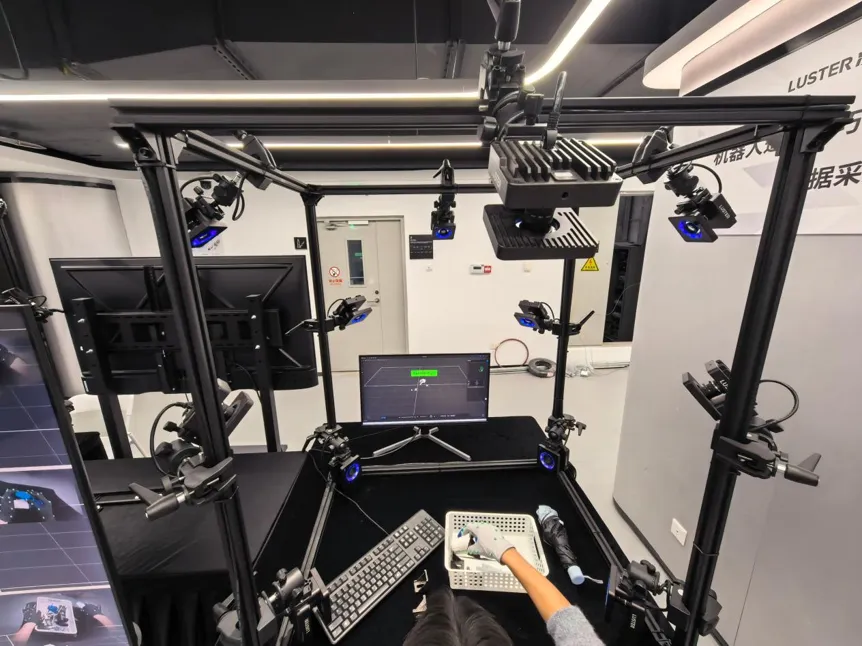
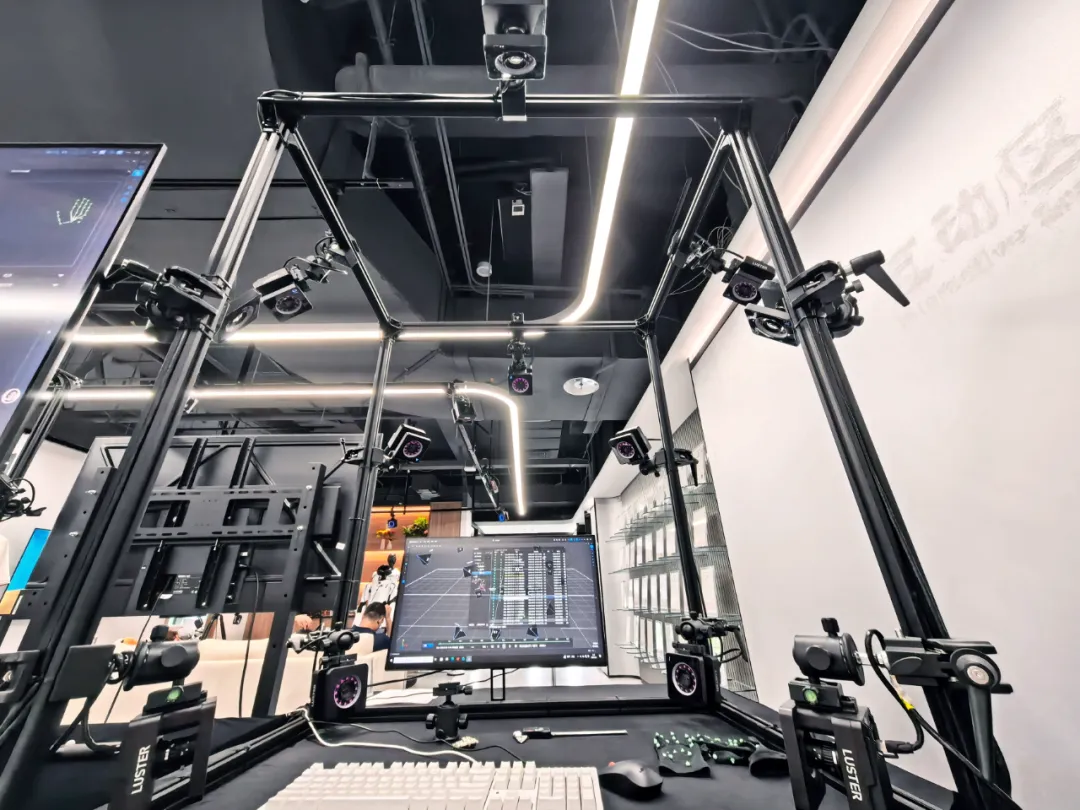
The technology behind this is the LuStage-RoboX multi-point scene data collection system in the customer view + 80 full-area 4K synchronized camcorder viewpoint arrays.
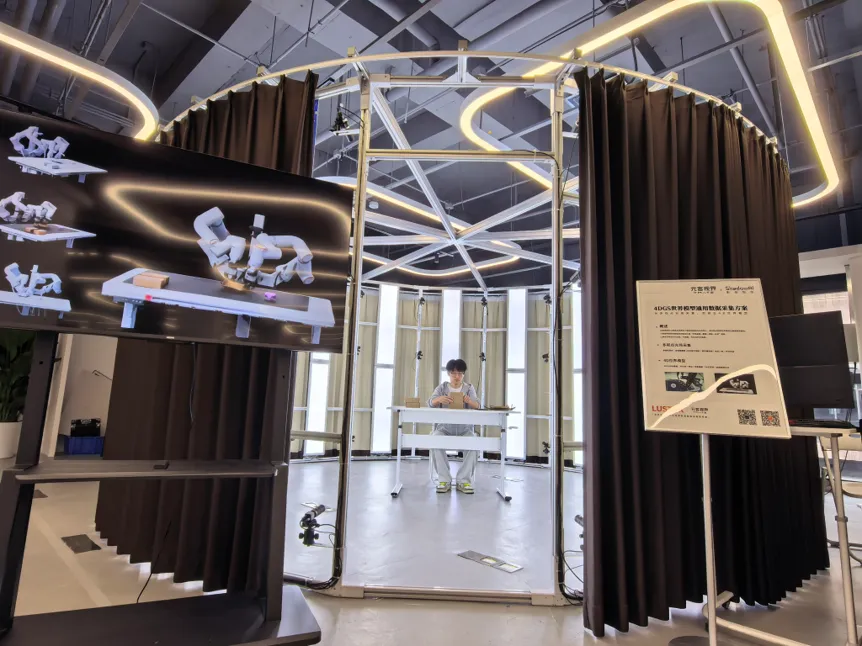
In the home scenario, it can reproduce the entire process from household cleaning to cooking, caring for the elderly; especially in industrial scenarios, the extreme reliability requires scene and object structure modeling data chamfer≤2mm, human movement native language labels body PVE≤20mm, arms≤5mm.
A total of 80 4K cameras are distributed and controlled to achieve 360° non-dead angle scanning at the same time, with some camera arrays completing the collection of real-world model data, and some camera arrays focusing on hand and object manipulation.
Additionally, the model draws on open world game LOD (Level of Detail) detail-level technology with high data accuracy; global scenarios switching to relatively lower data accuracy, reducing storage, CPU, GPU and network transmission costs, saving data collection costs and time, while maintaining high accuracy, efficiency and low costs; millisecond time synchronization, eliminating data gaps in multiple viewpoints from the source; 4DGS high accuracy high spectroscopy rendering, breaking through traditional cloud and grid modeling details bottlenecks.
More importantly, the introduction of the world model is based on real collected 4D data, which can automatically simulate a multitude of diverse scenarios and scale up the data. No longer relying on artificial data in a closed laboratory, but using real data to grow more training material for AI itself.
This is unquestionably the opposite of what Li Flight Atlas is doing. Atlas' core capabilities are to integrate text, images, video, camera postures, and 3D depth information into the same model framework, while the Stone Mountain training ground is also using real-world physical acquisition facilities to provide the rarest native 4D base data for this type of world model.
03.
The entire life cycle of the robot's clutch
The Robotics Workshop exclusively learns that the post-upgrading training ground has been designed around the training needs of robots in four core areas.
Region 1 is the 4DGS World Model Base Data Collection Area. It relies primarily on the LuStage-RoboX Multipoint Scenes Data Collection System with 80 4K camera arrays to provide high accuracy 4D time and space base data for the world model, while also reducing the scarcity of scene specifications, selection and scene matching to 4/8/16/32 depending on the collection and accuracy requirements.
Area 2 is the robotic general control model baseline data collection area, which relies mainly on FZMotion's frequency convergence motion capture system, covering standard baseline motion, robot assembly practice motion, factory deviation motion, brain model verification motion full-scene data.
Region 3 is a general-brain precision-operation scenarios pre-training data area that focuses on the first-person shadowing, precision, and generalization of hand data collection from the Ego perspective, using a multi-point real-valued reverse-marking of the Ego perspective, which officially reveals the ability to increase the integrity of the shadowing workflow data from the traditional 60% to more than 99.5%, solving the problem of learning how to operate precision.
Area 4 is a typical post-industrial training data collection area. It solves the problem of how to land on the actual production line by adopting non-intrusive data collection, without the need for workplace transformation, without the need to suspend mass production, with workers maintaining the original working posture, and with a production line batch impact rate of 0.
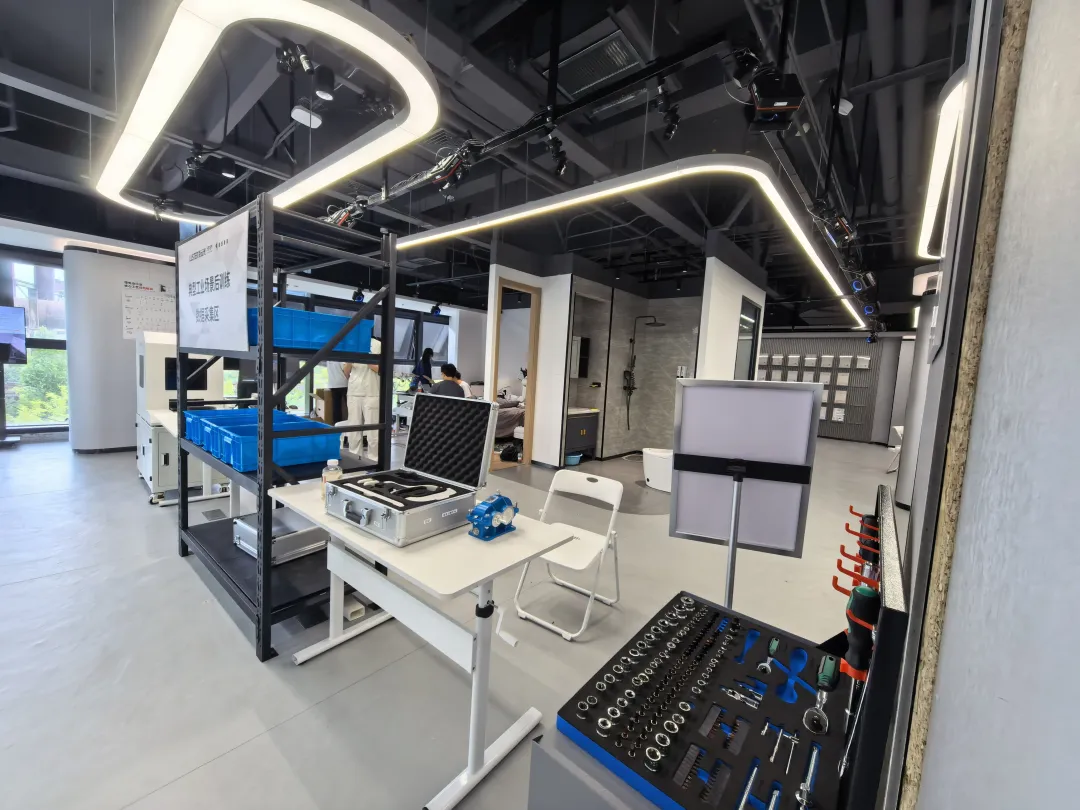
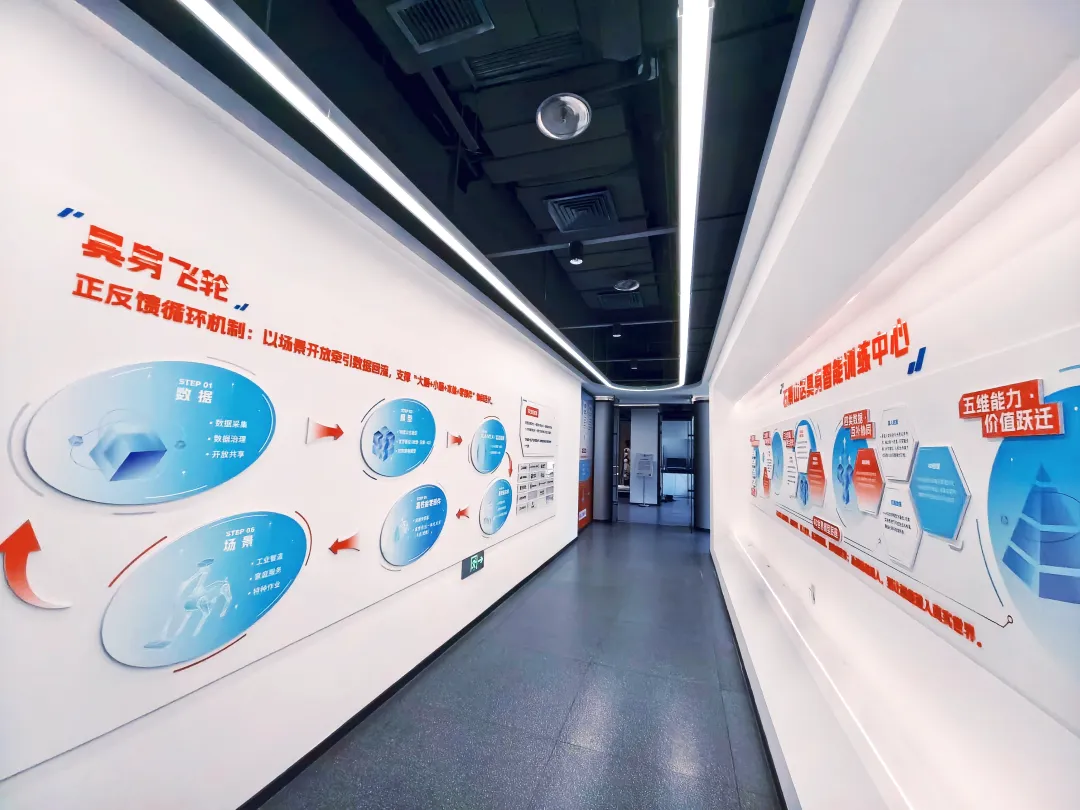
The four regions form a complete data pyramid structure, with general baseline data for 4D world models at the bottom, general capability data for robotic operation in the middle, specialized capability data for precise operation, and post-training data for specific industrial scenarios at the top.
04.
Two engines for the new training ground
Behind the upgrades, the client view is derived from its two kills, the FZMotion optical inertia fusion motion capture system and the LuStage-RoboX multipoint scene data collection system. The two systems provide a set of data on human sperm movement (mainly in charge of the brain) and another set of implementation of character field modeling and movement (mainly in charge of the brain), both of which form a better complement, together forming the technical closure of the 4D world model data collection.
Engine One: FZMotion optical inertial convergence motion capture system
Robots have to move steadily and accurately, relying on micro-brains, or operating control models. While micro-brains are most lacking in training, high-precision, error-bearing, continuous dynamic real motion data. FZMotion optical inertial convergence motion capture system, using optical high-precision positioning + inertial continuous convergence optical inertial convergence architecture, can still be tracked continuously in industrial repeat shadowing scenarios.
Engine two: LuStage-RoboX multipoint scene data collection system
If FZMotion solves the problem of vibrational vibration, then LuStage-RoboX solves the problem of staring at and understanding vibration. To understand the world, robots do not rely on single-pointed flat images, but on complete, continuous, time-space-consistent four-dimensional information, such as how objects move, shape, interact with their surroundings, and evolve over time.
The LuStage-RoboX multipoint scene data collection system, the core of which is a set of rotary camera matrices with 80 4K synchronous cameras, is distributed throughout the field, achieving 360° non-dead angle intensive sampling of scenes, millisecond time synchronous, eliminating time and space misplacement from multiple viewpoints. The system's output is no longer scattered 2D video clips, but high-resolution real 4D dynamic scene data, including character movement, object interaction, environmental change, photographic flow, all of which can be accurately digitized, and is a real-world three-dimensional model.
The system is most famous for its real-world use in the 2026 CTV Spring. In the fantasy series Dream Theater, the actors' stored figures are presented in a sub-millimeter level precision, with a 1:1 rendering of the animation and clothing, and the technology behind it is the integration of the LuStage+4DGS[4] 4D high-definition video with 360° high-density multi-visual synchronous imaging.
From the spring stage to the robotics training ground, from the boxing podium to the body-smart data base, the two systems share the same underlying philosophy of human-centered data collection.
Former client-view general manager Li Liu has made this clear: in the past, the logic of data collection was based on machines, human-controlled machines, not only low efficiency, but also low data quality, data-to-robot binding, unrepeatability; now it is based on human-core, i.e. building a general model using human action data as a sample, enabling multiple robots to share.
This transformation seems simple, but it has overturned years of conventional thinking in the industry. In the past, people thought about how to get robots to move and record, and now think about how to digitize the most natural human behavior, and then teach robots, FZMotion to capture people's movements, LuStage to record the world where people live, and combine the two to form a complete digital sample of the world in which clowns operate.
That's why this dual-engine program supports 4D world-modeling training: world-modeling is about learning not only what the world looks like, but also how the world operates. FZMotion teaches the brain how to move, LuStage teaches the brain how to watch, move and play, and robots can really learn how to see the world, understand the world, and enter the world.
05.
Back to the beginning: Atlas and Stone Mountain, walking on two legs
On a global scale, industry and academia have been convinced that Li Fye's Atlas proves one thing: that the world model may be the path to physical intelligence.
However, Atlas is still in the early stages of reaching out to a small number of partners, and World Labs has yet to disclose the full model parameters, training data, cost reasoning and third-party test results. It should be viewed as a technological direction to follow rather than a mature product.
And the upgrades to Beijing's Shijiazhuang Intelligent Training Center are another thing they're trying to do, to build a new generation of data-gathering infrastructure for this era of world models.
When the whole industry is talking about the world of lithium-ion models, who is providing real, high-precision, scalable training data to the world of lithium-ion models and who is solving this most fundamental problem?
A Chinese answer was given by Beijing's Shijiazhuang Intelligent Fitness Training Center.
It's not a perfect answer. It's been a choice and a rebuilding of a technological path. But it's the courage to admit that we can't go out of our way, the courage to push back, that gives the project the opportunity to go to true industrial value.
From simulation of monkeys to understanding the world of monkeys, from remote control monkeys in monkeys' laboratories to monkeys' 4D world model monkeys, this upgrade of Stone Mountain is essentially a cognitive revolution about how monkey robots learn monkeys.
As Duwar, Vice-General Manager, Duwar, said: "Optometric motion capture technology is the only way to accurately collect data at millimeter level at every link, and it's an irreplaceable infrastructure with physical intelligence from R&D to mass production".
At a time when Li Fye's Atlas is trying to define what the Silicon Valley world model should look like, Beijing's Stone Mountain Fitness Training Center is using FZMotion and LuStage to capture the world as it really is.
One of them is thinking and one of them is thinking and one of them is thinking and one of them is thinking.