From renderers, simulators, planners, to the closed loop of understanding, imaging, and action, the leading AI Lab in China and America is completing the world's models of AGI's two coordinates.
In 2026, "world model" is one of the most uncommon words in the AI circle. A sequence of videos that can be continuously generated is called a world model; a digital environment that changes in real time with a mouse to a mouse, also called a world model; a system that predicts future states in subspace, and a strategy for directly outputting robot actions, also uses the same name.
These models handle information from the world, but the boundaries of capability are far apart. The images in the video can be realistic enough, but they violate real physical laws; robots can make a single grab, and may only be familiar with objects, places, and trajectories in the lab. Whether a system has learned visual relevance, physical structure, or the relationship between action and results, it is difficult to answer with Demo alone.
Conceptual confusion increases the difficulty of technical judgement. Graphic quality, geometric accuracy, predictability and task success rates are mixed together, with different teams seemingly competing on the same course, and the actual answers may be different questions.
As a result, world model research has begun to return to a fundamental question: what capabilities do models need to have to move from generating content to understanding and changing the world?
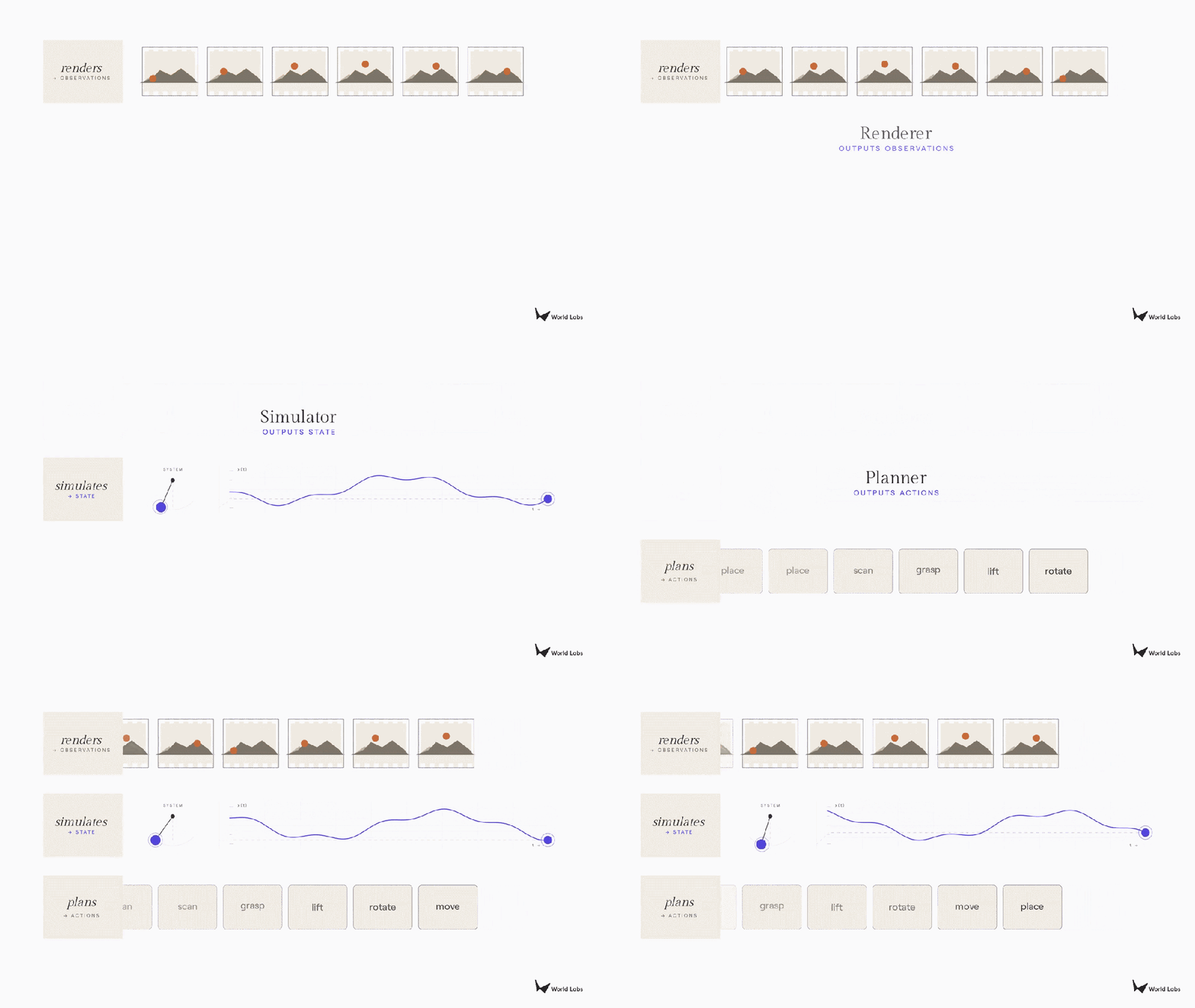
Lifeifei and World Labs divide world models into renderers, simulators, and planners, which output pixels, state of the world, and action, respectively.
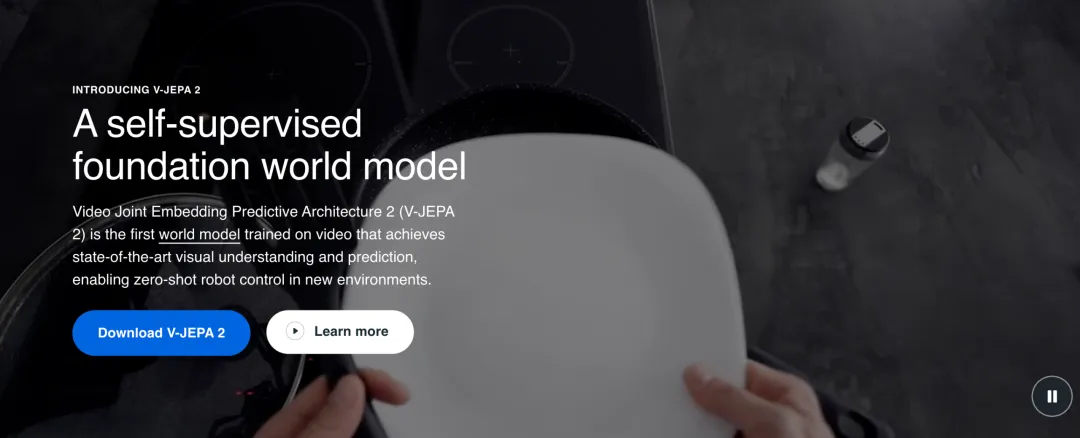
LeCun advocates the study of predictable world structures in abstract subspace, allowing models to retain information useful for understanding, reasoning and planning.
The third perspective was given by Zhu Zhong, a Chinese university. He publicly outlined the overall concept of the "general world model" when Motus published it in December last year, and in March this year he positioned it as the basis for connecting the digital world to the physical world. A few months later, Zhu Zhong and his team further refined the framework in their paper General World Models from First-Principles, defining the core capabilities of the first gender principles, and providing a five-level evolutionary roadmap.
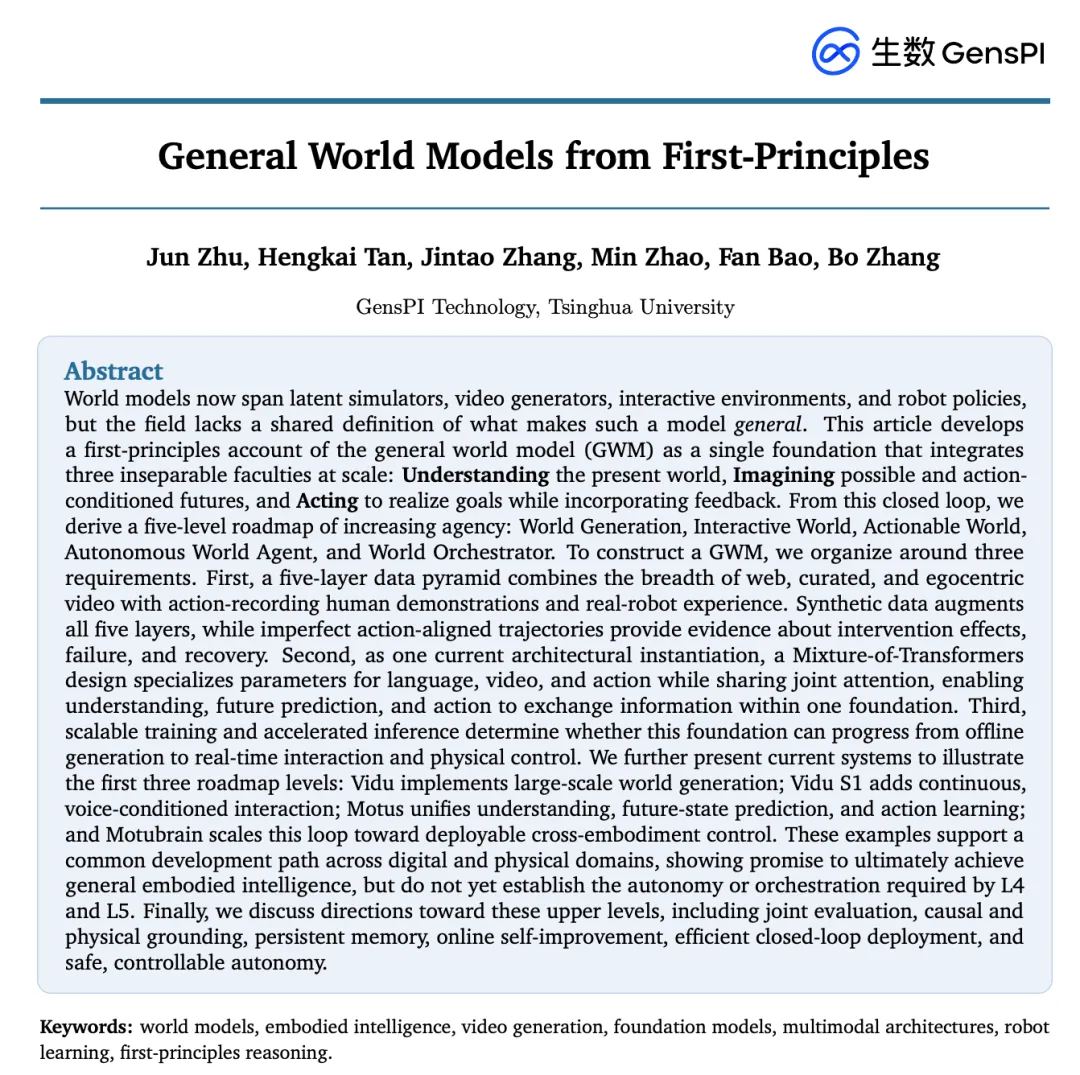
Technical report:
The paper attributes the core capabilities of the general world model to understanding, imagining, and acting. The model needs to form judgments about the present world from historical observations, project future possibilities of different choices, take action, and then modify itself with new observations.
Along this framework, video generation, real-time interaction, subspace prediction, and robotic control can be seen as different stages on the same capability path.
How far away is the world model from general intelligence and has been transformed into more specific questions: can it sustain a coherent world? can it predict the consequences of interventions? can it learn from real feedback? can it gradually target and organize more complex actions?
The First Sexual Principle of the World Model
Many people have had experience learning to ride a bicycle.
At the beginning, the body is always shaking. Seeing the car shift to one side, feeling the weight of the body begins to sink, the person will immediately adjust the direction and then continue to correct according to new feedback.
This is the simplest meaning of the world model.
In 1943, Kenneth Craik suggested that humans would form a "small-scale model" of reality in the brain, which would suggest the possible outcomes of different actions. The POMDP in reinforcement learning further describes the process by which an intelligent organism receives local observations, estimates the state of the world, takes action, and makes updated judgments based on new observations.
The team summarizes this logic as three core capabilities of the general world model, which are interconnected and form a continuously updated loop:
Understanding: the integration of information such as visual, language, sound, touch or robotic sensors into an internal judgment of the present world.
Imagination: From the present state, several possible futures are projected, especially "What would happen if I took action A instead of action B?"
Action: transforming predictions into interventions in the digital or physical environment and allowing new observations after the action to be reversed in checking and modifying models.
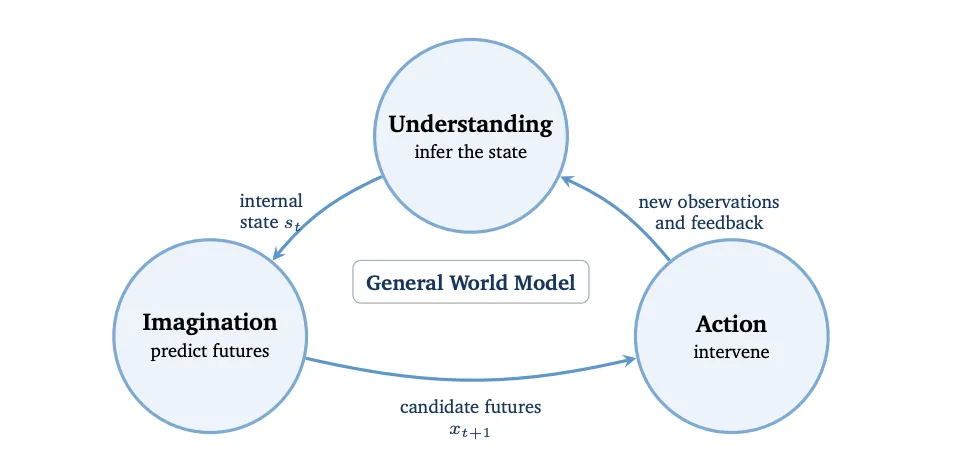
The three core capabilities of the General World Model form a closed loop: understanding the responsibility for inferring the present state, imagining the responsibility for predicting the possible future, action to change the world, and providing new evidence for the next round of understanding.
This is why video generation is not equal to the entire model of the world.
The video model can answer what the next picture might look like, but to go to the general world model, it also needs to answer, "How would the world be different if I changed this condition, moved this object, applied this action?"
How to understand, imagine, act, how to form a closed circle?
To describe how the world model evolves, the Zhu team further proposes a fifth-level route, which is to move from the L1 to create the world, the L2 to interact with the world and the L3 in the world, to the L4 autonomous world, and the L5 world organizers.
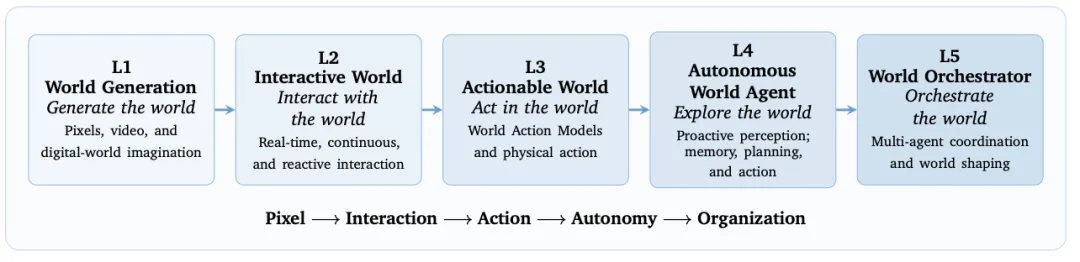
It would be more intuitive to understand with a glass that is pushed to the table.
The L1 model can generate a series of images of the cup sliding, hitting, shattering; the L2 model can continue to evolve the world after the user changes their perspective, changes their direction of pushing; the L3 model needs to judge whether the cup is going to fall, predict if the hand is reaching, and output a crawling action that the robot can actually perform. It is only after the action that it will know whether the weight, friction, and crawling timing of the cup is correct.
Back in the day, L4 was no longer just people giving instructions, it was able to detect risks, actively observe, supplement information, and correct strategies after failure. L5 was further faced with multi-stakeholder collaboration, such as who to grab cups, who to avoid, who to tune tools, and how to rearrange tasks in the face of environmental change.
The meaning of this route is that it transforms the "world model" from a noun into a set of questions that can be tested in stages.
L1 looks at whether the generation trajectory is coherent, L2 looks at whether the world can continue to respond, L3 looks at whether the model can change the physical environment, L4 looks at whether the system can actively explore and continue to learn, L5 looks at whether it can organize multidisciplinary collaboration in an open environment.
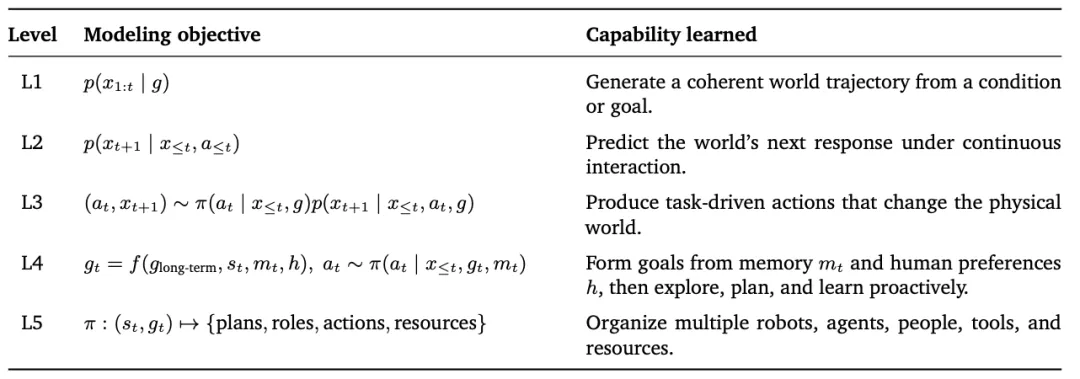
General World Model (GWM) Level 5 roadmap formal modeling goals and learning abilities.
According to the paper's judgement, existing systems have already addressed the first three levels, L4 and L5 are still open problems, with major gaps including causation and physical grounding, long-term memory, online learning, efficient deployment and security control. Assessment also compares predictions with real results, examining models' ability to migrate in unfamiliar tasks, environments and on-the-ground.
From video to physical, double verification of the same assumption
The difficulty of a world model is not just in algorithms.
Internet video is massive, recording a wide range of objects, characters, scenes, and movements, from which models can learn about spatial structure, object continuity, human behavior, and how events typically develop, but videos rarely synchronize the movements, forces, and intentions that cause change.
The path proposed by the Zhu team is to put these two types of data into a data pyramid that can be observed moving into action.
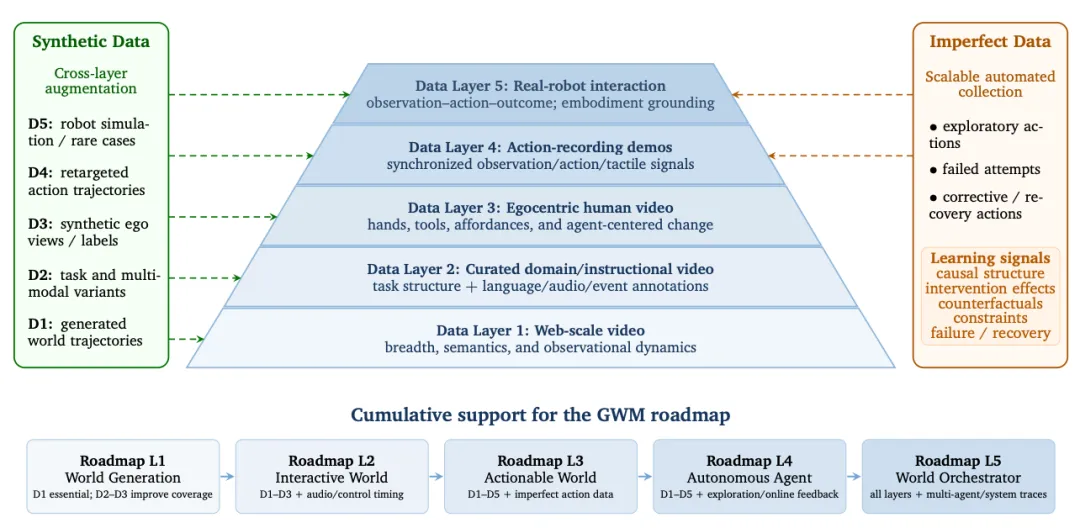
The data pyramid of the General World Model (GWM) and its relationship to the fifth-level capability routing map.
Below is the Internet-sized video, used to gain world knowledge and dynamic pioneering, followed by field video, first-person human video, human demonstrations with action recordings, and at the top is real robot interaction data. The higher the scarcity of data, the higher the cost, but the interaction between action, tasks and the robot itself is also clearer.
This explains why biotechnology is simultaneously advancing video generation and physical intelligence: the breadth of the world's knowledge is provided by video, and robotic data completes the task.
On the digital side, the Vidu series continues to explore the generation and interaction of the visual world. Video is not the end point of the world model, but an important starting point, allowing the model to learn how objects, scenes, movements and events evolve in large-scale time-space changes.
On the other side of the physical world, Mototus and Motubrain link environmental understanding, state prediction and robotic action to the same link. The model needs to look at the environment, predict the consequences of the intervention, then translate judgment into executable actions, and accept verification of the actual results.
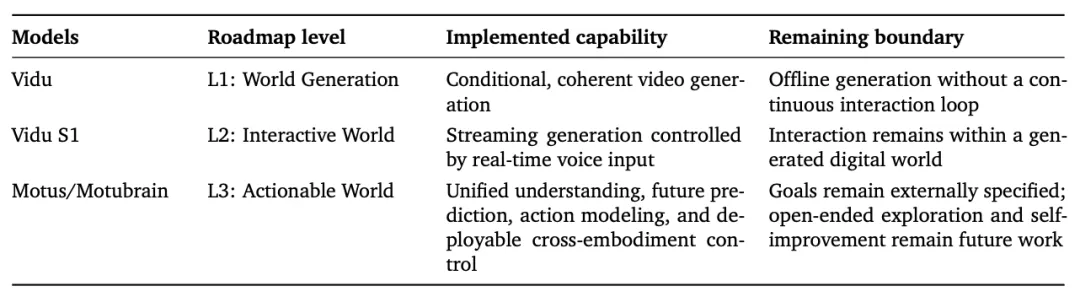
Implementation of the existing representation system from L1 to L3.
The two product lines thus form a double verification of the assumption of the same world model. Whether the digital environment test model understands and visualizes the world, physical environment test whether this knowledge supports action and is corrected in feedback.
To verify the underlying capabilities of sharing images, video, language, and robotic movements, it is necessary to synchronize computations around the same state of the world, with traditional modular systems passing information in stages, losing geometry, time, and uncertainty at interfaces. All models fully share parameters, which can also lead to training conflicts, allowing bulk video data to suppress scarce robot signals.
The MoT (Mixture-of-Transformers) architecture proposed by the Zhu team attempts to strike a balance between the two. Different models retain their respective expert parameters and exchange context through a shared attention mechanism. Vision tells what happens in the model environment, language provides goals and constraints, action brings interference with the environment, and three types of information update the model's judgment of the world.
The MoT provides a basis for unified computing, with physical laws, transnational migration, real-time reasoning and security control that still need to rely on data, training and systems engineering solutions. Its goal is clear: a universal world model requires a state of the world that can be read and written together by different models and continuously updated.
Motus2:
Let's get robots started.
Try it in your own world.
If Motus and Motubrain were to explore life-size models of the world and advance them to L3, allowing robots to generate actions based on environmental understanding and future predictions, then the recently proposed Motus 2 would add further results evaluation and strategic feedback, attempting to make the action loop self-improving.
Motus2 does not divide action generation, future simulation, and outcome evaluation into three separate systems. Instead, it uses a set of shared parameters, video-driven action models, to expose three control interfaces:
Policy / World-Action Model: proposing candidate actions that can be implemented;
Simulator / Action-Conditioned World Model: predicts the possible consequences of these actions in the visual world;
Evaluator / Value Model: Determine which outcome is closer to the goal of the task and use that judgment to select and improve.
We can think of it as a real "first mind, then hand".
The robot no longer gives an action directly after seeing an object, but first proposes a number of candidate schemes, previewing in the model the images and task progress that each will bring, and then choosing the better step. After execution, success, failure and less ideal results will no longer be just data waste, but will be evidence of the next round of dynamic modeling and value learning.
Action, prediction, evaluation, feedback and retaliation enter the same decision-making and learning cycle, which is the closed-loop evolution emphasized by Motus2.
On the data side, Motos2 uses layered training paths, extending from single-point first view video to synchronous double-point first view data, and then completing the intrinsic adaptation with robotic data. Its training uses approximately 130,000 hours of human first view recording, as well as more than 100 hours of robot trajectory and human alignment data.
This path is to allow the model to first accumulate a common experience of how humans interact with the world, and then to learn how the body can turn this understanding into action through robot data.
On the execution side, Motos2 also uses independent light touch specialists to fine-tune the short movements that are about to be performed and predict the force feedback after contact. Vision is good at seeing where objects are, how the world is changing, and touch complements the "last centimeter" that is most difficult when contact occurs, allowing the model to adjust the pressure, touch, crawling, etc.
Motus2 is still in the stage of extending from L3 to L4. Current validation focuses mainly on specific robots and operational tasks, with autonomous goal formation, durable memory, open environment generalization, long-term online learning and security controls still to be explored.
Its main advances have been to integrate strategy generation, future simulation, value assessment, and tactile feedback into a single system, enabling robots to anticipate consequences before action and use results after action to improve strategies to provide a verifiable pathway to the L4 autonomous world intelligence.
From probability learning to world intelligence
A Chinese technological path
The framework for the General World Model is also a continuation of the long-established research direction of Jiangsu and Qinghai TSAIL.
Prof. Zhu is a long-time researcher of the Bayesian methodology, probability machine learning, model generation and reinforcement learning, dealing with uncertainty, data distribution, future generation and action decisions respectively.
TSAIL has also developed and influenced a number of researchers who have joined the world's leading teams. During his undergraduate studies, he worked with Ju-Jun in Bayes studies, and during his undergraduate studies at the University of Jiangxi, where he later had a significant impact on scoring models and DDIM, respectively.
From probability modeling to generation and decision-making, this academic context also reflects the two types of inputs to the development of AGI. One is from language, which gradually enhances reasoning, tool calling and task execution; the other is from visual and dynamic worlds, which continues to move towards real-time interaction and physical action.
In the Chinese AGI industry map, IQ and BI can be seen as representative of two paths. IQ starts from language models, continuously enhancing reasoning, coding and agent capabilities; and BI starts from video generation, moving further into real-time interaction, physical action and strategy optimization.
The two routes are intersecting. Language Agents need visual feedback and environmental models, world models need language to express goals, rules and plans, and different inputs ultimately point to a common model of language, state of the world and action.
What is the meaning of this verse?
The competition for world models will ultimately shift from the shocking extent of the demo to the ability of the system to receive feedback.
Images can create a credible first impression, and geometry and physics determine whether the world can be used repeatedly, while action brings the model's judgments into reality. Whether a prediction is made, it is necessary to wait for the intervention to be confirmed; whether a mission is successful, it is also necessary to put it to the test in unfamiliar scenarios, long-term operation and continuous change.
Zhu's paper did not write the final answer to the struggle for a world model, but provided a set of questions that could be continued to test: what the model understands, how far it can imagine, and whether it can correct itself after action.
In the last decade, the most important advances in AI have come from the laws of learning language and data. At the next stage, models will also face a constantly changing environment. When models are able to continuously form judgments, assume the consequences of actions and continue learning in such an environment, world models will gradually become the basis of general intelligence from a crowded technical term.