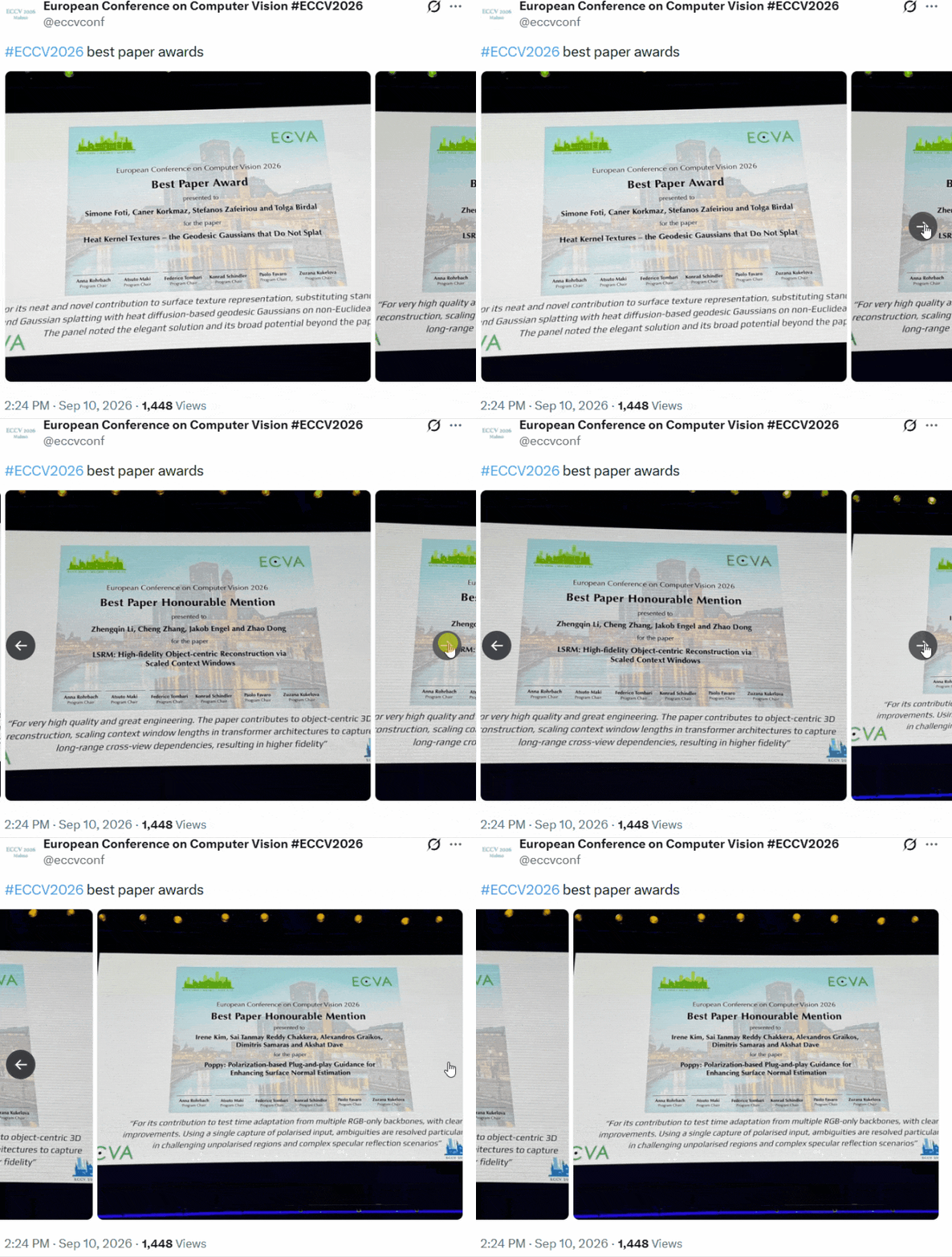
A few hours ago, ECCV announced awards such as this year's Best Paper Award.
The European Conference on Computer Vision (ECCV) is one of the world's top three conferences in the field of computer vision and enjoys a high academic reputation and influence in AI and computer science.
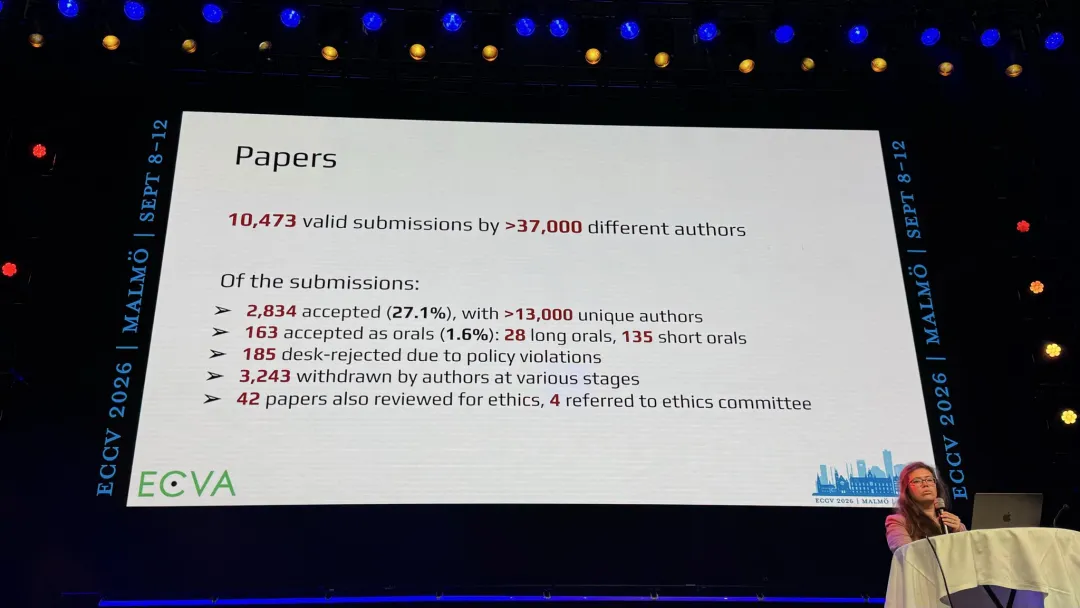
This year, the number of valid posts for ECCV papers was 10473, 2834 papers were received, with an average rate of 27.1%, and 163 entering oral, at a rate of 1.6%.
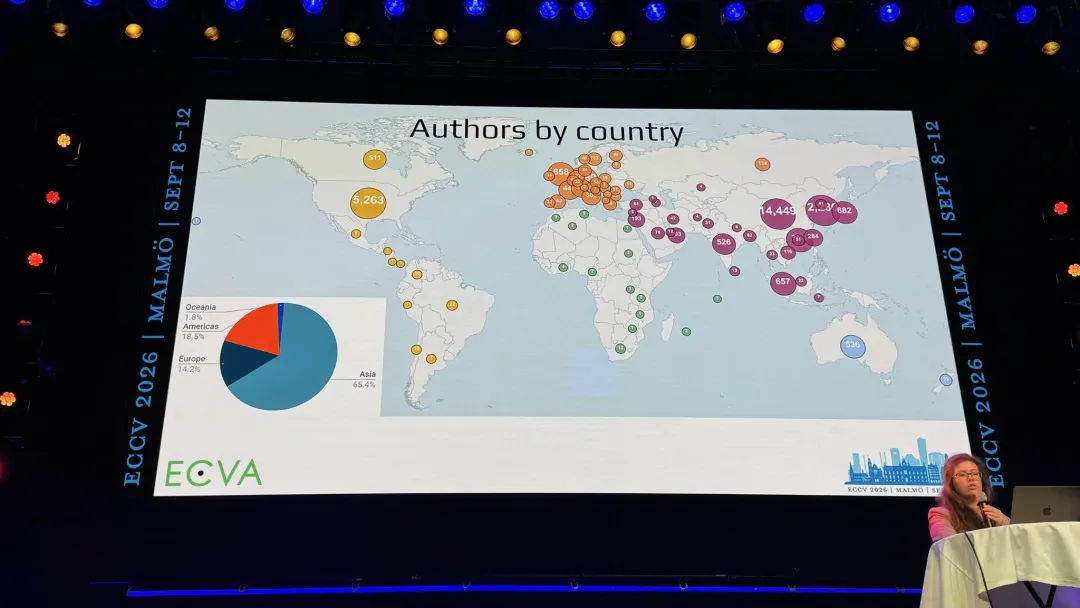
In addition, according to statistics, domestic authors have become the head of ECCV.
However, more interesting are the studies that have been approved.
Award for best paper
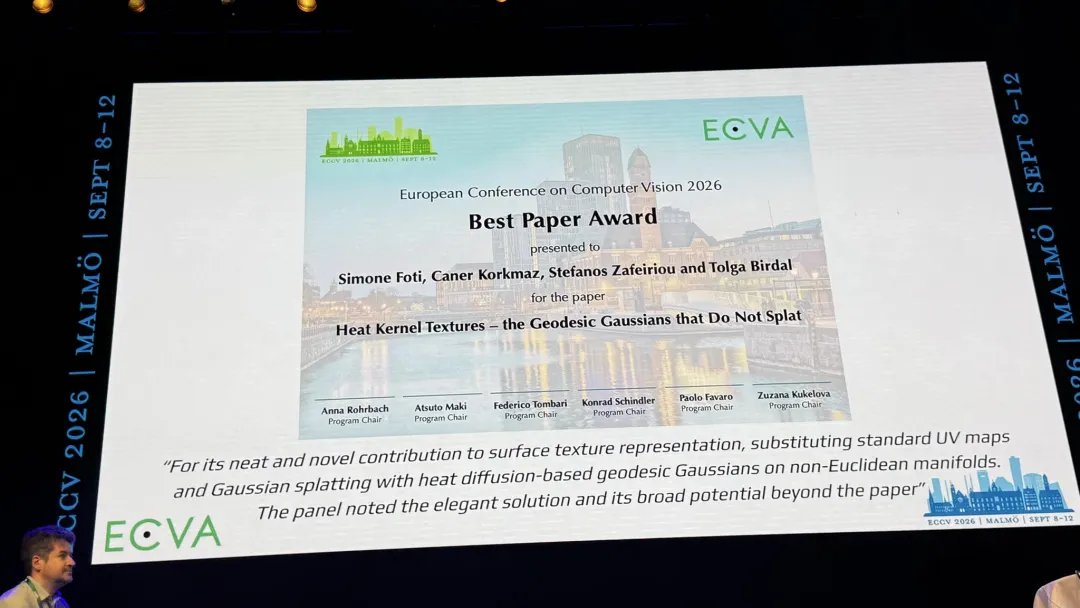
This year's prize for the best paper was awarded to the University of London's Heat Kernel Textures - the Geodesic Gaussians That Do Not Splat - by Simone Foti and Caner Korkmaz, both postdoctoral researchers and PhD students.
Reason for the award: "in recognition of its concise and innovative contributions to surface texture representation: the use of non-Euclidean fluid-based thermally diffuse geospatial gauges to replace standard UV mapping and geospatial gauges. The review committee noted that the scheme is elegant and has far greater potential than the paper itself".
Heat Kernel Textures -- the Geodesic Gaussians That Do Not Splat
Address of the paper:
Writing team: Simone Foti Caner Korkmaz Stefanos Zafeiriou Tolga Birdal
The study proposed a new method for representing 3D textures called Heat Kernel Textures, abbreviated as HKTex. It drew on the idea of 3D Gaussian Splatting to represent a large amount of Gaussian visual information, but no longer placed the Gaussian in 3D Euclidean space, but directly applied Gaussian-like thermonuclear coatings to the surface of an object's mesh.
Traditional 3D models typically use UV Mapping to attach texture, i.e. first rendering a three-dimensional surface "plain" into a two-dimensional image and then storing color on the image. This method has been used for decades, but there have been several problems: opening causes deformation, seam seams, inconsistent resolution of different regions, and a large amount of blank areas on UV images, wasting display and storage space. Complex models also need to replicate vertices at junctions.
HKTex does not use UV Maps at all.
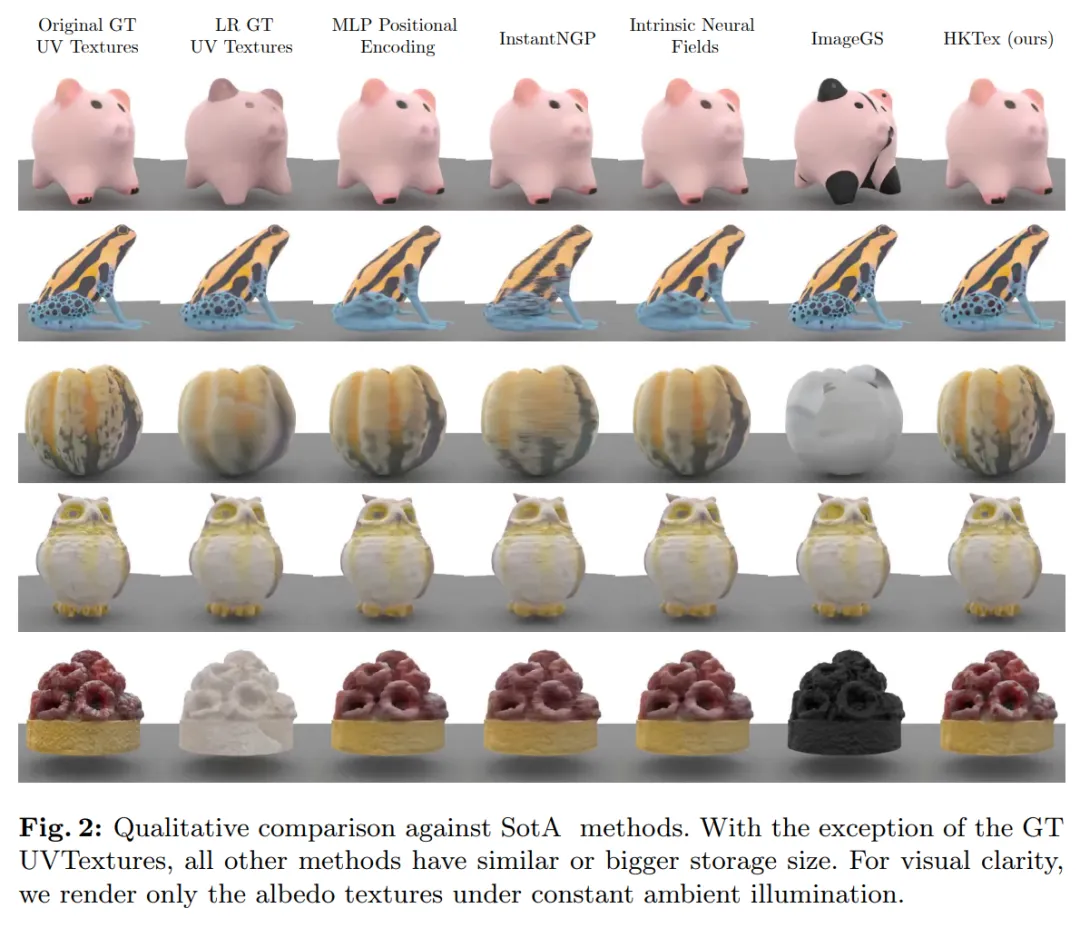
It can be imagined as: thousands of "color spots" are placed on the surface of the model, each of which resembles a Gaussian spotted along a curved geometric line. Mathematically, the author uses an anisotropic heat kernel (an heterogeneous heat core), which can be seen as a "Gaussian in curved space". Thus, even if the surface is curved, this primitive texture will naturally follow the surface curve and will not hang outside the model like a normal 3D Gaussian.
Although the method is inspired by Gaussian Splatting, it does not actually perform splatting. The dyeing time line first intersects with the Mesh and then calculates the contribution of the nearby heat kernels to the texture color dynamically at the intersection, so it can be directly integrated into a fiscally based r that can be minimized.