Soft robots have a soft structure that allows them to safely touch objects, adapt to complex environments, but can also lead to problems such as poor carrying capacity, limited accuracy of movement and poor resistance to interference.
Biological muscles provide a direct inspiration: when a person needs a steady end of the cup, precise handling tools, or resistance to external interference, the muscles that resist each other shrink at the same time.
Recently, a team from the South Pacific University of Technology published a research paper in the journal Science Advances titled Muscle Coactivation-Inspired Stiffness-Driven Control Strategy for Antagonistic Soft Robots.
Using the activation mechanism of muscle synergy, the study proposed a rigidity-driven data control strategy for anti-spinning software robots: not relying on complex parsing models, nor requiring real-time rigidity measurements, but learning robotic dynamics from simple motion data and considering movement goals and rigidity requirements while controlling the process.
The focus of this work is not simply on improving robot rigidity, but on incorporating rigidity regulation into motion controls to improve the accuracy, stability and anti-disruption capabilities of software robots.
01.
Why can't a software robot just control the location of a chip?
The basic unit in the study consists of two soft-driven cavities that are positioned back to back. When different negative pressures are applied to both sides, the robot bends to one side; while increasing the negative pressure on both sides, it can improve overall stiffness while maintaining a near-curved angle. This is similar to the way anti-muscle strain works: the difference in the variance of the cavities on both sides determines the movement, while the level of joint activation affects the stiffness.
Limited parametric results indicate that the structure's curved hardness can be increased from about 0.02 N·m/rad to about 1.79 N·m/rad, a change of about 88 times. At the same time, in a relatively close posture, the robot can be either in a low hardness state of 0.18 N·m/rad or in a high hardness state of 1.56 N·m/rad. In other words, the appearance of silicon does not mean that it is in a steady state.
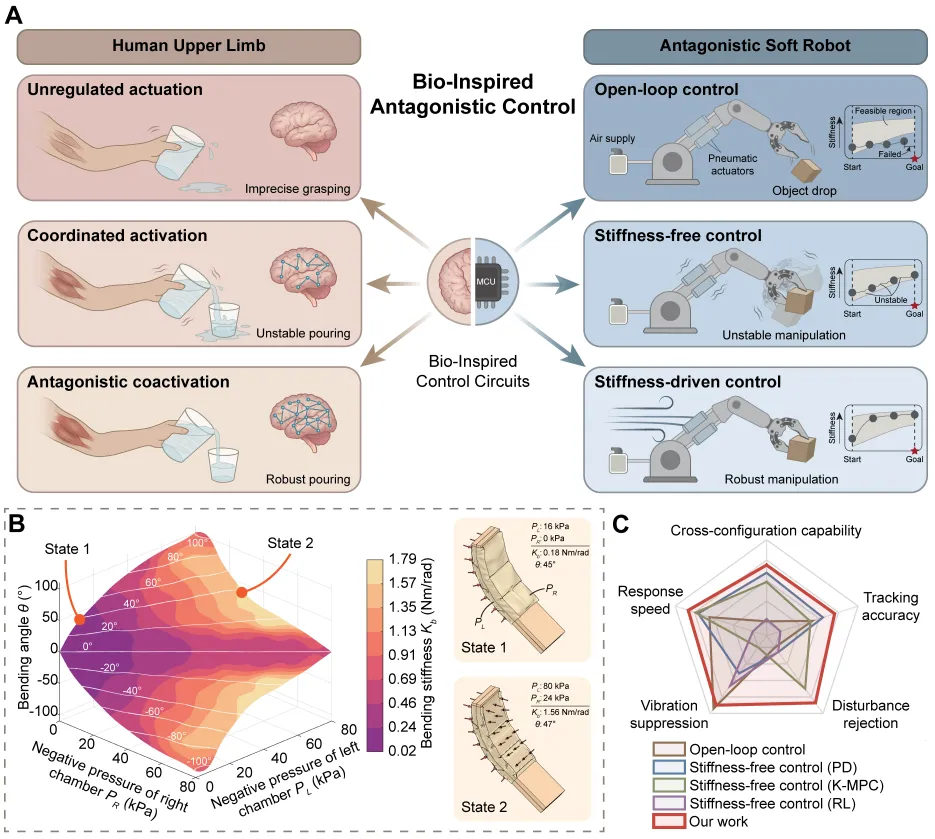
This also explains why just focusing on position errors is not enough to play a robot's performance. This is because the same target angle may correspond to multi-group control inputs, and the interference resistance, motion stability, and load performance of these inputs are not the same. If the controller ignores rigidity, the robot may be easily stunted or deflected by external interference even after reaching the target location.
02.
The design of the controller only needs to be learned from a few minutes of motion data.
Conventional methods of controlling rigidity usually require a more accurate parsing model to be built first and then calculated based on the model's position and rigidity. However, software structures have material nonlinearity, latency, friction and manufacturing differences, and model building and parameter recognition are often more difficult, and real-time measurement of rigidity is not easy.
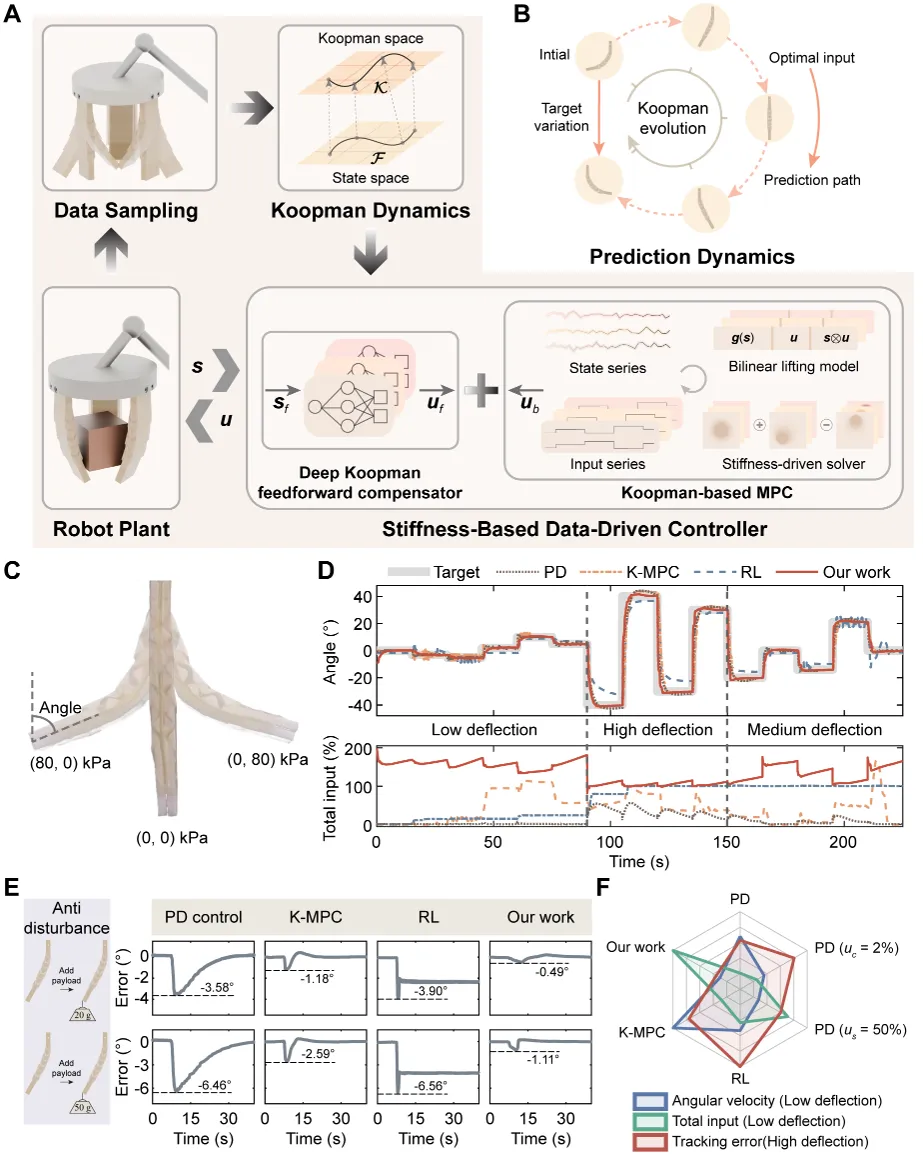
To reduce this barrier, the team constructed the Koopman Dynamics Model using robot state and time sequence data to control input. Its basic idea was to map the state of the original non-linear software robot to a higher-dimensional space, predicting future movements in this space in an approximate linear form, and then combining the model predictions to control online optimization control inputs.
The control framework consists of two key parts. The first is the rigidity-driven solver: using the relationship between the input resistance and the change in rigidity to take into account the demand for rigidity while optimizing the motion trajectory. The second is the forward compensator based on the depth of Koopman: giving a more appropriate forward input when heavily curved to improve the slow response of the soft gas system. The entire process does not require a resolution rigidity model to be written out in structure, nor does it require direct rigidity measurement in operation.
What needs to be explained is that the input and the indirect characteristics of the hardness are mainly assumed here. It is not the same as high-precision, real-time hardness measurement, but provides a calculable, optimized hardness adjustment pathway for the controller.
03.
More stable tracking and more load resistant
The team first conducted real-time tracking experiments consisting of different curvature values and compared them with PD controls, Koopman-MPC, which did not explicitly consider rigidity, and reinforcement learning controls.
In trajectory tracking experiments under different curvature values, PD, Koopman-MPC and reinforcement learning methods showed varying degrees of vibration at each of the small movement stages. In contrast, the method was able to maintain more smooth movement and track accuracy and response speed while curving significantly.
The team also imposed different loads on the robot while maintaining a certain curved angle. Because the load changed the original input deformation relationship, several control methods showed more obvious position biases. The proposed method combined with closed-loop feedback, online optimization and rigidity adjustment, reduced load-induced deformation and tracking biases, and demonstrated better resistance to disruption.
Experiments have also shown that hardness does not get better the higher the hardness. While simply adding a fixed pre-load may improve stability and anti-disruption capabilities, too much anti-shielding input will sacrifice tracking performance and response speed. Here, the real need is to optimize hardness along with the goals of the sport, finding a balance between accuracy, speed and ruggedness.
04.
The same idea that allows software robots to perform multiple tasks
After completing basic motion control verification, the team further examined whether the strategy could extend the limits of robotic applications. The experiment covered tasks such as grab, hardness perception, fluid transportation and reconstructible bridges.
It's easy, but it's also easy to catch.
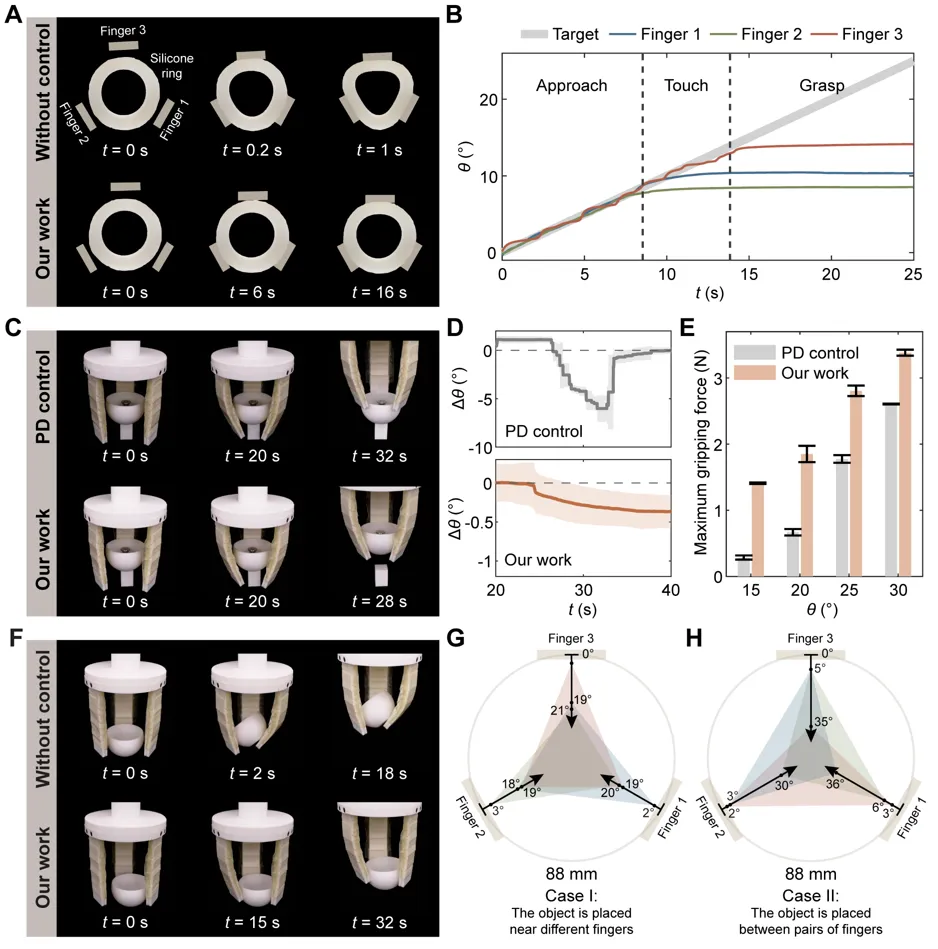
The researchers placed the three anti-fouling softness units at 120° intervals to form the three-fingered softness claws. In the face of the soft fouling ring, direct drive can easily cause noticeable squeeze deformation, while the closed-loop control can control the movement of the fingers according to the process of approaching the foil to the foil to grab the foil, reducing unnecessary deformation.
When faced with rigid objects, the problem is the opposite: if the rigidity of the fingers is insufficient, even when the angle reaches the target, it may not provide sufficient support. Compared to PD controls, the methods mentioned increase the maximum grip strength at 15°, 20°, 25° and 30° bending angles by 391%, 177%, 58% and 30% respectively.
Movie1
Before grabbing, determine how hard the object is.
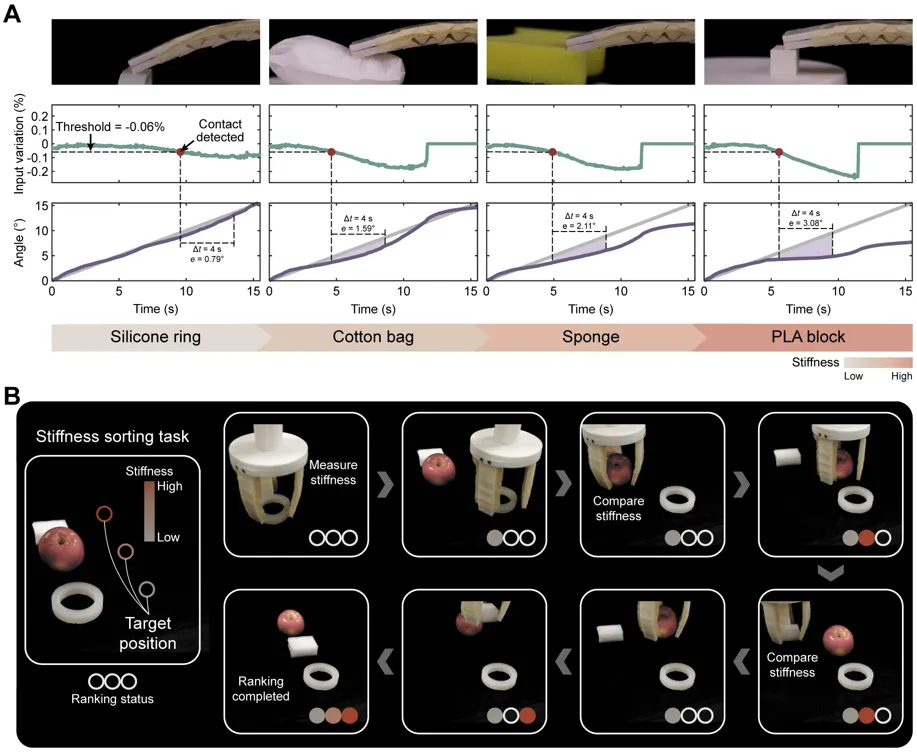
The controller can also build sensing modules using input after contact and changes in movement status. When the software unit touches an object along a predetermined trajectory, the system compares the rigidity of the object according to tracking deviations over a subsequent period of time, thus achieving the rigidity sequence of PLA models, sponges, cotton bags and rings.
On the mechanical arm platform, the three-fingered claw further completed the continuous task of measuring the clay by grabbing the clay to carry the clay. In three experiments, the clay rings, EPE bubble blocks and apple corresponding tracking errors were 2.38±0.07°, 2.66±0.05° and 3.12±0.01° respectively, thus completing the relative rigidity sequence.
From liquid transport to reconstructed bridges
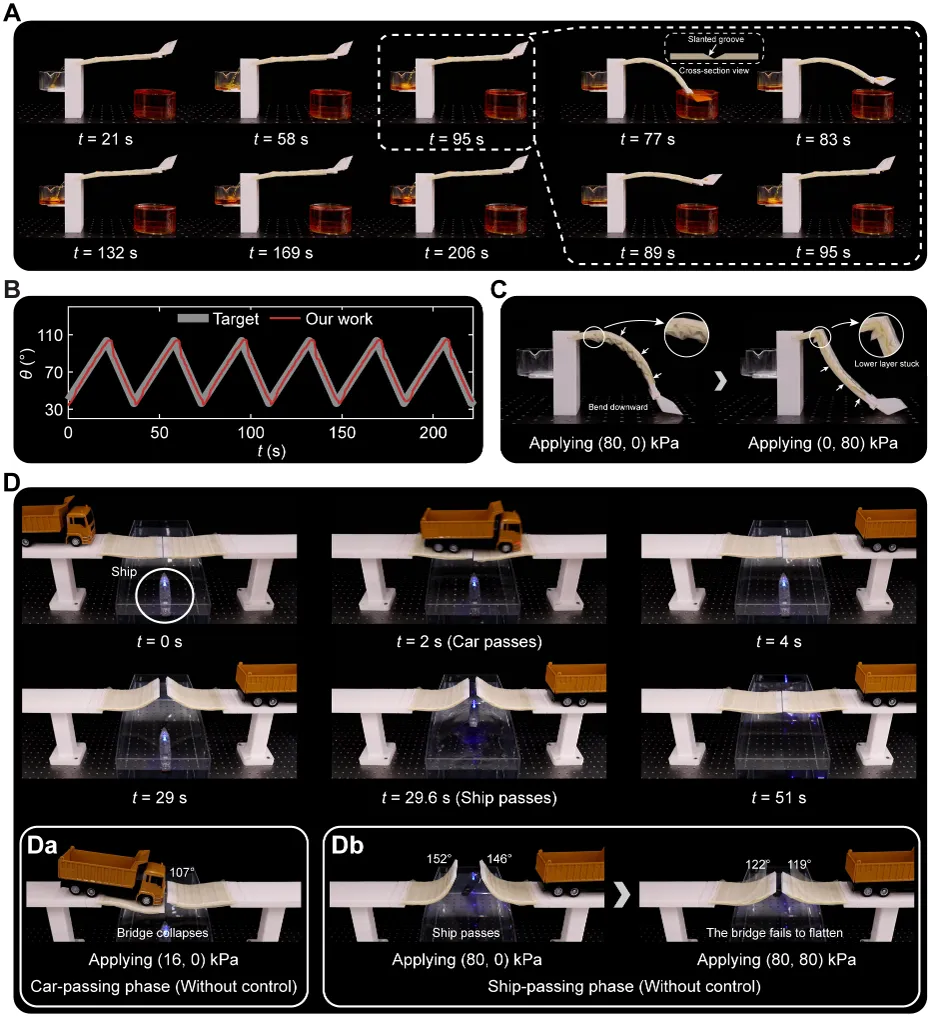
In the fluid transport experiment, the team designed the inclined trench in the center of the soft robot. The robot bends downwards to 37° to collect the fluid, then upwards to 103° at a rate of 3°/s to transport the fluid from the bottom to the top. The controller can adjust the collection angle according to fluid changes, reducing the incapacity to extract or leak liquids.
In the reconstructible bridge experiment, two anti-tank units respectively formed the two sides of the bridge: the bridge face was used to allow trucks to pass when approaching straight, and the boat to make a line when bending upwards. When relying solely on fixed input, the bridge face could sink under the vehicle load due to lack of rigidity, or could not be recovered due to structural friction and historical condition; closed-loop controls continuously modified the input according to real-time posture, allowing the bridge to switch between the two shapes.
Movie2
05.
Moving from aerodynamics to myopathy: the viability of verification methods
In order to test whether the idea relied on a certain structure or drive form, the team applied the control framework to the myelin-driven anti-software robot. The overall control structure remained unchanged, changing only the rigidity constraints by gas input to myelin-strength.
The experiments set up 0 N, 10 N, and 40 N, respectively, and tested in a non-disruptive, end-loading, and lubricating environment. The results showed that, under non-disruptive conditions, an increase from 0 N to 10 N significantly improved tracking; after continuing to increase to 40 N, yields decreased. However, in a loaded or high-resistance environment, the higher density of 40 N is more conducive to stability and accurate trajectory.
Movie3
This group of experiments further demonstrates that rigidity regulation is related to task conditions: medium rigidity may be sufficient when the environment is simpler; increased rigidity will only bring more noticeable benefits when faced with stronger loads or resistance. The goal of the controller is not to maintain a certain maximum rigidity, but to select the appropriate level of rigidity based on the task.
06.
What work has been done and what problems remain?
The main contribution of this study was to convert rigidity from the passive mechanical properties of silicon in a software robot into a variable that can be actively utilized by the controller. Through data-driven modeling, the system does not need to derive complex parsing models for each software structure; it can incorporate rigidity regulation into motion controls by countering constraints and optimizing input resistance in the absence of real-time rigidity sensors.
Its many applications also show that precise motion and rigidity regulation are not two separate things. When grabbing soft objects, it is necessary to control deformation to avoid damage; when carrying rigid objects or carrying loads, it is necessary to have sufficient rigidity; and the deviation of motion after contact can in turn provide information about the nature of the object.
At the same time, there are still clear boundaries to the current approach. Models are learned from limited data, and the original models may gradually become inaccurate after long-term aging, wear and tear or structural changes in software materials; current rigidity is mainly indirectly regulated through input and system response, rather than explicit real-time rigidity closures, and is still limited in rapidly changing contact environments. Subsequences can be combined with online learning, pressure sensing, visual feedback and multi-sensor integration, improving system long-term operation and adaptability in unstructured environments.
Therefore, the meaning of this work is more aptly summarized as: providing a relatively general path to deploying lower thresholds, allowing anti-software robots to learn the laws of motion while also using their own variable rigidity.
Paper information
Muscle Coactivation-Inspired Stiffness-Driven Control Strategy for Antagonistic Soft Robots
It was written by Ji Pan, Tianyu Chen, Junwei Li, Yifan Wang.
Unit: School of Mechanical and Aerospace Engineering, Nanyang Technological University, Singapore
† First co-author;* Communication author
It was published by Science Advances.