It's the first time in the history of the world.
AI teachers are already able to complete a number of single teaching tasks.
A mathematical problem can break down the steps; an English text can point to grammatical problems; a chessboard can also tell you how to think about the next step. In many situations, the model output is enough to be a patient instructor.
But the effect of teaching is not limited to the teacher. Whether students correct mistakes after listening, whether they just follow the instructions, whether the same explanation has different effects on different students, all happens on the student side.
AITeachers need to repeatedly observe the student's response if they want to learn personalized guidance.
In reality, these responses come primarily from human studies. Every time a teaching strategy is adjusted, students are organized to participate, collected interactions, and then evaluated artificially.
AIModels can be updated quickly, but the speed at which educational feedback is obtained is limited by the human study experimental weekly deadline.
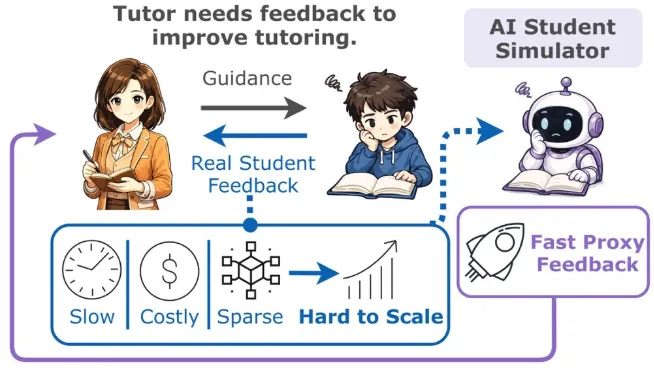
AI tutors need student feedback to improve teaching, but real feedback is more expensive. StudentSim wants to turn real student records into repeatable proxy feedback at the training stage.
The recent study of StudentSim is based on this contradiction.
The research team hopes to improveAIIn the process, the team puts the question on the student simulator: can AI students be trained with real student data that can be evaluated and replicated, so that AI teachers get more feedback during the training phase?
The article links to:https://arxiv.org/abs/2609.01591
The code link:https://github.com/microsoft/StudentSim
This is the first book in the Huggingface Paper series.
This is not isolated in today's AI agent research. User simulators are becoming a popular research area, reaching out to customers, e-commerce, clinics, and web operations. Researchers construct simulated users that allow agents to experience more interaction, testing strategies, language, and robotics before they go online.
User simulations in educational settings are more complex. Students have relatively stable knowledge boundaries, erroneous habits and learning trajectories.
Recently discussedHuman students are born digitallyIt's also about this kind of need.
Modeling students is not a new topic
From Bayes Knowledge Tracking in 1995, to Deep Knowledge Tracking, to Attention Knowledge Tracking, this direction has been explored by former students for nearly 30 years and is quite mature in student behavior.
What they have in common is that models only accept structured inputs such as titles, status, capacity values, and no natural language-guided inputs. Regardless of what teachers say, these models cannot interact to make changes in behavior like students do.
It would be convenient to have the big model play students directly. Writing "You're an elementary school student with a weak mathematical foundation" would make the model instantly replace a younger student's catchphrase with hesitation and uncertainty.
However, the tone and level of cognition of the characters are different.
One model can answer "I don't know much" with an elementary school exclamation, while the next provides a mathematical level of reasoning. It looks like it's playing students, and the actual feedback is still influenced by the model's own knowledge reserves, which may be much higher than the level of knowledge it is limited to.
This cognitive level bias is problematic when used in AI teacher training. The tutor receives not a response from a student below the current capacity limit, but a response from a high capacity model that has been packaged by humans.
This is why the ability to describe conditions as conditions alone is a fragile conditional pathway for large models. This route has been widely used in educational contexts for the past two years, including dialogue-assisted content, multi-smart body classrooms, and learner data generation. At the same time, a series of specific studies to test its effectiveness are also emerging, questioning the three perspectives of architecture, accuracy benchmarks, and teacher experience.
In education, an assessment of the effectiveness of instruction is usually not limited to how students respond independently, but also how far they can go after receiving help.
Vygotsky has proposedRecent development zone (zone of proximal development)This is what is being discussed:The gap between what students are currently able to do independently and what they are able to do with the support of their teachers reflects the space in which teaching can intervene.
The idea was later taken up by dynamic assessment as an operable measurement procedure: not only recording a student's answer yes or no, but also observing how his performance moves after giving hints.
Putting it on a student simulator, this idea corresponds to two types of abilities.
First, the simulator should be able to reproduce the state of students' independent responses, including boundaries of ability, erroneous habits and common choices. Second, the simulator should be able to produce corresponding changes after reading the instruction of the teacher, showing the updates that the student may receive with the help of the teacher.
StudentSim
StudentSim defines these capabilities as behavioral fidelity and guidance responsiveness, respectively, and trains and evaluates personalized student simulators accordingly.
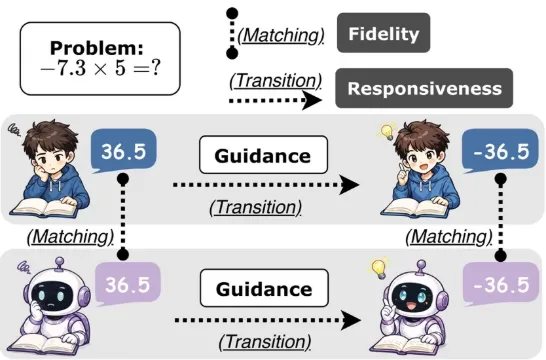
The student simulator needs to answer two questions simultaneously: whether the independent response is similar to that of the target student and whether there is a corresponding change following instruction from the teacher.
The training process is divided into two stages.
The first step is to combine the records of multiple students in a field and train a general student behavior model. This stage involves learning common mistakes, responding to formatting, and guiding corrective pathways.
The second step is to continue training using individual students' own records and get personalized simulators. Single students record less, and direct training is easier than matching; first, learn group laws, and then adapt personal data, so that each student can have a more stable access to the corresponding simulator.
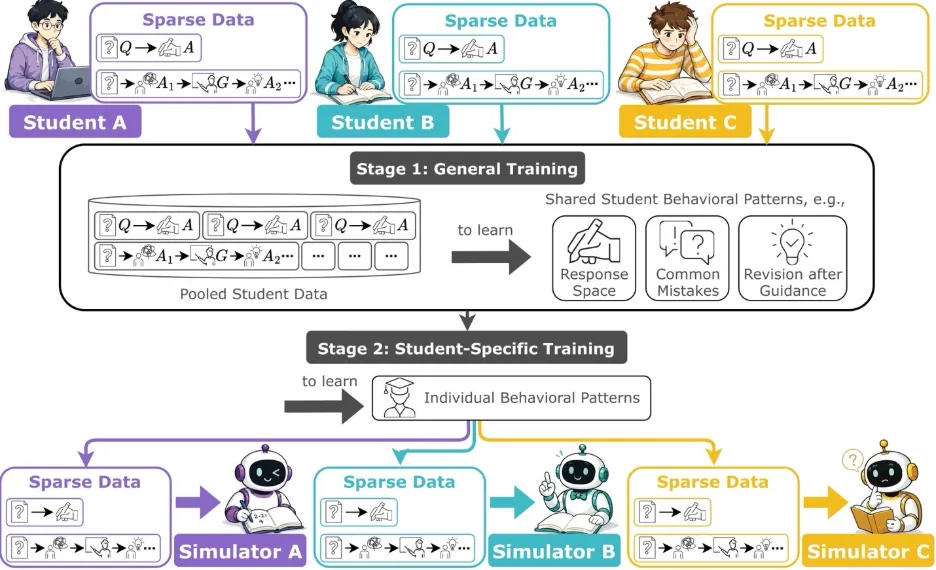
The training process
The team also constructed StudentSimEval, which evaluated 60 real-life students from three scenarios: chess, second-language English writing, and basic mathematics.
In chess, the simulator predicts the course of a player in the chessboard and changes course after instruction from the instructor. In bilingual writing, the simulator generates text that conforms to the learner's erroneous pattern and revises the script based on the teacher's critique. In mathematics, the simulator predicts the student's answer and corrects it after a lecture.
These tasks differed greatly on the surface and the objectives of the evaluation were consistent:First, see if the simulator is like the students themselves, and then see if it can respond to instruction.All methods are taken from the same student record and compared on the same held-out test record.
In chess outcomes, StudentSim's F was 0.5150, R was 0.9067; GPT-5.4 was 0.2316 and 0.7186 respectively; Maia2 was 0.4535 and 0.2721 respectively. In bilingual writing and mathematical experiments, StudentSim also exceeded the corresponding baseline on two indicators.
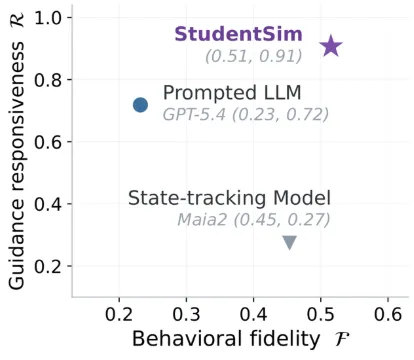
Two-dimensional results in chess ratings. GPT-5.4 responds to better guidance, but less fidelity to behaviour; Maia2 is closer to chess moves, but lacks natural language guidance input; StudentSim is higher in both indicators simultaneously.
The results showed a clear division of labor. GPT-5.4 was not reliable enough to read instruction and simulate specific students. Maia2 was closer to human chess movements, unable to absorb natural language instructor tips. StudentSim gained improvement in both individual behavior and instructional response through real-world learning record training and adaptation to each student.
However, the student simulator itself is not the purpose, and ultimately, its functionality needs to be grounded in the real world to be used to improve the teacher model.
In the past, AI tutors have been trained, and reward signals in some jobs have come from expert-labelled quality counseling conversations, as well as general large model referees using scores tables. There have also been attempts to apply the rewards to simulation students, but the adoption of cognitive levels does not guarantee real role-playing LLM students, rather than simulators trained on real learner data.
The paper further incorporates StudentSim.AI tutorStrengthening LearningThe process.
Experimental scenes are chess. The system takes out the wrong moves made by real students, the AI tutor generates instructions, and the StudentSim gives corrective moves after reading the instructions.
Stockfish is used to calculate changes in the quality of the correction path relative to the original error path, which is transmitted back to the tutor as an RL signal. The control group includes a tutor with no RL, and a tutor using GPT-5.4 as a student simulator reward.
Tutor generates guidance, a frozen AI student simulator gives modified answers, and the system updates tutors based on the quality changes before and after the modification.
The three groups of tutors use the same basic model, SFT starting points and GRPO settings, with different rewards sources.
After blind reviews from chess reviewers, StudentSim reward trained tutors ranked first in accuracy, guidance quality and personalization ratings.
Experts blindly evaluate three dimensions under conditions of disordered presentation: accuracy, proportion of responses to "no misleading fact errors", instructional quality and personalization ranging from 1 to 5 points. Tutors trained by StudentSim reward ranked first in all three dimensions.
More remarkable was a set of reverse-engineered experiments with GPT-5.4 when tutors trained by students with simulators, accuracy not only lost to StudentSim, but also lower than the baseline of completely unrealized RLs, dragging a significantly higher rate of serious fact error. The simulator was unreliable, pushing the teacher in the wrong direction: a cognitive level did not match the real students, but the ability to understand super-powered simulators, read-and-write guides could also introduce some sort of answer themselves, thus sending random rewards to the wrong guides, and the RL was optimized in the direction of confusion (or even error).
StudentSim does not replace real student experimentation with educational research. It transforms real student records into repeatable simulation feedback during the training phase, allowing AI tutors to complete more rounds of screening and optimization before entering human study.
For AI teacher systems that require personalized feedback, such as student simulators, a continuation of recent popular user simulator ideas (everyone can simulate and build a human digital hybrid), provides a disruptive engineering path:
Learning how students make mistakes, learning how students change under guidance, and reinforcing teacher model learning provide feedback signals on the machine learning time scale.