Haojie Huang is a fifth-year PhD student in computer science at Northeastern University, taught by Robert Platt and Robin Walters, with a research focus on robotic learning and deep learning in geometry. His early research focused on using symmetry to improve the sampling efficiency of simulation learning and presented original work such as Edge Grasp Net, Fourier Transporter, Imagination Policy, and recently focused on new pose-free action representation and operational learning paradigms. His work has been published in top conferences and journals such as IJRR, RSS, CoRL, ICRA, RA-L, ICLR, NeurIPS, ICML, and earned honors such as CoRL 2024 Outstanding Paper Finalist, RA-L 2026 Best Paper Honorable Mention.
If I Had One Bet on Robot Learning, I'd Bet on Cross-Entropy. The success of the big language model reveals a clear Scaling Law that applies to one-dimensional sequence data: by self-training and using the cross-entropy target function to predict the probability distribution of the next token, the model is able to model a very complex semantic probability distribution and continually improve performance as the data size and scale of the model increases.
However, it is not easy to extend this cross-entropy-based probability prediction paradigm directly to robotic learning: how should we define a robot's motion classification space and predict the motion probability distribution within a time window (temporal horizon)? The core difficulty is that robotic motion is essentially a high-dimensional cube. At every moment in the time window, the motion typically contains at least 6 or 7 degrees of freedom (including a claw).
Such a huge action space once again reveals a bitter lesson in robot-operated learning: the curse of dimensionality.
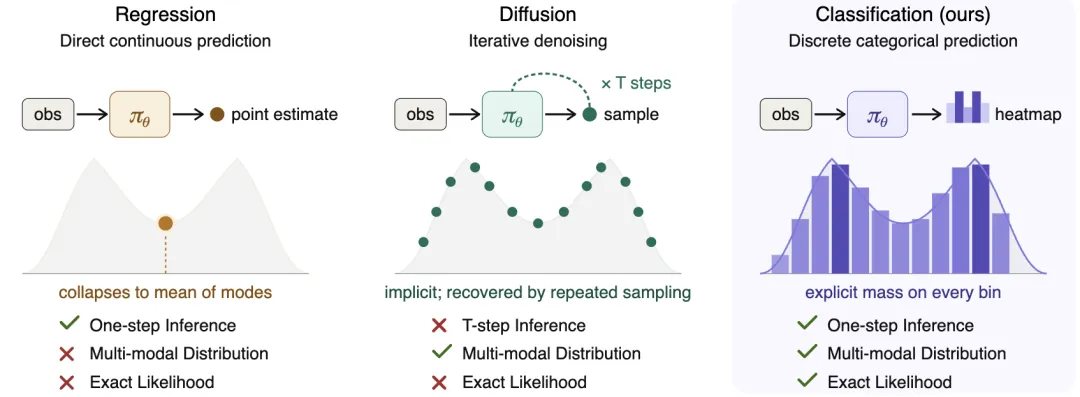
Figure1. Comparison of different policy-learning frameworks.
Action Map Policy (AMP) defines a new form of action representation. It first reverses three-dimensional motion orientation + translation as a 3D critical point trajectory and then projects these 3D critical points onto multiple camera planes. In this way, the original three-dimensional motion trajectory can be represented as a pixel trajectory in two-dimensional image space.
Project Website:
Paper Link:
The key is that AMP does not reduce noise through the scattering model, nor directly predict the location of these 2D pixel points through the regression model, but redefines the motion prediction as a pixel-level classification problem: the model predicts the probability that each pixel will be at the target key point location at different times, so that the pixel probability is distributed at each time step. With this ingenious expression of the motion, AMP first converted high-precision 3D closed-loop robot operation into a pixel classification problem in the image space, while still achieving three-dimensional operations in millimetres (less than 1 mm).
Input and output spaces are highly unified. Similar to LLM's unification of input and output in token space, AMP unifies visual observation and robotic activity into image space: input is an image, output is an action distribution defined on image. Action is no longer just an abstract low-dimensional vector, but becomes a pixel probability distribution with clear spatial significance.
Cross-entropy objective functions naturally have the ability to model complex, multi-modal probability distributions. Unlike direct regression to a defined action, classification models can naturally describe multiple actions that can be reasonably selective, which is especially important for highly multi-modal robot operations.
Compared to the diffusion-based policy that requires a multi-step inversion of noise, AMP can be used by a single model to directly obtain a distribution of movements at different times, significantly improving the speed of robot reasoning; at the same time, a complete probability distribution also makes action sampling very natural, allowing multiple different but rational action candidates to be selected based on the same observation.
Experiment 1: The model's ability to perceive and express multiple-peak distributions
First, let's look at a very simple but interesting experiment, and see what the difference is in this formulation. Four pieces of wood with exactly the same appearance are placed on the table, and the experimenter uses a laser pen to illuminate one of the pieces of wood, and the model needs to recognize this fine-grained visual signal and capture the target in the laser finger. Each piece of wood collects 10 demonstrations, for a total of only 40 demos. This experiment mainly tests two capabilities: the ability of the model to perceive fine-grained visual signals, and the ability to express multi-modal action distribution.
Diffusion Policy
Action Map policy
As can be seen, the Diffusion Policy (DiffPo) problem is apparently similar to mode collapse in this seemingly simple small test: the model is difficult to steadily grasp the pieces of wood in the finger according to the position of the laser pen. Since the experiment itself contains almost no spatial variation, the problem is not that the model needs to be generalized to the position of new objects, but rather that it exposes more directly whether the model can capture this particle condition signal and correctly express the corresponding multi-peak motion distribution.
In other words, this is not simply a problem that can be solved by adding more data. In contrast, AMP achieved a 100% success rate in this experiment, initially demonstrating its ability to perceive fine-grained visual signals and to express the distribution of multi-point motion.
Method: AMP architecture and main design
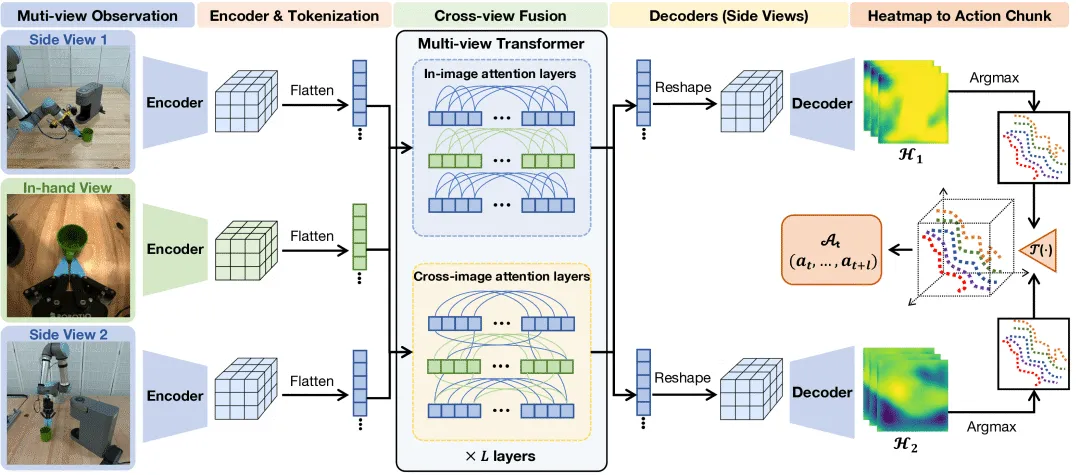
Figure2. Architecture of Action Map Policy. The left branches take one in-hand image and two side-view images as input. The center features a multi-view transformer that enables communication between the in-hand features and the side-view context features. The right branch consists of two decoders that generate heatmaps of keypoints across the temporal horizon.
AMP's overall architecture uses a set of X-Net-shaped Encoder and Decoder designs. The left-hand branch of X-Net is Encoder, which compresses the input images into latent feature maps and then expands them into tokens; the middle section is Multi-view Transformer, which contains in-image attention layers and cross-image attention layers, which are used to model features within a single image while learning and exchanging information between different camera views; the right-hand branch is Decoder, which redecodes features into heatmaps with the same spatial resolution as the input image, to express the probability distribution of different keypoints at different pixel locations at different times.
The model training process does not require any explicit 3D trajectory monitoring, but is completed end-to-end in the image space. At the reasoning stage, the model first selects the most likely pixel position in the heatmap by using argmax to obtain the keypoint motion trajectory on the two-dimensional image plane; it then combines the camera's inputs and outputs to restore the corresponding 3D space trajectory through triangulation (triangle measurement).
Experiment 2:3D Closed-Loop simulation of real machine learning
AMP was validated in three breakfast scene missions: making coffee, baking bread, and steaming eggs. These missions examined the model's high-precision operation capabilities as well as its ability to execute long-term multi-step tasks. For example, placing coffee capsules accurately into a coffee maker, inserting bread crumbs into a narrow oven, pressing buttons or a lever, and closing the lids of the steamer accurately required higher spatial precision and stable locking control.
Making Coffee: The robot needs to open the coffee machine lid, put it in the coffee capsule, place the cup, and finally press the start button.
Toast Bread: The robot needs to put two pieces of bread into the slot of the toast maker and press the trigger to start baking.
Steam Egg: The robot needs to place the three eggs in the corresponding slot of the evaporator, and finally the seal is precisely placed on the evaporator.
These three tasks contain multiple successive operating stages, so not only do they test the precision of single-step movements, but they also test the model's ability to stay in the task state for a longer period of time and continue to complete subsequent operations.
AMP-Breakfast Combo-Make Coffee
AMP-Breakfast Combo-Toast Bread
AMP-Breakfast Combo-Steam Egg
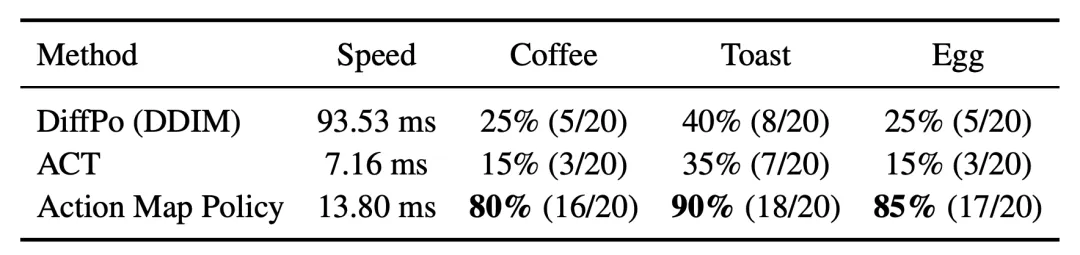
Table 1: Real-world performance Comparison.
The results showed that: 1) AMP was significantly better than Diffusion Policy (DiffPo) and ACT in three tasks, improving the success rate by about 50% and 70% respectively. When the test scene was subject to greater spatial variation (spatial variation) or higher operating accuracy requirements, the performance of both baselines decreased significantly, while AMP maintained a stronger spatial generalization capability and stable operating accuracy. 2) AMP's reasoning speed was also significantly faster.
Additional Experiments
The AMP article also systematically analyzes the operational accuracy that this method can achieve. Experiments show that the reconstruction accuracy of 3D motion is almost linearly correlated with the resolution of the input image; at 224×224 image resolution, AMP can achieve a position reconstruction error of about 1 mm and a rotation error of 1.3°. In addition, the article also includes a large number of simulation experiments and a detailed ablation study to further analyze the role of different components in motion expression, model architecture and training design.
Compared to the World Action Model (WAM), AMP will focus action reasoning on more compact pixel-level key points of expression, rather than representing a future state by generating images or videos like WAM, and then retrieving robot movements from visual prediction via inverse dynamics layers. Thus, AMP avoids the additional computational costs of high-dimensional image generation, making it lighter and more efficient in terms of motion expression, computational resource requirements and reasoning speeds.