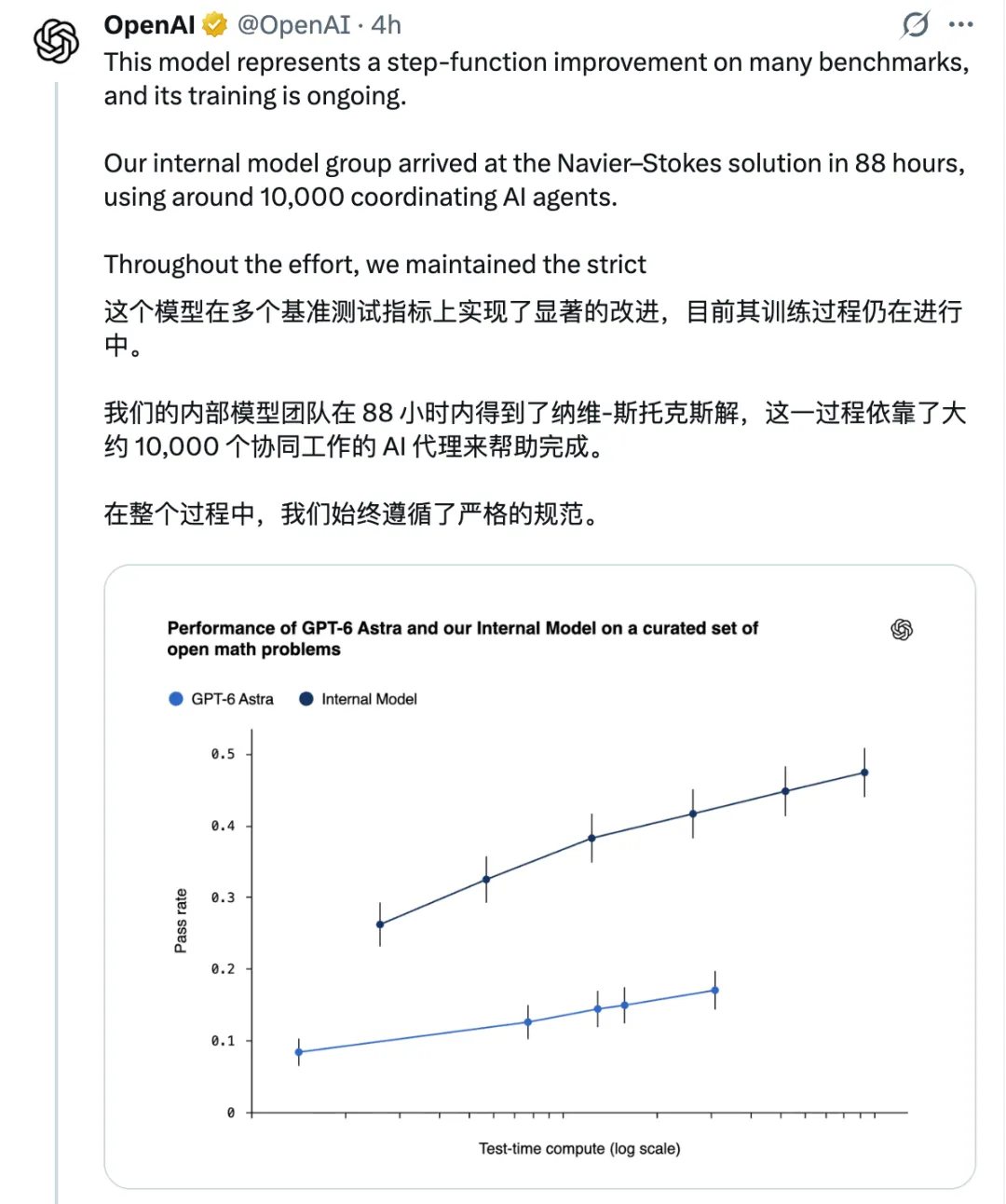
OpenAI just released a major news release saying that they used an unpublished next-generation flagship model more powerful than GPT-6 Astra to combine about 10,000 collaborative AI Agents, and in just 88 hours, tackled one of the seven-thousand-year-old puzzles of the Cray Mathematics Institute, the existence and smoothness of the Navier-Stokes Equation.
In the last 90 years, no one has addressed the issue, with a $1 million reward each.
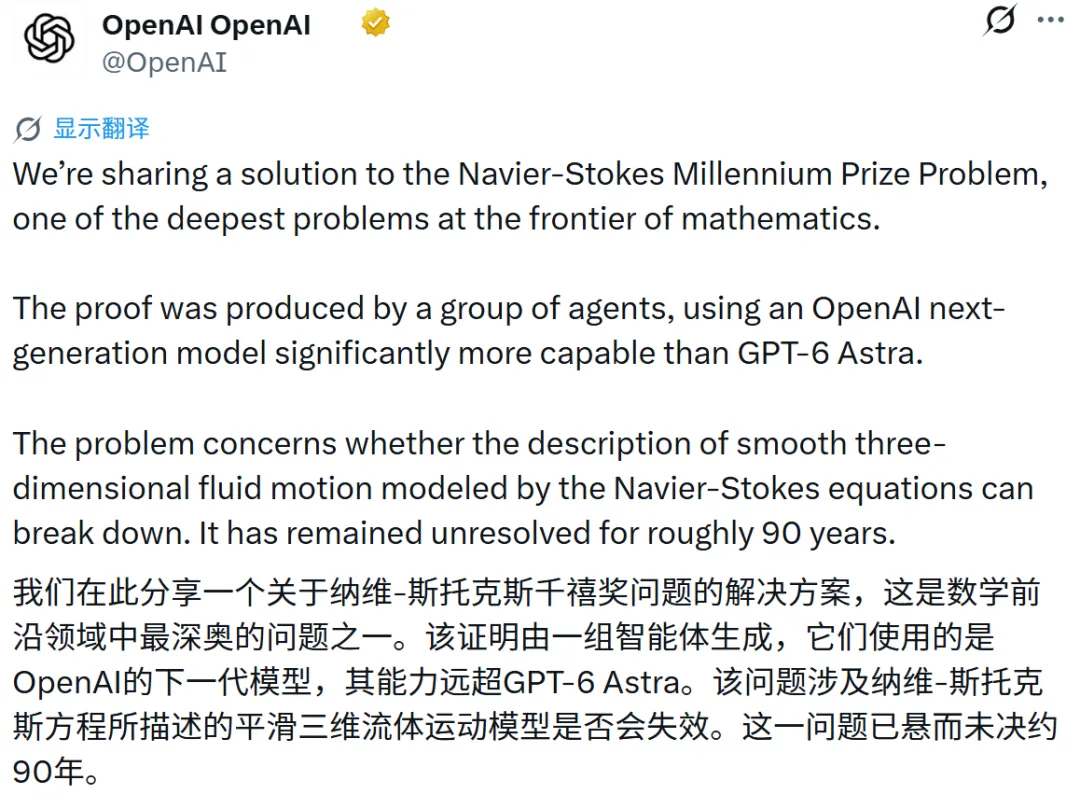
The statement was accompanied by a complete 166-page mathematical derivative paper and the accompanying Lean Formal Mathematical Verification Code.
In addition, OpenAI made it clear in a tweet that it would give up the $1 million prize to the Clay Mathematical Institute, claiming that the core value of this achievement is to show the world that AI (AGI) is truly turning into the engine that drives scientific exploration at the forefront of humanity.
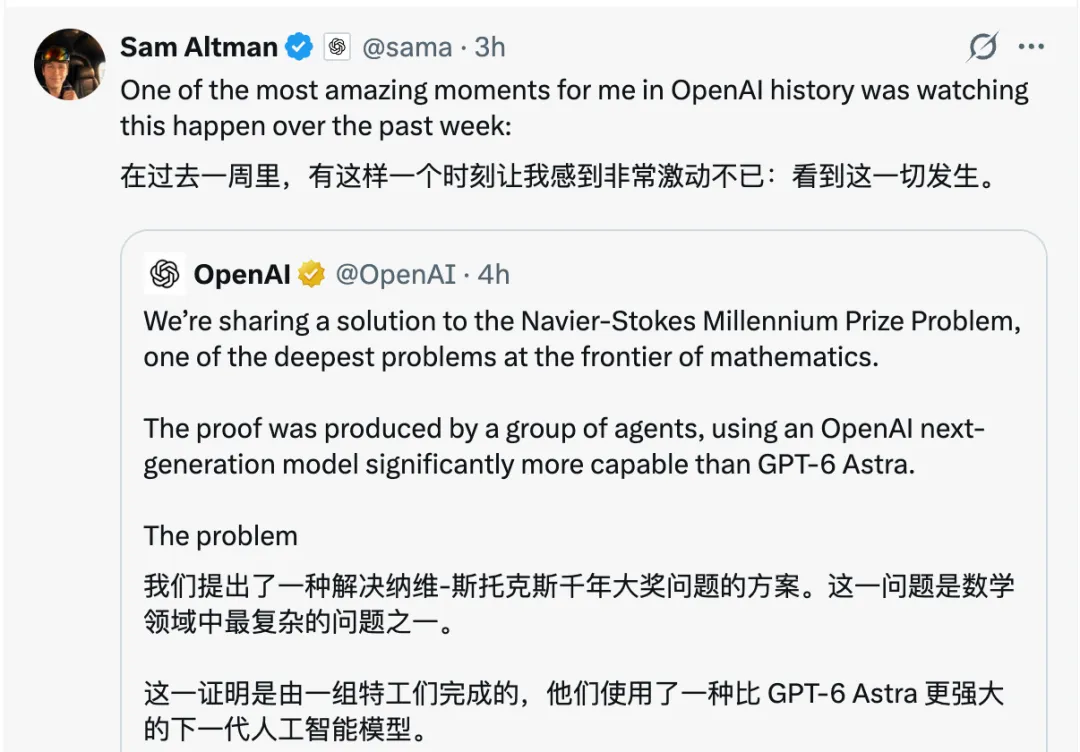
Sam Altman said: "For me, one of the most shocking moments in the history of OpenAI has been witnessing this happen over the past week".
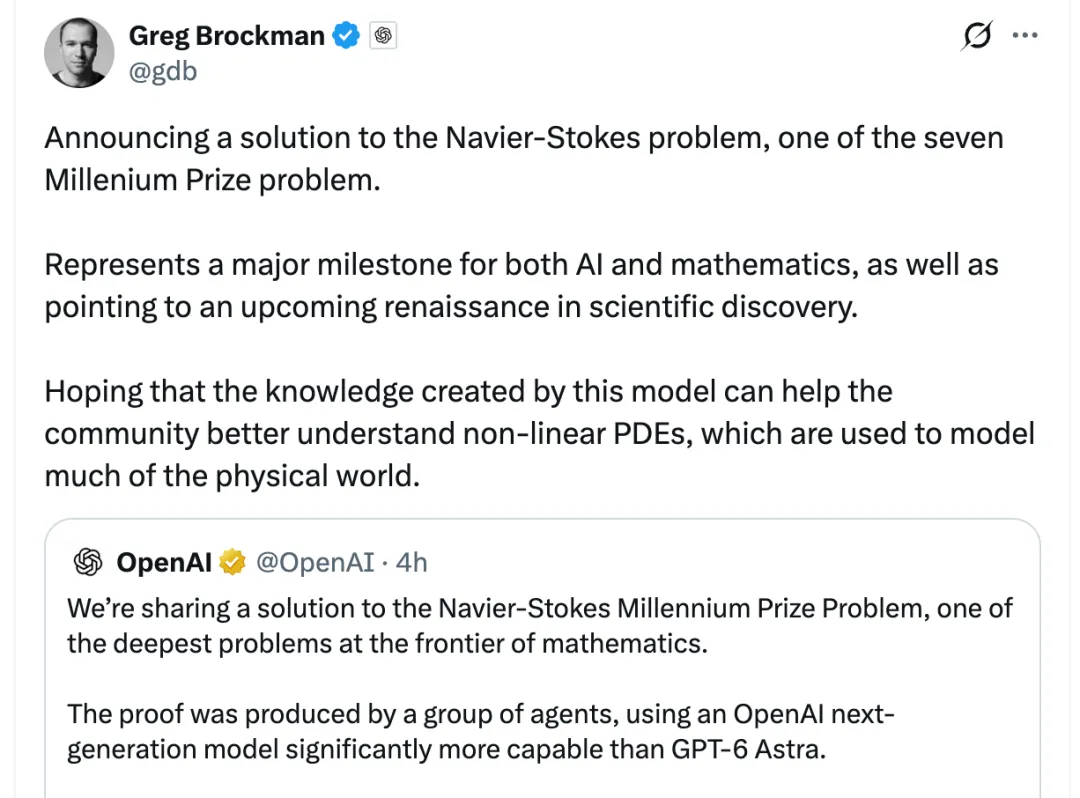
Greg Brockman also said: "This marks a major milestone in AI and mathematics, and it also predicts a whole new revival of scientific exploration".
So what is the "Navi-Stokes problem", one of the Seven Millennium Puzzles, and how is OpenAI tackled?
The faster the spin, the faster the spin.
Navi Stocks' equation can be understood as Newton's second law of motion in the fluid world.
It considers fluid as a continuous medium that describes the movement of water, air, and even blood through factors such as velocity, pressure, viscosity, and external force. Aircraft design, weather forecasting, and blood flow studies are not separate from it.
The question that has plagued the mathematical community is: if the 3D fluid is initially smooth enough, can it remain smooth forever, or will it suddenly appear in a limited amount of time?
"Curiosity" here means that the local flow rate calculated by the equation increases infinitely in a limited amount of time. Fluids in reality cannot, of course, reach infinity, so that the curiosity represents a continuous flow model that is ineffective at this time.
The Cray Institute's official thesis allows for four solutions: A, B, which requires that solutions in the absence of foreign forces always exist and remain smooth; and C, D, which allows for the construction of a smooth foreign force that makes it impossible for the equation to maintain a smooth solution at all times.
OpenAI has chosen the C-D direction.
In this 166-page paper, the fluid is initially stationary and subsequently subjected to a smooth external force that is limited in both space and time.
The system gradually forms a spiral. The fluid continues to rotate towards the center, with the spiral core continuously shrinking and being extended along the axis. OpenAI describes it as an increasingly thin Italian flavor.
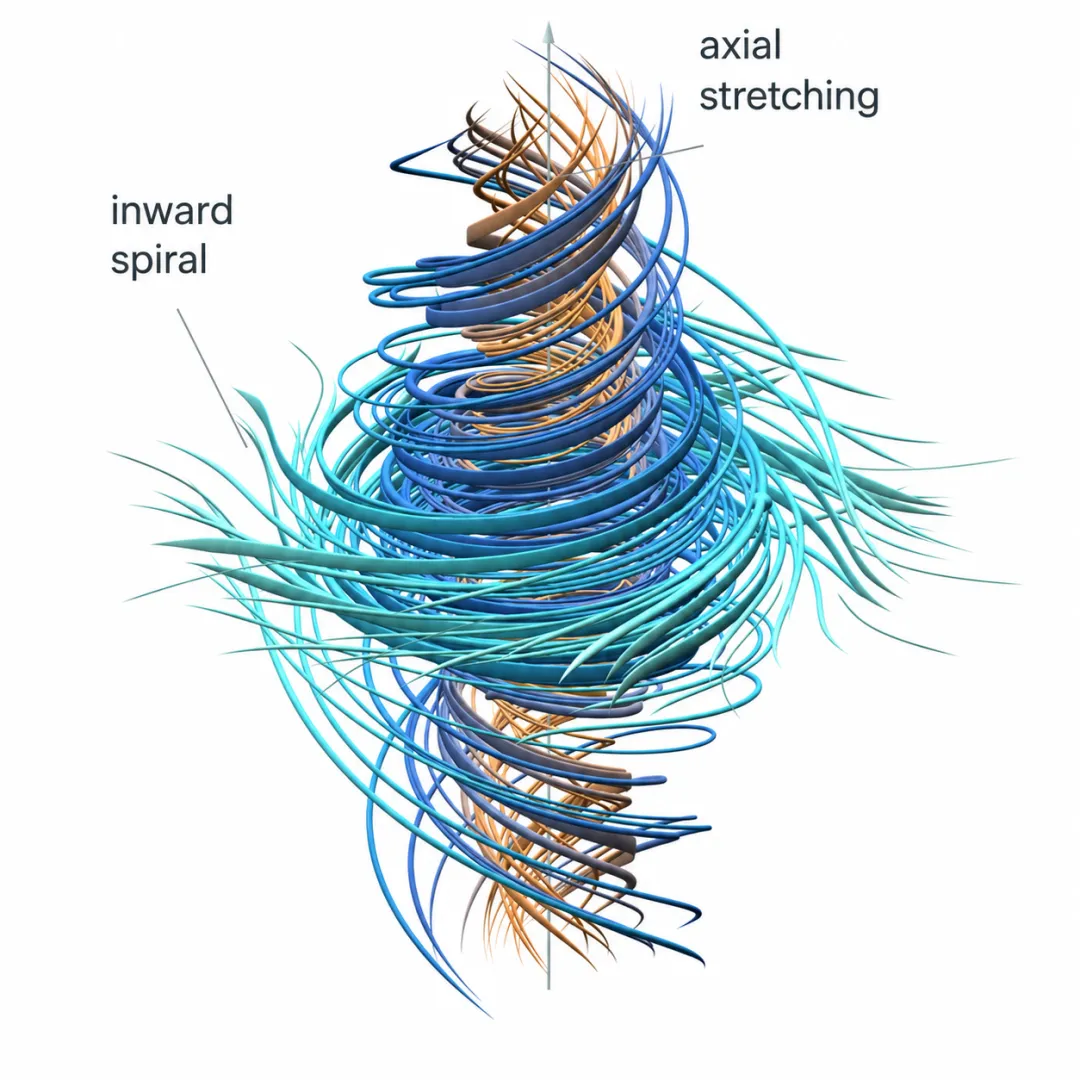
The fluid rotates inward and stretches along the axis, the center of rotation shrinks and the local speed increases. Image source: OpenAI
As the core shrinks, the fluid rotates more and more rapidly, and the local velocity eventually becomes infinite in a limited amount of time. At the same time, the areas of intense motion are also shrinking rapidly, so the dynamics of the entire system remain limited.
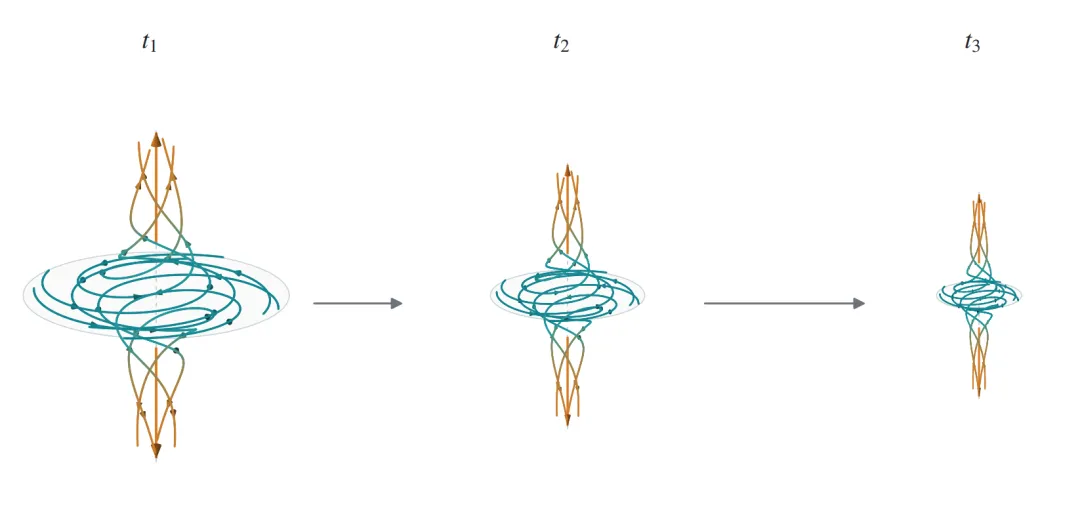
As the odd times approach, the area of intense flow is shrinking and increasing. Image source: OpenAI paper
The most difficult thing to prove is that it is not possible to create an infinite amount of extraneous force by adding human beings. Things like acceleration, pressure gradient, motion transfer and elasticity increase rapidly, and they must offset each other in an extremely precise way, ultimately leaving a smooth extraneous force somewhere.
If the set were to be constructed, it would prove that the three-dimensional Stokes equation is indeed likely to collapse within a limited time, corresponding to the two cases of C, D in the Cray Institute's official title.
10 Agents make up a math research team
The way Agent is organized behind this result is amazing.
OpenAI did not allow all Agents to repeat attempts along the same route, but instead divided them into groups of different sizes. Different groups obtained slightly different problem descriptions, respectively exploring the A, B directions that proved to be always smooth, and finding the C, D directions that were limited in time.
These Agents can read the cached version of the Internet, run the code, and communicate with other Agents in the group.
After the start of the project, OpenAI also allowed some of the agents to try relatively easy problems, including the Eura equation after eliminating the static object. Nearly 100 agents collaborated for about 50 hours, leading to the limited-time proof of the zero-energy Eura equation.
After seeing progress on this route, OpenAI focused resources on other issues on NaviNastokes and provided the results of the Eura equation to the subsequent Agent.
Intermediate results produced by different groups are also regularly summarized. OpenAI uses Codex to organize the most valuable ideas of each group and then pass these clues on to other groups to achieve cross-referencing between different research routes. As training continues, new versions of the internal models are also successively replaced in the system.
About 88 hours after the launch of the first agents, the system came up with the Navientox solution on September 5th. Subsequently, the GPT-6 Astra took another 17 hours to complete Lean formalization and verification.
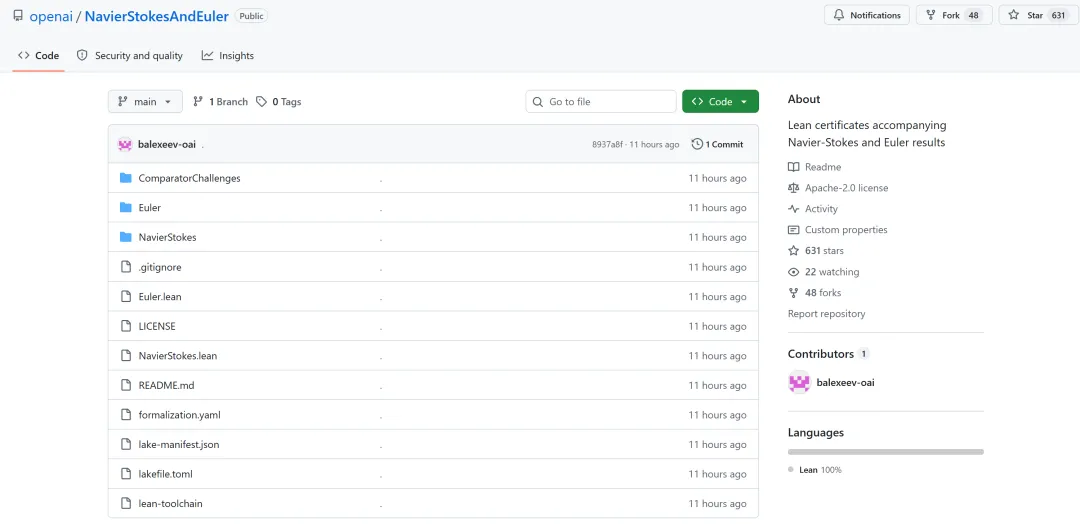
OpenAI simultaneously opened Lean formalized code for the results of the Naveen Stocks and Eura equations.
Throughout the entire evaluation process, all Agents exchanged 4.9 million messages, generating about 30 billion Token outputs. Of these, the NaviStock project accounted for 2.7 million messages and about 13 billion Tokens.
Mark Chen, head of research at OpenAI, also revealed at a press conference that the computational cost of solving the problem alone was "millions of dollars".
The capability of this demonstration thus encompasses two levels: a stronger next-generation model, and a collaborative system to organize tens of thousands of agents into research teams and to continuously exchange and screen results.
OpenAI emphasizes that security measures applicable to the evaluation of front-end models, including continuous monitoring and isolation environments, have always been maintained throughout the process.
AI steals other people's research?
Shortly after the announcement, the evidence was embroiled in a dispute over user data and results.
New York University mathematics professor Tristan Buckmaster and Anthropic researcher Levent Alpöge have also previously studied the problem of close fluid equations.
According to a four-page statement released by Buckmaster, the studies of the two were based on years of work by Diego Córdoba and Luis Martínez-Zoroa, and were extensively used by them to compile and review evidence after the release of Claude, Codex and GPT-5.6 Sol.
The following is the link:
According to Buckmaster, the two achieved the three-dimensional uncompressed Eura equation's time-limited odd-point result with a smooth extraneous force on August 15 and completed Lean verification on August 22.
On September 3, after rumors circulated that Anthropic researchers had solved major mathematical problems, Buckmaster actively contacted OpenAI. OpenAI had already launched an internal model to explore several millennia-old puzzles on a massive scale.
Buckmaster said he was alarmed when he later learned that OpenAI was using a smooth-extraneous route to solve the Navientox problem. Because he and Alpöge had been working on long-term unpublished manuscripts through the Codex, a research route that was relatively rare in mathematics.
He then asked OpenAI whether the internal model had visited the two Codex sessions, or had used the data to train. OpenAI told him that the model did not query user data, but Buckmaster said he did not get a clear answer about the training data.
Buckmaster also claimed that OpenAI had proposed a separate Naveenstox paper published by him and would exclude from signing Anthropic's Alpöge.
OpenAI researcher Sébastien Bubeck denied this claim and showed some chat clips. He never requested that Alpöge be removed from "his own work" and said the communication was to coordinate the timing of the two releases.
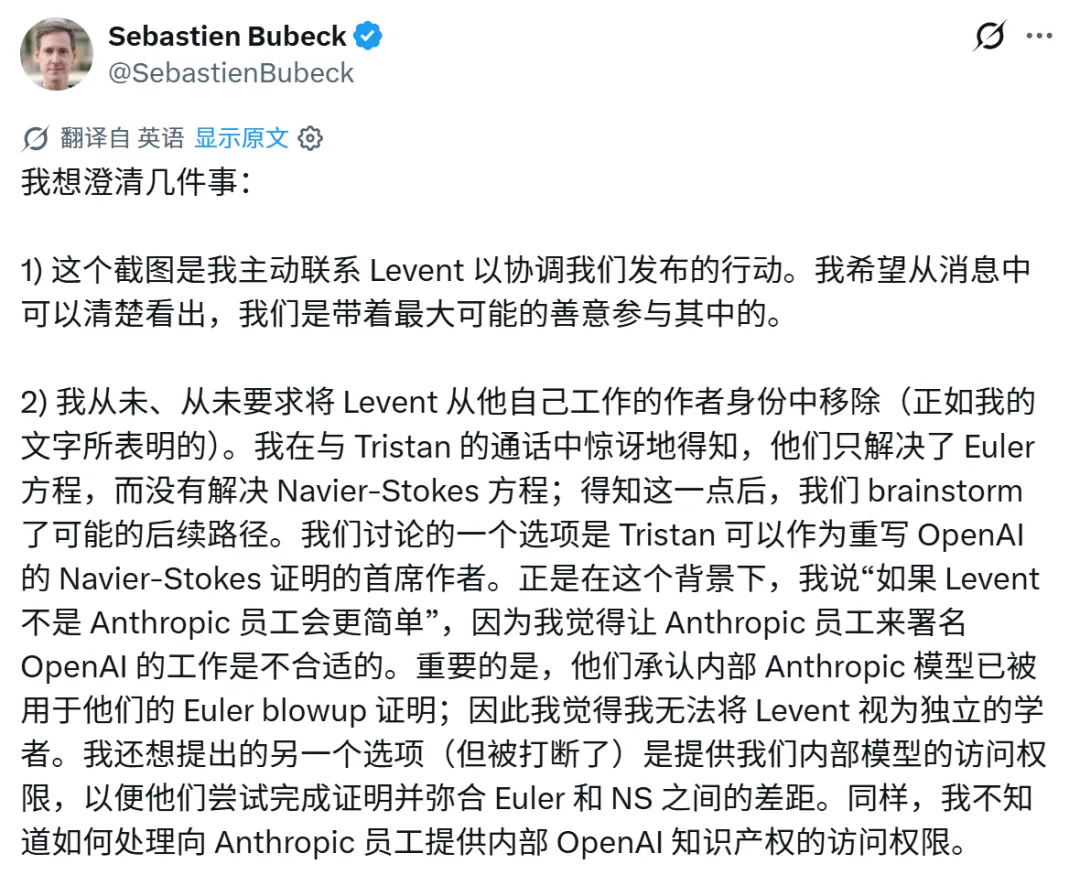
OpenAI responded on its official blog that prior to the public release of Buckmaster and Alpöge, neither the OpenAI researchers nor the Agent had seen their results in any way, nor had they accessed specific user data to solve problems.
However, OpenAI also said that the company could not entirely rule out identifying data generated by two people who used OpenAI products to help model training in some way.
OpenAI also stressed that the two groups of work solved different specific problems: Buckmaster and Alpöge solved the extrapolating Eura equation, OpenAI's Agent solved the non-extropolating Eura equation; OpenAI's now-published Naveenstock proof contained smooth extrapolating.
Less than a week after the launch of Astra, the next generation of models has arrived.
OpenAI began training the internal model on August 28.
Officials did not disclose its name, parametric scale and specific benchmark scores, only revealing that its mathematical capabilities have improved unprecedentedly and that its performance continues to grow as training continues.
In this study, it was responsible for leading around 10,000 agents looking for evidence, while the newly-released Astra "retired second line" took an additional 17 hours to complete the formalization and verification of Lean.
An unpublished model, which mobilizes 10,000 Agents, explores almost a hundred years of human research in 88 hours. Perhaps the way mathematical research is organized and how we understand the speed at which AI is advancing will need to be reshaped.
OpenAI says it is focusing on understanding the model and thus determining the pace at which future capabilities will be improved.
Perhaps this 88-hour "Mathematical Struggle" is just one corner of the next generation's model capabilities.
The link is as follows: