One of the most exciting stories about AI in the last two years has been to let models improve themselves: they generate training data themselves, they rewrite tips themselves, they repair their own code.Recursive self-improvement (RSI) is a measure of self-improvement.。
The answer is no. From STaR, Self-Refine, to STOP, Darwin Gödel Machine, ADAS, AFlow, almost all RSI systems follow the same structure, a fixed set of improvements that repeatedly work on the model.So even if the model is getting stronger, "the way to make the model stronger" is completely fixed and thus limited to one stage of self-improvement.。
Recently, a team of researchers from more than a dozen of the top offshore universities in the world, including Stanford, Berkeley, MIT, Qingdao, and North Korea, released the MetaRSI-v1 technology report, which presents the world's first unified Model-RSI, Data-RSI, Harness-RSI, and Harness-RSI iterative self-improvement architecture.For the first time, the recurring role of self-improvement in the RSI's self-perpetuating self-improvement has entered the "square age".。
MetaRSI/RSI^2 A Meta-Recursive Self-Improving System for Recursive Self-Improving Systems Themselves
The main page of the project:https://github.com/CosmosMind-ai/RSI-Harness
The paper:
HuggingFace:
In the absence of any external teacher model involvedMetaRSI-v1 makes it a small model with only 3 billion activated parameters.Self-improvement averaged 10.9 points across four benchmarksIt also has six flagship models, including the GPT-5.6 and the Claude Opus 5.Average increase of 7.3 pointsMore important than the numbers, MetaRSI-v1 is a set of attempts.Unifying the entire RSI architectural languageOne core, two sequence axes, three arithmetic, an entire sub-RSI layer, and the five laws.
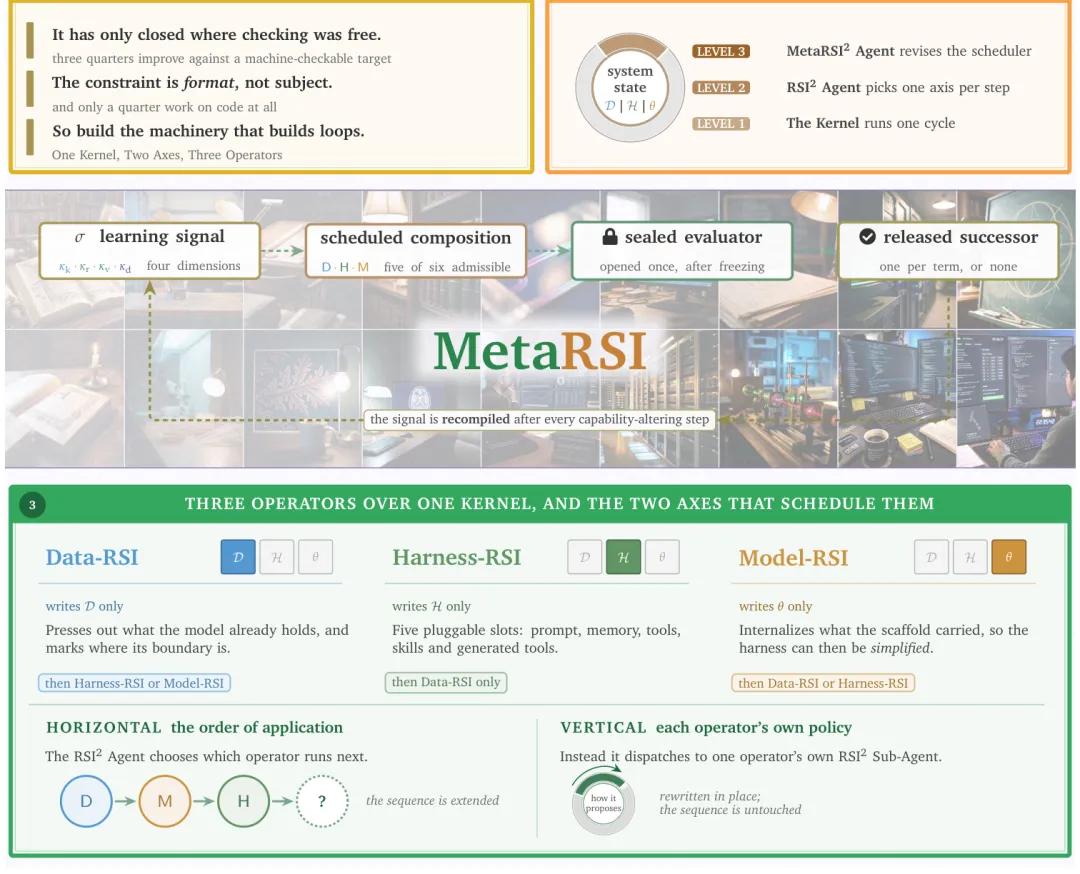
Figure 3: MetaRSI-v1 overview
A: Unified Loop Kernel paradigm
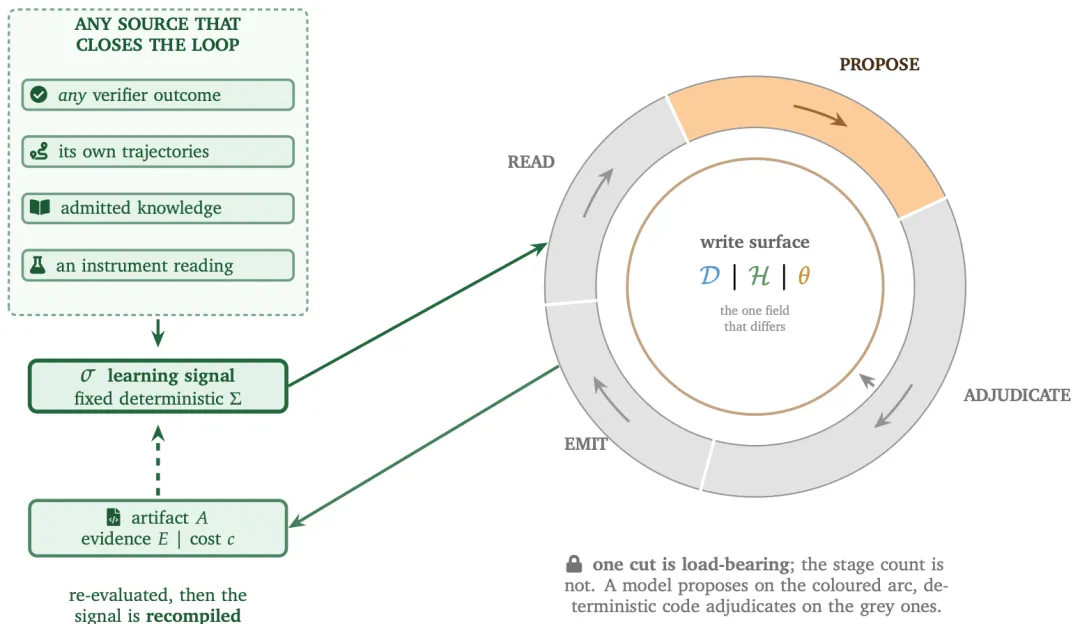
Figure 4: Loop Kernel pattern
The Loop Kernel is a unified form of self-improvement first proposed by MetaRSI-v1.For the first time, it abstracted "how progress happens" into a closed loop unrelated to the object: it consumes feedback-based learning signals, makes changes to the Data, Harness, Model, makes verifier decisions, and flows the results back to the next round of signals. Data, Harness, Model can then be unified into different instance-based algorithms of the same kernel, combine, unify, and self-improve.For the first time, we have a unified, reusable underlying skeleton.。
There are three types of algorithms: Data-RSI, Harness-RSI, Model-RSI.
Using the same Loop Kernel, self-improvement was carried out on three writeable surfaces: Data-RSI, Harness-RSI, Model-RSI.
Data-RSILearning signals are extracted from their own operating trajectories, and experience testing is used to synthesize data and convert it into downstream consumption, marking and magnifying the model's capacity-to-negative capacity boundaries.
Harness-RSIUsing feedback signals learnt, improvements, additions and subtractions were made to the five removable slots of System Prompt, Skill, MCP, Tools, and Memory that Harness disassembled.
Model-RSIUpdate the parameters and structure of the model itself to integrate repeatedly validated behavior into the model.
Three, horizontal planning and vertical optimization strategies
Horizontal orchestration: the order in which the algorithm is appliedRSI2 Agent: Select the next algorithm at each decision point based on signal feedback, then organize the algorithm and run it into the RSI Loop Kernel.
Vertical optimization is an internal strategy for optimizing algorithms.The RSI2 Agent instructs the target algorithm's RSI2 Sub-Agent to optimize the RSI system itself by rewriting the algorithm itself based on learning signals and environmental feedback.
Four, four Agent synchronized three-layer RSI nesting.
The entire architecture is coordinated by four agents and can be replaced locally by human experts to form a human-in-the-loop system.
Transition Agent: is responsible for linking the product of the upstream algorithm to the next algorithm's consumption of the product.
2、RSI2 Agent: Optimize the horizontal axis at each decision point to specify the next algebra) or vertical axis (to rewrite the strategy instructions to Sub-Agent)
3 RSI2 Sub-Agent: In vertical optimization, acceptance fromRSI² AgentThe RSI strategy within the calculator is adjusted according to the execution instructions.
4′′MetaRSI2 Agent: Learn how to do the right longitudinal optimization, optimizationRSI² AgentIt's about learning strategies.
The four agents correspond to three RSI optimization levels: algorithm improvement of target systems, bi-axis sorting improvement of algorithm use, and sub-layer improvement of bi-axis sorting strategy itself.
Experiments: Both small models and front-end models are self-evaluating.
The experiment was carried out on two routes:Small model routeUsing a trainable open source model, Data, Harness, Model, all three algorithms are enabled;Frontline model routesFor top models such as Claude Opus 5, GPT-5.6 Sol, and Kimi K3, these models have large parameters or are closed-source models that only enable Data and Harness algorithms.
Route one: Self-improvement of small models. The target model is Qwen 3.5-35B-A3B ((35B total input, 3B activation), evaluated on four benchmarks in Terminal-Bench 2.1, SWE-bench Pro, GPQA-Diamond high-difficulty subset, AIME.
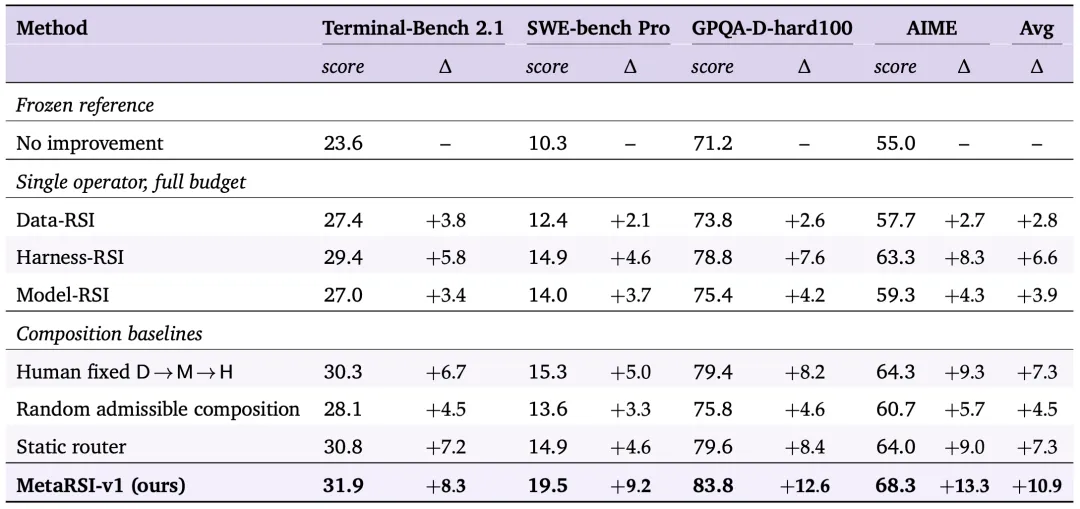
Figure 5: MetaRSI allows Qwen 3.5-35B-A3B to be automated
MetaRSI-v1 improved by an average of 10.9 points, while SWE-bench Pro improved by 10.9 points.Resolution rate nearly doubledThe meta-layer brings a higher ceiling to the RSI.Significant increase in cumulative gains from continuous evolution。
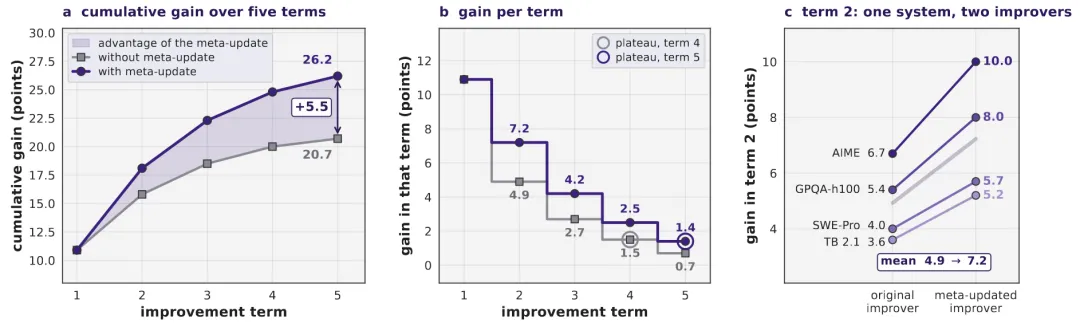
Figure 6: "Improving Improvers", MetaRSI allows small models to expand their cumulative automation gains
Route 2: Self-improvement of the front-end model. Multiple front-end models improved by an average of 7.3 points on Terminal-Bench 2.1, indicating that the MetaRSI paradigm is similar to the front-end model.The flagship model also retains considerable space for self-improvement.。
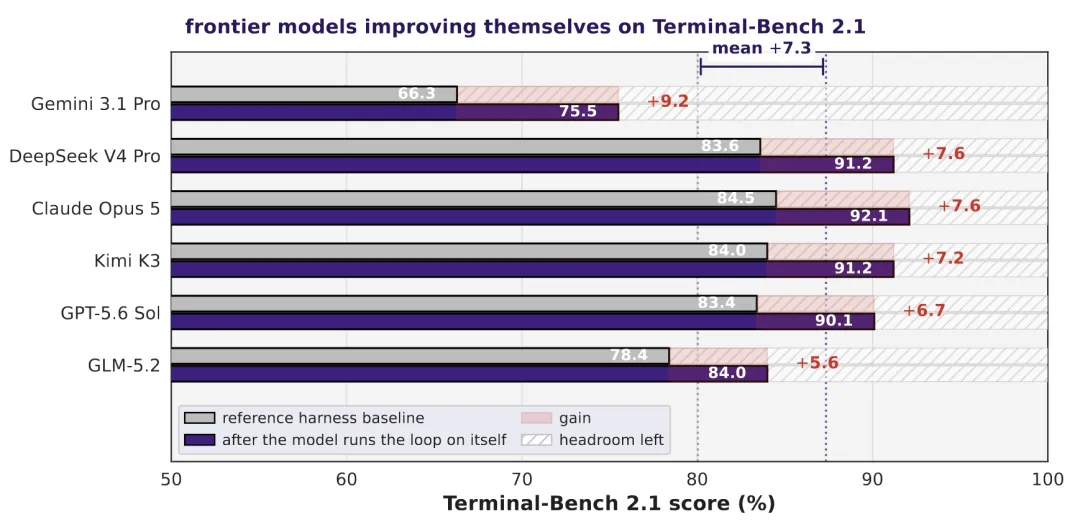
Figure 7: Self-improvement of the six front-end models
Six and Five Laws: The unit of progress is the circle
The MetaRSI is clear.Two complementary improvement routesHarness-RSI keeps weight unchanged, allowing self-improvement to cover any model that can be called through the interface; Model-RSI integrates capabilities into the model through training.
And the MetaRSI.Data-RSI is redefined for the first timeBorder detection of a model's capabilities and amplification, by combining the analysis of learning-signal feedback from the executive trajectory and the outside world, gains verified experience and scales to replicable data, and identifies where these experiences can be supported, framing the positive and negative boundaries of the model's capabilities.
Data-RSI's products are simultaneously supplied to Harness-RSI and Model-RSI consumption, and the changes in the two routes are able to flow back to Data-RSI, re-branding the capability boundaries, driving the next round, and the capability is thereby disclosed and accumulated. In this process, Harness can not only add but also subtract: Data-RSI's exaggerated exposure problems become redundant after Model-RSI is internalized, and the knowledge originally absorbed in Harness becomes redundant, and Harness-RSI's system removes, retains, and withdraws the capability after the relay test.
On top of this, MetaRSI refines five laws.
Law One: Verification determines the frontier of self-improvement. Whether a domain can form a self-improvement loop depends on whether the domain task can be verified and whether there is a suitable verifier.
Law 2: Self-knowledge expires, rediscovering the boundary of ability is the speed bottleneck. The RSI changes the ability of the Agent, and its original system description immediately fails.
Law 3: Capacity is not related to the carrier, but the cost is related to the carrier. For example, the same capability is placed in the Harness and the cost is repaid every time the reasoning is made; the integrated model is only paid once, and the mature cycle can continuously transfer the capability to a cheaper carrier.
Law 4: Reliability is measured by unwritable quantities. Within the closed loop, the true power amplification and loosening success criteria are given exactly the same scores, and this deviation cannot be detected internally, nor can it be corrected statistically.
Law 5: Circulation is free of creativity, and all gains are essentially induced by the input or capability of external information clusters. Self-improvement can only reorganize, amplify and solidify the potential of the model that already exists. Therefore, each upgrade must be divided into two parts: which are the ones that amplify the existing capabilities and which are actually newly introduced from the outside.
Seven: From architecture to ecology: every area of science has its own cycle
MetaRSI-v1 does not require a field to run the entire Loop step by step. Because scientific research and engineering practice is itself a pipeline: proposing assumptions, designing experiments, executing, interpreting, each link has clear inputs and outputs.When enough small cycles are turned around, they are intertwined and eventually woven into a large cycle that covers the entire field of scientific research.
This also lowers the barrier of access to the new domain. One domain requires only three things: a run-of-the-results task family, a set of correct-judge verifiers, and an even rough initial footrest; the rest can all be taken over by the general mechanism.
In order for this paradigm to really flow,The team simultaneously opened RSI-HarnessA Harness that can self-learn, self-replicate, and be usedHarness Genome for transplantation for different fields of science and engineering practiceThe team was built simultaneously.Genome is an open communityHopefully, every field of science will be able to unleash its own reliable scaffolding so that every new closed loop can start on the shoulders of its predecessors.