It's the first time in the history of the world.
In real industrial environments, data is not static.
Noise, absence, abnormalities, and distribution drift are constantly occurring, and the academic community's approach to data set-oriented design can often fail once it enters a new data environment, requiring redirection or even rebuilding processes.
Time-sequence prediction is one of the most typical scenarios of this problem.
From financial forecasting, power mapping, to climate change, medical monitoring, and industrial sensor analysis, many decisions depend on judging future trends, but the characteristics of different datasets vary greatly and fixed models and manual processes are often difficult to sustain.
It's a pain in the ass, and it's a pain in the ass.Teams from institutions such as the University of SydneyIt has been proposedBECRA(Bootstrapped Exploration with Causal Reasoning)It's a way of predicting the timing of adaptation.Agent training paradigm。
Its goal is not to come up with a fixed predictive model, but to train one that can "...It's my own exploration, my own summary of experiences, my own migration experience".Predictive agents: try multiple strategies on different datasets, compare successful and unsuccessful cases, extract replicable strategic experience from them, and apply it to new, unseen datasets.
Address of the paper:https://openreview.net/pdf?id=8d2LLxwU1r
Address code:https://github.com/Adaptive-Forecasting-Agent/BECRA
Background of research
Time sequence prediction seems to be a classic problem, but it is still very difficult in real applications.
The root of this is that the data characteristics of different time sequences vary greatly: some are cyclical, some are volatile, some are serious, some have anomalies, some are very short, and some contain complex relationships between multiple variables.
Therefore, it is difficult to expect a fixed model to apply to all scenarios.
A common practice in the industry is to manually design prediction processes for each data set. For example, first decide whether to fill in the gaps, then decide whether to perform abnormal processing, decomposition, unification, and finally choose the right prediction model. These processes often rely on expert experience and repeated errors, costly and difficult to migrate.
More importantly, these experiences are often not stored in a systematic manner. Experiences that a team spends a significant amount of time putting together on a particular dataset often have to start over again in exchange for the next dataset.
This raises a key question:How can prediction agents not only execute predictions, but also learn "what kind of data should match what kind of prediction strategies" by constantly exploring them?This is exactly what BECRA is asking about this issue.
Core Methods
Traditional prediction systems are focused on:It's a data set, which model works best".BECRA is concerned about another issue:Why does one strategy work under these data conditions and not under other conditions?"。
This transformation is crucial.
Knowing only "which model is good", the experience is difficult to migrate because the next dataset may be completely different; but if you can summarize more abstract strategic experiences, such as "some kind of filling is more appropriate when the data gap is obvious", "some sort of abnormal processing and model combination is more stable when the sequence fluctuates strongly and abnormally", "some decomposition or cyclical modeling strategies are more advantageous when data cycles are strong, then Agent learned that the relationship between "data characteristics" and "strategy selection" is a kind of relationship.It can be accumulated, it can be explained, it can be movedI'm not sure what I'm saying.
Around this idea, the overall process of BECRA is divided into four stages:
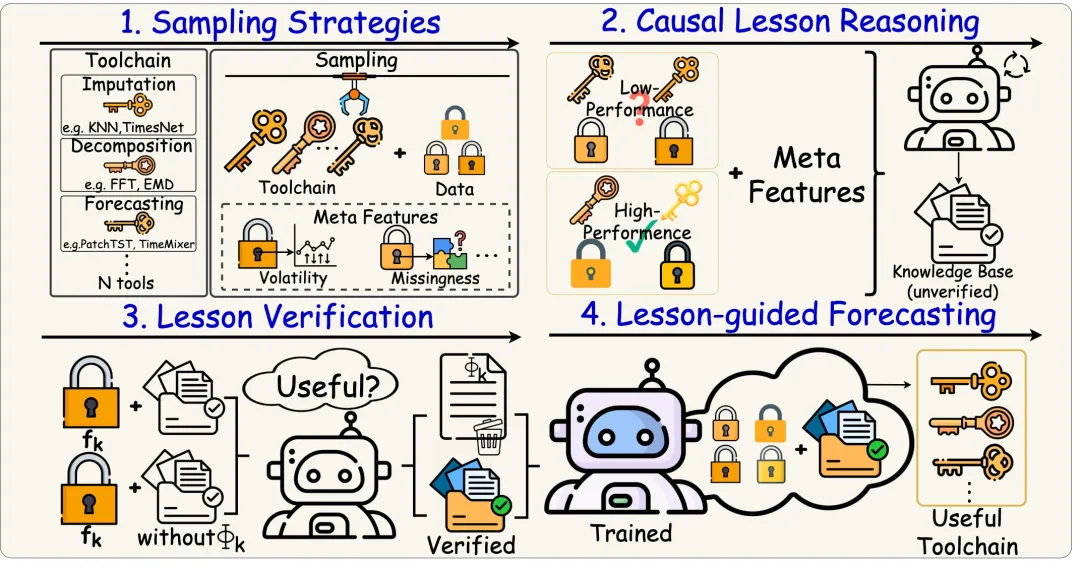
Figure 1: BECRA's overall framework. The system uses strategic sampling, causal empirical reasoning, empirical verification and empirically guided prediction to form strategic knowledge that can be accumulated and migrated.
The first step is to explore the strategies of sampling.
BECRA enabled Agent to experiment with a large number of different predictive "suites", combining different processing steps and models freely, and not only keeping track of the successes but also the failures.
This is somewhat similar to the idea of "repeat, better than worse" in reinforcement learning (like GRPO); but BECRA is not satisfied with just knowing "which scheme is better", it wants to figure out "which one is better".Why good, why bad".。
The second step is Causal Lesson Reasoning.
Knowing which tool chains perform well and which perform poorly is not enough. BECRA compares the performance of the same or similar tool chains across different datasets, and combines elements of the datasets with the idea of modeling combinations of tools to allow large models to analyze:
Which data characteristics match the capabilities of the toolchain, which characteristics may cause the toolchain to fail, and how these factors together affect the ultimate predictive effect.
The result is not a parametric record for a single data set, but a readable experience of "what data conditions, what strategies should be used, and why".
It is because these experiences establish links between the characteristics of the data element, the toolkit and the predictive effects that they are able to migrate to new datasets instead of simply remaining in memory of historical results.
The third step is Lesson Verification.
Automatically summarized experiences are not necessarily reliable, and some laws may only be caused by accidental or individual experiments. For this reason, BECRA constructs paired verification around each candidate experience: under the same data set, toolchain candidate and evaluation conditions, one scheme allows Agent to use this experience to develop a predictive process, while the other scheme shields this experience and compares the predictive performance of the two schemes on independent verification data.
If added to the experience, Agent is able to consistently obtain better results on data that corresponds to its applicable conditions, indicating that the experience does indeed have a practical guiding role; if performance is not improved or the effect is unstable, the experience will not enter the knowledge base.
This preserves not merely "sounding reasonable" conclusions, but reliable experience of testing actual predictive outcomes.
Step 4: Experience guided forecasting (Lesson guided forecasting)
After collecting a series of reliable experiments and encountering new data that had never been seen before, Agent did not need to be trained from scratch, but to directly select from the experience database the experience that matches the current data characteristics, and accordingly to the new data a suitable prediction scheme, that is, to plug in.
And that's because what's left is "experience to see", not model parameters.It's the same thing with a bigger, lower-level model like Claude, Gemini, Qwen, etc.The more you learn, the more intelligent you become, the more reliable you become.
Performance highlights
Multi-sequence tasks: verifying adaptability and ability to migrate
Experiments were conducted on a number of common benchmarks, including ETH1, ETH2, ETTm1, ETTm2, Electricity, Weather, and large-scale M4 datasets, covering both long-term and short-term forecasts, and comparing them with regular LLM agents, single forecast models, LLM-based time-series models, and time-series baseline models.
Table 1 shows the results of BECRA on six long-term prediction benchmark datasets and compares them with ordinary LLM Agent, single architectural prediction model, LLM-based timeline model and time sequence base model.

Long-term forecasts of strict adoptionleave-one-outSetup: For each target data set, the agent can only use the experience learned from other data sets, and cannot see the performance of the strategy on the target data set beforehand. This examines whether it actually has the ability to migrate, rather than remembering the best answer to a particular data set.
The results show that BECRA can use the accumulated strategic lessons to build predictive processes on unprecedented datasets and achieve competitive results on multiple benchmarks.
Table 2 shows BECRA's short-term forecast results on different frequency categories in the M4 data set, and compares them to multicultural representative baselines.
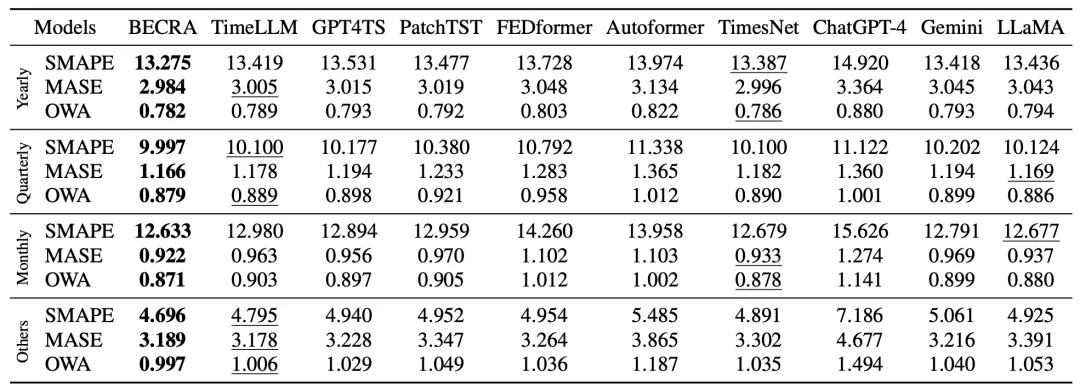
Short-term forecasting is validated on highly heterogeneous M4 datasets. The M4 contains different frequencies, different types of time sequences, and experiments show that the strategic knowledge BECRA has learned can be used not only for long-term forecasting but also to migrate to short-term forecasting scenarios.
Missing and unusual scenarios: Still stable under imperfect data
The real-world timeline is often incomplete: sensors may have short-term failures, financial data may be affected by abnormal fluctuations, and industrial systems may produce continuously missing data fragments.Random MissingSimulating continuous interruptionsLoss of blocks(and different proportions)Unusual pollutionI'm here to do a stress test.
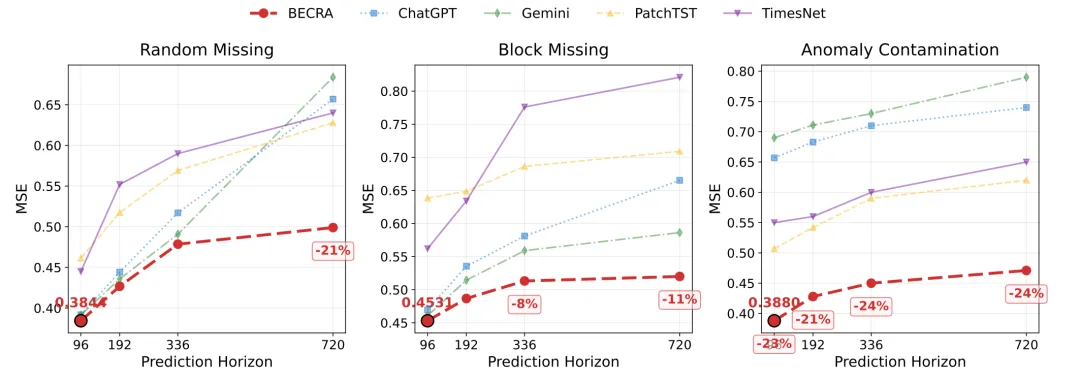
Figure 2: BECRA's robustness assessment in the case of random absences, block failures and abnormal pollution scenarios.
The results show that in these challenging scenarios, BECRA's performance provides evidence that the strategic experience it learns can help Agents choose more appropriate processing and prediction processes based on data issues. This also shows that the value of BECRA lies not only in improving predictive accuracy on a single benchmark, but also in giving Agents a certain strategic adaptability.
Efficiency: Reducing the cost of repeat trials and errors
The cost of predictive systems comes not only from model training, but also from a large number of repeated test errors.
AutoML methods typically require re-searching strategies on each new dataset and re-payment of search costs once a new task is encountered.
What makes BECRA different is that it translates a portion of the cost of searching intoRepeatable strategic knowledgeAgents: Acquire experience in early exploration, and then use lessons already available to reduce search space and reduce repetitive test errors when faced with new data sets.
Table 3 compares the cost of testing AutoML cold start and BECRA hot start on six datasets to demonstrate the role of repeatability experiences in reducing repeat searches.
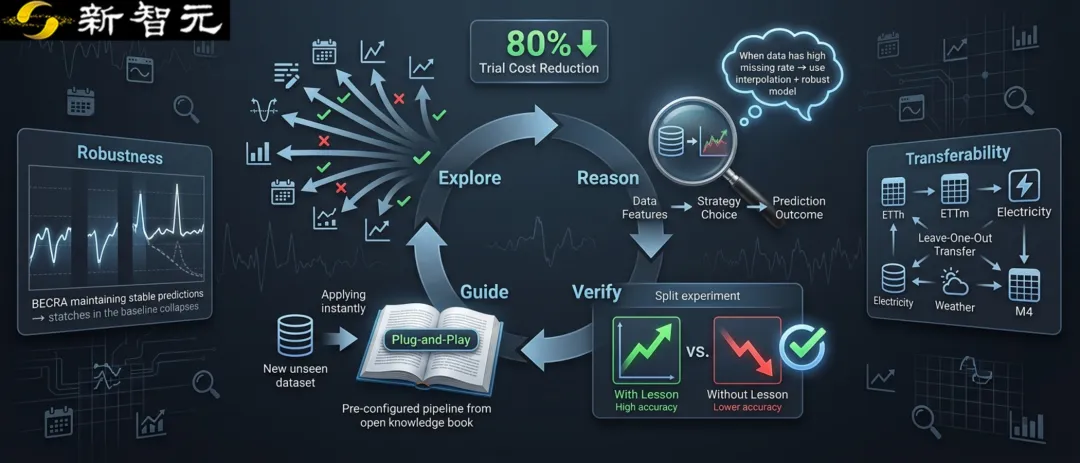
The paper's computational cost analysis shows that with the same candidate toolchain setup, the representative AutoML baseline is reduced compared to BECRA.More than 80%Trial cost: AutoML requires 1177 trials on 6 datasets, while BECRA requires a total of only 211 trials after warm-start. This shows that experience accumulation mechanisms have the potential to significantly reduce the cost of repeat exploration in dynamic prediction environments.
Summary
BECRA's core purpose is to predict the time sequence from theThe problem of model selection".I'm going to move on to:Agent training issues".。
In the past, many approaches focused on designing a stronger predictive model, or searching for a better pipeline for a particular dataset; BECRA focused on getting Agent to learn.How to choose strategies based on data characteristics and accumulate this selection experienceThis gives predictive systems the opportunity to move from a one-time tool to a smart body that can continuously learn and migrate experiences.
This is particularly important for the real industrial landscape: the real data environment changes frequently, and manual reconstruction of predictive processes is expensive, slow, and difficult to scale.
BECRA provides a new direction: allowing Agents to accumulate experience in different missions and replicate it in future missions. The volatility patterns of financial assets vary greatly, market conditions change, energy and industrial data are often missing, anomalies and distribution drift, and such an unstable environment is suitable for an Agent that can choose a strategy based on the dynamics of data characteristics.
Furthermore, as long as a task involves:You can choose different tools or strategies under different data conditions".The paper also notes that the mechanism is expected to be further expanded into areas where data scarcity, such as materials science, drug discovery, and the complex combination of tools are rare.