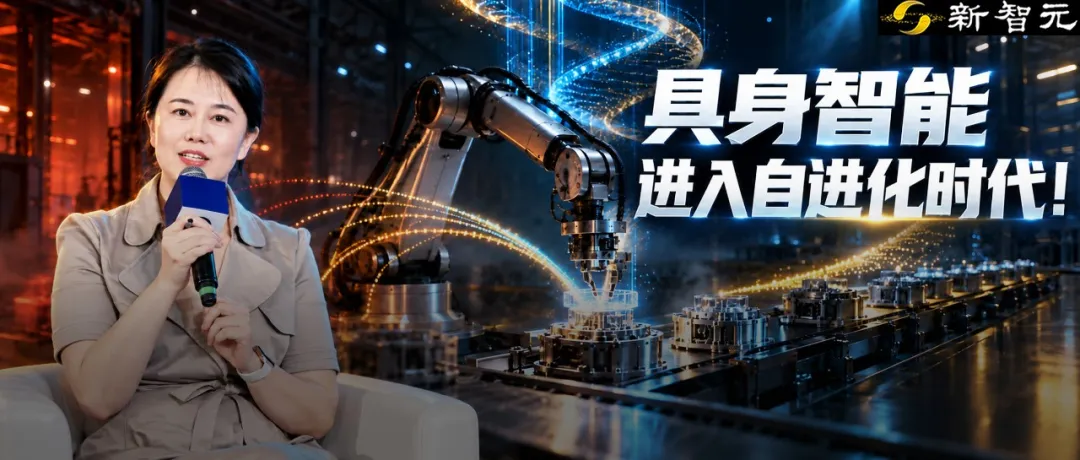
It's the first time in the history of the world.
The core issue of discussing physical intelligence is changing: who has more data to build a stronger base model, who can actually deploy the robot on the ground and keep it functioning.
The trend towards physical intelligence has changed.
Over the past two years, the industry's hottest debate has been around the basic model: VLA or the world model, end-to-end or layered architecture, who has more parameters, more data, and stronger zero-shot capabilities?
Now that models are starting to come out of the laboratory, a new question is overwhelming the battle: can robots really achieve stability in the field?
Silicon Valley has just reached a consensusChina is on the move.In Silicon Valley, this change has become a common feeling among researchers and investors.
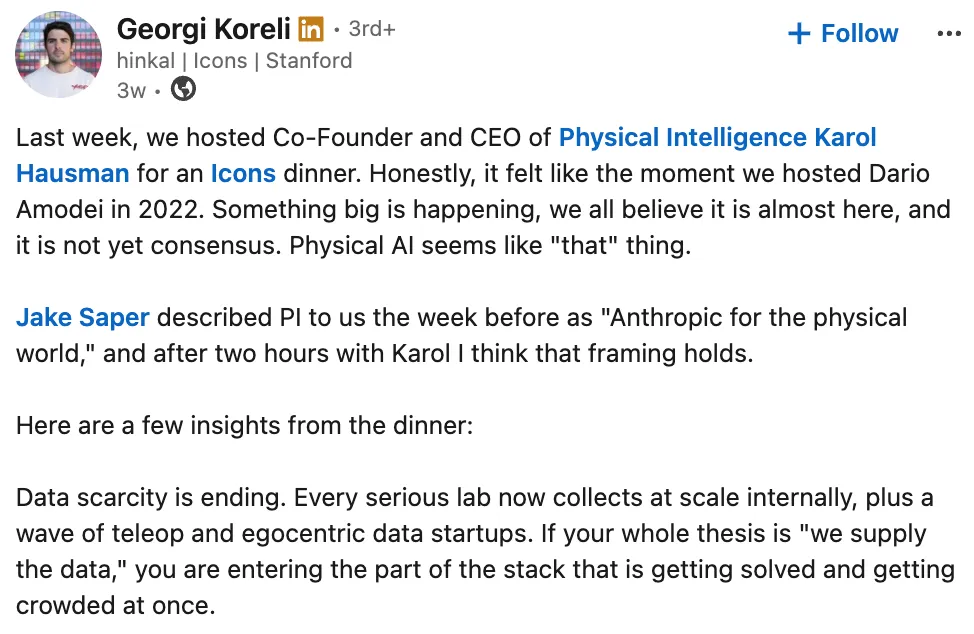
Investor Giorgi Koreli recently retold the judgment of Karol Hausman, co-founder and CEO of Physical Intelligence, at a closed-door dinner: The robotic data scarcity is being mitigated, and what's really unresolved is the last line from "doing it" to "reliably completing tasks".
Modeling is the process of reproducing the actions of a data set, and the success of a task is what companies want.
From 0 to 60% of zero-shot capabilities are mainly data problems, from 60% to deployable, and no one has solved it yet.
And domestically, a team has been betting on the same problem earlier.
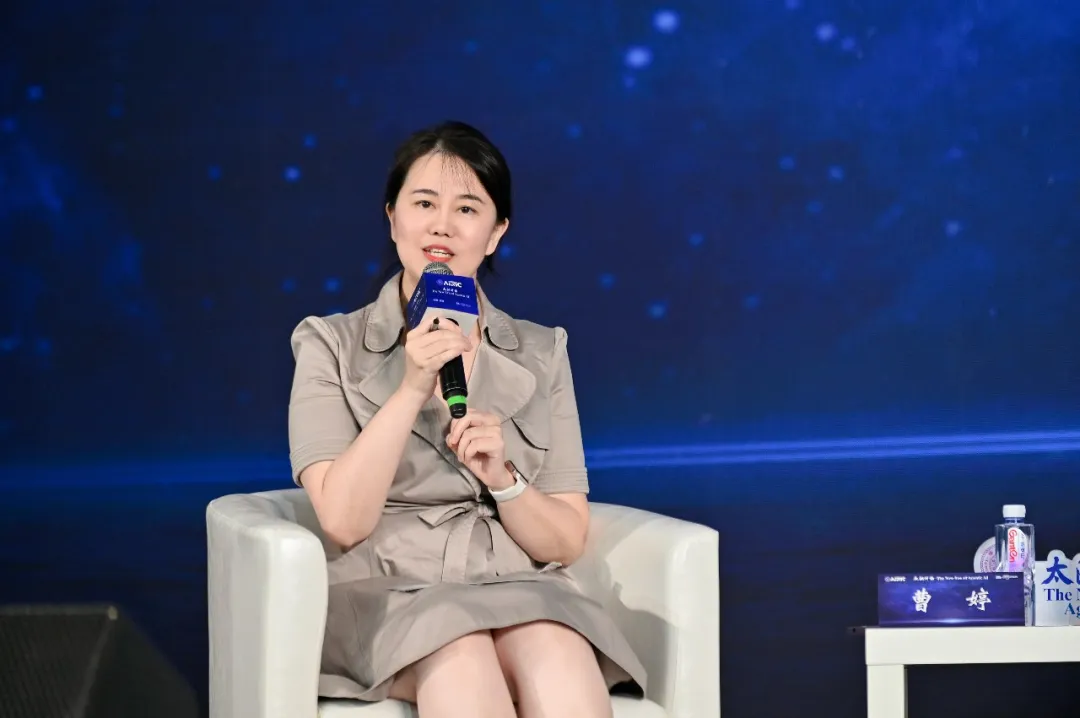
In 2026, from z0 to Zetta ζ, and then to Zeva, AIR, Z-Trans, a professor at the Institute of Intelligent Industry at Tsinghua University (AIR) and the domain transformation she initiated, will be open source.Causal learning world models, closed-loop online learning agents, and the training-driven infrastructure that supports full deployment cyclesThe focus shifted from "what happens when a robot leaves the factory" to "what can be learned when a robot is deployed" and first defined the complete paradigm of a set of real-world physical deployments as:It's all about self-evolution.
From Microsoft's Asian Institute to China AIR, and then to launching domain switching, she's always asking the same question: How can AI not only be established in papers and benchmarks, but create value in the real world?
The answer lies in a real interaction. A mechanical arm reaches out to a transparent plastic water cup, the first time it is overpowered, the second time it is in an incorrect position, the third time it is adjusted, the water cup is picked up, and then a similar cup can be successfully grasped.
Between the several attempts, the model was not retrained, the weight was not updated, but learned what to do next from interaction with the physical world.
A video of robots' evolution was played tens of thousands of times in Little Red Book: without updating the model weight, robots learn to do better the next time they interact with the physical world.
This is exactly how domain transformation attempts to tackle the "deployability gap": allowing robots to move from "deployment-to-typing" to "post-deployment evolution", the more powerful they can be in real work.
After 60 minutes, the final battle deployedThe success of the big model is based on an extremely attractive logic: more data, larger parameters and more computing, which can lead to a continuous surge in capabilities. Thus, the early Intelligences began to replicate this path: collecting more operational data, training larger VLA and WAM models, and then fine-tuning them to suit different tasks.
This path can significantly improve the initial capabilities of robots, but encounters bottlenecks as they move towards real deployment. Modeling optimization is a repetition of the action in the data, but the company needs task stability to succeed. So, as more and more physical models, more and more demos are surprising, there are still very few robots that can actually enter factories, laboratories and home long-term work.
The "60 points" mentioned in the introduction is not a generalization of the precision and alignment of all tasks, but a generalization of the industrial stage: pre-training to solve the basic operational capabilities of robots, deployment requires solving whether it can be "continued" in environmental changes, execution errors and long-term situations.
The underlying reason is that continuous changes in the physical world cannot be ignored by offline data. Robots face friction, collisions, location changes and execution failures that only happen in action. Every change in the environment is re-collected, fine-tuneed and deployed, not only costly, but also unable to produce a scale effect.
So, from 60 seconds to deployable, what's missing is not one more offline training, but a new capability: robots can use real feedback in their deployments to continuously correct biases, transforming each success and failure into the experience of the next action.The next phase of the competition will also shift from those with more offline samples to those who can lead the way in the development of the deployment of the learning loop.
"Automation" is not a new concept in the digital world, and has been discussed for years in the areas of software agents, smartphones, and big models.Physical intelligence is an evolutionary paradigm in the real physical world: Physical intelligence interacts continuously in a deployment environment, independently corrects strategies through feedback and experience, and continually improves mission success rates.。
The focus of domain shifting is never on whether or not robots succeed randomly, but whether or not they can continue to grow stronger as they interact.In almost every domain-switching work published, we see a Success Rate Scaling Curve that increases with the number of interactions.。
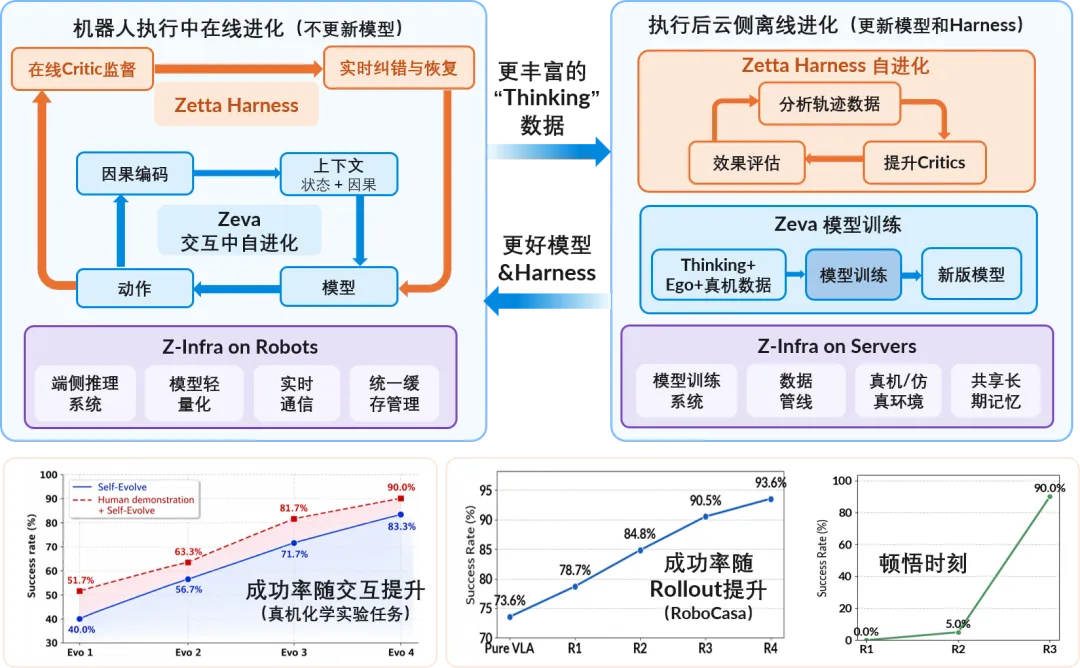
Domain-switching self-evolution system: Zeva and Zetta implement online and offline models and Harness learning closures, Z-Infra cloud collaboration to support full-cycle evolution
It is not a denial of pre-training or no data, but a redefinition of the two: pre-training is the starting point of ability, deployment is the starting point of evolution, and real interaction is a constantly growing data source.
Cao Cao's three choicesUnderstanding why domain transformation chose this path requires going back to Cao Cao's research trajectory of more than a decade ago.
Her first critical choice was to join Microsoft's Asia Research Institute, where Cao Cao was the chief research director for a long-term study of edge intelligence and neural network training systems. At the time, the core contradiction was that model capacities were growing rapidly, and the computing and storage capabilities of mobile phones, PCs, and IoT devices were extremely limited. Cao Cao led the team to tackle ultra-low-bit model quantization, high-level model efficiency reasoning based on spreadsheets, and other technologies that enabled complex neural networks to access Microsoft Office, Windows, Bing, and other products.
This experience shaped Cao Cao's judgment, which continues to this day: algorithmic metrics are not the end. It is only when the model can run under the constraints of real hardware, real costs and real business that technology completes the leap from paper to industry.
Her second choice was to join the Institute of Intelligent Industry (AIR) at Tsinghua University, founded in the summer of 2025 by Zhang Xiaolu, where the subjects of the study also shifted from limited hardware AI to the ever-changing physical world. Large models, VLAs and robotic hardware have matured, bringing physical intelligence from what can be imagined to what can be done.
However, the team soon discovered that models can perform actions in fixed settings, that slight changes in the environment can fail, and that the valuable information contained in the failure is directly discarded by the traditional system.
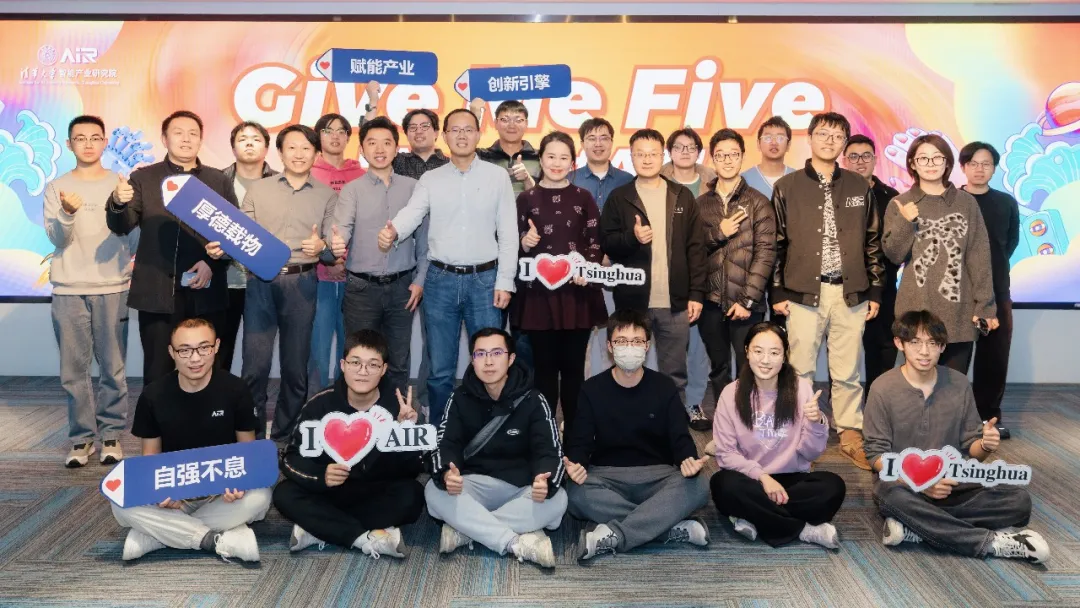
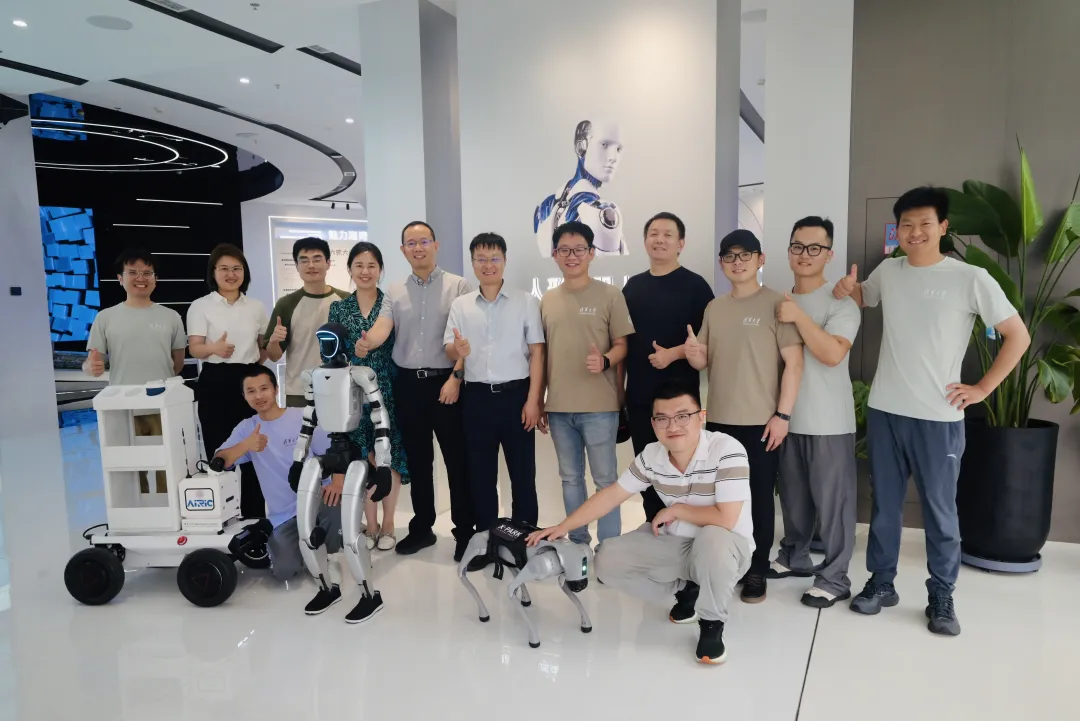
Photo by Liu Yun-nyu and Cao Wei in Qingdao AIR research group
Cao Cao's third choice arose from this: to launch Z-Trans domain transformation (Z-Trans) in collaboration with Qingdao AIR's vice-president, Professor Liu Yun, to push research into the evolution of physical intelligence into the industry.
He is a longtime AIoT and edge intelligence researcher, IEEE Fellow, and former Chief Research Officer at the Microsoft Asia Research Institute. The two initiators share a long-term accumulation of collaboration with "Algorithmic Silicon System Hardware". They are concerned not only with making models with higher scores, but how to turn them into systems that can be deployed, learned and run for the long term.
This also explains the ambition behind the name "domain transformation": to allow intelligence to no longer be locked into the domain defined by training data, but to be able to adapt and migrate through interaction after entering new tasks, new environments and new carriers.
Learn to evolve through interactionThe core of the domain-switching evolutionary closed loop is Zeva: it does not update parameters, but it can learn real physical conditions from each interaction of the robot and use what it learns for subsequent actions.
Recently, works such as the Generalist G1.5 and Skild S1 have brought literature into the field of firearms: allowing robots to adapt directly to the examples and experiences in the context, expanding the model's generalization to new tasks.
In-Context Causal Learning, ICCL:** allows robots to extract causal relationships between their actions and state changes from their interaction trajectories, while filtering the background, lighting and other irrelevant correlations.** Robots do not mimic what others have done, but understand their actions as success or failure under the current physical conditions of deployment, and apply them to the next improvement.
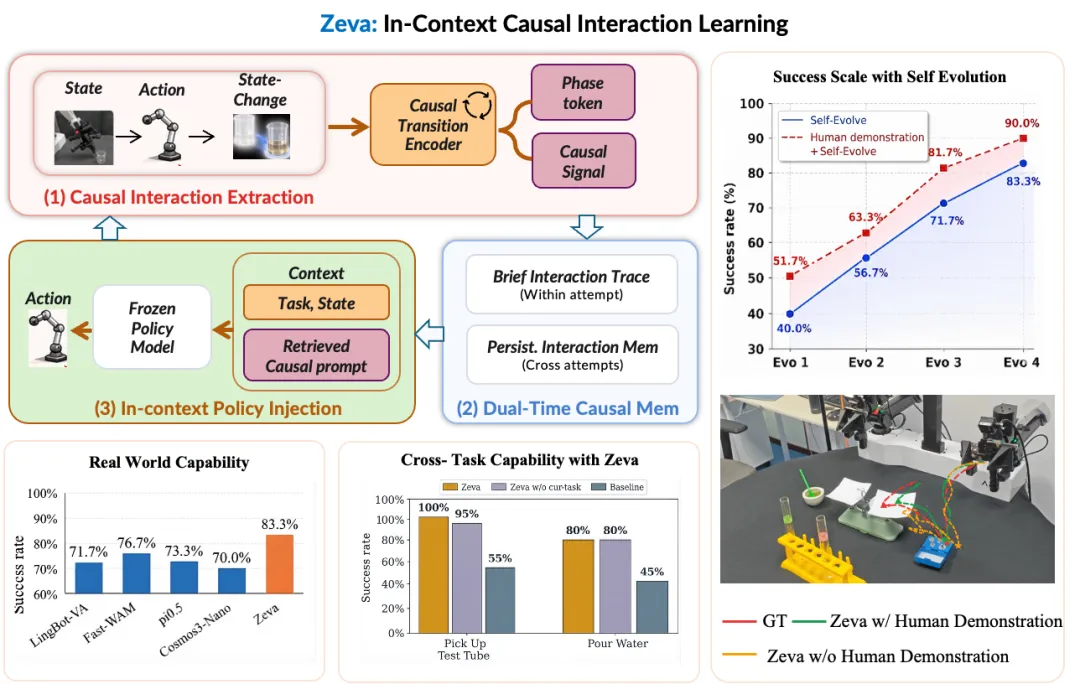
Zeva's core mechanism can be broken down into three phases.
The first stage isCausal interaction extractionThe Causal Transition Encoder (CTE) refers to a combination of visual states, execution movements, and observed effects as "causal interaction states" and further encodes them as a task phase with an interaction signal. Simply put, the system does not only remember "the claw moves a distance", but tries to identify: which step of the task the robot is at, what changes the action makes to the object, whether these changes propel the task forward to the target.
The second stage isTwo-time factor memoryBrief Interaction Trace (BIT) retains the dynamic information from recent attempts to help the robot understand what just happened. Persistent Interaction Memory (PIM) combines and consolidates useful evidence between multiple attempts in the same episode. The former, like working memory, is closer to sustainable accumulated experience.
The third stage is:Injecting the context strategyThe system retrieves from memory evidence of interactions matching the current task phase to construct a Causal Prompt for the underlying strategy of the freeze. The model parameters remain unchanged, but the context on which it is based is different each time it makes decisions. Past interactions are compressed into causal experiences that can be used for the next reasoning call.
The most counterintuitive part of the route is here:The model is not updated, but the capabilities can continue to grow.
It turns context-based reasoning into a way of learning.It also transforms the actual failure of robots from "ineffective samples" into usable learning signals.In Zeva's public experiments, the cumulative success rate of the freeze model increased from 26% to 73% on multiple typical body reference missions; SOTA was achieved in other cutting-edge VLA/WAM models in the RoboCasa 365-Atomic 5 and ChemLab-Evo evaluations of the True Chemistry Lab.
To extract the causal relationship from the misplacement of the measurement paper, complete in-context learning and improve task accuracy.
It's also worth noting that human demonstrations can also go into the same context, further increasing the success rate by ~10%. This means that when robots are deployed in the future, "teaching them a new operation" gives them the opportunity to move from a long process of data acquisition and training to a process that is closer to human instruction: demonstrate once, let it try, correct in execution, and leave the experience behind.
Exercising and correcting errorsZeva enables models to learn from interaction, but learning is not the same as stabilizing the task. The real task is a long link: the robot must understand the goal, break down the steps, execute the actions, observe the results, and recover immediately when deviations occur.
Recent works such as Claude Plays Robotics, Aspire, and Cap-X have begun exploring large-scale model supervision of physical tasks, and Agentic AI has also brought "planning and execution" into the field of robotics. But the real world will not stop and wait for reasoning: every step is called by a large model, and a few seconds of delay can change the state of the environment; only after the end of the task, reset, there is no time to save the already deviated execution process.
This is exactly what Zetta Z is aiming for. With its Harness connectivity base model, robot body and environmental feedback, Zetta Z was the first to propose a scalable lightweight critical that enables online closed-loop learning through a triple loop.
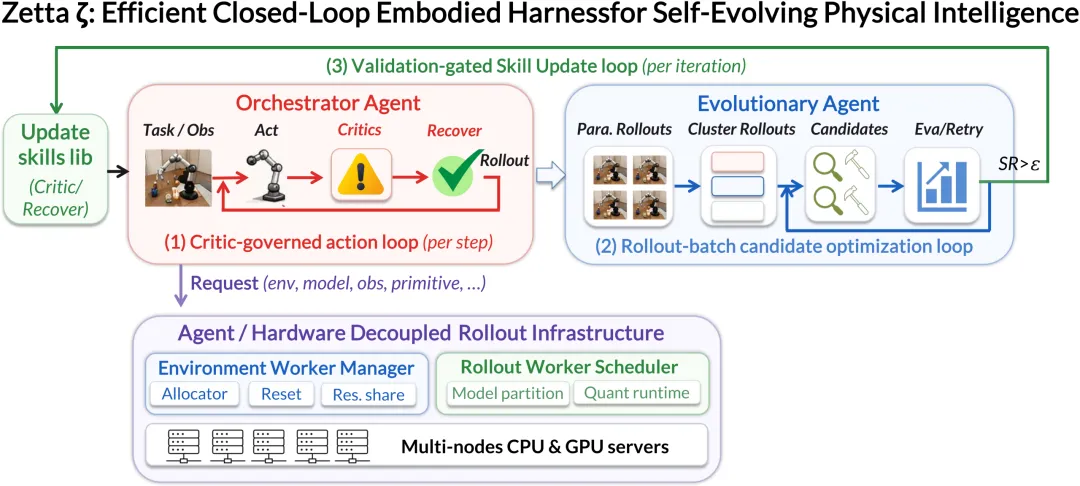
The first is:Action level error correction closed loopWhen running, the critical continuously monitors the physical state of the robot and immediately triggers recovery once it detects a slip, loss of contact, or transportation stagnation; only when the fault is removed, the state is re-established, and control is transferred back to the model to continue execution.
The second is:Batch experience optimizes closureAfter completing a batch of rollouts, Zetta ζ clusters the failed trajectory, locating the first moments of deviation from the normal state, then from evaluation, state representation, planning controls to recovery strategies, and automatically generating critical, recovery and tool candidate updates.
The third is:Check the door controls and update the locksCandidate skills don't come online directly, but only through historical regression testing and isolation data verification. Only by really improving success rates and broadening to new scenario updates can they enter the skill memory library, avoiding robots being just a "back-to-back" failure sample.
This triple loop allows each rollout to be no longer an exhausted execution record, but to be absorbed into verifiable, reusable skills. In the team's open results, Zetta ζ achieved a mission success rate of 90.8% and 93.6% for LIBERO PRO and RoboCasa, respectively, under a limited rollout budget, well above other methods, and the success rate continued to grow with the rollout.
What's even more exciting is that growth doesn't always happen evenly. Robots may fail repeatedly, but after a critical exploration, they master recovery strategies and then stabilize success.
If Zeva's solution is "how to learn from interaction to experience causes", Zetta's solution is "how to oversee, correct mistakes in long-term execution, and turn experience into skills".
Model, Agent, Infra is closed.But users don't care about whether they use VLA, WAM or ICCL behind the robot, nor do they pay for a more advanced technical term. They only care about the results: whether the task can be completed steadily, whether artificial takeovers can be reduced, whether deployment costs can be reduced, whether output can be continuously improved.The real productivity is what the end users are willing to pay for.
To turn model capabilities into this productivity, Zeva and Zetta alone are not enough, but a set of infrastructures that supports scale deployment and continuous evolution. The smart industry often talks about data planes, but not all data flows can form planes.
If a robot produces data on the ground that still needs to be copied, cleaned, tagged, trained, and updated step by step, the more data it has, the greater the burden of operation. This is more like a data stream than a self-accelerating shutdown. A real data flyer requires a system to know which data is valuable, to perform low-cost rollout and evaluation, to inject experience into a model or context, and to quickly deploy it to the device for verification.
Z-Infra covers the entire cycle from deployment to continuous learning, including data pipelines, environmental rollout pipelines, and efficient deployment of reasoning pipelines. It connects real-life robots on one side, and connects models with Agents on the other, allowing "interaction to judge memory bits to be called and retrieved".
The three levels of capability thus form a complete structure:
- Zeva Model is responsible for encoding physical interactions as a cause-and-effect experience and calling them in the context above;
- Zetta Harness is responsible for online execution, step-by-step supervision, error recovery and experience tampering;
- Z-Infra is responsible for scalable data flow, rollout and efficient deployment reasoning.
This architecture also explains why domain transformation emphasizes the ability to combine end-to-end clouds. Robot interactions with the physical world are extremely sensitive to latency, and critical decisions cannot always wait for the cloud to return.
Cao Cao's past accumulation in model quantification, spreadsheet computation and efficient reasoning has shaped a continuous technical logic: in the past, it was to install stronger models into limited hardware, and now it is to allow continuous learning and reasoning to enter the robot's core. A series of works, such as T-MAC, Bit Distiller, Pregated-MoE, LUT Tensor Core, form the technical basis for the team to optimize collaboration from algorithms to underlying systems.
When Models, Agents, and Infra co-exist, the data flyer can only really begin to shift: the more robots are deployed, the more real long-tail problems encountered; the more efficient interactions, the more causal experience and skills formed; the more experience, the lower the cost of adapting to new tasks; the lower the cost of adapting, and the more scenarios robots can enter.
This is a different Scaling path from pure pre-training. The former mainly extends data and parameters before training, while the latter extends effective experience after deployment. The two are not in conflict, but the latter is more likely to determine whether robots can get into real positions from standard products.
From a user's point of view, Model, Agent and Infra should ultimately be hidden in the background. There is only one continuous upward productivity curve left in the foreground: the longer robots work, the higher the success rate, the less human intervention required, and the lower the cost of unit tasks.
Four obstacles to the path of evolutionFor investors, the technological direction is only the first step. The more critical question is: why is this team?
Domain transformation transforms the deployment of robots into data production, transforming data production into capacity evolution, and ultimately creating a steadily deepening fortress stream.
The first is:Team and Ecological BarriersThe domain transformation was enriched by Qingdao AIR, which inherited Apollo's ecological and industrial resources, teams across cutting edge research, system implementation and industrial delivery. This enabled domain transformation to both continue to define technical problems and to rapidly validate and advance technology to real-world scenarios.
The second is:Complete technical barriersModel is responsible for learning, Agent is responsible for executing and correcting errors, Infra is responsible for scaling the closed loop. There are three things that are essential: without Model, experience cannot be transformed into a capability; without Agent, the capability cannot be verified continuously in the real environment; without Infra, real interaction cannot be scaled down.
The third is:Real barriers to data interactionPublic data can train initial capabilities, but it's difficult to cover real-life processes, long tails and failures. We will deploy the "state-of-the-art bias correction" in the evolutionary process, continuously transforming it into verifiable, replicable causal experiences, forming "in-body experience data" similar to the big model Thinking Data, into an asset of experience where traditional trajectory data is difficult to replicate.
Fourth isScene of Barriers to ReturningThe more deployments, the more interactions, the more experience, the lower the cost of adapting to similar tasks, and the lower the marginal cost of creating capability duplication.
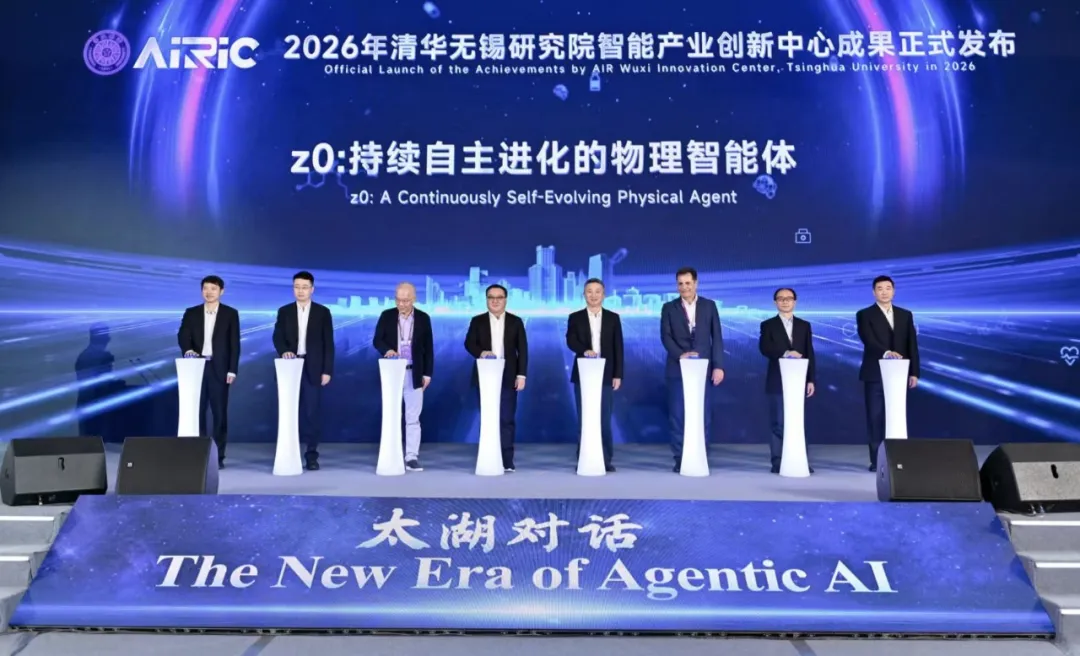
On June 6, 2026, Z0 was jointly released by four academics, including Zhang Hongjiang, Zhang Xiaojut, Rahim Tafazolli, Liu Yong, and Yang Yang, the director of Qingdao AIR. This means two things for an early company: on the one hand, the technological path of a domain change has common support from academic frontier and industrial practice; on the other hand, China AIR and Apollo ecosystems can help technology get into the real first scene faster and get the most critical interactive data in deployment.
From z0 to Zetta ζ and then to Zeva, the domain shift took about three months to continually align concepts, Agent and model frameworks. The intensive release was not the final barrier, but demonstrated that the team was moving "self-evolution" from a name to a complete technical system.
The definers of a new course are often not the first to shout the slogan, but the first to give the full technical language, verification pathways and engineering systems. In this regard, the field shift for "physical evolution" has moved from conceptual to product and ecological levels.
After pre-training, being physically intelligent enters the age of evolutionIn the past two years, physical intelligence has completed the most important infrastructure: VLA, world models and large-scale robotic data, moving machines from "don't do" to "basically will". As Karol Hausman judges, data scarcity is easing, models and hardware are coming.
That's why the "Year of Robot Deployment" of 2026 cannot be measured by shipments alone. Users don't care about VLA, WAM or what kind of Agent architecture is behind it, they only care about whether robots can stabilize tasks, reduce man-made takeovers, reduce unit costs, and continually improve output while working.Users don't pay for the technical term, they only pay for real productivity.
Noxies Restoration Industrial Park deploys guided robots, food delivery trucks, and tourist machines with z0 switches
As Karol puts it, opportunities with physical intelligence are deploying layers: ROI, workflow integration, remote intervention, and continuing to learn from real feedback. It may also not lead to a sudden "Chat GPT moment", and more like Waymo's roadmap, all of the problems won't be solved at the same time one day, but as reliability and deployment capabilities gradually cross critical points, robots will steadily enter more and more real positions.
It is at this stage that Cao is betting. From Zeva's context-based cause learning, to Zetta's online execution and skill evolution, and to the entire Z-Infra support deployment cycle, the team has run through the complete loop of "interacting to generate data-driven data-driven experience-driven experience-driven capability enhancement to drive more deployments".
The more robots deploy, the more real causal data accumulates; the more experience, the higher the success rate, the lower the cost of adapting to new tasks; the lower the cost, the more large-scale deployments can be driven.
When real-world transformation turns the data plane into a physically intelligent one, the robotics industry will move from "delivery machines" to "continuously growing productivity for delivery".
About China AIR and Domain Change
The Institute for AI Industry Research (AIR) of Qinghai University, founded by Zhang Jiaoyu, is a research institute for the internationalization, intelligentization and industrialization of China's fourth industrial revolution.
Z-Trans is the world's first system-defined and deployed physically intelligent company with a "self-evolving" paradigm, developed by the Institute of Intelligent Industry (AIR) at Tsinghua University, jointly developed by Prof. Cao Cao and Prof. Liu Yun. The company's direct-attack industry "60 seconds to deployable" core tunneling pre-training allows robots to "do", but the real world needs to "continue".
Domain conversion to Zeva's context-causal learning model, Zetta's online execution and error-correcting closed loop, and the Z-Infra training drive infrastructure's three modules build a complete Model-Agent-Infra system that allows robots to learn and evolve autonomously from each real interaction without updating their weights.
Experimental data shows that Zeva will increase the cumulative success rate from 26% to 73%, with Zetta achieving a 90.8% success rate on LIBERO PRO, and continuing to grow with interaction. The team, which combines top-level research from Microsoft's Asia Research Institute and the Apollo Industrial Ecology Dual Genome, has developed full-featured technology, real cause data, scenario profitability, and ecological input quadrilateral. Domain transformation is driving robots from "continuous delivery machines" to "continuous delivery increased productivity".

What is it?
Vice-dean of the Institute for Intelligent Industry at Tsinghua University, Bo Guo, professor of international data, chief researcher, national high-level talent, IEEE Fellow; former director of research at the Microsoft Asia Institute, long-time employee of AIoT, end-to-end intelligence research.
He is the recipient of several international top academic conferences awards such as MobiCom, MobiSys, SenSys, and CCF Technology Advancement First Prize.

What are you doing?
Professor at Tsinghua University, bringing talent to the top level in Beijing
Former head of research at the Microsoft Asia Institute, focused on edge intelligence, physical intelligence, and more.
He is a four-time top conference paper winner and a finalist for the ACM/Microsoft Research Highlights, among which the ACM Research Highlights were personally recommended by David Patterson, winner of the Turing Award.